Translation Quality Assurance Process: A Step-by-Step Framework for LSPs
Key Takeaways
- A modern translation quality assurance process combines automation (QA tools, TMS checks) with expert linguists at multiple review stages to achieve consistent results across all client accounts.
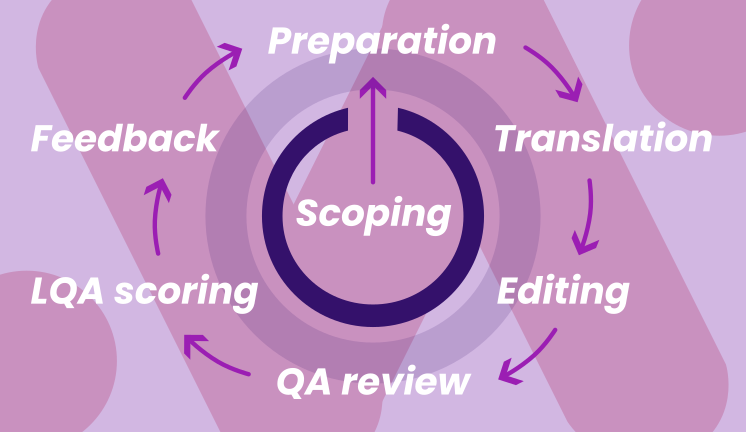
- Follow a clear, repeatable workflow: scoping → preparation → translation → editing → QA review → LQA scoring → client feedback loop.
- TQA functions as a risk-management tool, particularly critical for regulated sectors like medical, legal, and financial translations.
- LSPs should treat translation quality assurance as a management system with KPIs, scorecards, and continuous improvement cycles—not a one-off spellcheck before delivery.
- A documented TQA framework enables scaling operations, onboarding new linguists, and handling volume spikes without compromising quality standards.
What Is Translation Quality Assurance for LSPs?
Translation quality assurance for Language Service Providers is a comprehensive, multi-layered approach designed to ensure translated content meets predetermined standards for linguistic accuracy, consistency, and fitness-for-purpose. Unlike ad-hoc quality checks, a structured translation quality assurance process operates throughout the entire translation lifecycle.
The distinction between translation quality (the outcome) and the translation quality assurance process (the system) matters significantly. Quality is what you deliver; QA is the machinery that achieves and maintains it consistently across dozens of languages, markets, and client accounts. This becomes especially important when clients cannot evaluate translations themselves, particularly in specialized domains requiring subject-matter expertise.
A mature TQA framework typically covers multiple dimensions:
- Linguistic (terminology, grammar, style)
- Visual (layout, formatting, text expansion)
- Functional (links, buttons, software behavior)
- Cultural (appropriateness for the target locale)
LSPs commonly reference established standards and models to guide their frameworks, including ISO 17100 (translation services requirements), ISO 18587 (machine translation post-editing), and quality metrics frameworks like TAUS DQF and MQM. These provide baseline requirements while allowing customization for specific client needs.
Why LSPs Need a Structured Translation QA Process
Handling dozens of markets and large content volumes with scattered, inconsistent checks simply doesn’t scale. Without documented processes, LSPs face mounting risks: inconsistent quality between projects, difficulty onboarding new linguists, and no audit trail when clients ask how quality is maintained. A structured translation qa process protects client brands, prevents miscommunication, and reduces costly rework over multi-year engagements.
The financial and reputational stakes are substantial. From approximately 2010 through 2025, the industry has seen increased emphasis on TQA as a risk-management tool, particularly in regulated sectors. A mistranslated dosage instruction in pharmaceutical content, an incorrect legal clause in a financial disclosure, or a culturally inappropriate marketing message can trigger legal repercussions, damage a company’s reputation, and erode customer satisfaction.
A consistent TQA framework delivers operational advantages:
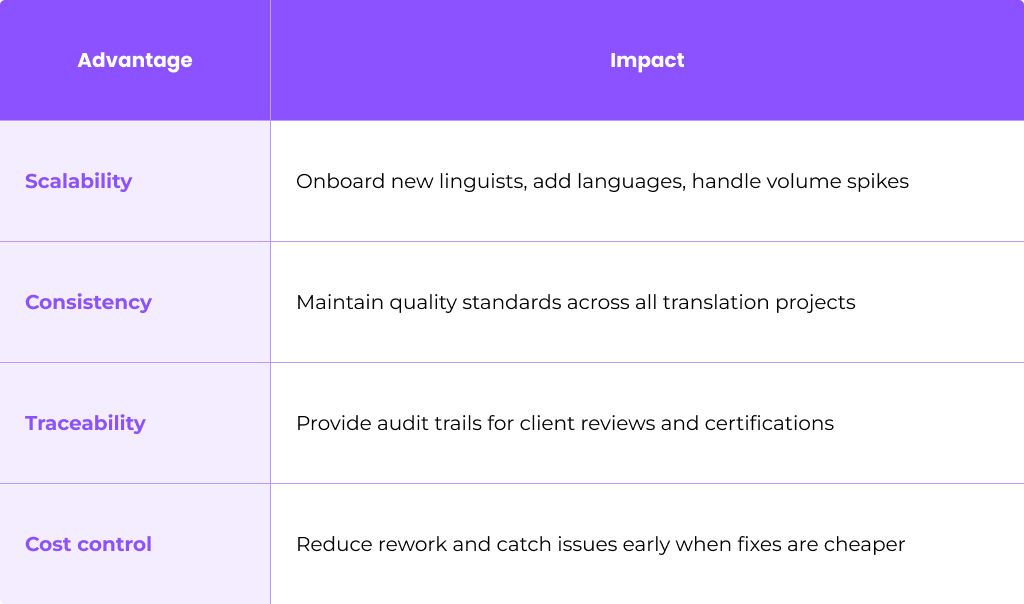
From a sales perspective, LSPs with documented quality assurance processes can demonstrate clear quality metrics, workflows, and audit trails to prospects—turning quality management into a competitive advantage rather than an operational burden.
Core Principles of an Effective TQA Framework
Before diving into specific steps, it’s worth understanding the design foundations that make a translation quality assurance process effective. These principles inform every decision throughout the workflow.
Client-specific quality targets: Quality isn’t absolute—it’s context-dependent. A glossy marketing brochure may tolerate minor stylistic variations that would be entirely unacceptable in a pharmaceutical instruction for use or legal documents. Define quality criteria in advance for each project based on purpose, target audience, risk level, and acceptable error thresholds.
Measurable criteria: Vague quality goals lead to vague results. Establish clear error categories, severity levels, and permissible error rates that can be tracked and compared across projects.
Repeatable workflows: Document processes so new linguists can be onboarded consistently and audits can verify adherence. Every step should have clear responsibilities and decision-making rules.
Role separation: Avoid self-check bias by separating translation, editing, and QA review functions. This is particularly critical for high-risk content where human expertise catches what individual translators might miss.
Tool-supported checks: From around 2020 onward, LSPs increasingly rely on Translation Management Systems, CAT tools, and automated QA checkers. The framework should be technology-agnostic in principle while leveraging these tools for efficiency.
Step-by-Step Translation QA Process for LSPs
Actual steps vary by client or content type, but the following represents a proven baseline workflow for most LSPs. Each subsection covers a distinct phase: pre-production, translation and editing, QA and LQA, delivery, and post-project review.
Each step specifies responsibilities (PM, translator, editor, QA specialist, DTP engineer) and sample capabilities to look for in your technology stack. Keep in mind that workflow complexity should match content risk—not every project needs every step at full depth.

Step 1: Scoping and Quality Planning
This phase happens before any file reaches translators and is led by the project manager or solutions architect. Skipping proper scoping is one of the most common causes of quality problems downstream.
Key tasks during scoping include:
- Gathering source files and clarifying content purpose (legal contract, marketing landing page, in-app UI, instruction manual)
- Identifying target locales and establishing deadlines
- Defining quality targets: error categories, permissible error rates, mandatory terminology, and whether LQA scoring will be applied
- Aligning on reference materials: client glossaries, style guide specifications, legacy translations, and brand voice rules
- Selecting the workflow path based on risk and budget
Common workflow configurations include:
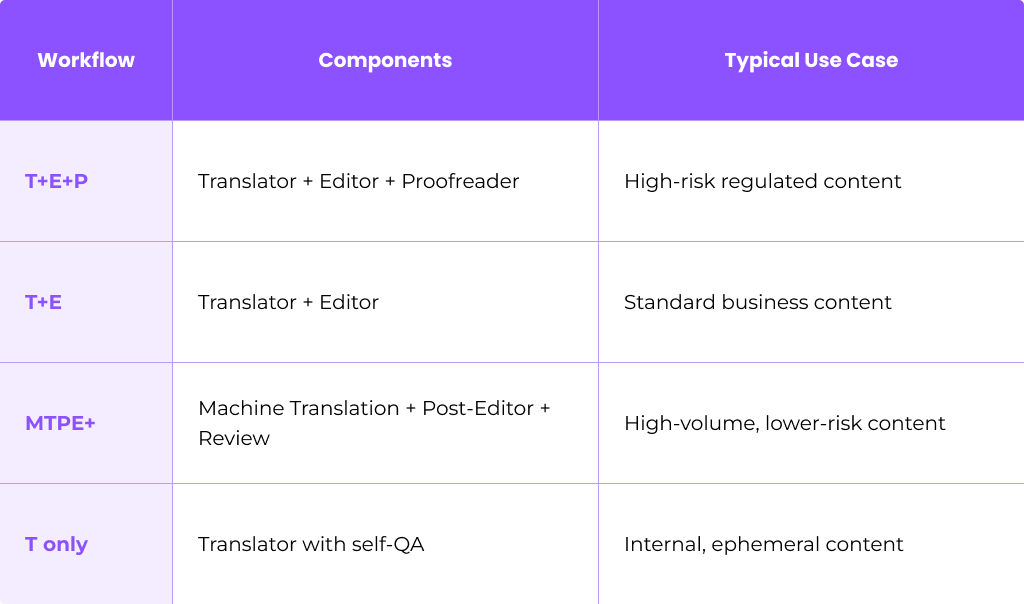
The PM should document these decisions in the project setup so all team members start on the same page.
Step 2: Resource Selection and Briefing
The foundation of high quality translations is the person doing the work. LSPs must assign qualified translators who are native speakers of the target language and have demonstrated expertise in the relevant industry or subject matter. This isn’t a preference—it’s a structural requirement for catching cultural nuances and domain-specific terminology.
For longer-running programs, maintain stable translator-editor teams to preserve consistent terminology and style continuity. Frequent linguist rotation undermines the benefits of translation memory leverage and glossary adherence.
Briefing components should include:
- Project scope and content type
- Tone of voice requirements
- Specific do’s and don’ts
- Sample approved translations exemplifying desired quality
- Clear instructions for escalation channels when questions arise
- Expectations for self-QA (required QA check passes, minimum TM leverage usage, handling of tags and placeholders)
Store all briefing material in the TMS or project portal for traceability. This documentation supports future audits and ensures consistency when multiple translators work on related batches.
Step 3: Translation with In-Tool QA
During the translation phase, linguists work within a CAT or TMS environment using translation memory, term bases, and contextual previews where available. This integrated approach helps ensure consistency and leverages previous approved translations.
Automated QA checks should run during translation to catch potential errors early:
- Spelling errors and grammatical errors
- Terminology mismatches against the established term base
- Tag consistency (critical for structured content)
- Numeric mismatches between source and target
- Character limits violations (essential for UI translation)
Human translators should resolve QA warnings proactively instead of leaving them for later stages. This represents a shift from treating QA as something done “to” translators after the fact to embedding quality awareness into the translation process itself.
For MTPE workflows, translators must pay extra attention to machine translation outputs. MT engines can introduce factual errors, tone mismatches, and awkward sentence structure that automated tools won’t flag. Professional linguists should perform a segment-by-segment self-review pass before handing off to the editor.
Step 4: Bilingual Editing and Proofreading
An independent editor reviews both source and target texts for accurate translation, terminology consistency, and adherence to client style guides. The editor serves as the first external check on the translator’s work.
Understanding the distinction between editing and proofreading is important:
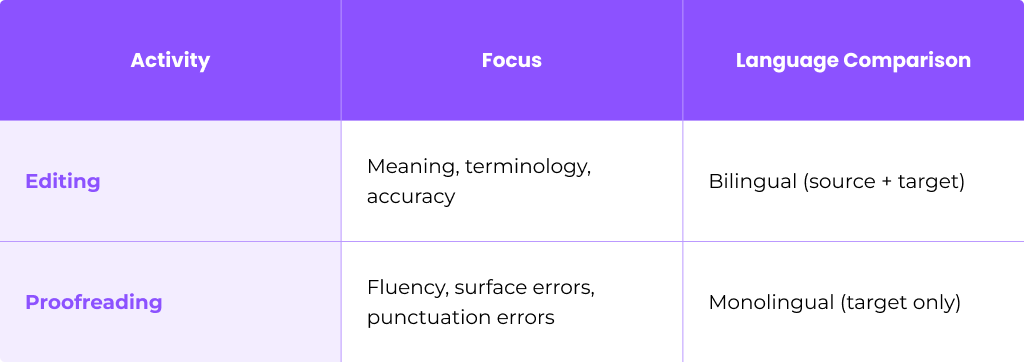
Editors should run QA checks again after making changes to avoid introducing new issues or breaking structural tags. Using tracked changes or TMS revision histories allows LSPs to later analyze typical error patterns by project or linguist—valuable data for continuous improvement.
For lower-risk content like internal training materials, LSPs might combine editing and proofreading into a single step to manage costs. However, this compression should be a deliberate decision documented in the workflow, not a default practice.
Step 5: Formatting, DTP, and Functional Checks
Following the translation and editing phases, translated material must be reintegrated into its final format—whether InDesign files for desktop publishing, web content management systems, mobile apps, or help centers.
Common issues to check during this phase:
- Text expansion (translated content often occupies more space than source, especially English to Romance languages or German)
- Line breaks and truncation in UI components
- Right-to-left layout considerations for Arabic and Hebrew
- Font support for CJK (Chinese, Japanese, Korean) languages
- Correct format for dates, times, and currencies in the target locale
For software localization projects, functional QA becomes necessary. This includes verifying that links work correctly, buttons display proper translated text, error messages are appropriately formatted, and search functionality works across multiple languages.
Screenshots or staging builds should be used by QA linguists to see content in context. Non-linguistic specialists like designers and testers should log localization issues in the same tracking system as linguistic bugs for full visibility.
Step 6: Final Linguistic QA Review
A dedicated QA reviewer or senior linguist performs a final comprehensive check on near-final assets, ideally viewing content in context through PDF proofs, staging websites, or test applications.
Typical checks at this stage include:
- Missing translations or missed segments
- Incorrect numbers or data
- Unresolved terminology issues
- Style inconsistencies across the project
- Country-specific regulatory phrasing (critical for life sciences, legal, and financial content)
Use structured QA checklists with separate sections for linguistic, visual, and functional items. All discovered issues should be logged with severity levels (critical, major, minor) tied to client-defined quality models.
At this stage, reviewers should focus on systemic issues that might affect many files or languages rather than isolated typos that earlier QA layers should have caught. This helps identify errors that indicate process problems rather than individual mistakes.
Step 7: Language Quality Assessment (LQA) and Scoring
Linguistic quality assurance through formal LQA scoring takes quality assurance in translation to a quantifiable level. Reviewers annotate errors and assign scores using established models like MQM (Multidimensional Quality Metrics) or TAUS DQF.
The lqa process is typically applied to samples (approximately 5-10% of project volume) for ongoing programs, especially in high-risk domains. Scoring every word isn’t practical or cost-effective for most projects.
Errors are categorized into types with severity weighting:
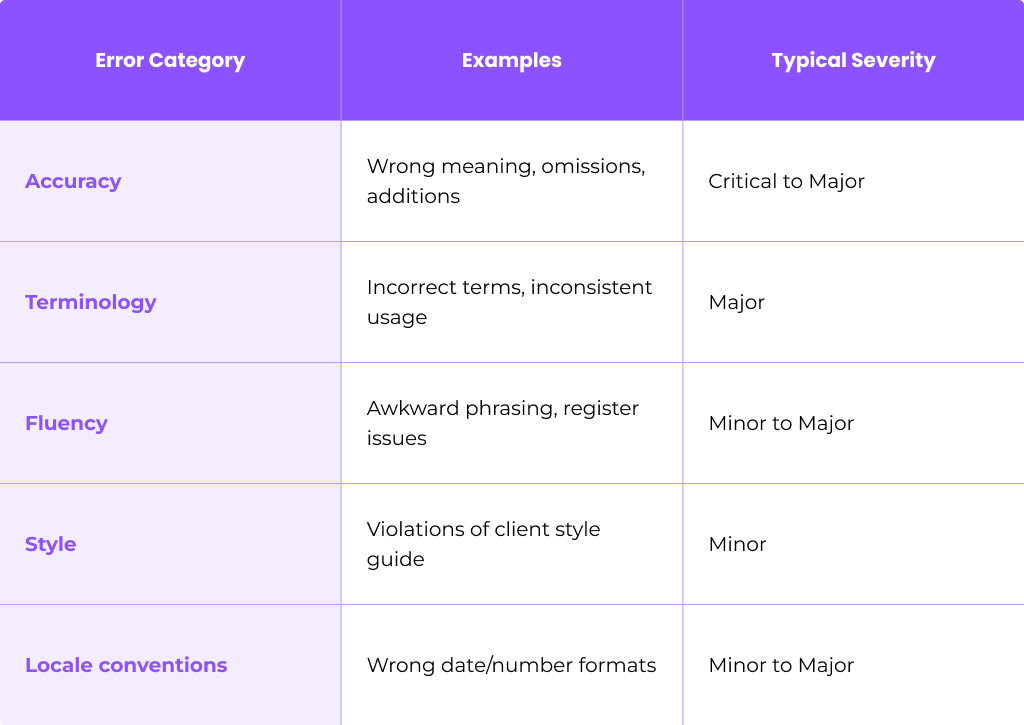
Generate scorecards per linguist, per language, and per project to identify trends over quarters or full years. These results should feed into linguist coaching, vendor ratings, and process adjustments—the purpose is improvement, not punishment.
Step 8: Client Review, Sign-Off, and Feedback Loop
The project manager presents deliverables with a brief summary: workflow followed, any known limitations, and open questions for client review. This transparency builds trust and sets appropriate expectations.
Provide clients with simple review guidelines so internal reviewers (in-house legal, marketing, product, or compliance teams) focus on preference changes versus actual errors. Without guidance, client reviewers may flag stylistic preferences as “mistakes,” creating unnecessary revision cycles.
Feedback loops should include:
- Collecting and categorizing client subject-matter expert feedback
- Updating glossaries, style guides, and TMS configurations based on agreed changes (with version dates for tracking)
- Documenting lessons learned and sharing with all involved linguists before subsequent releases
This final step closes the loop and ensures that improvements carry forward to future translation projects rather than being lost.
Technology Stack for Translation QA in LSPs
Tools don’t replace human QA but make consistent, scalable quality management possible. From approximately 2015 onward, technology adoption in TQA has accelerated significantly.
Core technology components include:
- Translation Management System (TMS): Central hub for project coordination, asset management, and workflow automation
- CAT tools: Environment where translation happens, with translation memory and term bases
- Automated QA checkers: Enforce rules across projects at multiple workflow stages
- Terminology management: Maintain controlled vocabularies and ensure consistent terminology
- Reporting dashboards: Visualize quality metrics, trends, and vendor performance
Look for capabilities like real-time QA warnings during translation, TM leverage analytics, and in-context editing that shows translators how content appears in its final format.
Integration with design and development tools (Git repositories, Figma, Sketch, CMS platforms) supports visual and functional QA by connecting linguistic work to the environments where content will live.
For enterprise clients handling sensitive information, data security and compliance (GDPR, SOC 2) should be integrated into your quality assurance framework as a standard requirement.
Automated QA Checks and Their Limitations
Automated tools provide valuable consistency and efficiency when properly configured. Typical automated checks include:
- Spelling and grammar verification
- Tag integrity (ensuring structural elements are preserved)
- Number consistency between source and target
- Non-translatable element detection
- Terminology enforcement against approved term bases
- Length restriction checks for UI content
These checks should run at multiple points (translator stage, editor stage, final QA) with configurable rule sets per client or content type. Stricter checks for legal documents make sense; the same rules applied to internal FAQs create unnecessary friction.
However, automated tools have clear limitations. They cannot judge nuance, tone, cultural appropriateness, or legal implications. Human review remains essential for catching obvious errors that fall outside rule-based detection and for evaluating whether translated text reads naturally to native speakers.
Managing false positives requires ongoing attention. If linguists start ignoring QA warnings because they’re too frequent or irrelevant, the entire system loses effectiveness. Regularly fine-tune QA profiles to balance thoroughness with practicality.
Using TMS Analytics for Continuous Improvement
Your translation management system and QA tools generate valuable data that should inform process decisions. Track metrics across 6-12 month periods:
- Error rates by project, language, and linguist
- MTPE productivity and quality estimation scores
- TM leverage percentages
- On-time delivery rates
- LQA scores and error type distributions
Quality dashboards should display this information in accessible formats for operations managers and client success teams. Use data to adjust workflows: adding extra review steps where error rates are high, changing MT engines that produce poor translation outputs, or expanding glossaries for problematic domains.
Establish internal SLAs or KPIs to make quality discussions concrete—for example, “maximum of 5 critical errors per 10,000 words” or “average LQA score above 98% for Tier 1 clients.”
Quarterly business reviews with strategic clients provide opportunities to present QA metrics and planned improvements, demonstrating proactive quality management and supporting global growth for client partnerships.
Managing Risk in High-Stakes Translations
Not all content carries the same risk profile, and LSPs must adapt their tqa process depth accordingly. Applying the same workflow to a patient information leaflet and an internal FAQ wastes resources on one and creates unacceptable risk on the other.
High-risk domains requiring stricter QA workflows include:
- Life sciences (Instructions for Use, patient information leaflets)
- Legal agreements and contracts
- Financial disclosures and regulatory filings
- Safety-critical manuals and warnings
For these domains, apply enhanced quality assurance checks: double editing, mandatory senior reviewer sign-off, required LQA scoring, and alignment with local regulations (EU MDR for medical devices, EU consumer protection regulations, FDA guidelines for pharmaceutical content).
Risk-based TQA keeps costs proportionate. Heavy QA where stakes are high protects the brand’s reputation and prevents legal repercussions. Lighter workflows for low-risk internal or ephemeral content control costs without compromising quality standards where it matters.
Escalation and Error-Handling Procedures
When critical errors are discovered after delivery—a mistranslated dosage instruction, an incorrect legal clause, a compliance violation—formal escalation procedures should trigger immediately.
Key elements of an incident process:
- Immediate mitigation: Halt distribution if possible, issue corrected versions
- Root-cause analysis: Determine whether the error resulted from terminology gaps, insufficient briefing, translator error, process failure, or tool malfunction
- Corrective actions: Implement retraining, process revisions, or additional oversight
- Stakeholder communication: Transparent updates to affected parties
Maintain an internal log of serious issues with timestamps and actions taken. This documentation demonstrates due diligence in audits or client reviews and helps identify patterns that indicate systemic problems.
Repeated incidents in the same area may trigger reassignment of linguists, revision of work instructions, or fundamental workflow changes. The goal is building an error free system—or as close to one as realistically achievable.
Building a Continuous Improvement Culture Around TQA
A translation quality assurance process is never “finished.” Markets evolve, client needs change, and technology advances. LSPs that treat their framework as static will fall behind competitors who continuously refine their approaches.
Regular training keeps linguists and project managers current on new tools, updated client guidelines, and emerging terminology in their subject-matter areas. Periodic internal quality audits—random project sampling, double-checking workflow adherence, reviewing compliance with SOPs—help maintain framework integrity.
Build feedback loops not only from clients but also from translators, editors, and QA specialists about process friction points. The people doing the work often have the clearest view of where inefficiencies exist or where manual processes could be streamlined.
Document improvements and communicate them to clients. Demonstrating proactive quality management strengthens relationships and differentiates your LSP from competitors who only react to problems.
Vendor Management and Linguist Performance
LSPs can use LQA scores and QA findings to maintain vendor scorecards for freelancers and partner agencies. This data-driven approach removes subjectivity from performance discussions.
Set performance thresholds and remediation plans for linguists who fall below standards. Options include coaching sessions, test projects with extra review, or gradual increases in project complexity as performance improves. Reserve termination for cases where improvement isn’t happening despite support.
Reward high-performing linguists with preferred status, first choice on premium projects, or rate reviews where appropriate. This reinforces the connection between quality and compensation while building long-term relationships with your best talent.
Run annual or semi-annual performance reviews using data from 12-month periods rather than isolated incidents. Transparent, respectful feedback processes help build the stable, high-quality vendor relationships that support consistent delivery across localization projects.
FAQ
These questions address practical concerns LSPs often have when formalizing their translation quality management processes. Answers focus on actionable guidance for implementation.
How detailed should my TQA workflow be for small, fast-turnaround projects?
A lightweight version of the full process is sufficient: scoped briefing, T+E workflow, automated QA checks, and a brief final check. Don’t skip all QA steps—instead, compress roles and use stricter automated QA rules for same-day or next-day projects. Document a “fast-track” workflow in your SOPs so staff know exactly which steps can be safely omitted. Even small jobs should update glossaries and style guides if significant client feedback is received.
When is it worth investing in formal LQA scoring instead of just regular review?
LQA scoring delivers the most value for long-term programs, regulated industries, and large-volume accounts where identifying trends over time matters. For one-off marketing campaigns or low-risk internal documents, structured human review may be sufficient without numeric scoring. Consider piloting LQA on a subset of languages or content types for 3-6 months to gauge impact before rolling it out widely. LQA data supports vendor decisions and client discussions, which justifies the extra cost for strategic accounts.
How do I choose automated QA tools that fit my LSP’s workflow?
Prioritize QA tools that integrate natively with your TMS and CAT environments to avoid file juggling between systems. Evaluate rule configurability, support for multiple languages and scripts, and the ability to define client-specific exceptions. Run side-by-side tests on recent projects to see which tool catches the most relevant issues with the fewest false positives. Factor in licensing costs, performance at scale (millions of words per month), and vendor support when making your selection.
How can LSPs balance cost and quality when clients have tight budgets?
Risk-based workflows are essential: use full T+E+LQA for critical content and streamlined workflows for low-risk translated content. Leverage translation memory effectively, use machine translation with careful post-editing for appropriate content types, and consider partial sampling review instead of full coverage. Discuss trade-offs transparently with clients so they understand what each option includes or omits. Investing in good glossaries and style guides early typically reduces QA costs over following years.
How long does it typically take to implement a robust TQA framework at an LSP?
A basic, documented framework can be designed and piloted in 4-8 weeks, depending on company size and complexity. Full rollout—training vendors, configuring tools, and refining workflows based on real data—often takes 6-12 months. Start with a few key clients or languages, then expand once your approach and metrics are stable. Continuous improvement means the framework keeps evolving even after initial implementation, adapting to new content types, client requirements, and industry developments.
Table of Contents
- What Is Translation Quality Assurance for LSPs?
- Why LSPs Need a Structured Translation QA Process
- Core Principles of an Effective TQA Framework
- Step-by-Step Translation QA Process for LSPs
- Technology Stack for Translation QA in LSPs
- Managing Risk in High-Stakes Translations
- Building a Continuous Improvement Culture Around TQA
Ready to manage your Translation company easily?
Get Started for Free