TBMS vs TMS vs CAT Tool: The Definitive Comparison Every LSP Owner Needs to Read
Key Takeaways
- CAT tools handle the actual translation work—segmenting text, storing translation memory, and enforcing terminology for human translators.
- TMS platforms manage localization workflows at scale—automating content ingestion, task routing, and collaboration across multiple languages.
- TBMS (Translation Business Management Systems) run the business side—quotes, jobs, invoices, vendor payments, and profitability reporting.
- A growing LSP will typically need all three layers working together: CAT for linguists, TMS for content and workflow, TBMS for business operations.
- “All-in-one” platforms blur these categories, so buyers must verify what’s actually covered before signing contracts.
- Choosing the right mix directly impacts margins, scalability, and the owner’s ability to step out of daily firefighting.
If you’ve ever felt confused about where translation management systems end and business management begins, you’re not alone. The localization industry is filled with overlapping terminology, marketing buzzwords, and platforms claiming to do everything. This guide cuts through the noise and gives you a clear understanding of what TBMS, TMS, and CAT tools actually do—and when you need each one.
What Do TBMS, TMS, and CAT Actually Mean? (Quick Definitions)
Before diving into features and decision frameworks, let’s establish clear definitions. These three categories serve distinct yet interdependent roles in the localization ecosystem, and understanding the boundaries between them will save you from costly mistakes.
CAT Tool (Computer Assisted Translation): This is the environment where human translators perform the actual translation work. Computer assisted translation CAT tools break down source text into segments, store previously translated segments in translation memory databases, and apply terminology from term bases. Think of it as the translator’s workbench where the linguistic work happens.
TMS (Translation Management System): Translation management systems TMS orchestrate the entire localization process. They ingest content from content management systems, code repositories, or design tools, automate task assignment and routing, and facilitate collaboration across localization teams. A proper TMS acts as the central conductor for translation projects.
TBMS (Translation Business Management System): This is the system of record for your LSP’s business operations. A TBMS handles everything from lead tracking and quote generation to job creation, purchase orders, invoices, vendor payments, and financial reporting. It’s your “quote-to-cash” backbone.
Many products mix two or even all three roles, which fuels the confusion you see in vendor marketing. Understanding these boundaries helps you evaluate what any platform actually delivers versus what it claims.
CAT Tools: Where the Actual Translation Work Happens
For language service providers, understanding what CAT tools focus on is essential—even if you’re not doing the translation yourself. These are the systems your translators live in daily, and their capabilities directly affect translation quality, consistency, and speed.
CAT tools segment text into manageable units, store translations in translation memories, and enforce terminology databases. This approach drastically cuts repetitive tasks and improves translation consistency across projects. When a translator encounters a sentence similar to one they’ve translated before, the tool suggests matches, reducing manual effort and maintaining consistent quality.
Core Features of Modern CAT Tools
- Translation Memory (TM): Stores previously translated segments along with source equivalents, context metadata, and formatting tags. The system suggests exact, fuzzy, or context-aware matches to reuse past translations.
- Term Bases: Specialized terminology databases storing approved terms with definitions and usage notes, preventing inconsistent terminology across projects.
- Segment-Based Editor: A focused environment where translators work on individual segments, often sentence by sentence.
- Inline Tag Handling: Preserves formatting without alteration, reducing formatting errors in final deliverables.
- Basic QA Checks: Automated verification for spelling, number consistency, and terminology compliance.
- Concordance Search: Retrieves partial matches within TMs for reference during ongoing projects.
Popular CAT Tools in 2024
Most CAT tools have shifted to cloud-based or hybrid models offering real-time collaboration. Here are some widely used options:
- SDL Trados Studio
- memoQ
- Wordfast
- Memsource (now part of Phrase)
- Smartcat
- MateCat
- XTM Workbench
When CAT Alone Is Enough
A CAT tool may be sufficient for:
- Freelance translators managing their own clients
- Micro LSPs handling a few regular clients
- One-off technical manuals with simple file delivery
- Individual translators who don’t need project coordination
However, CAT tools rarely cover end-to-end LSP operations. Most CAT tools lack proper CRM functionality, quoting engines, invoicing capabilities, or vendor payables management. As your client base grows and you engage multiple translators, you’ll quickly hit the ceiling of what computer aided translation tools can handle on the business side.
TMS: Managing Localization Workflows and Content at Scale
While CAT tools and translation happen at the linguistic level, translation management systems operate one layer up. A TMS orchestrates the entire translation workflow—automatically ingesting content, routing tasks, and tracking progress across target languages.
For enterprises and larger LSPs managing high quality multilingual content, a TMS becomes essential. These platforms reduce manual tasks by automating file handling, project setup, and MT pre-translation, allowing project managers to focus on exceptions rather than routine operations.
Core TMS Capabilities
- Workflow Automation: Rules-based routing of tasks based on metadata, risk levels, or language pairs
- Online Collaboration: Real-time work across localization teams with role-based access
- Machine Translation Integration: Neural MT for high-volume content, domain-tuned MT for regulated industries, and adaptive MT that learns from corrections
- Centralized TM and Terminology: Single source of truth for language assets across all translation projects
- Analytics and Reporting: Insights on volumes, turnaround times, and performance metrics
- Content Integrations: Direct connections to CMS, code repositories, and design tools
Real-World TMS Examples
Several platforms exemplify modern translation management in 2024:
- Phrase (formerly Memsource)
- Lokalise
- Smartling
- XTM Cloud
- Wordbee
- Trados Enterprise/Accelerate
Most of these embed a web-based CAT workbench or offer connectors to external CAT environments preferred by vendors. This flexibility lets linguists work in their tool of choice while project managers maintain oversight.
Where TMS Falls Short
Here’s what trips up many LSP owners: while a TMS can store jobs and vendor information, it’s usually weak on true business management. Most translation management systems lack:
- Multi-currency invoicing with complex tax handling
- Purchase order generation and tracking
- Margin analysis by client, service, or language pair
- Cash-flow forecasting
- Advanced rate cards with fuzzy-match pricing matrices
A TMS excels at production workflows but wasn’t designed to run your LSP as a business. That gap is where TBMS comes in.
TBMS: The Missing Piece for Running an LSP as a Business
This is the layer most often overlooked by LSPs—and it’s the one that determines whether you can scale profitably or stay trapped in manual operations. A Translation Business Management System handles everything from the moment a client inquiry arrives until the money hits your bank account.
Think of TBMS as the ERP for language service providers. It’s not about managing translation projects in a linguistic sense; it’s about managing translation operations from a business perspective.
Key TBMS Modules
CRM for Clients and Prospects: Track leads, manage sales pipelines, and maintain client relationship history—all with localization-specific context.
Rate Cards and Price Lists: Store complex pricing structures including fuzzy-match pricing matrices, MT/TM/human blends, and multi-tier vendor rates.
Automated Quote Generation: Generate quotes automatically by importing word counts and TM breakdowns, applying rate cards, and calculating costs in minutes rather than hours.
Job Templates: Standardize job creation for recurring project types, reducing setup time and human error.
Vendor Database: Profile translator skills, rates, availability, and performance—enabling smart vendor management and assignment.
Financial Workflows: Handle purchase order issuance, invoicing with tax handling, vendor payments, and profitability reporting with real-time margins.
How TBMS Connects with TMS and CAT
A good TBMS doesn’t operate in isolation. It connects with your other systems through APIs:
- Imports word counts and match categories from TMS or CAT tools
- Automatically creates jobs based on approved quotes
- Synchronizes status updates and delivery dates
- Triggers invoicing when jobs complete
This integration eliminates double data entry and keeps financial tracking accurate without manual reconciliation.
Benefits for Owners and Managers
The real value of TBMS becomes clear when you consider what it enables:
- Real-time visibility: See margins by client, service, and language pairs instantly
- Cash-flow forecasting: Know what’s coming in and what’s going out
- Delegation without losing control: Your team can manage operations while you focus on strategy
- Professional client experience: Fast, accurate quotes build trust and improve acceptance rates
Why Generic Tools Don’t Work
Some LSP owners try to use HubSpot for CRM and QuickBooks for accounting. The problem? Neither understands localization-specific logic:
- Multi-tier vendor assignment based on language pairs and specialization
- Complex rate structures combining TM leverage, MT post-editing, and human translation
- Word-count-by-match imports for accurate pricing
- Fuzzy-match discounts and minimum charges
General business tools force manual workarounds that eat hours every week. A dedicated TBMS speaks your language.

How TBMS, TMS, and CAT Fit Together in a Modern LSP Stack
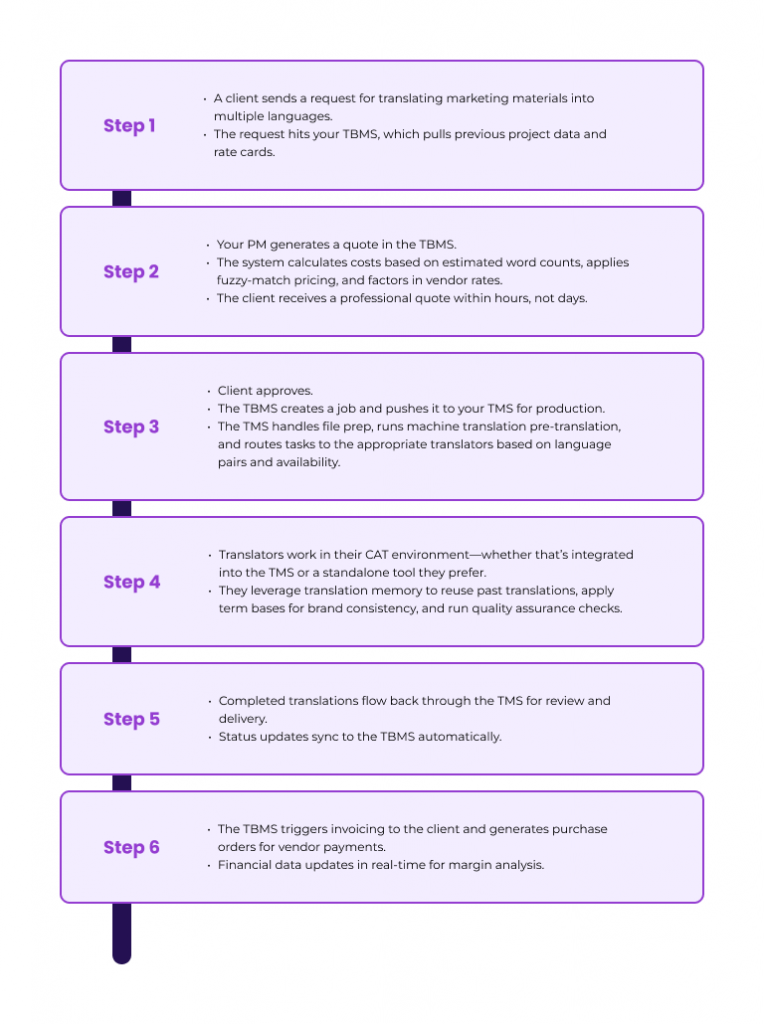
Understanding each system individually is one thing. Seeing how they work together in daily operations brings clarity to the whole picture. Let’s walk through a typical project lifecycle.
A Day in the Life of an Integrated Stack
Which System Owns What Data?
Clear data ownership prevents confusion and ensures accountability:
Integration Priorities
Not all integrations deliver equal value. Focus first on connections that eliminate the most repetitive tasks:
- Word counts by match category from TMS/CAT into TBMS for pricing
- Status synchronization so PMs see real-time progress
- Delivery links between systems
- Advanced analytics and reporting
A Note on “All-in-One” Platforms
Some platforms market themselves as covering TBMS, TMS, and CAT in a single solution. Before buying, map your real processes—sales, production, and finance—and verify each is properly supported. All-in-one convenience can mask gaps in critical areas.
Decoupling layers keeps flexibility when you need to switch vendors, onboard clients with their own TMS preferences, or add languages with specialized requirements.
All-in-One vs Best-of-Breed: Which Approach Makes Sense for Your LSP?
This is one of the most debated questions among LSP owners. Both approaches have merit, and the right answer depends on where you are in your growth journey.
The All-in-One Approach
An all-in-one platform claims to include CAT, TMS, and TBMS functions in a single solution. Examples include platforms like Smartcat or XTM that aim to cover multiple layers.
Advantages for Smaller LSPs (up to 10-20 regular vendors):
- Single login simplifies daily operations
- Quicker setup with less configuration
- Fewer integrations to manage and maintain
- Easier training for new team members
- Predictable subscription costs (often $50-200 per seat monthly)
Drawbacks for Growing LSPs:
- Limited customization of workflows as complexity grows
- Difficulty replacing only one layer if it underperforms
- Potential vendor lock-in affecting negotiating power
- Weaker financial and reporting features compared with dedicated TBMS
- May not support client-specific TMS requirements
The Best-of-Breed Approach
This strategy involves choosing separate, specialized software for each layer. For example: a standalone TBMS for business operations, Phrase for translation management, and Trados for CAT environments.
Advantages:
- Each system excels at its specific function
- Flexibility to swap components as needs evolve
- Supports clients who mandate specific TMS platforms
- Deeper features in each category
- Better version control and specialized capabilities
Drawbacks:
- More complex initial setup
- Multiple vendor relationships to manage
- Integration effort (plan for 6-12 months for full synchronization)
- Higher total cost in some scenarios
A Pragmatic Path Forward
For most LSPs, the answer isn’t one or the other—it’s a phased evolution:
- Start lighter with integrated tools when the team is small
- Gradually separate TBMS from TMS as client volumes and compliance demands grow
- Maintain flexibility on CAT tools to accommodate vendor preferences
The goal isn’t perfect architecture from day one. It’s building a stack that matches your current reality while leaving room to grow.
Decision Framework: What Your LSP Actually Needs Right Now
Rather than buying based on feature lists, start with your actual bottlenecks. Here’s guidance based on company size and maturity.
Solo Translators and Micro LSPs (1 PM, <10 Vendors)
Priority: A solid CAT tool plus a simple TBMS-style layer for quotes and invoices.
A full TMS may be optional unless you handle complex web or software localization. Focus on translation efficiency and basic business operations. Spreadsheets might work for tracking, but even a simple TBMS adds professionalism and speeds up quoting.
Small LSPs (1-3 PMs, 10-30 Regular Translators)
Priority: A dedicated TBMS for business operations while letting linguists work in familiar CAT tools.
At this stage, your pain points are likely slow quotes, scattered vendor information, and manual invoicing. A TBMS addresses these directly. Add a TMS when content integrations and workflow automation become recurrent bottlenecks—typically when you’re handling continuous localization or managing translation projects for tech clients.
Medium LSPs (5+ PMs, 50+ Translators, Multiple Verticals)
Priority: An ERP-like TBMS with deep automation (quote-to-invoice) connected to one or more TMS and multiple CAT tools.
Your clients have diverse requirements. Some may mandate their own TMS. Your translators have tool preferences. A robust TBMS serves as the business backbone while supporting flexibility in production tools. Integration capabilities become critical.
Enterprise LSPs (Multi-Region, Multi-Entity)
Priority: TBMS features like multi-entity support, complex tax rules, advanced reporting, and robust APIs to integrate with corporate finance and BI tools.
At this scale, the TBMS must function as a true enterprise system. Look for features like:
- Multi-currency and multi-jurisdiction tax handling
- Advanced profitability reporting by region, client, and service type
- Integration with ERP systems and business intelligence platforms
- Audit trails and compliance features
Find Your Bottlenecks First
Before shopping, list your top five current operational problems:
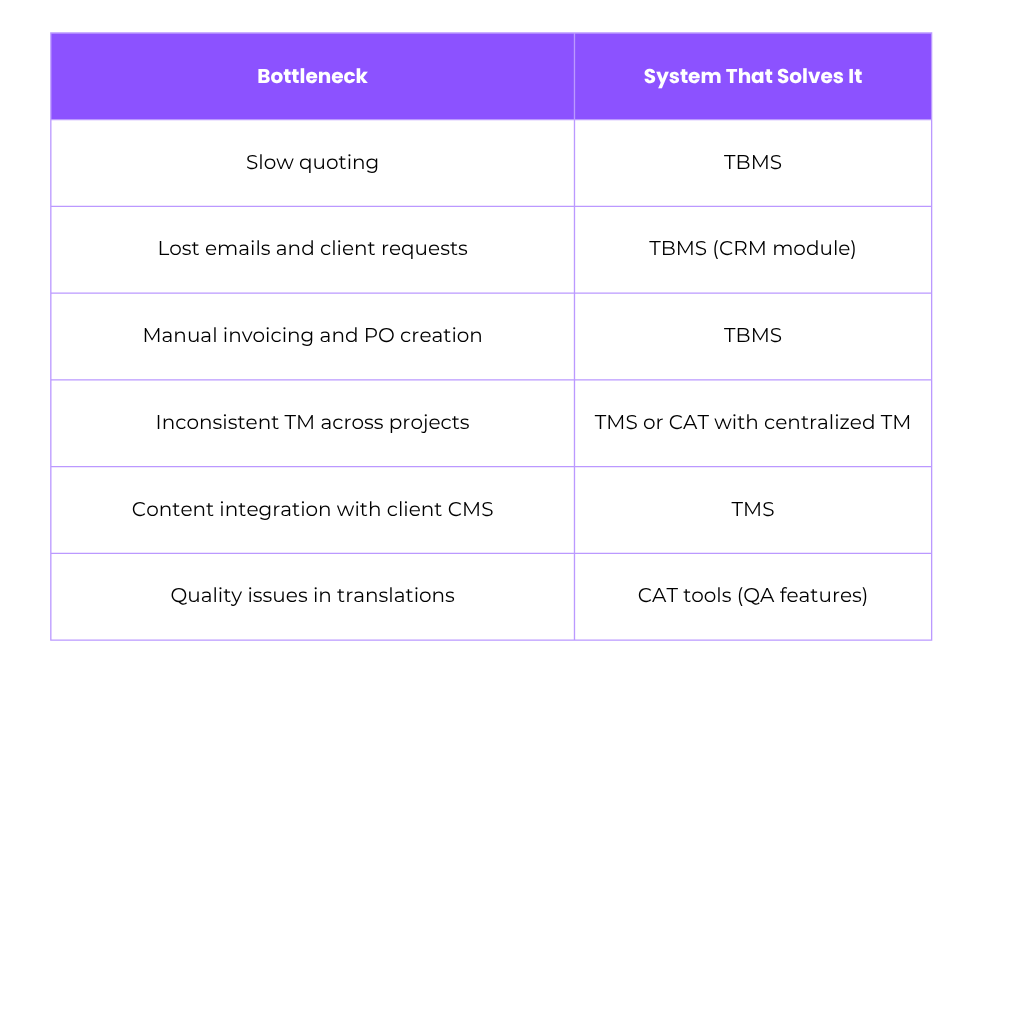
Map each pain point to the type of system that actually addresses it. This prevents buying a TMS to solve TBMS problems—a common and costly mistake.
Cost, ROI, and Common Pitfalls When Selecting TBMS, TMS, and CAT
Understanding the investment required—and the returns you can expect—helps build a solid business case for upgrading your translation technology stack.
Typical Pricing Models
CAT Tools: Usually per-seat licenses ranging from $100-500 per year. Some offer cloud subscriptions at $50-200 per user monthly.
TMS: Volume-based SaaS pricing ($0.01-0.05 per word) or user-based models ($100-500 per user monthly). Enterprise agreements vary significantly.
TBMS: Tiered subscription pricing typically ranging from $500-5,000 monthly depending on volume, users, and features. Some use revenue-based pricing.
ROI From TBMS
The business case for TBMS is compelling:
- Faster, more accurate quotes: Reduce turnaround from days to hours
- Less manual data entry: Save PM hours weekly
- Automated invoicing and POs: Cut DSO (days sales outstanding) by 20-30%
- Margin visibility: Prevent unprofitable jobs before they happen
- Overall margin uplift: 15-25% improvement from automation and better pricing
ROI From TMS
TMS delivers value through operational efficiency:
- Reduced hand-offs: Automation of file prep and project setup
- Automatic content syncing: Direct CMS integration eliminates manual file handling
- Lower PM overhead per job: 20-40% throughput gains
- Better asset reuse: 30-50% TM reuse rates in mature setups
- Consistent translation quality: Centralized TM and terminology
Common Pitfalls to Avoid
Buying a TMS to solve TBMS problems: If your pain is quoting, invoicing, and vendor payments, a TMS won’t fix it. Match the solution to the actual problem.
Expecting a CAT tool to handle accounting: Most CAT tools have no financial features. Don’t force them into roles they weren’t designed for.
Underestimating integration effort: Plan for 6-12 months to achieve full synchronization between systems. Rushing leads to data silos.
Overpaying for unused features: Industry data suggests 20-50% cost inflation from buying features the team won’t use in 12-24 months.
Red Flags When Evaluating Vendors
- Vague “AI-powered everything” claims without specifics
- Lack of transparent pricing (requiring sales calls for basic information)
- Unclear integration stories with major CAT tools
- No live demo of quote-to-invoice workflows (for TBMS vendors)
- References only from companies unlike yours

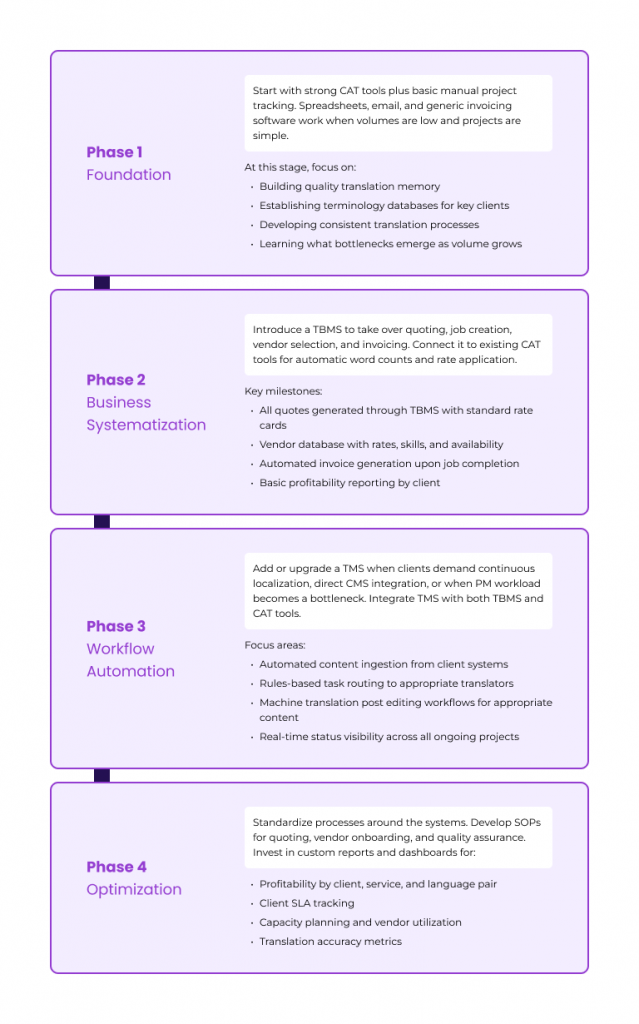
Implementation Roadmap: From Spreadsheets to an Integrated Stack
Transformation doesn’t happen overnight. Here’s a phased approach that matches system adoption to business growth.
Change Management Tips
Pilot first: Test with one or two key clients before full rollout. Learn what works before scaling.
Migrate data carefully: Legacy translation memory and terminology databases are valuable assets. Plan migration thoroughly.
Train in stages: Don’t overwhelm the team with a “big bang” switch. Phase training by role—PMs first, then vendors, then finance.
Measure baseline metrics: Know your current quote turnaround, margins, and on-time rates before implementation. This proves ROI later.
FAQ
Do I really need all three: TBMS, TMS, and CAT tools?
Not every LSP needs all three from day one. Every professional translation workflow needs at least a CAT environment—that’s foundational. A TBMS typically becomes vital as soon as you have recurring clients and multiple vendors; it brings order to quotes, invoices, and vendor payments. A TMS becomes critical when you’re dealing with complex content integrations, continuous localization, or high-volume workflows where manual project coordination breaks down.
The evolution usually follows business growth: CAT first (immediate), TBMS second (when business operations become painful), TMS third (when production complexity demands it).
Can a TMS replace my TBMS and accounting tools?
Most TMS platforms are not designed to handle full financial workflows. While some can generate simple cost reports or basic invoices, they rarely support advanced quoting logic, multi-currency taxation, vendor payables, and deep integration with general ledgers.
You’ll typically find TMS lacking in areas like fuzzy-match pricing matrices, purchase order management, cash-flow forecasting, and margin analysis by client or language pair. For anything beyond basic cost tracking, you need a dedicated TBMS or risk building elaborate spreadsheet workarounds.
Is it a problem if my clients use their own TMS?
Not at all—this is common, especially with enterprise clients who have established localization infrastructure. Many LSPs work inside client-owned TMS environments daily.
The key is treating the client TMS as a production tool while maintaining your own business processes. Your TBMS sits on top, controlling pricing, purchase orders, and invoicing regardless of which TMS handles the workflow. Ensure data can be reconciled between systems: job identifiers, word counts, and delivery confirmations should flow back to your TBMS for accurate billing and vendor payments.
How do I prioritize integrations between TBMS, TMS, and CAT tools?
Start with the connection that eliminates the most manual work. For most LSPs, this means word counts and price calculations flowing from TMS/CAT into TBMS. This single integration can save hours of manual data entry per week.
Second priority is status synchronization—letting your TBMS show real-time progress without PMs checking multiple systems. Third, add file delivery links so completed work flows seamlessly. Finally, implement advanced analytics or API-driven automations for reporting and capacity planning.
What KPIs should I track once my systems are in place?
A TBMS-centric stack should surface these key metrics:
- Quote acceptance rate: Target 70%+ to ensure pricing and turnaround are competitive
- Average quote turnaround time: Aim for under 24 hours for standard projects
- Gross margin per client and language pair: Target 25-40% depending on service type
- On-time delivery rate: Target 95%+ to maintain client confidence
- Vendor utilization: Target 80%+ for core vendors to ensure efficiency
- Average DSO (Days Sales Outstanding): Target under 45 days for healthy cash flow
Track these monthly and look for trends. Improvements validate your technology investment; declines signal process issues to address.
Table of Contents
- What Do TBMS, TMS, and CAT Actually Mean? (Quick Definitions)
- CAT Tools: Where the Actual Translation Work Happens
- TMS: Managing Localization Workflows and Content at Scale
- TBMS: The Missing Piece for Running an LSP as a Business
- How TBMS, TMS, and CAT Fit Together in a Modern LSP Stack
- All-in-One vs Best-of-Breed: Which Approach Makes Sense for Your LSP?
- Decision Framework: What Your LSP Actually Needs Right Now
- Cost, ROI, and Common Pitfalls When Selecting TBMS, TMS, and CAT
- Implementation Roadmap: From Spreadsheets to an Integrated Stack
- FAQ
Ready to manage your Translation company easily?
Get Started for Free