How to Scale a Translation Agency from $0 to $1M Revenue: A Step-by-Step Roadmap
Key Takeaways
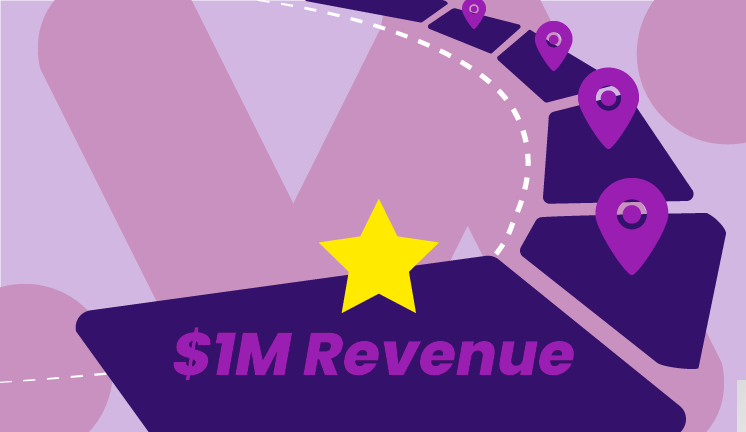
- This roadmap provides a practical, numbers-driven approach to grow a translation agency from $0 to $1M annual recurring revenue, tailored for 2024–2026 realities including AI tools, remote teams, and integrated localization demand.
- Scaling requires shifting from a freelancer mindset to agency operations: standardized workflows, a coherent tech stack, and clear positioning in specific industries drive sustainable growth.
- The article walks through concrete revenue milestones ($0–$10k, $10k–$30k, $30k–$100k, $100k–$1M/month), with specific actions, team roles, and tools for each stage.
- AI and automation (TMS, machine translation, connectors, QA tools) are used to increase margins and capacity without sacrificing quality or replacing human expertise.
- The FAQ covers common scaling questions: pricing models, when to hire project managers, balancing quality vs. speed, and whether to build a proprietary platform.
Introduction: What “Scale” Really Means for a Translation Agency
When we talk about scaling a translation agency, we’re not just talking about landing more clients or translating more words. We’re talking about building a business that generates predictable annual recurring revenue, maintains healthy margins, and operates through systems rather than founder heroics.
The 2024–2026 window presents a unique opportunity. There’s an explosion of AI-powered tools transforming the translation process, global remote talent is accessible like never before, and clients increasingly expect integrated localization—not just one-off document translation. Companies want partners who can plug into their existing tech stack and scale global content alongside their business goals.
The target here is $1M annual revenue with sustainable 25–35% net margins. That means you’re not just hitting a big top-line number with chaotic operations and burned-out team members. You’re building a business that runs efficiently, delivers high quality translations consistently, and leaves you with real profit.
This article is written from the perspective of a founder-operator who wants to build a systems-driven agency—not a lifestyle freelancer business. If you’re ready to treat translation services as a scalable company rather than a solo practice, this roadmap will show you how.
Stage 1: From $0 to $10k/Month – Validate Your Niche and Offer
This is the “founder-does-everything” phase. You’re handling sales, translation, project management, invoicing, and client communication. It typically covers months 0–12 of your agency, and your primary job is to validate that clients will pay for your services.
Financial Goals and Realistic Targets
The realistic goal for this stage is reaching a consistent $8k–$10k monthly revenue from 3–10 recurring clients with minimal fixed costs. At $0.08–$0.12 per word for specialized work, you’ll need approximately 80,000–125,000 billable words per month to hit these numbers—or a mix of project fees and retainer arrangements.
Keep your overhead low. You don’t need fancy offices, expensive software subscriptions, or full-time employees yet. Your costs should primarily be cloud-based tools and your own time.
Why Niche Selection Matters
Choosing a focused niche is faster to scale than being a generalist. Consider verticals like:
- SaaS UI and help documentation
- E-commerce product catalogs
- Legal contracts for startups
- Life sciences regulatory submissions
- Gaming localization
- Technical documentation for software companies
The positioning advantage is quantifiable. A translator positioned as a “SaaS localization expert” can command $0.12–$0.18 per word for interface strings, while a generalist offering “translation services” may only achieve $0.04–$0.08 per word. This 2–3x pricing differential means you can reach $10k monthly with 5–8 smaller SaaS clients instead of needing 30–50 generalist clients.
Prospecting Tactics for Early-Stage Agencies
Pricing Strategy
Start around $0.08–$0.12 per word for specialized work, or offer flat project fees for well-defined scope. Avoid racing to the bottom with $0.02–$0.03 commodity rates. If you’re translating product catalogs or marketing materials, the value you create justifies premium pricing.
Fixed-fee project pricing works well at this stage because it aligns incentives with the client’s timeline and budget, not word count maximization.
Minimal Tool Stack
Keep your tech stack lean:
- Cloud CAT tool: memoQ cloud, Phrase, or Smartcat ($30–$100/month)
- SOPs and documentation: Google Drive or Notion
- Client tracking: Simple CRM or spreadsheet for quotes, invoices, and client data
Don’t over-invest in platforms before you’ve validated your business model. The primary bottleneck is sales and delivery execution, not technology.
Building Your Foundation
Deliver obsessively good service and fast turnaround at this stage. Your reputation and word-of-mouth are your primary competitive assets. By month 6–8, you should have collected 5–10 solid testimonials and developed 2–3 detailed case studies with specific metrics (markets launched, words translated, turnaround times).

Stage 2: From Solo to Micro-Agency – Building the First Scalable Process
This stage typically spans $10k–$30k monthly revenue (roughly $120k–$360k annualized) and requires the critical psychological shift from personal heroics to basic infrastructure. You can no longer do everything yourself and maintain quality—or your sanity.
The moment you hit consistent $15k+ months, you need to start thinking about processes that work without you touching every project.
Your First Hires
Start with part-time or per-project translators in your main language pairs (typically 2–4 pairs at this stage), plus at least one reliable editor/proofreader. The separation of production from quality checks is essential—you need an independent quality gate.
When recruiting your translation team, look for:
- Demonstrated domain expertise in your chosen vertical
- Proficiency with CAT tools your agency uses
- Willingness to follow documented SOPs and accept feedback
Avoid hiring solely based on academic credentials. Many highly skilled individual translators struggle in team environments because they’re used to full autonomy.
Building Repeatable Workflows
Document your translation workflows in simple, 1–2 page SOPs:
- Intake form: Capture client details, content type, target languages, deadline, style preferences
- Quoting template: Word count, service level, deadline, pricing applied consistently
- Translation + review + delivery steps: Clear handoffs between roles
- Delivery checklist: All deliverables included and formatted correctly
The right level of documentation is enough that someone could step through the process once with minimal guidance and execute competently on repeat.
When to Implement a Translation Management System
A translation management system becomes necessary around 50k–100k words monthly. Below this threshold, a cloud CAT tool is sufficient. Above it, a TMS creates a single source of truth for translation memories, glossaries, and client-specific assets.
The TMS market is growing at 14.81% CAGR, reflecting that agencies investing in proper tech infrastructure gain competitive advantages in efficiency and consistency.
Project Management Practices
Implement basic project management discipline:
- Kanban boards (Trello, Jira, ClickUp) for visibility into project status
- Clear SLAs: 2–3 business days for 2,000–3,000-word jobs in established language pairs
- Deadline buffers: If client needs Friday delivery, internal deadline is Wednesday
Gradually Stepping Back from Translation
Stop doing all translation yourself. Keep only the most strategic or highly specialized work while pushing routine content to your growing linguist pool. Your time is better spent on sales, client relationships, and building processes.
KPIs to Track
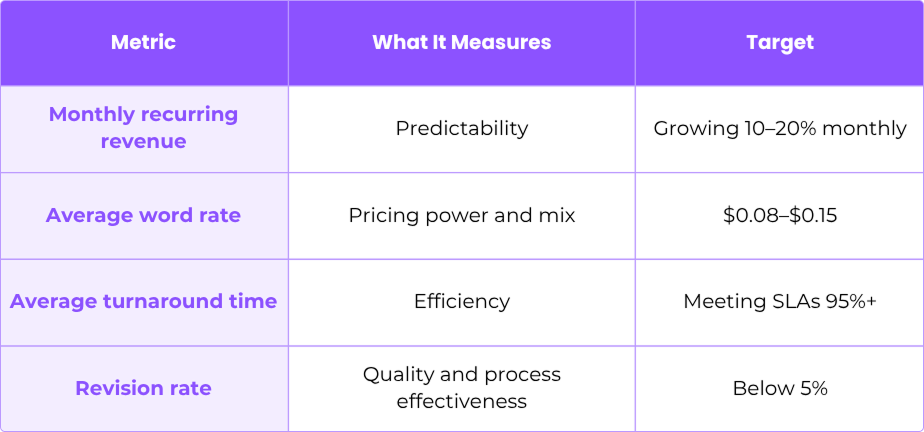
Review these monthly to identify patterns and bottlenecks.
Stage 3: From $30k to $100k/Month – Systematize, Specialize, and Productize
This is the “real agency” phase. You have multiple concurrent projects, recurring enterprise clients, and at least one full-time PM. Monthly revenue ranges from $30k–$100k ($360k–$1.2M annualized), and your operations need to match this scale.
Deepening Your Specialization
Specialize deeply by vertical and content type:
Verticals:
- Life sciences regulatory submissions
- Fintech documentation
- Gaming localization
- E-learning course translation
Content types:
- Regulatory documents
- UI strings and software interfaces
- Marketing campaigns
- Video/multimedia localization
This specialization allows you to develop repeatable processes, maintain superior glossaries and translation memories, and command premium pricing.
Productized Services
Move from custom-quoting every project toward standardized packages:
SaaS Localization Sprint: $8,000 for complete localization into 4 languages (English source to German, French, Spanish, Japanese), including 2,000–3,000 words of UI strings + help documentation + in-app messaging, with 5-day turnaround and one round of changes.
Productized services create predictable revenue, faster sales cycles (no custom quoting overhead), and clearer delivery expectations for clients and your team.
Expanding Your Tech Stack
Your technology infrastructure should now include:
- Robust TMS with connectors for platforms your clients use (Shopify, Contentful, HubSpot, Salesforce Commerce Cloud)
- Machine translation engines for high-volume content where human post editing is appropriate
- QA tools for consistency checking, terminology control, and formatting validation
The strategic use of machine translation positions MT as an efficiency tool, not a replacement for human expertise. Develop decision trees: marketing campaigns and regulatory content require 100% human translation; product catalogs receive MT + human review; internal documentation receives MT + terminology check only.
Building Specialized Linguist Pools
Create dedicated teams per major client and per vertical. Each team maintains:
- Shared glossaries and terminology databases
- Style guides and brand voice documentation
- Client-specific instructions in a centralized repository
This approach reduces revision rates from 5–7% to 2–3%, accelerates delivery, and improves client satisfaction.
Role Clarity
At this stage, establish clear role boundaries:
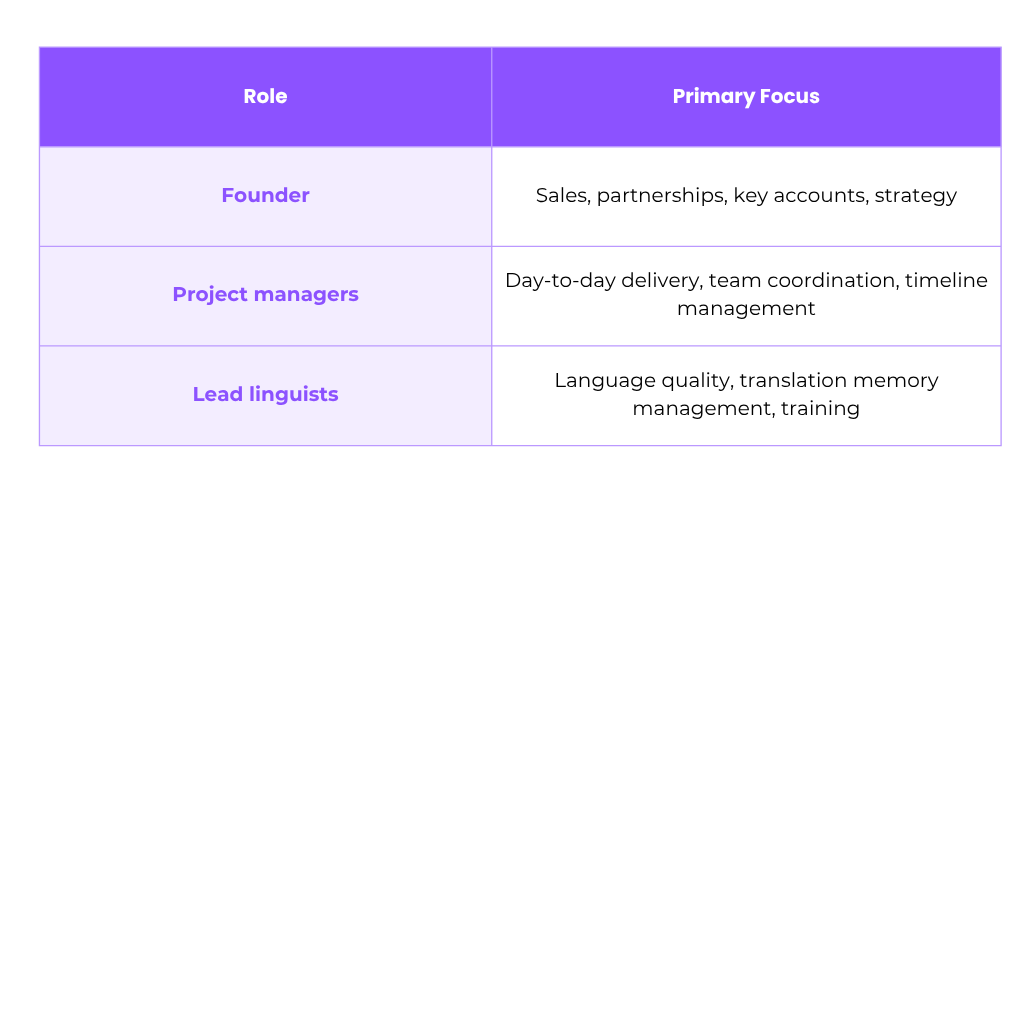
Formalizing Quality Assurance
Implement systematic QA processes:
- Standardized checklists for “done” definition
- Bilingual review steps with independent reviewers
- Terminology approval workflows with clients
- Periodic audits of translation memory usage and error patterns
Error pattern analysis helps you identify glossary gaps and process breakdowns proactively rather than reactively.

Stage 4: From $100k/Month to $1M+ Annual Revenue – Scaling Operations and Margins
By this stage, you have multi-country clients, multi-language projects (often 10+ languages), and a team of PMs, linguists, and possibly dedicated sales reps. Annual revenue exceeds $1.2M, providing resources for serious infrastructure investment and specialized roles.
Projects at this scale might include 5M-word documentation sets translated into 18 languages, game launches across 12+ markets, or coordinated e-commerce rollouts where product catalogs, marketing materials, and customer support content must launch simultaneously.
Operational Scaling Levers
Create standard workflows for large engagements with documented playbooks:
- Enterprise documentation localization: Typical phases, timelines, resource allocation, quality gates
- Game/multimedia localization: Different phases, different specializations, in-context review processes
- E-commerce catalog rollouts: SKU handling, product attribute translation, market-specific adaptations
These playbooks accelerate project setup, improve resource forecasting accuracy, and create institutional knowledge that survives team turnover.
Automation and Integrations
At this scale, manual file handling creates unacceptable overhead and error risk. Implement:
- CMS/TMS connectors for bidirectional content sync
- APIs for automated job creation based on content triggers
- Automatic MT pre-translation with configurable rules about content types
- Automated routing based on language pair, content type, and deadline
For example, when a SaaS client updates product information in Contentful, the updated content automatically flows into your TMS, gets translated according to pre-configured workflows, and automatically updates in target markets.
Building a Leadership Layer
The founder should transition toward strategy, partnerships, and large enterprise sales. Build a leadership layer:
- Head of Operations: Oversees delivery, quality, and PM team
- Lead PM or Delivery Director: Ensures on-time, on-quality delivery
- Quality Director: Ensures consistency across clients and projects
This transition is difficult but essential. No individual can directly manage the volume and complexity at this scale.
Margin Management
Monitor unit economics carefully:
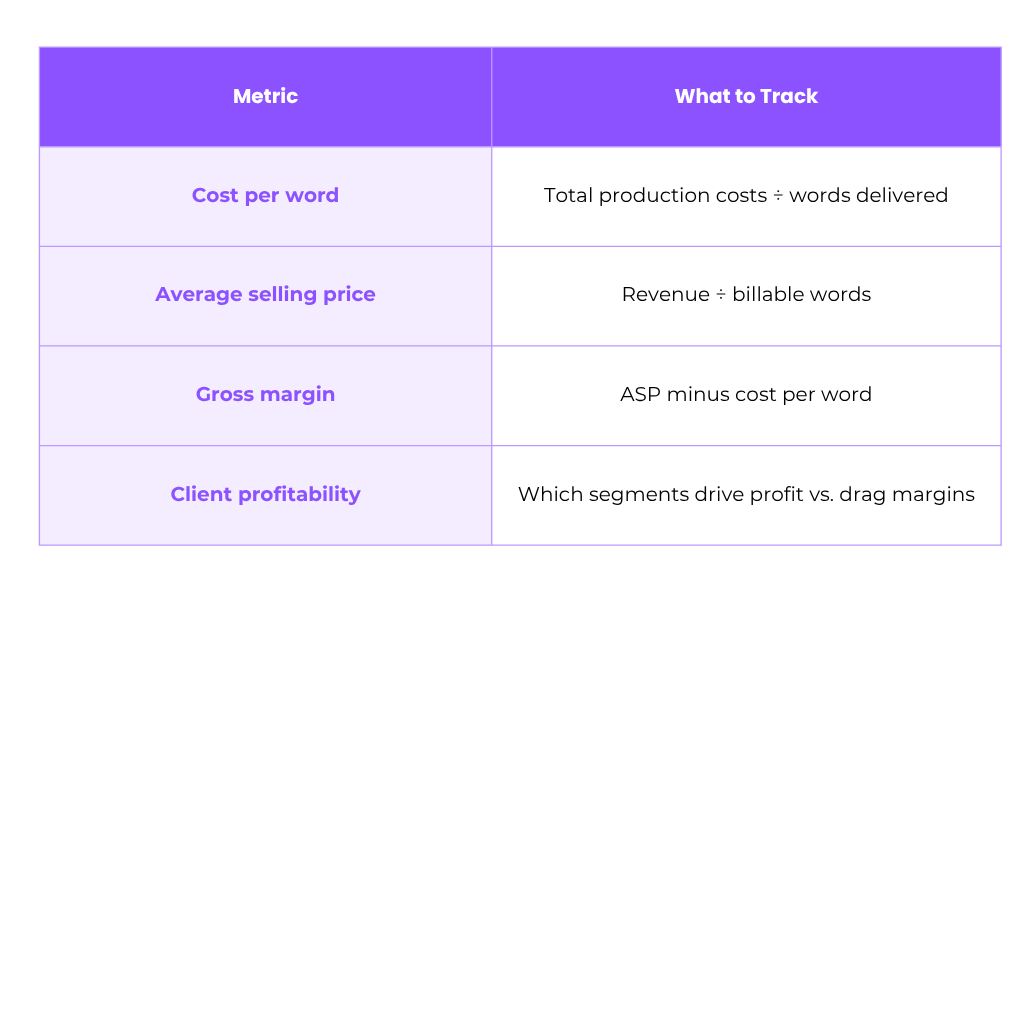
Using MT plus post editing on appropriate content (30% of volume at $0.04–$0.06 cost, charged at $0.08–$0.12) while maintaining human translation on specialized content (70% at $0.10–$0.15 cost, charged at $0.18–$0.30) dramatically improves blended margins.
Formal Account Management
Implement quarterly business reviews for key clients:
- Performance dashboards (turnaround, quality scores, on-time delivery)
- Translation volume and usage trends
- Proactive suggestions for expansion (new language pairs, new content types)
This relationship depth creates switching costs and generates expansion revenue from global enterprises scaling their localization needs.
Risk Management
Build operational redundancy:
- Multiple translators and editors per language pair
- Backup PMs for critical projects
- Data security standards (encrypted storage, role-based access, audit logs)
- Compliance processes for regulated industries
Tech Stack to Enable Scalable Translation Operations
Hitting $1M revenue without a coherent tech stack leads to chaos, errors, and thin margins. Your technology infrastructure should follow a hub-and-spoke model with the TMS as the central system.
Core Systems
Workflow Automation
Implement connectors and integrations:
- CMS connectors: Shopify, WordPress, Sitecore, Salesforce Commerce Cloud, Contentful
- APIs for custom integrations: Client-specific systems and workflows
- Automatic job routing: Based on language pair, content type, deadlines
These integrations eliminate manual file handling, reduce turnaround time, and minimize error risk from manual transfers.
AI Beyond Raw Machine Translation
Leverage ai models for:
- AI-assisted QA checks: Terminology consistency, untranslated segments, formatting preservation
- Content classification: Determining what should be fully human vs. MTPE
- Style guide drafting: Using LLMs to draft terminology lists that humans refine
This represents collaboration where AI handles pattern recognition and humans make judgment calls.
Vendor and Client Portals
Provide real-time visibility through a single interface:
- Client portal: Project status, delivery timelines, quality metrics
- Linguist portal: Assigned jobs, glossaries, style guides, communication channels
These portals reduce coordination overhead and save time through asynchronous communication across time zones.
Security and Compliance
Satisfy enterprise IT and procurement teams with:
- Role-based access controls
- NDAs and confidentiality agreements
- Encrypted storage and secure file transfer
- Audit logs and compliance documentation
Building and Managing a High-Performance Linguist and PM Team
Quality and scalability depend on the strength and stability of your human team, even in an AI-heavy environment. Technology amplifies human expertise—it doesn’t replace it.
Recruiting Translators and Editors
Focus on candidates with:
- Industry experience: 3+ years in your target vertical
- CAT/TMS proficiency: Familiar with your specific tools
- Process orientation: Willingness to follow SOPs and accept feedback
Recruitment channels that work well:
- University translation program networks
- Referrals within the translation community
- Targeted LinkedIn outreach to translators with specific industry experience
Structured Onboarding
Formal onboarding should include:
- Training on your TMS and CAT tools (agency-specific, not generic tutorials)
- Review of relevant style guides, glossaries, and client instructions
- Expectations around communication norms, turnaround, and quality standards
- Practical test projects with detailed feedback
The investment (typically 8–16 hours per new team member) pays dividends through faster ramp-up and reduced errors.
PM Role Evolution
Project managers evolve from task coordinators to workflow orchestrators:
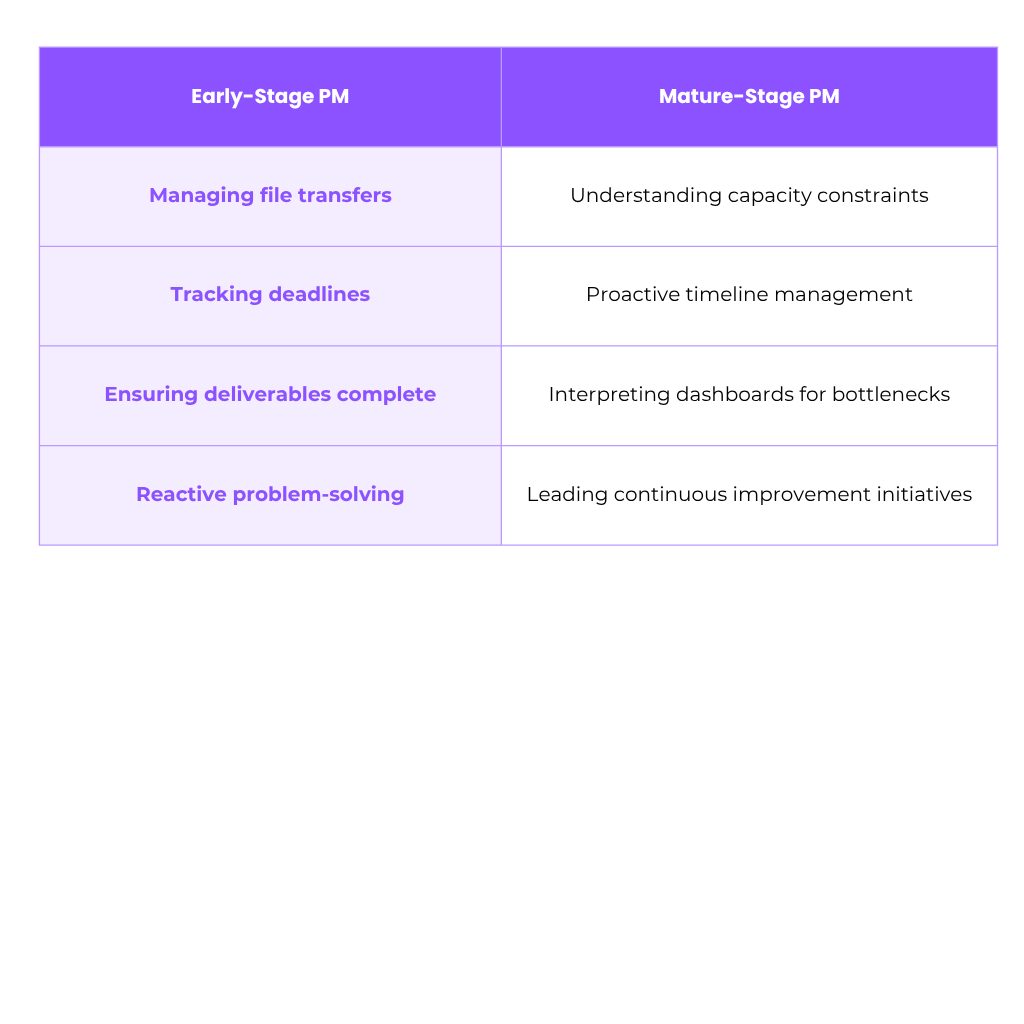
Performance Metrics
Track progress for both linguists and PMs:
- On-time delivery rate
- Quality scores (internal QA or client feedback)
- Responsiveness to questions and clarifications
- Consistency scores (glossary and style guide adherence)
Review metrics monthly and use them for coaching, compensation decisions, and identifying top performers for lead roles.
Retention Strategies
Retain your best people through:
- Competitive compensation benchmarked against market rates
- Predictable work volume for top performers
- Clear advancement paths (lead linguist, reviewer, trainer roles)
- Responsive feedback loops
- Equity or profit-sharing for senior team members

Revenue Models, Pricing, and Profitability at Scale
Pricing discipline is critical for sustaining healthy margins once you move beyond the founder-does-everything stage. The right pricing strategy ensures your company grows profitably, not just in revenue.
Common Pricing Models
Tiered Service Levels
Structure pricing based on service levels:
- Raw MT: Lowest cost, internal use only
- MT + light post editing: $0.04–$0.06/word, high-volume documentation
- Full human translation + editing: $0.10–$0.15/word, standard content
- Specialized regulated content with multi-step QA: $0.15–$0.25/word
- Rush/complexity surcharges: 25–50% premium
2024–2026 Price Ranges
For agencies with established positioning:
- MTPE on high-volume documentation: $0.04–$0.06 per word
- Standard human translation: $0.08–$0.12 per word
- Specialized regulated content: $0.15–$0.25 per word
- Brand-critical marketing content: $0.18–$0.30 per word
Negotiating with Enterprise Buyers
Frame value in terms of:
- Reduced time-to-market for new markets
- Risk mitigation (regulatory, legal, brand consistency)
- Consistent brand voice across global audience
- Integration with their workflows and systems
Volume discount structures (e.g., 2% at 500k+ words/year, 5% at 1M+ words/year) create predictability and incentivize consolidation with your agency.
Profitability Levers
Improve quality and margins simultaneously:
- Translation memory leverage: Reuse previous translations to reduce translator hours
- Right mix of MT and human work: Use MTPE where appropriate, human-only where necessary
- Vendor rate optimization: As volume grows, negotiate better rates without underpaying
- Minimize rework: Better briefs, complete client assets, clear terminology reduce revision costs
Scaling Sales: From Word-of-Mouth to Predictable Pipeline
Many agencies stall at $20k–$30k/month because they rely solely on referrals. Scaling to $1M requires repeatable lead generation and a consistent sales process.
Core Acquisition Channels
Outbound Outreach
- Target localization managers, product managers, and marketing leaders
- Personalize based on company expansion plans and localization needs
- Focus on clients in your specialized verticals
Content Marketing
- Detailed case studies with specific outcomes and metrics
- Guides addressing client challenges (e.g., “How to Launch Your SaaS in 8 Markets Simultaneously”)
- SEO-optimized content attracting organic traffic
Platform Partnerships
- Partnerships with TMS providers, CMS platforms, and SaaS vendors
- Integration listings and co-marketing opportunities
- Referral relationships with complementary service providers
Creating Compelling Case Studies
Case studies should include:
- Context: Client challenges and market expansion goals
- Approach: How your agency structured the localization
- Results: Markets launched, words translated, time-to-market improvements
- Metrics: Specific numbers with dates
For example: “Helped a SaaS platform launch into 8 new markets simultaneously while maintaining 4-day turnaround on 500k+ words/quarter, resulting in $2M incremental revenue in first 6 months.”
Sales Process Structure
Build a repeatable process:
- Discovery call: Understand needs, current volumes, language pairs, pain points
- Localization audit: Propose solution and estimate effort/cost
- Custom proposal: Clear SLAs, pricing tiers, scope definition
- Time-boxed pilot: 1–3 month proof of capability
Aligning Sales with Operations
Ensure quality isn’t sacrificed:
- Set realistic turnaround standards based on actual capacity
- Clarify which content types get which workflows
- Document all commitments in the SOW
- Respond quickly when scope changes arise
Sales Tools
Basic infrastructure supports efficiency:
- CRM to track deals and pipeline (HubSpot, Pipedrive, Salesforce)
- Email automation for follow-ups
- Shared proposal template repository
- Pricing calculator for consistent quoting
Measuring, Optimizing, and Continually Improving Your Agency
Scaling is iterative. You improve quality and processes based on data rather than guesswork.
Key KPIs Dashboard
Quarterly Reviews
Examine systematically:
- Top revenue-generating clients (and whether they’re profitable)
- Least profitable projects or client segments
- Operational bottlenecks (where projects slow down, where quality issues occur)
- Automation opportunities (what manual work could be eliminated)
Use a simple framework: identify top 3 problems, prioritize by impact, assign owners, track progress toward resolution.
SOP Library Formalization
Build version-controlled processes for:
- Intake and quoting
- Production and translation
- Quality assurance and review
- Delivery and handoff
- Crisis handling (urgent multi-language announcements)
Review and update quarterly based on team feedback and observed process breakdowns.
Feedback Loops
Create structured mechanisms:
- Client feedback through surveys and periodic conversations
- PM and linguist input on process frustrations and improvement ideas
- Translation of feedback into updated style guides, templates, and training
Treat failures as learning opportunities, not blame situations.
Experimentation
Pilot new capabilities systematically:
- Testing new MT engines on defined content sets
- Trialing ai powered QA workflows
- Exploring new markets or language pairs
Each experiment should be time-bounded with clear success metrics and review dates.
FAQ
When should I hire my first full-time project manager?
A full-time PM usually makes sense once you consistently exceed $15k–$20k/month and you’re spending more than 50% of your time on coordination instead of sales or strategy. At that point, the cost of the PM (typically $50k–$70k annually with benefits) is justified by freed founder time for higher-value activities.
An earlier hire may be justified if you’re juggling many small projects in multiple language pairs, working in highly regulated industries that require strict QA, or finding that clients are unhappy with response times and communication. The key signal is when coordination overhead is limiting growth.
Do I need to build my own translation platform to scale to $1M?
Generally, no. Using established TMS and CAT tools with APIs and connectors is usually faster and cheaper than building proprietary technology. The solution already exists—you just need to implement it properly. Focus your resources on service delivery, client relationships, and team development.
Custom development may make sense later for niche workflows, competitive differentiation, or branding purposes. But only pursue this after your core business model and processes are stable and profitable. Building technology too early diverts resources from revenue-generating activities.
How can a small agency compete with large LSPs and AI-heavy platforms?
Your advantages over global enterprises and generic platforms include specialization (deep industry and content expertise), responsiveness (faster decisions, direct access to decision-makers), and tailored workflows (customized processes for each client’s needs). Large LSPs often provide generic service that doesn’t adapt to specific client contexts.
Position AI as part of your toolkit—using it for speed and cost-efficiency—while emphasizing your human expertise, QA rigor, and closer collaboration with client teams. Customers value partners who understand their industry, maintain brand consistency, and speak their language (literally and figuratively). Satisfaction guaranteed comes from this combination of technology and expertise.
What’s the right balance between human translation and machine translation?
The right balance depends on risk and visibility. Mission-critical, regulatory, and brand-sensitive content should be human-led because errors create legal, compliance, or reputation risks. Repetitive or low-risk documentation (internal processes, product specs with established terminology) can use MT plus post editing effectively.
Develop clear internal rules for when MT is allowed, documented in your SOPs. Always measure quality through linguistic accuracy checks and client feedback to ensure quality meets expectations. The goal is finding efficiency without sacrificing quality—technology serves your standards, not the reverse.
How long does it realistically take to grow from $0 to $1M in revenue?
With focused niche positioning, decent sales execution, and smart use of technology, many agencies can reach $1M annual run rate within 3–5 years. Some achieve it faster with larger average deal sizes or strong industry connections; others take longer due to market conditions or slower process development.
Speed depends on several factors: average deal size (a few large clients vs. many small ones), client concentration risk, your ability to delegate effectively, and how quickly you systematize your delivery and quality processes. The agencies that scale fastest are those that treat process development as seriously as client acquisition from day one.

Building software that helps small and medium-sized language service providers run their business.
About Rishi →Table of Contents
- Introduction: What “Scale” Really Means for a Translation Agency
- Stage 1: From $0 to $10k/Month – Validate Your Niche and Offer
- Stage 2: From Solo to Micro-Agency – Building the First Scalable Process
- Stage 3: From $30k to $100k/Month – Systematize, Specialize, and Productize
- Stage 4: From $100k/Month to $1M+ Annual Revenue – Scaling Operations and Margins
- Tech Stack to Enable Scalable Translation Operations
- Building and Managing a High-Performance Linguist and PM Team
- Revenue Models, Pricing, and Profitability at Scale
- Scaling Sales: From Word-of-Mouth to Predictable Pipeline
- Measuring, Optimizing, and Continually Improving Your Agency
- FAQ