DeepL vs Google Translate: Which Translation Solution Is Right for Your Company?
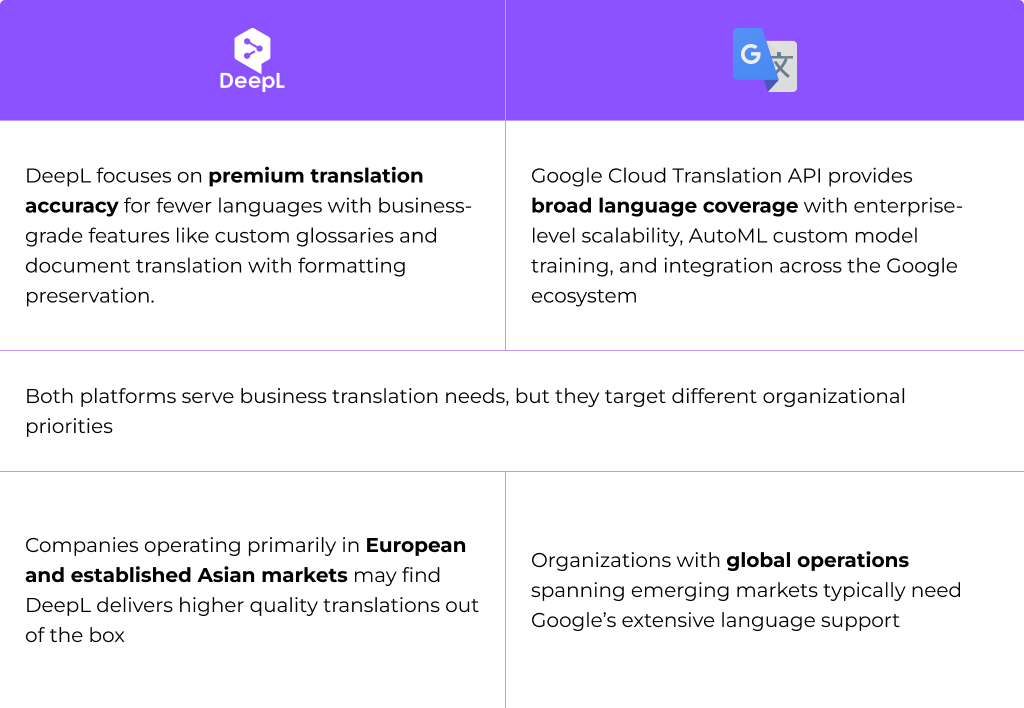
Choosing between DeepL and Google Cloud Translation API depends on your translation volume, target languages, and how much you prioritize translation quality versus broad language coverage. DeepL delivers more natural sounding translations for European language pairs and major Asian languages, while Google Translate offers enterprise-scale machine translation across 130+ supported languages with flexible integration options.
Below is a practical comparison of DeepL vs Google Translate for business use.
DeepL vs Google Translate Translation: Key Differences
The core difference comes down to depth versus breadth.
Translation Quality for Business Content
Translation accuracy directly impacts brand reputation and customer trust. Poor translations in marketing campaigns or business documents can damage credibility and create costly misunderstandings.
DeepL Business Translation Quality
DeepL has built its reputation on superior contextual accuracy, particularly for European languages and key Asian language pairs. The neural machine translation engine produces more accurate translations that preserve tone, idiomatic expressions, and nuanced grammar.
Key quality features include:
- Glossary support across 105 language pairs for consistent brand terminology
- Natural sounding translations ideal for customer-facing content
- Strong performance in marketing copy and creative content translation
- Document translation preserving original formatting for DOCX, PPTX, and PDF files
Unlike Google Translate, DeepL often requires less post editing for polished, publication-ready content in its core language pairs. However, for languages outside its primary support—particularly newly added or beta languages—translation quality may require more human review.
Google Translate Business Quality
Google Cloud Translation API delivers reliable accuracy across its massive language coverage, making it practical for companies operating in multiple languages simultaneously.
Quality characteristics include:
- Consistent baseline performance across 130+ languages
- AutoML custom model training for industry-specific terminology
- Translation LLM and Adaptive Translation modes for style-controlled output
- Strong performance in technical documentation and straightforward business communications
Google Translate performs well for high-volume content translation where consistency matters more than creative nuance. For highly stylistic content or marketing campaigns requiring cultural adaptation, the output tends toward literal interpretation unless custom trained with your own training data.
Language Coverage and Global Reach
Language support determines which markets you can effectively enter and serve.
DeepL Language Support for Business
DeepL currently supports 36 languages, with recent additions including Vietnamese, Hebrew, and early-access Thai. Document translation now covers Traditional Chinese and Arabic.
Coverage strengths:
- High quality translations for major European languages and widely spoken languages
- Excellent for companies operating in developed markets across Europe, North America, and key Asian economies
- Glossary feature available for 15 core languages
Coverage limitations:
- Limited options for emerging markets and regional dialects
- Some newer language pairs lack full feature parity (latency-optimized modes, glossary support)
- Not suitable as sole solution for truly global operations spanning different languages across all regions
Google Translate Global Language Coverage
Google Cloud Translation API supports well over 130 languages with ongoing expansion efforts toward 1000+ languages.
Coverage advantages:
- Comprehensive support for global market penetration
- Essential for companies requiring multilingual customer support across emerging markets
- Regional data center presence for compliance and latency optimization
- Continuous expansion of supported languages
For organizations needing to translate text across dozens of language pairs tested against real-world business scenarios, Google’s breadth is unmatched.
Business Features and Enterprise Integration
Integration capabilities affect workflow efficiency and determine how translation fits into existing business processes.
DeepL Business Features
DeepL offers tiered solutions for different business scales:
- DeepL API Pro: Base subscription (~$5.49/month) plus per-character billing (~$25 per million characters) with priority execution and enhanced security
- CAT tool integrations: Seamless workflow integration for translation memory and localization teams
- Document translation: Format preservation for business documents including Office files and PDFs
- Team collaboration: Centralized billing, admin dashboards, SSO, and saved translations
- Glossary support: Custom glossaries ensuring consistent terminology across all translated content
The Business plan reports 99.0% availability SLA, with Enterprise tiers offering higher guarantees and custom invoicing.
Google Cloud Translation Features
Google Cloud Translation provides enterprise-grade capabilities:
- Cloud Translation API: Advanced and Basic tiers with different feature sets
- AutoML Translation: Train custom translation models on proprietary datasets for domain-specific accuracy
- Batch processing: High-volume document translation for entire web pages and large content libraries
- Google Workspace integration: Native connections with existing productivity tools
- Adaptive Translation: LLM-powered translation that adapts to business examples and style preferences
Google’s infrastructure supports embedding machine translation into mobile apps, desktop app integrations, browser extensions, and custom applications.
Security and Compliance Requirements
Data protection requirements vary significantly across industries and regions. Both platforms address enterprise security needs differently.
DeepL Security for Business
DeepL provides strong data protection assurances particularly valuable for regulated industries:
- ISO 27001 certification and SOC 2 Type II audit completion
- No data retention: Pro user customer data is not stored beyond processing or used to train translation models
- GDPR compliance: EU-based data processing with data residency options
- Encryption: Data protection in transit and at rest
For companies handling sensitive legal translations, financial documents, or healthcare information, DeepL’s explicit commitment that customer data never trains their models offers clear compliance advantages.
Google Translate Enterprise Security
Google Cloud maintains comprehensive security infrastructure:
- Multiple certifications: ISO 27001, 27017, 27018, 27701 plus SOC 2 and SOC 3 reports
- Data residency options: Regional deployment across global data centers
- Advanced access controls: Integration with Google Cloud IAM for identity management
- Comprehensive audit trails: Choosing between DeepL and Google Cloud Translation API depends on your translation volume, target languages, and how much you prioritize translation quality versus broad language coverage. DeepL delivers more natural sounding translations for European language pairs and major Asian languages, while Google Translate offers enterprise-scale machine translation across 130+ supported languages with flexible integration options.
- Below is a practical comparison of DeepL vs Google Translate for business use.
- DeepL vs Google Translate Translation: Key Differences
- The core difference comes down to depth versus breadth.
- Translation Quality for Business Content
- Translation accuracy directly impacts brand reputation and customer trust. Poor translations in marketing campaigns or business documents can damage credibility and create costly misunderstandings.
- DeepL Business Translation Quality
- DeepL has built its reputation on superior contextual accuracy, particularly for European languages and key Asian language pairs. The neural machine translation engine produces more accurate translations that preserve tone, idiomatic expressions, and nuanced grammar.
- Key quality features include:
- Glossary support across 105 language pairs for consistent brand terminology
- Natural sounding translations ideal for customer-facing content
- Strong performance in marketing copy and creative content translation
- Document translation preserving original formatting for DOCX, PPTX, and PDF files
- Unlike Google Translate, DeepL often requires less post editing for polished, publication-ready content in its core language pairs. However, for languages outside its primary support—particularly newly added or beta languages—translation quality may require more human review.
- Google Translate Business Quality
- Google Cloud Translation API delivers reliable accuracy across its massive language coverage, making it practical for companies operating in multiple languages simultaneously.
- Quality characteristics include:
- Consistent baseline performance across 130+ languages
- AutoML custom model training for industry-specific terminology
- Translation LLM and Adaptive Translation modes for style-controlled output
- Strong performance in technical documentation and straightforward business communications
- Google Translate performs well for high-volume content translation where consistency matters more than creative nuance. For highly stylistic content or marketing campaigns requiring cultural adaptation, the output tends toward literal interpretation unless custom trained with your own training data.
- Language Coverage and Global Reach
- Language support determines which markets you can effectively enter and serve.
- DeepL Language Support for Business
- DeepL currently supports 36 languages, with recent additions including Vietnamese, Hebrew, and early-access Thai. Document translation now covers Traditional Chinese and Arabic.
- Coverage strengths:
- High quality translations for major European languages and widely spoken languages
- Excellent for companies operating in developed markets across Europe, North America, and key Asian economies
- Glossary feature available for 15 core languages
- Coverage limitations:
- Limited options for emerging markets and regional dialects
- Some newer language pairs lack full feature parity (latency-optimized modes, glossary support)
- Not suitable as sole solution for truly global operations spanning different languages across all regions
- Google Translate Global Language Coverage
- Google Cloud Translation API supports well over 130 languages with ongoing expansion efforts toward 1000+ languages.
- Coverage advantages:
- Comprehensive support for global market penetration
- Essential for companies requiring multilingual customer support across emerging markets
- Regional data center presence for compliance and latency optimization
- Continuous expansion of supported languages
- For organizations needing to translate text across dozens of language pairs tested against real-world business scenarios, Google’s breadth is unmatched.
- Business Features and Enterprise Integration
- Integration capabilities affect workflow efficiency and determine how translation fits into existing business processes.
- DeepL Business Features
- DeepL offers tiered solutions for different business scales:
- DeepL API Pro: Base subscription (~$5.49/month) plus per-character billing (~$25 per million characters) with priority execution and enhanced security
- CAT tool integrations: Seamless workflow integration for translation memory and localization teams
- Document translation: Format preservation for business documents including Office files and PDFs
- Team collaboration: Centralized billing, admin dashboards, SSO, and saved translations
- Glossary support: Custom glossaries ensuring consistent terminology across all translated content
- The Business plan reports 99.0% availability SLA, with Enterprise tiers offering higher guarantees and custom invoicing.
- Google Cloud Translation Features
- Google Cloud Translation provides enterprise-grade capabilities:
- Cloud Translation API: Advanced and Basic tiers with different feature sets
- AutoML Translation: Train custom translation models on proprietary datasets for domain-specific accuracy
- Batch processing: High-volume document translation for entire web pages and large content libraries
- Google Workspace integration: Native connections with existing productivity tools
- Adaptive Translation: LLM-powered translation that adapts to business examples and style preferences
- Google’s infrastructure supports embedding machine translation into mobile apps, desktop app integrations, browser extensions, and custom applications.
- Security and Compliance Requirements
- Data protection requirements vary significantly across industries and regions. Both platforms address enterprise security needs differently.
- DeepL Security for Business
- DeepL provides strong data protection assurances particularly valuable for regulated industries:
- ISO 27001 certification and SOC 2 Type II audit completion
- No data retention: Pro user customer data is not stored beyond processing or used to train translation models
- GDPR compliance: EU-based data processing with data residency options
- Encryption: Data protection in transit and at rest
- For companies handling sensitive legal translations, financial documents, or healthcare information, DeepL’s explicit commitment that customer data never trains their models offers clear compliance advantages.
- Google Translate Enterprise Security
- Google Cloud maintains comprehensive security infrastructure:
- Multiple certifications: ISO 27001, 27017, 27018, 27701 plus SOC 2 and SOC 3 reports
- Data residency options: Regional deployment across global data centers
- Advanced access controls: Integration with Google Cloud IAM for identity management
- Comprehensive audit trails: Detailed logging for compliance reporting
- Google supports PCI DSS and HIPAA compliance where enabled. However, businesses must verify contract terms regarding whether data may be used for model improvement—enterprise agreements typically offer opt-out provisions.
- Pricing Models and Cost Considerations
- Pricing structure significantly affects long-term translation costs, especially at scale.
- DeepL Business Pricing
- DeepL uses a hybrid subscription and usage-based model:
- DeepL’s pricing is predictable for consistent translation needs. However, per-character rates make it relatively expensive at very high volumes—translating 5 million characters monthly costs approximately $631 with DeepL versus $500 with Google’s standard NMT.
- Google Cloud Translation Pricing
- Google offers pay-as-you-go pricing with volume discounts:
- Google’s model favors organizations with variable or extremely high translation volumes. Volume discounting reduces marginal costs significantly at enterprise scale.
- Business Use Case Scenarios
- Different business needs determine the optimal translation tool choice.
- Hybrid approach consideration: Many organizations use DeepL for premium content translation—marketing, UX copy, customer communications—while leveraging Google for backend content, high-volume user-generated material, or language pairs DeepL doesn’t fully support.
- DeepL vs Google Translate: Which Should You Choose?
- Choose DeepL Business if you:
- Prioritize translation quality over language breadth
- Operate primarily in European/Asian markets with common languages
- Need glossary support for consistent brand terminology
- Handle sensitive content requiring strict data retention policies
- Want predictable costs at moderate volumes
- Choose Google Cloud Translation if you:
- Require extensive language coverage across 130+ languages
- Need enterprise-scale integration with existing cloud infrastructure
- Process high volumes where pay-as-you-go pricing reduces costs
- Want custom model training through AutoML for specialized domains
- Operate globally including emerging markets with non European languages
- For many organizations, comparing DeepL and Google Translate isn’t about choosing one exclusively. The right translation tool strategy may combine both top translation engines—DeepL for high quality translations in primary markets, Google for scale and coverage everywhere else.
- Evaluate based on your specific language pairs, volume requirements, quality standards, and security needs. Both platforms continue evolving rapidly, with DeepL expanding language support and Google enhancing AI translator capabilities through LLM integration.Detailed logging for compliance reporting
Google supports PCI DSS and HIPAA compliance where enabled. However, businesses must verify contract terms regarding whether data may be used for model improvement—enterprise agreements typically offer opt-out provisions.
Pricing Models and Cost Considerations
Pricing structure significantly affects long-term translation costs, especially at scale.
DeepL Business Pricing
DeepL uses a hybrid subscription and usage-based model:
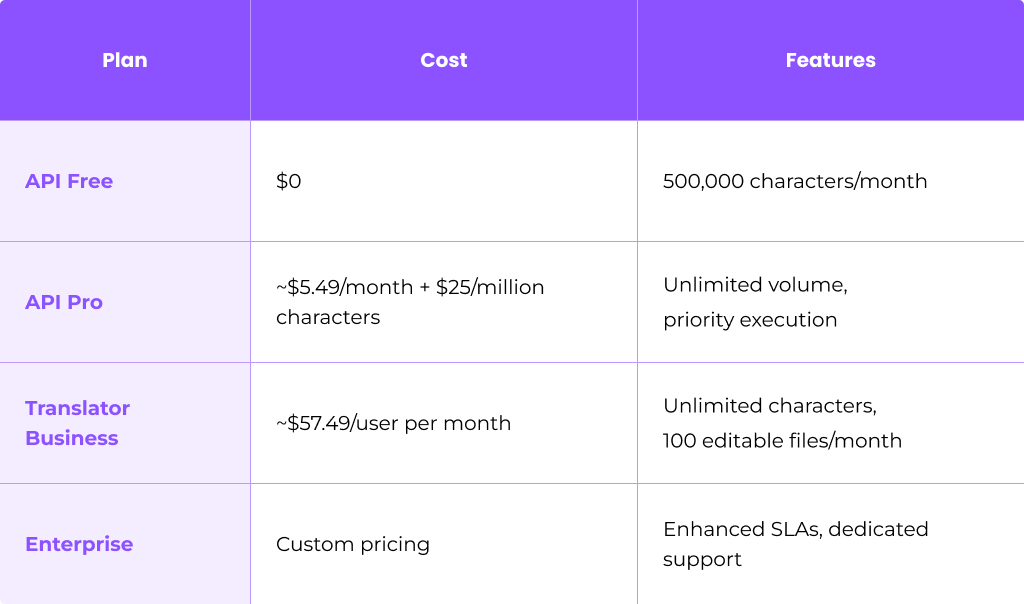
DeepL’s pricing is predictable for consistent translation needs. However, per-character rates make it relatively expensive at very high volumes—translating 5 million characters monthly costs approximately $631 with DeepL versus $500 with Google’s standard NMT.
Google Cloud Translation Pricing
Google offers pay-as-you-go pricing with volume discounts:
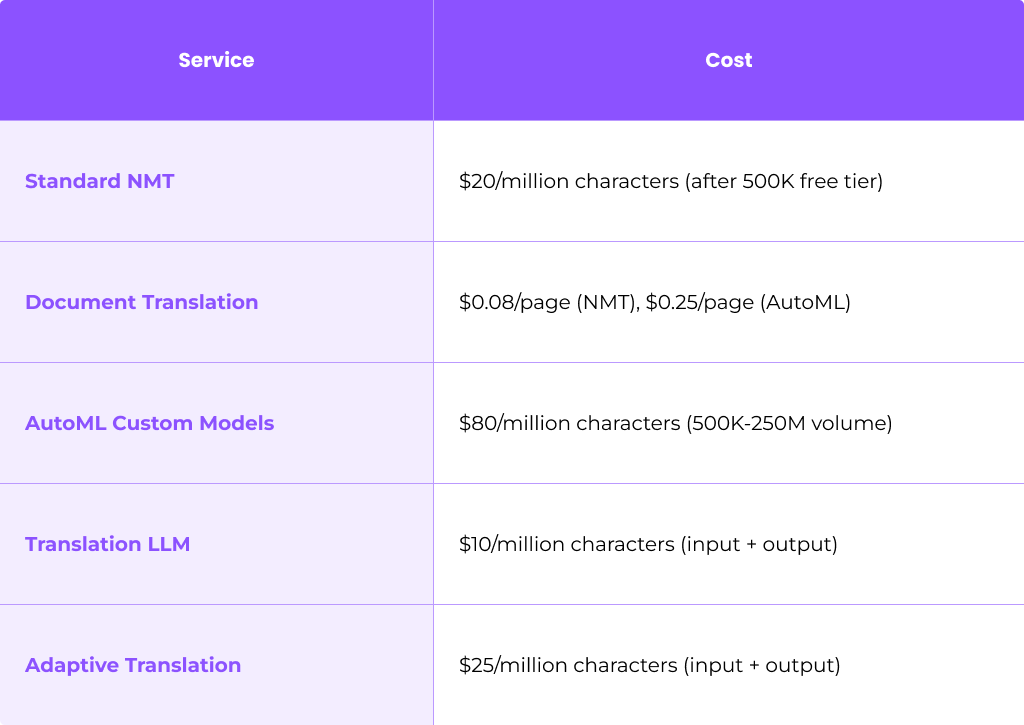
Google’s model favors organizations with variable or extremely high translation volumes. Volume discounting reduces marginal costs significantly at enterprise scale.
Business Use Case Scenarios
Different business needs determine the optimal translation tool choice.
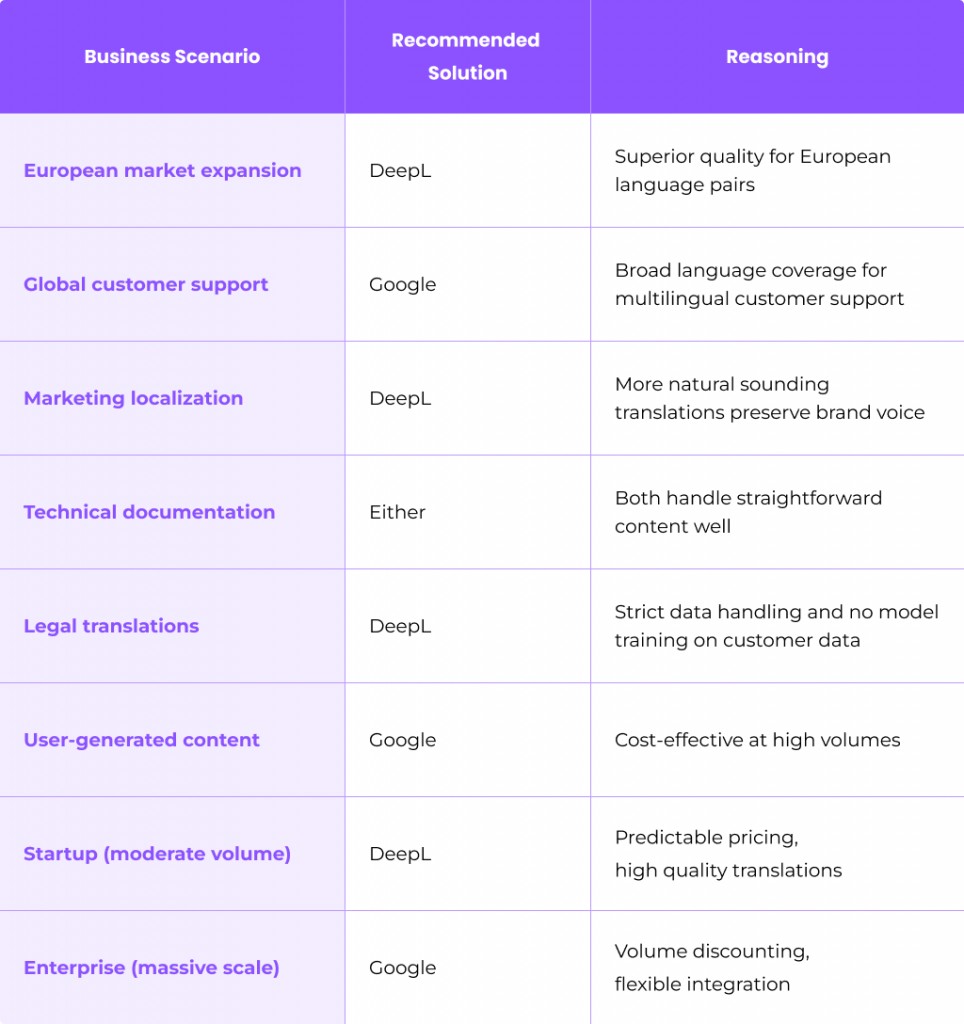
Hybrid approach consideration: Many organizations use DeepL for premium content translation—marketing, UX copy, customer communications—while leveraging Google for backend content, high-volume user-generated material, or language pairs DeepL doesn’t fully support.
DeepL vs Google Translate: Which Should You Choose?
Choose DeepL Business if you:
- Prioritize translation quality over language breadth
- Operate primarily in European/Asian markets with common languages
- Need glossary support for consistent brand terminology
- Handle sensitive content requiring strict data retention policies
- Want predictable costs at moderate volumes
Choose Google Cloud Translation if you:
- Require extensive language coverage across 130+ languages
- Need enterprise-scale integration with existing cloud infrastructure
- Process high volumes where pay-as-you-go pricing reduces costs
- Want custom model training through AutoML for specialized domains
- Operate globally including emerging markets with non European languages
For many organizations, comparing DeepL and Google Translate isn’t about choosing one exclusively. The right translation tool strategy may combine both top translation engines—DeepL for high quality translations in primary markets, Google for scale and coverage everywhere else.
Evaluate based on your specific language pairs, volume requirements, quality standards, and security needs. Both platforms continue evolving rapidly, with DeepL expanding language support and Google enhancing AI translator capabilities through LLM integration.
Table of Contents
- DeepL vs Google Translate Translation: Key Differences
- Translation Quality for Business Content
- Language Coverage and Global Reach
- Business Features and Enterprise Integration
- Security and Compliance Requirements
- Pricing Models and Cost Considerations
- Business Use Case Scenarios
- DeepL vs Google Translate: Which Should You Choose?
Ready to manage your Translation company easily?
Get Started for Free