How to Get Your First 10 Clients as a New Translation Agency (Without Cold Calling)
Key Takeaways
- Your existing network is the fastest path to your first 3–5 translation clients—use personalized LinkedIn messages and emails instead of cold calls to secure projects within 2–4 weeks.
- Focus on 1–2 profitable niches (e.g., SaaS localization, legal translations for EU law firms) rather than marketing yourself as a generalist who handles “all languages for all industries.”
- A professional, conversion-focused website and optimized LinkedIn profile can generate inbound inquiries without paid advertising—70% of B2B buyers research providers on LinkedIn before reaching out.
- Strategic use of platforms like ProZ and TranslatorsCafé, combined with partnerships with agencies and complementary businesses, can fill your client roster to 10 within 60–90 days.
- A repeatable system (consistent outreach + proof of quality + smooth onboarding) matters far more than certifications or big marketing budgets when you’re at the beginning.
Introduction: Why Your First 10 Clients Matter
Your first 10 clients as a new translation agency aren’t about maximizing profit. They’re about building proof: gathering testimonials, refining your systems, and figuring out which types of projects you actually enjoy and do well. Many translators make the mistake of chasing any job that comes their way, but the real goal in these early months is to validate your niche, test your pricing, and create a foundation for a sustainable freelance business.
This article is written for small, modern translation agencies and freelancers who want to grow without picking up the phone to cold call strangers. If you’ve ever dreaded the idea of interrupting someone’s day to pitch your services, you’re not alone—and you don’t have to do it. The strategies here focus on relationship-building, online presence, and strategic positioning instead.
Landing your first 10 clients within 3 months can do more than pay your bills. It proves that your niche has real demand, that your rates are acceptable to the market, and that your workflows actually function under pressure. Expect concrete, practical actions throughout this guide—specific platforms to join, sample messages to send, and timelines to follow. The focus is on building long-term relationships with direct clients who value quality, not racing to the bottom for one-off marketplace gigs.

Step 1: Define a Profitable Niche Before You Market
Before you spend a single hour on marketing, you need to decide who you’re marketing to. Research consistently shows that new translation agencies thrive when they narrow their focus to 1–2 high-demand sectors rather than trying to serve everyone. This specialization lets you craft messaging that speaks directly to specific client pain points—and positions you as an expert rather than a generalist.
Here’s how to pick your niche from day one:
- SaaS startups needing app and website localization: Demand has surged as tech companies expand globally. SaaS companies posted over 15,000 localization-related jobs in Europe alone during 2023–2024.
- EU law firms requiring contract translations: Legal translation requests grew 22% year-over-year due to increasing cross-border regulations and EU compliance mandates.
- Marketing agencies needing transcreation: This goes beyond literal translation—it adapts campaigns to evoke the same emotional response in target cultures, incorporating local idioms, colors, and cultural nuances.
To research demand, check LinkedIn job posts for keywords like “translation,” “localization,” or “multilingual content” from 2020–2025 in your target industries. You can also use Google Trends to see whether searches for terms like “SaaS localization” are rising (up 40% since 2022).
A focused niche shapes your entire marketing message. Instead of saying “I translate documents,” you can say: “We help B2B SaaS companies launch in DACH markets with culturally attuned localizations that boost user retention by 30%.”
Create an ideal client profile with specifics:
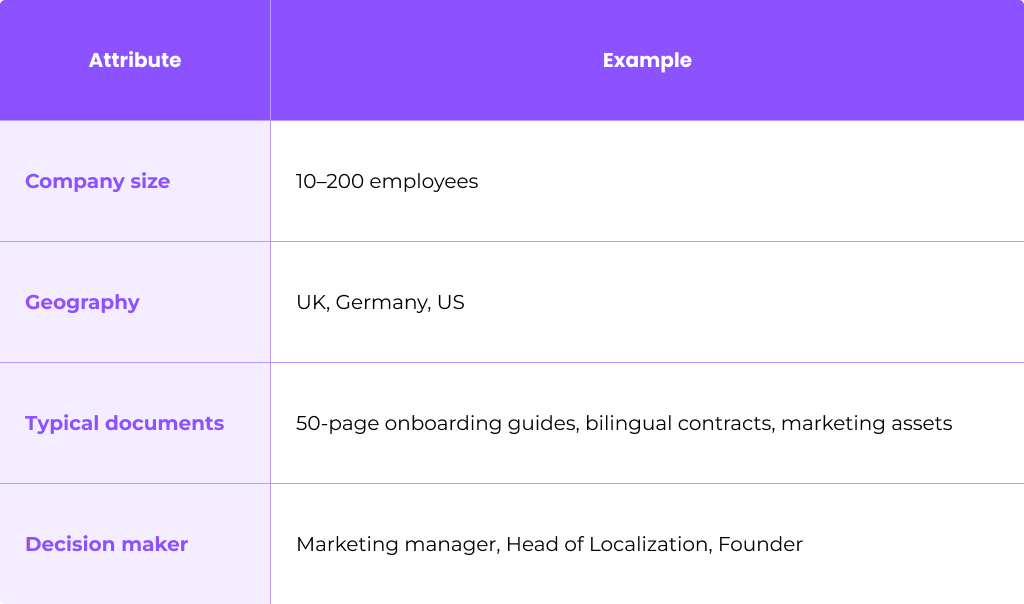
When you know exactly who your ideal clients are, every piece of content you create and every outreach message you send becomes more effective.
Step 2: Build a Lean but Trustworthy Online Presence
You don’t need a $10,000 website to look credible. A minimal viable website—typically under $500 via platforms like WordPress—can serve as your digital storefront, optimized for conversions rather than flashy design. The goal is to give potential clients just enough information to trust you and take the next step.
Here are the essential pages your website needs:
- Home: A bold, clear niche statement front and center (e.g., “EN–DE Legal Translations for EU Law Firms”)
- Services: Your language pairs, industries served, and specific deliverables (“contract transcreation with NDA compliance”)
- About: Your story and experience—weave in specifics like “10 years in German legal documentation, localized 200+ contracts in 2023”
- Portfolio/Samples: 2–5 real or anonymized examples showing your work (“50-page SaaS onboarding guide, English to German, delivered in 5 days with 98% client satisfaction”)
- Contact: A simple form plus email, ideally integrated with a tool like Calendly for instant scheduling
Use real dates and project types wherever possible. Saying “localized a SaaS onboarding guide in 2023” is far more compelling than “I have experience with technology translations.”
Your LinkedIn presence matters just as much—data shows that 70% of B2B buyers research providers on LinkedIn before making contact. Agencies with optimized profiles secure 3x more inbound inquiries.
Optimize your profiles with:
- Professional photo (not a vacation selfie)
- Focused headline: “EN–DE Legal Translator Helping EU Law Firms Go Multilingual”
- Featured section with case-study blurbs or sample work
Even if you’re just at the beginning, include 1–2 simple case-study style descriptions. These can come from pro-bono or discounted work—for example: “Audited a UK marketing agency’s Spanish landing pages, identifying 15 cultural mismatches that improved conversion by 18%.”
Step 3: Get First Clients from Your Existing Network (Without Calling)
Your warm network is the fastest, lowest-stress way to secure your first 3–5 clients without any phone calls. According to 2023 ATA surveys, 45% of translators’ initial clients still come from personal connections, and warm outreach has a 90% higher close rate than cold approaches.
Here’s a concrete plan you can execute in the next 7–14 days:
- List 50 people you know within 24 hours: Previous colleagues, university classmates, professors, ex-employers, friends working in target industries
- Send each a personalized note: LinkedIn message or email tailored to the relationship
- Ask for introductions, not immediate work: “Do you know any marketing managers or founders expanding to Germany who might need translation help?”
Sample message:
“Hi [Name], I recently launched a translation agency specializing in SaaS localization for the German market. I’m not asking you to hire me—but do you know anyone in your network who might be expanding internationally and could use this kind of support? Happy to offer them a free 1-page audit of their current German content.”
This approach emphasizes introductions over direct asks, which increases response rates by approximately 40% according to networking studies in professional services.
Offer value upfront to demonstrate expertise without sounding desperate:
- Free review of their website’s translated pages
- Quick audit of a landing page or email sequence
- Feedback on an existing translation they’re unsure about
One freelance translator secured a $5,000 contract simply by noticing errors in a classmate’s startup demo video subtitles and offering to fix them properly.

Step 4: Use Online Platforms Strategically (Without Becoming Dependent)
Online platforms are a stepping stone to your first 10 clients—not a long-term business strategy. The goal is to use them for 60–90 days to build momentum, then transition good platform clients into direct relationships.
Monitor these platforms between now and the next 90 days:
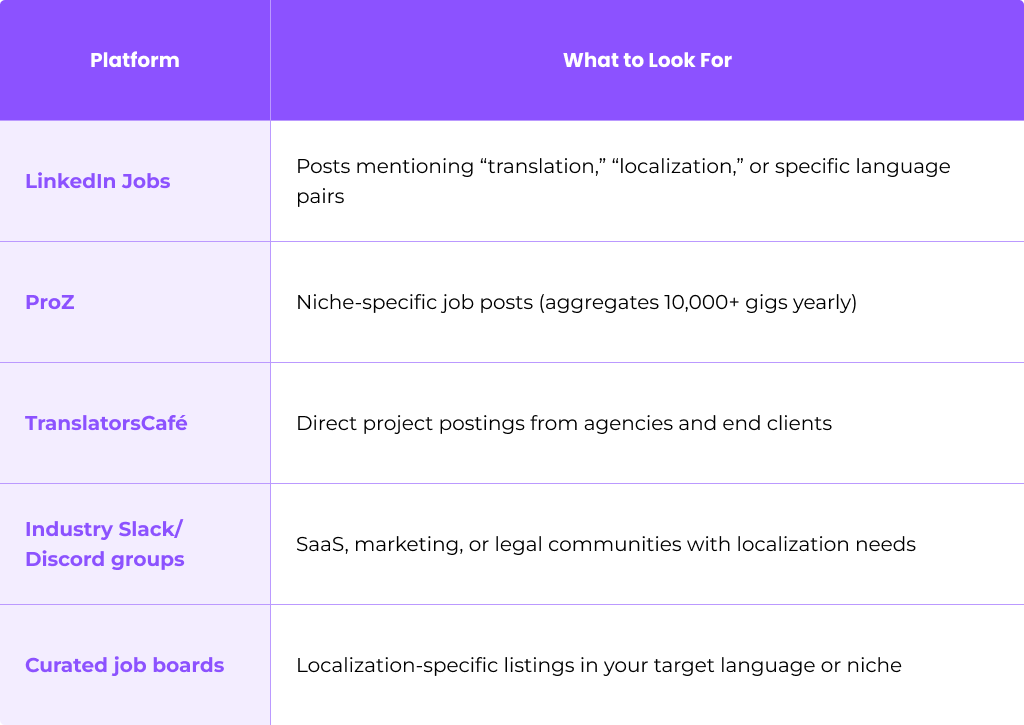
Create a profile that stands out:
- Niche-focused title: “EN–ES Legal & Compliance Specialist” beats “Spanish Translator”
- Detailed language pairs: Be specific about your expertise and target language
- 3–5 service packages: Include clear pricing ranges (e.g., “Website Localization: $0.12/word, 7-day turnaround”)
Platform analytics show that personalized proposals win at a 25% rate versus just 5% for generic copy-paste bids. Send 5–10 tailored proposals per week that reference specific project details.
When a platform client becomes a repeat customer, move them into a direct relationship. Propose a retainer or ongoing work agreement—for example, monthly blog translations at a fixed rate. Case studies from translation companies show that 60% of platform clients can convert to ongoing direct work once trust is established.
Step 5: Partner with Agencies and Complementary Businesses
Partnerships with established organizations can unlock a steady flow of work without requiring you to build your own sales pipeline from scratch. According to 2024 industry reports, partnerships generate 35% of new agency revenue.
Start with translation agencies:
- Apply to 10–20 agencies in your niche through their online application forms
- Submit flawless test translations (300-word samples scoring 95%+ on accuracy)
- Clearly state your language pairs and specializations
Then expand to complementary service providers who serve the same industries:
- Copywriters working with international clients
- SEO consultants handling multilingual campaigns
- Design studios creating websites for global companies
- Marketing agencies managing multi-market campaigns
Propose white-label or referral arrangements. Your pitch might be: “We handle the multilingual versions of campaigns you already manage, ensuring cultural fit—here’s a sample transcreation of a UK ad into German that boosted CTR by 22%.”
Sample outreach email structure:
- Brief intro and how you found them
- Your niche focus and relevant expertise
- 2–3 sample project types you could handle for their clients
- How the arrangement benefits them (referral fees of 10–20% are standard, or you simply make their services more complete)
The advantages include immediate workflow without heavy sales overhead. The trade-off is lower margins (20–30% below direct clients), but the volume and consistency often make it worthwhile, especially when you’re building your new business.
Step 6: Attract Clients with Content, Not Cold Calls
Content marketing replaces cold calling by bringing ideal clients to you over 30–90 days. Data shows that content-driven translation agencies gain 4x more leads than those relying solely on outreach.
Choose 1–2 main channels and commit to consistency:
- LinkedIn: Most B2B decision-makers are already there
- Your website blog: Builds SEO authority over time for long-tail searches like “German SaaS localization services”
Publish weekly short, practical posts tied to your niche and specific years or industries:
- “5 Common Mistakes in German Versions of English SaaS Pricing Pages (2024)”
- “How EU Law Firms Can Standardize Bilingual Contracts Without Losing Meaning”
- “What DACH Marketing Teams Get Wrong About English-to-German Transcreation”
Expert insights from the industry emphasize hyper-specificity over general language tips. A post titled “Why Your German Landing Page Isn’t Converting” will attract more of the right person than “10 Tips for Better Translations.”
Reuse each piece of content across multiple formats:
- LinkedIn post → Website article → PDF checklist → Email newsletter item
Include a subtle call to action: “Message us to review your current translations” or “DM for a free localization checklist.”
Step 7: Create a Smooth, Professional Onboarding Experience
Good onboarding turns first-time clients into repeat customers and sources of referrals. Data suggests that 70% of first-time clients become repeat buyers when the onboarding process is clear and professional.
Set up a simple 4–5 step process:
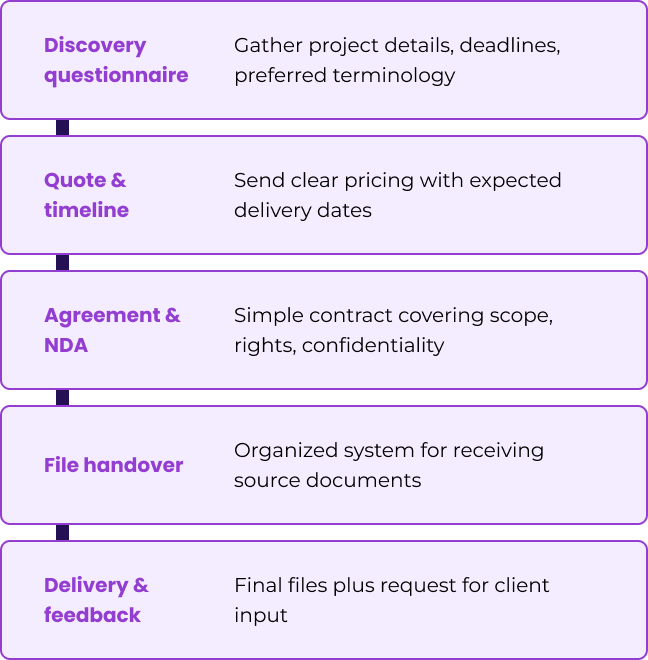
Use low-cost tools rather than complex software in the early months:
- Google Forms for intake questionnaires
- PDF templates for agreements
- Shared folders (Google Drive, Dropbox) for file exchange
- Free CRM like HubSpot to track client interactions
After every signed project, send a welcome email outlining:
- Next steps and your process
- Key deadlines and milestones
- Communication rules (response times, preferred channels)
- Payment terms and invoicing schedule
Upon successful delivery, ask for a short written testimonial or LinkedIn recommendation. This accelerates getting future clients by providing social proof that many translators overlook.
Step 8: Turn First Projects into Long-Term Clients and Referrals
Your first 10 clients can become the foundation of your agency’s yearly revenue if you focus on retention and referrals—not just project completion.
Identify recurring needs during or after each project:
- Does the client publish a monthly blog that needs translation?
- Are there regular legal updates or compliance documents?
- Do they release product notes with each new feature?
Once you’ve completed 1–2 successful projects, propose simple retainers or monthly packages:
- “Monthly content package: Up to 5,000 words of blog translation for $600/month with priority turnaround”
- “Quarterly contract review: All new legal documents localized within 72 hours”
Emphasize stability and priority access—clients value knowing they have a reliable translator on call.
Request referrals 1–2 weeks after successful delivery:
“I’m so glad the project went well! If you know any other companies looking for [specific service], I’d really appreciate an introduction. Happy to offer them the same level of attention we gave your project.”
Track basic metrics to understand which types of clients to pursue more aggressively:
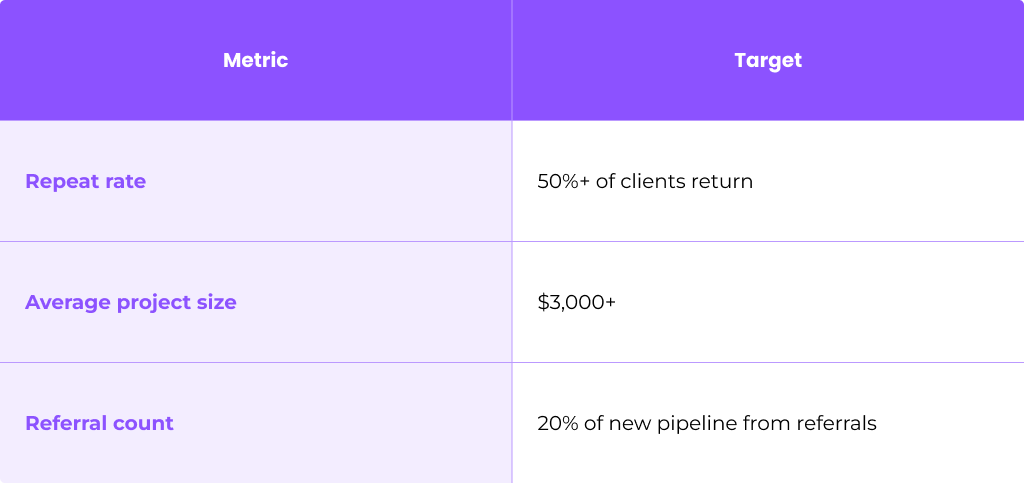
When you realize which niches and project types generate the most profitable, repeatable translation work, double down on those areas.
FAQ
Do I need official translation certifications to get my first 10 clients?
While certifications like ATA or CIOL add credibility, many early clients care more about subject-matter knowledge, responsiveness, and clear examples of past work. According to 2024 surveys, 65% of translation hires were based on portfolios rather than formal qualifications.
Show quality through test pieces, pilot projects, and references rather than waiting until you earn credentials. You can always pursue certifications later once cash flow from early clients covers exam fees and training time.
How much should I charge as a new translation agency?
Pricing depends on your language pairs, niche, and complexity—but underpricing makes it harder to cover agency overheads and positions you as low-quality. According to 2024 ProZ surveys, specialized niches like legal or medical can command rates 25% higher rates than general translation.
Research current market rates by checking professional associations, agency rate surveys, and recent job postings. Start with a clear minimum project fee plus per word or per-hour rates, and adjust after your first 5–10 projects based on client feedback and workload. Expect ranges of $0.10–0.20 per word for most niche-adjusted work.
How long does it usually take to get those first 10 clients without cold calling?
Most new agencies can realistically land 10 clients within 2–4 months if they consistently apply the strategies described: network outreach, platform proposals, content creation, and partnership building.
Results depend on weekly activity volume, niche clarity, and follow-up discipline—not on any single magic tactic. Set weekly targets: 10 outreach messages, 5 platform proposals, 2 content posts. Track your progress so you know what’s working and can adjust.
Should I work only with direct clients or also with translation agencies at the beginning?
Working with other translation agencies offers advantages: easier initial workflow, less need for sales and project management, and good practice for your systems. However, rates are typically 20–30% lower than direct work.
Direct clients mean higher rates and closer relationships, but more responsibility for quoting, invoicing, proofreading, and quality control. A mixed approach works well during the first year—use agencies to stabilize workload while gradually building a base of more direct clients in your chosen niches.
What if I offer multiple language pairs—will that help me get clients faster?
Offering too many pairs as a small agency can dilute your positioning and make marketing harder. It’s difficult to be known as the expert English translator for legal documents when you’re also advertising services in 12 other languages.
Lead with 1–2 core pairs and industries in all marketing messages. You can still accept other combinations through trusted freelancers or other translators in your network. Revisit your language offering once you see which pairs and sectors generate the most profitable, ongoing work—then expand strategically rather than trying to serve everyone in the world from day one.
Table of Contents
- Introduction: Why Your First 10 Clients Matter
- Step 1: Define a Profitable Niche Before You Market
- Step 2: Build a Lean but Trustworthy Online Presence
- Step 3: Get First Clients from Your Existing Network (Without Calling)
- Step 4: Use Online Platforms Strategically (Without Becoming Dependent)
- Step 5: Partner with Agencies and Complementary Businesses
- Step 6: Attract Clients with Content, Not Cold Calls
- Step 7: Create a Smooth, Professional Onboarding Experience
- Step 8: Turn First Projects into Long-Term Clients and Referrals
- FAQ
Ready to manage your Translation company easily?
Get Started for Free