PM Checklist: Translation Project Manager From Client Brief to Final Delivery
Key Takeaways
- A comprehensive checklist is essential for consistent, thorough maintenance and compliance across all stages of the translation project lifecycle.
- Preventive maintenance checklists can be tailored to specific assets or systems; every organization should create a checklist suited to their unique needs and industry requirements.
- There are two main types of preventive maintenance checklists: pass-or-fail and step-by-step, both of which help ensure tasks are completed consistently and thoroughly.
- Ensure your preventive maintenance checklist is comprehensive, clear, easy-to-understand, and flexible to maximize its effectiveness.
- A translation PM checklist covers the full project lifecycle: client intake, scoping and quoting, asset preparation, production management, linguistic and functional QA, delivery, and post-project review.
- This checklist is designed for translation project managers handling multi-language projects with tight deadlines, compliance requirements, and complex file formats in 2024.
- Standardized workflows, thorough documentation, and dedicated QA phases prevent costly rework, client escalations, and regulatory failures.
- The checklist works for both LSP agencies and in-house localization teams running ongoing translation programs—not just one-off jobs.
- Modern TMS and CAT tools (like memoQ, Phrase, Smartcat, and Lokalise) should be integrated throughout each phase for tracking, automation, and quality control.
What Is a Translation Project Manager Checklist?
A translation PM checklist is a step-by-step guide for managing translation and localization projects from the first client brief to final signed-off delivery. It standardizes every critical task across languages, markets, and file types—whether you’re localizing marketing PDFs, web copy, software strings, or legal contracts. A comprehensive checklist ensures all tasks are covered and can be tailored to the specific assets or systems being maintained.
The checklist helps both new and experienced PMs avoid missed steps that derail projects. Terminology alignment, file preparation, in-context QA, and compliance verification all need explicit attention. Without a documented process, even experienced teams forget steps under deadline pressure. Using a preventive maintenance checklist template can help standardize processes and ensure consistency.
This article focuses on practical, production-ready items you can adapt immediately. It’s not generic theory. Whether you work in legal, medical device, SaaS, or marketing localization, you’ll find actionable guidance for each phase. Every organization should create and follow a preventive maintenance checklist tailored to their unique assets and industry requirements. Ensuring your checklist is comprehensive, clear, easy-to-understand, and flexible will maximize its effectiveness and compliance.
Core stages of a translation PM checklist:
- Client intake and requirements gathering
- Scoping, quoting, and project planning
- Preparing assets, tools, and workflows
- Managing the translation and editing process
- Linguistic and functional QA
- Final delivery, handover, and client approval
- Post-project review and continuous improvement
There are two main types of preventive maintenance checklists: pass-or-fail checklists and step-by-step checklists. A pass-or-fail checklist indicates whether a machine or process is in ideal working condition or if there is an issue to address, while a step-by-step checklist details every step required to complete a maintenance activity. Preventive maintenance checklists help ensure that maintenance tasks are completed consistently and thoroughly.
Phase 1: Client Intake and Requirements Gathering
Most translation project failures trace back to unclear intake. Ambiguous instructions, missing files, and assumed deadlines create problems that compound throughout production. This phase should have a dedicated checklist for every new project or major content update.
Client and Stakeholder Information
Start by capturing the basics that prevent miscommunication:
- Client company name and project name
- Primary contact person (day-to-day communication)
- Decision-maker for approvals (may be different from contact)
- Billing contact for invoicing
- Time zones for all stakeholders
- Preferred communication channel (email, Slack, Teams, project portal)
Time zone mismatches cause more delays than most PMs realize. Confirm these upfront—especially for cross-continental teams.
Content Scope
Define exactly what needs translation:
- Source language (with locale variant if relevant, e.g., en-US vs en-GB)
- All target languages and locales (e.g., fr-FR, fr-CA, de-DE, de-AT)
- File formats: DOCX, XLSX, InDesign, Figma exports, XLIFF, JSON, PO, SRT
- Word count or segment count estimates from source files
- Whether images, UI screenshots, or embedded graphics need localization
- Whether software strings include code, placeholders, or variables requiring protection
Timeline Details
Capture deadline specifics with precision:
- Client’s requested delivery date and time with time zone (e.g., “2024-09-15 17:00 CET”)
- Intermediate milestones: first draft, editing complete, QA complete
- Whether in-country or client-side review is required (and how long they need)
- Buffer time for unexpected revisions—at minimum, add 10-20% to the project schedule
Quality and Brand Requirements
These details prevent rework during QA:
- Tone of voice and formality level (e.g., formal “Sie” vs informal “du” in German)
- Brand guidelines, forbidden terms, and approved product names
- References: previous translations, existing style guides, term bases
- Subject-matter expert contacts for technical clarifications
Ensure Compliance and Risk
For regulated content, capture these early:
- NDA requirements and signature status
- Data protection needs: GDPR, HIPAA for medical content, industry-specific rules
- Security protocols: encrypted file transfer, restricted access, role-based permissions
- Regulatory standards: medical device labeling requirements, legal disclaimers by jurisdiction
Ensure all safety measures, such as lockout/tagout procedures and required personal protective equipment (PPE), are clearly outlined in the pm checklist. Including safety protocols in your checklist is essential to ensure compliance and reduce the risk of accidents during maintenance tasks.
One manufacturing company faced a $47,600 recall because a single safety label phrase was mistranslated. Compliance questions at intake aren’t optional—they’re insurance.
Phase 2: Scoping, Quoting, and Project Planning
Accurate scoping on day one prevents scope creep, overtime, and margin loss. This phase turns client requirements into a concrete project plan with realistic timelines and transparent costs. It is important to involve key personnel such as maintenance managers and senior technicians when creating a pm checklist to ensure all necessary tasks and procedures are included.
Additionally, keeping an inventory of parts and supplies needed for maintenance tasks is essential to prevent delays in the maintenance schedule.
Word Count and Analysis
Run source files through your CAT or TMS system to generate detailed counts:
- New words (no TM match)
- Repetitions within the project
- Fuzzy matches by range: 75-84%, 85-94%, 95-99%
- Exact matches (100%) and context matches (101%)
- Locked/pre-translated segments from previous projects
This analysis directly impacts cost. Higher TM leverage means lower per-word charges for the client and faster turnaround.
Cost Calculation
Build your quote with these elements:
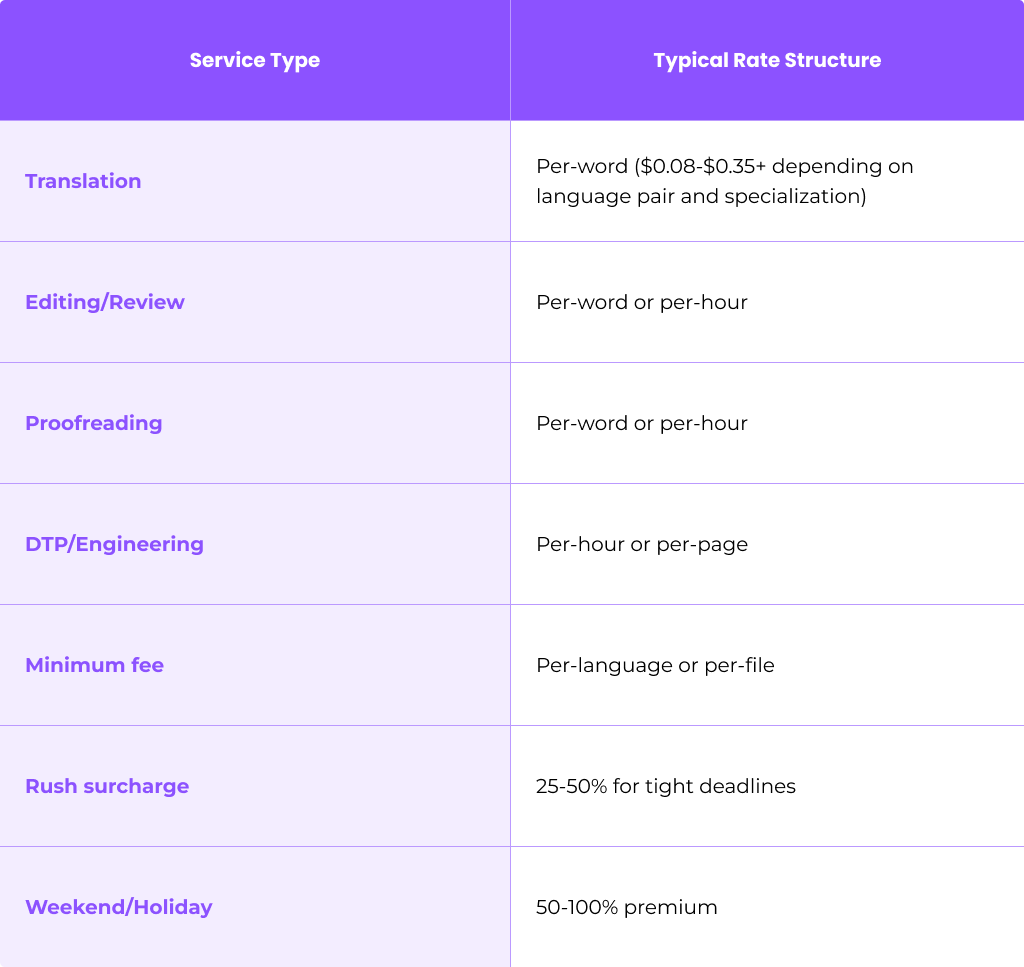
Technical content (medical device IFUs, legal contracts, financial reports) commands higher rates than general marketing copy. Rare language pairs also carry premiums.
Project Scope Definition
Clarify the workflow level:
- T-only: Translation without editing
- T+E: Translation plus editing
- TEP: Translation, editing, and proofreading (ISO 17100 standard)
- MTPE: Machine translation with human post-editing
Decide which languages need full TEP versus lighter review. Confirm whether client reviewers will participate—and factor their review time into the schedule.
Resource Planning and Automated Scheduling
- Assign internal PM responsible for the project
- Select lead translator(s) and reviewer(s) per language pair
- Verify subject-matter expertise (e.g., medical terminology, SaaS UI, regulatory language)
- Check availability around key dates, holidays, and vacation periods
- Identify backup resources for critical languages
Risk Assessment
Identify bottlenecks before they become emergencies:
- Complex InDesign layouts with embedded text
- Hard-coded software strings requiring engineering support
- Tight regulatory deadlines without flexibility
- Missing context (no screenshots, no product access)
- Client stakeholders unavailable during review periods
Document mitigation actions: earlier file delivery, engineering prep work, extended buffers.
Deliverables Planning
Specify exact output formats:
- Translated InDesign packages with linked assets
- Localized .po or .json files for software
- SRT/VTT subtitle files with line limits (e.g., 2-line maximum, 42 characters per line)
- Final PDFs with embedded fonts
- Translation memory and termbase exports if agreed
Define file storage location, naming conventions, and handover method.
Phase 3: Preparing Assets, Tools, and Workflows
Robust preparation ensures consistent translations and reduces rework during QA. This phase transforms scattered reference materials into a structured environment for linguists.
Terminology Setup
Build or verify glossaries and term bases:
- Key product names and features (with approved translations per locale)
- Industry-specific terms (medical, legal, financial, technical)
- Forbidden terms (competitor names, outdated branding, legally problematic phrases)
- Client approval: identify who signs off on terminology decisions
For regulated content, terminology errors carry legal and safety risks. Get approvals before translation begins.
Style Guides
Confirm or create language-specific style guides covering:
- Voice and tone (formal vs casual, direct vs indirect)
- Punctuation rules and quotation mark styles
- Date, time, number, and currency formats by locale
- Units of measurement (metric vs imperial)
- Capitalization conventions
- Locale variants: en-US vs en-GB, pt-BR vs pt-PT, es-ES vs es-MX
CAT/TMS Configuration
Set up the project in your translation management system:
- Define source and target languages with correct locale codes
- Assign subject domain tags for TM segmentation
- Set fuzzy match thresholds (e.g., show matches above 70%)
- Link relevant translation memories and term bases
- Configure segmentation rules for the content type
- Grant linguist access to all required project resources
Using maintenance management software and maintenance software, such as a computerized maintenance management system (CMMS), can automate, organize, and streamline preventive maintenance (PM) tasks. Preventive maintenance software enables organizations to access and manage PM checklists digitally, providing real-time updates and facilitating communication among maintenance teams. Digital technology like CMMS apps can display tasks in checklist form, helping avoid human error and ensuring accurate recordkeeping across teams and locations. Automating preventive maintenance tasks via a CMMS increases quality, reduces unexpected downtime, and helps asset-heavy industries streamline their asset management.
Modern TMS platforms like Phrase and memoQ support pre-translation, automated QA checks, and progress dashboards—use them.
File Preparation
Prepare files for translation:
- Extract translatable text from design files (InDesign, Figma, XD)
- Protect non-translatable content: placeholders (%s, {variable}), HTML tags, XML attributes
- Use regex rules or tag protection features in your CAT tool
- Verify correct character encoding (UTF-8 for most modern projects)
- Check for hard-coded strings in software files that need engineering extraction
Reference Materials
Upload context for linguists:
- Previous localized versions of similar content
- UI screenshots showing where strings appear
- Product documentation and user guides
- Marketing collateral with brand examples
- Video/audio for subtitle or voiceover projects
Workflow Design
Define the production sequence:
- Translation
- Editing
- Proofreading (if TEP workflow)
- In-context/functional review
- Client sign-off
Set up automated notifications in your PM tool. When a translator marks their portion complete, the editor should receive an immediate handoff notification. To streamline workflow management, it is important to assign tasks to specific team members and utilize automated scheduling features, ensuring that each step is completed on time and responsibilities are clearly allocated.
Phase 4: Managing the Translation and Editing Process
During production, the PM’s role shifts to coordination, quality monitoring, and schedule management. It is essential to involve the maintenance team in the process, gather their feedback, and ensure safety compliance throughout preventive maintenance activities. Changing conditions—client revisions, linguist availability, scope adjustments—require flexible response. Regularly review and update your preventive maintenance checklist to reflect any changes in equipment conditions, regulatory requirements, operational capacity, and feedback from maintenance personnel.
Kickoff Actions
- Send confirmed brief to all translators and editors
- Share style guides, glossaries, and example texts
- Clarify escalation channels: shared Q&A spreadsheet, TMS comments, Slack channel
- Confirm point of contact for urgent queries
- Set expectations for daily output and communication frequency
Progress Tracking
For large projects, establish internal checkpoints:
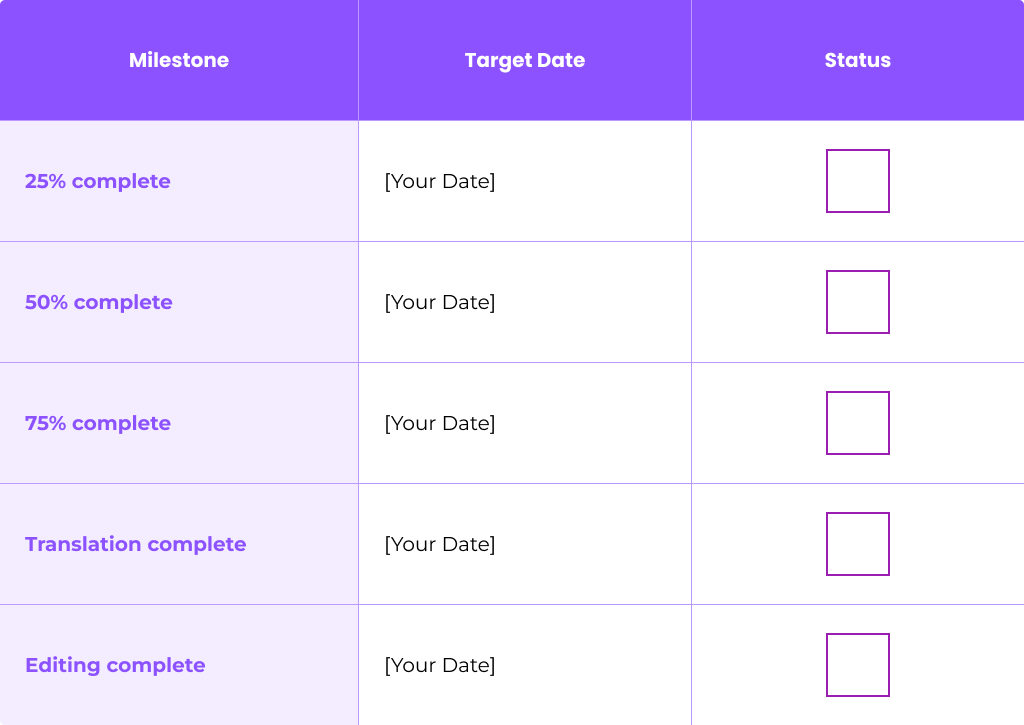
Track daily word output per linguist. Use Gantt charts or Kanban boards for visual project status. Flag deviations early—don’t wait until deadlines are missed.
Query Management
Centralize all linguistic questions:
- Route queries through a single channel (TMS comments, shared spreadsheet)
- Obtain answers from client SMEs within agreed timeframes
- Ensure clarifications are visible to all language teams
- Record Q&A for future project reuse
Unanswered queries stall production. Set response-time expectations with clients at project start.
Quality Safeguards During Production
Require translators to run pre-delivery checks:
- Spellcheck in source and target languages
- CAT tool QA: tag consistency, number mismatches, terminology enforcement
- Glossary adherence verification
- Placeholder and variable integrity
A thorough inspection process and routine inspections are essential to ensure quality and compliance, helping to catch errors early and maintain consistent standards.
Editors review with fresh eyes, catching issues translators may have overlooked.
Change Management
Document client changes mid-project:
- Updated product names, UI labels, or marketing messages
- Scope additions (new files, new languages)
- Deadline adjustments
Update term bases and style guides immediately. Communicate scope or deadline impacts to all stakeholders—never absorb changes silently.
Phase 5: Linguistic and Functional Quality Assurance
Production (translation and editing) and dedicated QA are distinct phases. QA catches errors that slipped through editing and validates that content works in its final environment. Including safety checks as part of the QA process is crucial to ensure equipment safety and compliance during inspections, calibration, and maintenance activities. For regulated industries, this phase is non-negotiable. Using preventive maintenance checklists enhances safety by ensuring that all necessary inspections and maintenance tasks are performed regularly, and helps organizations maintain compliance with industry regulations and standards.
Linguistic QA
- Final proofreading for spelling, grammar, punctuation, and style
- Terminology adherence verification against approved glossaries
- Consistency check: repeated phrases should match across files and languages
- Source-target fidelity: nothing omitted, nothing added incorrectly
- Style guide compliance: tone, formality, formatting conventions
Functional/In-Context QA
Review content in its final environment:
- Staged website: check layout, truncation, link functionality
- Test app build: verify string display, button labels, menu items
- Typeset PDF: confirm formatting, page breaks, image captions
- E-learning module: test navigation, audio sync, interactive elements
Functional QA catches issues invisible in translation files: truncated strings, text overflow, broken line breaks, corrupted characters.
Formatting Checks
Verify correct handling of:
- Bold, italics, underline formatting
- Bullet styles and numbered lists
- Headers and footers
- Hyperlinks and cross-references
- Images with localized captions
- Right-to-left script alignment (Arabic, Hebrew)
- Bidirectional text in mixed-language content
Regionalization Checks
Validate locale-specific elements:
- Date formats (MM/DD/YYYY vs DD.MM.YYYY)
- Currency symbols and decimal separators
- Address formats
- Measurement units (metric vs imperial)
- Legal disclaimers required by jurisdiction
- Localized UI elements: buttons, menus, error messages
Tools and Metrics
Use automated QA tools (built into CAT/TMS or standalone like Xbench, Verifika):
- Missing translation detection
- Tag mismatch identification
- Terminology enforcement
- Number and date format verification
Track error types using LQA categories:
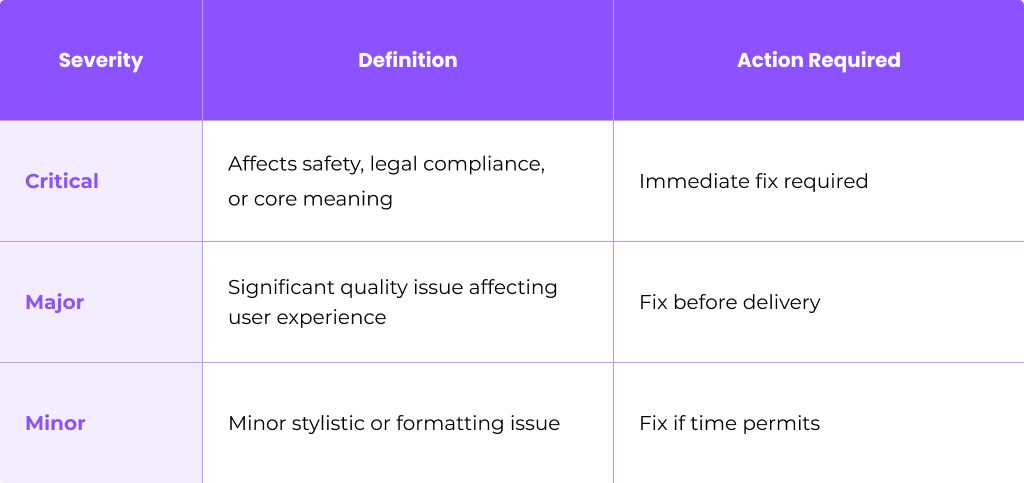
A target of 98%+ terminology consistency indicates strong quality control.
Phase 6: Final Delivery, Handover, and Client Approval
A structured delivery process reduces back-and-forth, speeds sign-off, and demonstrates professionalism. Don’t just send files—provide a complete handover package.
Delivery Package Contents
- Translated files in requested formats
- Files organized by language code (en-US, fr-FR, de-DE folders)
- Original source files for reference
- Packaged resources: fonts, linked assets, design file exports
- Export bundles for design tools if applicable
Documentation
- Translation memory export (TMX format)
- Termbase export (TBX format)
- Change log or “what’s new” summary
- Known limitations or pending client decisions
- Any flagged issues requiring client attention
Instructions to Client
Include a concise review guide:
- How to add comments or feedback (in-tool, spreadsheet, or tracked changes)
- What not to change directly in bilingual files
- Which feedback applies globally vs to specific languages
- Deadline for client review and feedback
- Contact for questions during review
Sign-Off Process
Define what constitutes “final approval”:
- Written confirmation via email or ticketing system
- Who has authority to approve (named stakeholder)
- Where approval is stored for audit purposes
- What happens after approval (archiving, billing)
Version Control
Ensure final files follow clear naming conventions:
ProjectName_fr-FR_2024-09-15_v3-FINAL.docx
Store files securely in the agreed repository or cloud folder with appropriate access controls.
Phase 7: Post-Project Review and Preventive Maintenance Continuous Improvement
Every sizable translation project—new product launch, website relaunch, regulatory submission—should end with a retrospective. Even 30 minutes yields valuable insights for future work.
Review Topics
- Schedule adherence: actual vs planned dates
- Budget and margin: actual cost vs quote
- Quality outcomes: number and severity of client issues post-delivery
- Resource utilization: translator productivity, editor workload
- Client satisfaction: formal or informal feedback
Feedback Collection
Obtain structured feedback from:
- Client stakeholders: marketing manager, product owner, legal reviewer
- Internal linguists: what slowed them down, missing context, unclear instructions
- QA team: recurring error patterns, tool limitations
Asset Updates
After project completion:
- Add final approved translations to translation memories
- Update term bases with new terminology decisions
- Archive outdated terms or deprecated phrases
- Update style guides with new precedents
- Store reference materials for future similar projects
Process Improvement
Identify 2-3 concrete actions for the next project:
- Earlier terminology sign-off to prevent mid-project changes
- Richer briefs with UI screenshots for software strings
- More realistic internal deadlines avoiding weekend crunches
- Different resource allocation for problematic language pairs
- Tool configuration changes based on workflow friction
Sample Translation PM Comprehensive Checklist (From Brief to Delivery)
This condensed checklist covers the full lifecycle. Using a checklist template helps standardize preventive maintenance procedures, improving efficiency and reducing errors. A good preventive maintenance checklist is complete, clear, and adaptable, with detailed procedures, safety considerations, and time estimates to ensure operational safety and cost savings. Preventive maintenance checklists also facilitate easier onboarding of new staff by providing clear instructions and help organizations maintain compliance with industry regulations and standards. Print it, digitize it, or adapt it for your team’s project management system.
Intake
☐ Capture client name, contacts, time zones, and communication preferences
☐ Confirm source language and all target locales (e.g., fr-FR vs fr-CA)
☐ Collect all source files with word count estimates
☐ Document delivery date with time zone (e.g., “2024-09-15 17:00 CET”)
☐ Obtain style guides, glossaries, and brand guidelines
☐ Confirm compliance requirements (NDA, GDPR, regulatory standards)
Planning
☐ Run CAT/TMS analysis for word counts and TM leverage
☐ Calculate costs and prepare quote with all service components
☐ Define workflow level (T-only, T+E, TEP, or MTPE)
☐ Assign PM, translators, and editors per language pair
☐ Identify risks and document mitigation actions
☐ Confirm final deliverable formats and handover method
Preparation
☐ Upload approved glossary to TMS project
☐ Configure CAT tool with correct languages and TM settings
☐ Prepare files: extract text, protect non-translatables, verify encoding
☐ Upload reference materials (screenshots, previous versions, guides)
☐ Set up workflow stages with automated notifications
Production
☐ Send kickoff brief to all linguists with style guides and glossaries
☐ Set internal checkpoints (25%, 50%, 75% complete)
☐ Monitor daily progress and track against schedule
☐ Manage Q&A: route queries, obtain answers, share with all teams
☐ Document any scope changes and communicate impacts
QA
☐ Complete linguistic QA: spelling, grammar, terminology, consistency
☐ Perform functional/in-context QA in final environment
☐ Verify formatting: bold, bullets, headers, links, RTL alignment
☐ Validate regionalization: dates, currencies, legal disclaimers
☐ Add internal QA deadline: 48 hours before client delivery
Delivery
☐ Package files in requested formats with clear organization
☐ Export and share TM/termbase if agreed
☐ Include change log and review instructions
☐ Apply version naming convention to all final files
☐ Store files securely with appropriate access controls
Review
☐ Conduct post-project retrospective within one week of delivery
☐ Collect feedback from client and linguists
☐ Update TMs, termbases, and style guides with project learnings
☐ Document 2-3 improvement actions for future projects
Best Practices for Translation Project Managers in 2024
Tools and client expectations have evolved significantly. Today’s PM needs linguistic awareness, technical proficiency, and strong organizational skills to succeed. Regular maintenance is crucial for ensuring equipment reliability and safety, and it is important to review and update your pm checklist periodically to keep it effective. Regular use of preventive maintenance checklists can extend the lifespan of assets by addressing wear and tear before it leads to failure, and also improves operational efficiency by ensuring maintenance tasks are completed consistently and thoroughly.
Embrace Digitalization
- Use TMS and CAT tools for project tracking, not email chains
- Leverage shared glossaries and style guides in cloud-based systems
- Implement automated notifications for workflow handoffs
- Use dashboards for real-time progress visibility across languages
Communication Habits
- Schedule regular status updates for multi-week projects
- Define response-time expectations with clients and linguists
- Document all key decisions in writing—verbal agreements get forgotten
- Establish clear escalation paths for urgent issues
Build Scalability
- Create reusable templates: briefs, estimates, checklists, QA reports
- Standardize workflows for recurring content types (monthly newsletters, software releases)
- Maintain master style guides and glossaries that grow over time
- Train backup PMs on your processes
Prioritize Data Security
- Enforce secure file sharing (encrypted transfer, password protection)
- Implement role-based access to client content
- Follow deletion and archiving policies aligned with GDPR and client requirements
- Use secure portals rather than open email attachments for sensitive content
Invest in Professional Development
- Stay updated on localization trends: MT/MTPE workflows, AI-assisted QA, continuous localization
- Participate in industry communities and forums
- Review and update your checklist at least annually
- Learn from post-project retrospectives and industry case studies
The $12,000 legal counsel fees from one mistranslated NDA clause could have funded significant process improvement. Prevention beats correction every time.
FAQ
How is a translation PM checklist different from a generic project management checklist?
A translation PM checklist includes language-specific elements that generic PM templates ignore: term base approvals, locale conventions, CAT/TMS setup, and linguistic QA phases. It accounts for multi-language coordination, client in-country review processes, and file engineering tasks like working with XLIFF, JSON, or InDesign packages. Without these specialized steps, translation projects often require expensive rework, suffer inconsistent terminology, and risk regulatory non-compliance.
Do I need a different checklist for each language pair?
The core checklist stays the same across language pairs, but certain languages require additional steps. Arabic and Hebrew need right-to-left layout verification. Japanese may require cultural review for honorifics and formality. Chinese projects must specify simplified vs traditional variants. Maintain a master checklist plus short language-specific add-ons addressing unique alphabet, punctuation, character encoding, and formatting requirements.
How does machine translation (MT) and MTPE change the PM checklist?
MT and MTPE workflows add extra steps: engine selection, domain adaptation assessment, MT quality evaluation, and explicit post-editing instructions. PMs must decide which content types are MT-eligible (internal support docs, high-volume low-stakes content) versus those requiring human-only translation (legal contracts, flagship marketing, safety-critical materials). Add checklist items to track productivity and quality metrics for MTPE versus human translation—this data refines future workflow decisions.
What is a reasonable timeline for a multi-language translation project?
Timelines depend on volume, subject matter, language pairs, and workflow complexity. A rough benchmark: 2,000-2,500 new words per linguist per day for standard content. Add time for preparation (1-2 days), QA (1-2 days), and client review (2-5 days depending on stakeholders). For a medium project—20,000 words into 5 languages with full TEP—budget at least 2-3 additional working days beyond pure translation time for unexpected revisions and stakeholder delays.
How often should I update my translation PM checklist?
Review and update your checklist at least annually, or immediately after any major incident (critical client escalation, missed regulatory deadline, quality failure). Add new items when tools change, file types evolve, or regulatory frameworks shift. Involve senior linguists and account managers in updates—their frontline experience catches gaps that PM assumptions miss. A static checklist becomes outdated quickly in a field where technology and client expectations advance rapidly.
Related reading: 4 Reason to have a translation project management? · AI in Translation Project Management: Real vs Hype in 2026

Building software that helps small and medium-sized language service providers run their business.
About Rishi →Table of Contents
- What Is a Translation Project Manager Checklist?
- Phase 1: Client Intake and Requirements Gathering
- Phase 2: Scoping, Quoting, and Project Planning
- Phase 3: Preparing Assets, Tools, and Workflows
- Phase 4: Managing the Translation and Editing Process
- Phase 5: Linguistic and Functional Quality Assurance
- Phase 6: Final Delivery, Handover, and Client Approval
- Phase 7: Post-Project Review and Preventive Maintenance Continuous Improvement
- Sample Translation PM Comprehensive Checklist (From Brief to Delivery)
- Best Practices for Translation Project Managers in 2024
- FAQ