Translation Agency Business Plan Template for 2026

Key Takeaways
- This article provides a practical, 2026-ready business plan template specifically designed for launching or growing a translation agency, covering every essential section from executive summary to financial projections.
- The plan balances classic sections with a lean, actionable structure you can actually use month to month as a living document rather than a static file.
- It reflects 2024–2026 industry dynamics including AI-assisted translation, remote teams, and surging global B2B demand in sectors like SaaS, legal, and med-tech.
- Each section includes concrete guidance on what to write and how the final section should look on the page, helping you create a professional document.
- The article closes with an FAQ answering common questions about pricing, niches, and funding specific to translation agencies entering the market in 2026.
Starting a translation agency in 2026 means entering a market projected to reach $85-90 billion by decade’s end. The opportunity is real, but so is the competition from established LSPs, freelance marketplaces, and AI-powered tools.
What separates agencies that thrive from those that struggle? A clear, actionable agency business plan that guides decisions from day one through sustainable growth.
This template walks you through every section you need, grounded in current market data and practical benchmarks. Whether you’re self-funding from savings or preparing to secure funding from outside sources, you’ll find the structure and specifics to build your roadmap.

Executive Summary (Snapshot of Your Translation Agency in 2026)
This section should be 1–2 pages at most. Write it last but place it first in the final plan. Think of it as your elevator pitch expanded into a concise overview that any reader can scan in three minutes.
Open with a short intro paragraph presenting:
- The agency’s name (e.g., “GlobalBridge Translations LLC”)
- Core services (certified legal translations, medical localization, SaaS app adaptation)
- Launch date (e.g., Q1 2026)
- Primary market (EU-based SMEs expanding to U.S. and APAC markets)
- Operating model (remote-first, hybrid, or office-based)
A remote model can reduce overhead by 20-30% compared to office-based competitors, which matters when you’re establishing operations with limited capital.
Include 3–5 bullet points or a short paragraph covering your key 12-month goals:
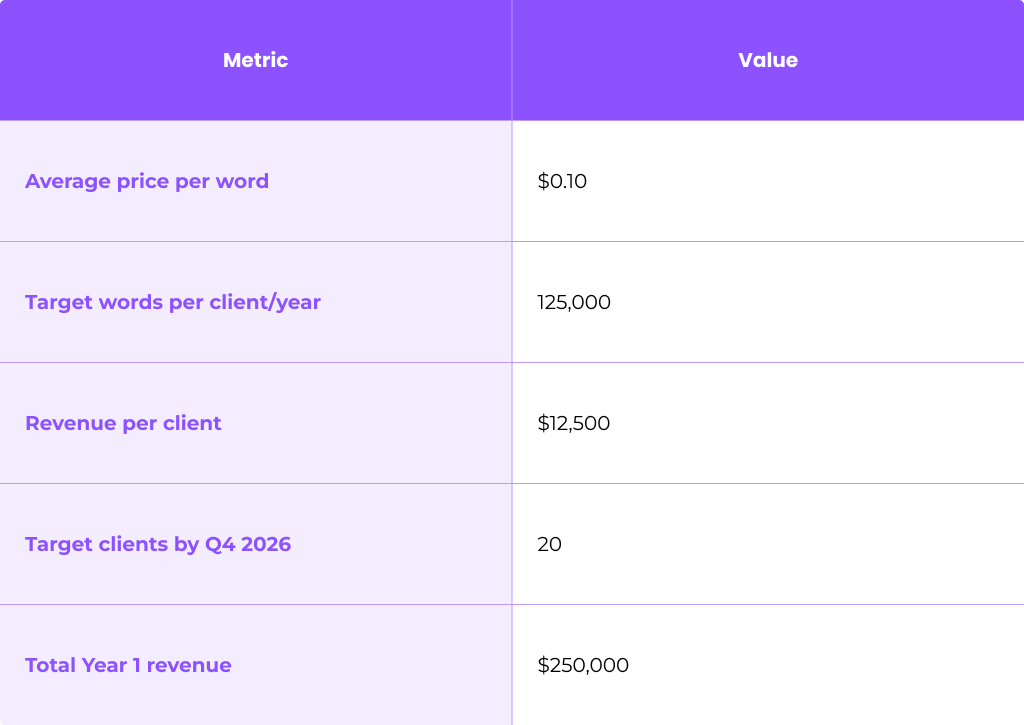
- First-year revenue target (e.g., $250,000 total revenue from 20 recurring clients)
- Average project value assumptions (e.g., $12,500 per client annually)
- Client acquisition milestones by quarter
- Service expansion targets
- Team growth benchmarks
The executive summary must clearly state funding needs. If you need $50,000-$100,000 for CAT tools like MemoQ or SDL Trados, initial marketing, and first hires, say so. Specify expected break-even timing—industry benchmarks suggest month 10-12 is achievable for lean agencies, though some templates indicate 29 months for higher-capitalized startups.
Mission Statement
Craft a 1–2 sentence mission that clearly states what the agency does, for whom, and the value it creates.
Strong example: “We deliver precise, culturally attuned translations for tech and legal teams navigating EU-U.S.-Asia expansion, blending human expertise with AI efficiency to ensure 99% on-time delivery.”
Your mission statement should reference:
- Quality standards (ISO 17100 certification)
- Reliability commitments (turnaround guarantees)
- Specialization areas (regulated industries, SaaS localization)
Avoid generic phrases like “bridging language barriers” or “connecting cultures.” Be specific enough that this could sit on your homepage and help potential customers immediately understand your focus.
Vision Statement
Define where your agency wants to be by 2030 in terms of revenue, markets served, and reputation. This vision statement shapes long-term decisions and helps prospective employees understand your trajectory.
Consider including:
- Revenue aspirations ($5-10 million by 2030)
- Client base goals (100+ recurring clients)
- Geographic coverage (serving 12+ time zones)
- Network scale (200+ vetted linguists across major language pairs)
Your vision should articulate becoming a trusted long-term partner for international expansion, not just a commodity translation vendor. Mention aspirations around technology integration—combining human expertise with AI/MT and building proprietary termbases that create competitive barriers.
Company Description
Open with a narrative paragraph covering:
- Legal name of the agency
- Founding year (2026)
- Headquarters or primary jurisdiction (e.g., Dublin, Ireland for GDPR advantages or Austin, Texas for U.S. tax benefits)
- Initial setup approach (home-office start to keep costs under $15,000)
Describe your business structure clearly. Are you positioning as a boutique specialist agency focusing on two or three verticals? A niche LSP covering translation and localization? Or a multi-service organization including interpreting and multimedia?
Your company description should outline founder backgrounds in detail:
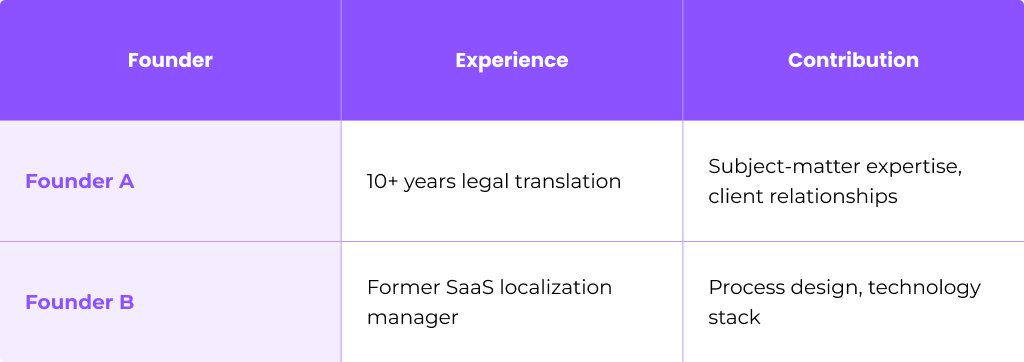
This experience shapes positioning. General agencies often falter on terminology consistency—70% of clients report issues according to industry surveys. Your specific expertise addresses this pain point directly.
Specify launch details:
- Main language pairs at launch (EN–DE–FR–ES for software, fintech, and e-commerce)
- Planned language expansion (AR-ZH by 2028)
- Legal structure (LLC, Ltd, or GmbH)
- Ownership split (e.g., 60/40 between founders)
- Workforce model (80% vetted freelancers, tested on 500-word samples scoring 95%+ accuracy)
Market Analysis (Translation & Localization Landscape for 2026)
Start with a brief industry overview using concrete numbers:
- Global language services market reached approximately $65 billion in 2025
- Projected CAGR of 7.2% through 2030
- E-commerce localization driving 15% annual demand growth
- Cross-border trade exceeding $2.5 trillion requires multilingual content
Key growth trends include AI-powered translation tools achieving 90-95% accuracy in common pairs, but creating demand for human QA in nuanced contexts. Remote teams enable 24/7 coverage across time zones, and regulatory requirements in EU, U.S., and APAC markets mandate certified translations.
Profile your target clients in concrete terms:
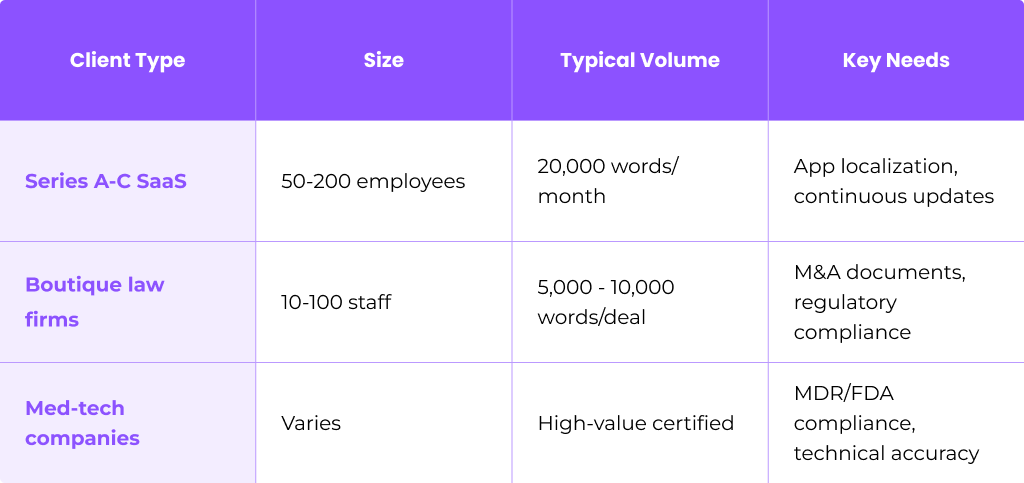
Client pain points to address:
- Freelancer no-shows causing 25% project delays
- Terminology drift requiring 40% rework on some projects
- MT hallucinations in legal texts risking $100K+ fines
- Inconsistent quality from unvetted linguist marketplaces (30-40% of projects affected)
Your competitor analysis should cover local agencies (5-7 day turnaround, 10-15 cents/word), global LSPs (faster but 20% premium pricing), freelance platforms (cheap but 50% quality failure rate), and AI tools like DeepL Pro ($20/month but unsuitable for certified work).
Key opportunities for 2026–2028:
- Post-editing of machine translation (MTPE) for SaaS content (40% market growth)
- Multilingual SEO (Google-optimized localized content boosting traffic 2.5x)
- Specialized legal/financial translation (stable 12% margins)
- Continuous localization integrated with client development cycles

Target Market Segmentation
Define 2–3 clear client segments for your agency:
Segment 1: Series A–C SaaS Companies
- Location: EU-based, expanding to U.S. and APAC
- Size: 50-200 employees, $5-50M revenue
- Volume: 100K words/quarter recurring
- Attractive because: Ongoing product updates create retainer potential at $10K/month
Segment 2: Boutique Law Firms
- Location: U.S. and EU cross-border practices
- Size: 10-100 staff
- Volume: 2K-10K words per deal
- Attractive because: Regulatory-driven repeat business, compliance requirements mandate quality
Segment 3: Med-Tech Companies
- Location: APAC market entry focus
- Size: Varies
- Volume: High-value certified work
- Attractive because: Premium rates (25 cents/word), low competition in specialized pairs
Each segment should connect to recurring document needs, regulatory obligations, or ongoing content marketing demands that create predictable revenue rather than one-off projects.
Competitive Analysis
Identify competitor types rather than naming specific companies:
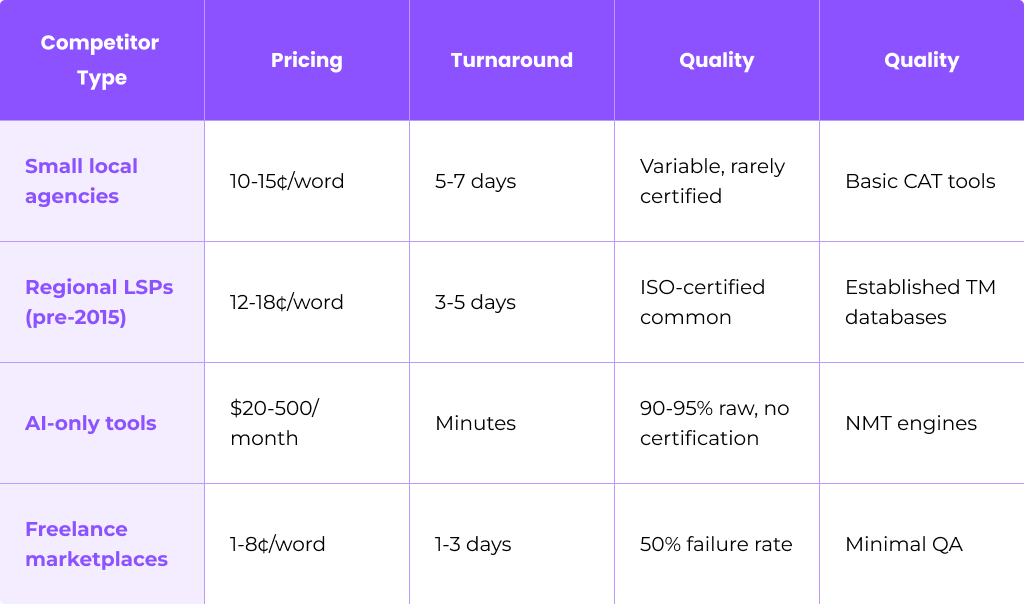
Your differentiators for 2026 might include:
- Deep industry specialization (legal German, medical French) where only 1% of translators are truly fluent
- Documented QA processes with double-check sampling
- 24–48 hour standard turnaround through timezone arbitrage
- ISO 17100/18587 certification (including MTPE certification)
- GDPR-compliant secure portals reducing breach risks by 90%
Barriers to entry in 2026 include the need for subject-matter expert linguists, proven quality through client references (6-12 months to establish), and data security compliance requirements. These barriers protect agencies that invest in building them properly.
Services Offered (Translation, Localization & Related Solutions)
Open with a clear statement of main service lines available from launch in 2026. Your services form the foundation of how you create value for customers and generate revenue.
Core Services at Launch:
- Document Translation – Contracts, user manuals, technical documentation (projected 70% of revenue)
- Software/App Localization – TMS-integrated workflows for SaaS products
- Website and SEO Translation – Optimized content for international search visibility
- Certified Legal/Medical Translation – Notarized, sworn translations for regulatory compliance (25-30% margins)
Phased Services (2027+):
- Interpreting Services – Remote and on-site for client meetings
- Multimedia Localization – Subtitling, voiceover, eLearning content
Technology stack supporting these services:
- CAT tools (Phrase, Memsource, or MemoQ at $300-$2,000/user/year)
- MTPE workflows reducing time by 40% while maintaining 98% accuracy
- Centralized termbases and translation memories
- Secure client portals for file transfer
Service tiers help clients understand options:
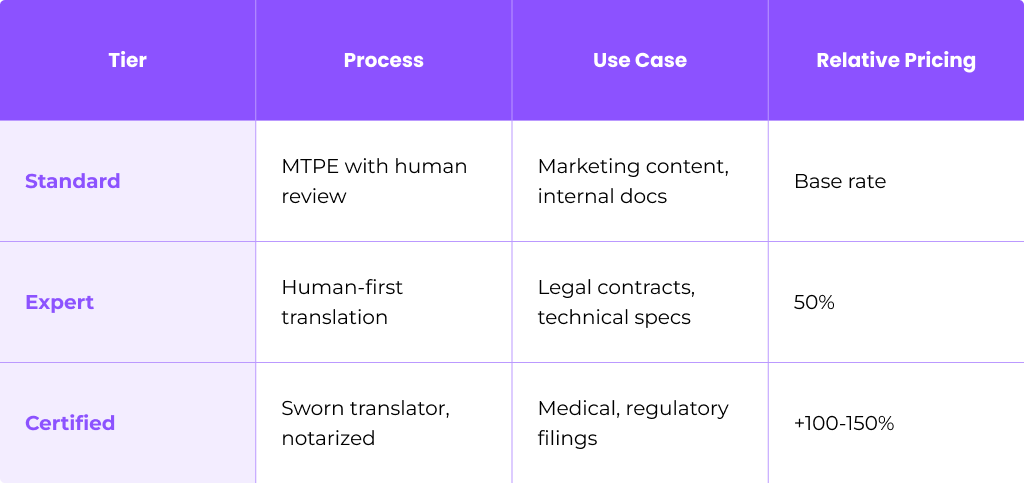
Service Packages and Pricing Logic
Structure pricing based on market norms for 2026:
- Per word (most common): ranges from 8-25 cents depending on tier and language pair
- Per hour: for editing, consulting, or complex formatting work
- Per project: fixed quotes for defined scopes
- Monthly retainer: for clients with ongoing volume (e.g., $8-15K/month)
Example Project Scopes:
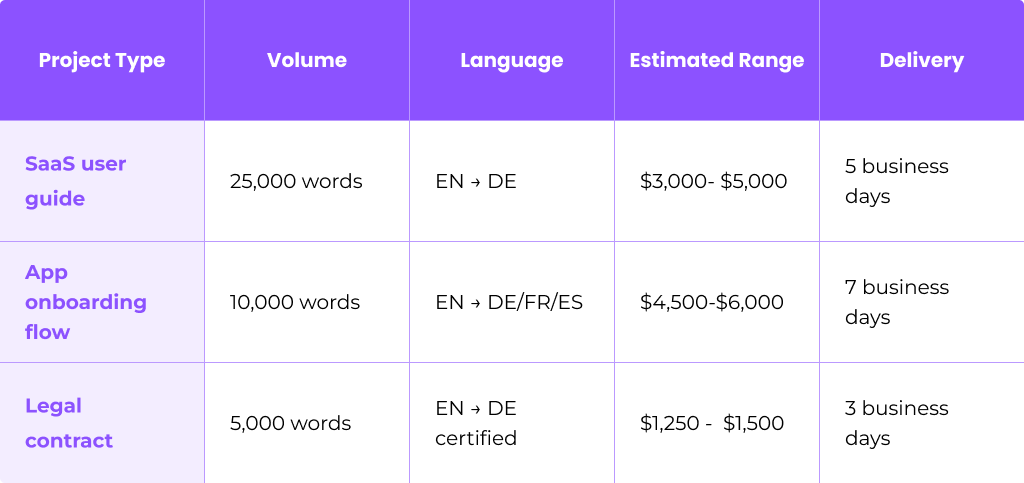
Emphasize transparent quoting practices:
- Clear word counts excluding formatting
- Defined delivery times in business days
- One free revision included
- Volume discounts after 50K words (typically 10%)
- Rush surcharges (50% for 24-hour delivery)
These policies reduce disputes—industry average shows 15% of projects involve scope disagreements when terms aren’t clear upfront.
Marketing Strategy (How Your Translation Agency Will Win Clients)
Link your 2026 revenue targets directly to specific marketing channels and actions. A $250K first-year target requires approximately 20 clients at $12,500 average value, meaning you need concrete plans for finding and converting those customers.
Positioning Statement: “Specialist B2B translation partner for tech and legal clients expanding across EU, U.S., and APAC markets. We combine deep industry expertise with modern technology for accurate, fast delivery.”
Primary Client Acquisition Channels:
- LinkedIn Outbound – 200 targeted messages/month to SaaS and law firm decision-makers (expect 10% response rate)
- Content Marketing – Blog posts on topics like “2026 GDPR Localization Requirements” driving 500 leads/year through SEO
- Partnerships – Tech associations, legal networks, export councils
- Email Marketing – Nurture sequences for leads not ready to buy immediately
- Referrals – Structured ask process after successful projects
Marketing campaigns should include lead magnets that demonstrate expertise:
- Free compliance audits (20% conversion to paid work)
- 2026 cross-border localization guides
- Terminology checklists for specific industries
Brand elements for launch:
- Professional website ($5K budget yields 15% organic traffic)
- Sample portfolio with anonymized case studies
- Testimonials collected during first 6-12 months
Sales Process and Client Experience
Outline a repeatable sales process for consistent results:
- Inquiry – Website form, LinkedIn response, referral introduction
- Needs Analysis – 30-minute call scoping 80% of requirements
- Quote – Delivered within 24 hours of analysis
- Test Job – 500-word sample ($300, 95% close rate after)
- Contract – Net-30 terms, NDA included
- Onboarding – TM setup, style guide development
- Ongoing Management – Dedicated contact, quarterly reviews
Manage client expectations through:
- Clear deadline commitments in writing
- Defined revision cycles (1 included, additional at rate)
- NDAs and secure file transfer tools standard
- Regular status updates on larger projects
Retention Strategies for 2026–2027:
- Quarterly check-ins optimizing translation memories (20% cost savings for clients)
- Proactive suggestions for additional languages or markets
- Volume discount reviews at milestones
- Early access to new services
The goal is moving from one-off projects to retainer relationships. Aim to shift 60% of clients to retainers within their first six months—this provides predictable revenue and supports business growth.

Organizational Structure and Operations
Start with your 2026 organizational structure at a high level. A lean launch team focuses resources on revenue-generating activities.
Launch Team Roles:
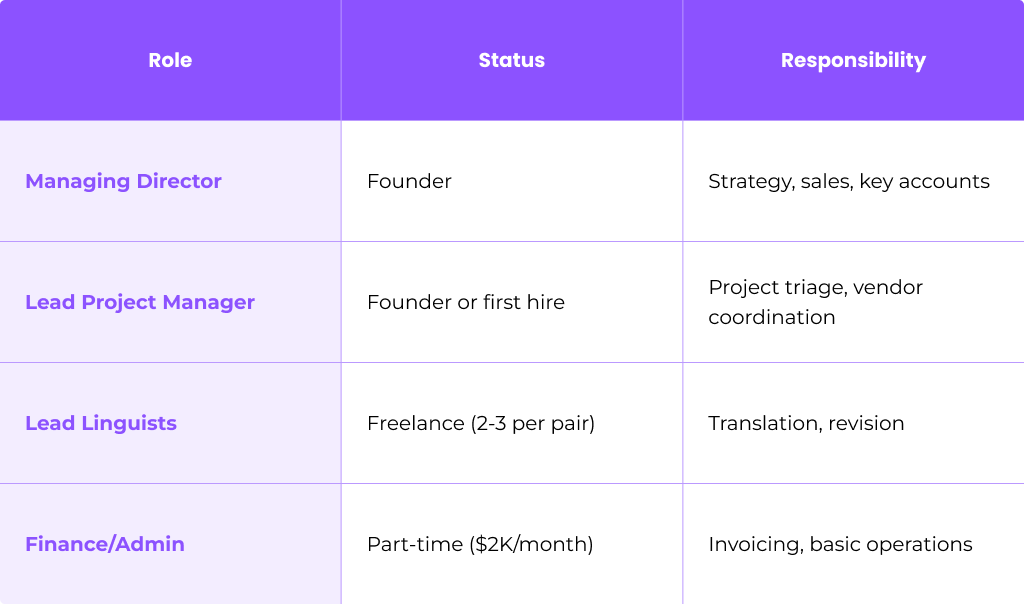
Clarify the mix between in-house and freelance support staff:
- 5-10 freelance linguists per major language pair
- Vetted through ProZ tests (98% pass rate requirement)
- 500-word sample translations before approval
- NDAs and references required
Core Operational Processes:
- Intake – Secure portal for file upload
- Assignment – Skills matrix matching linguist to project
- Translation – CAT tool with TM and termbase
- QA – Double-check 10% sample minimum
- Delivery – Tracked file transfer, confirmation
- Feedback – NPS collection (target >8)
Daily Operations Tools:
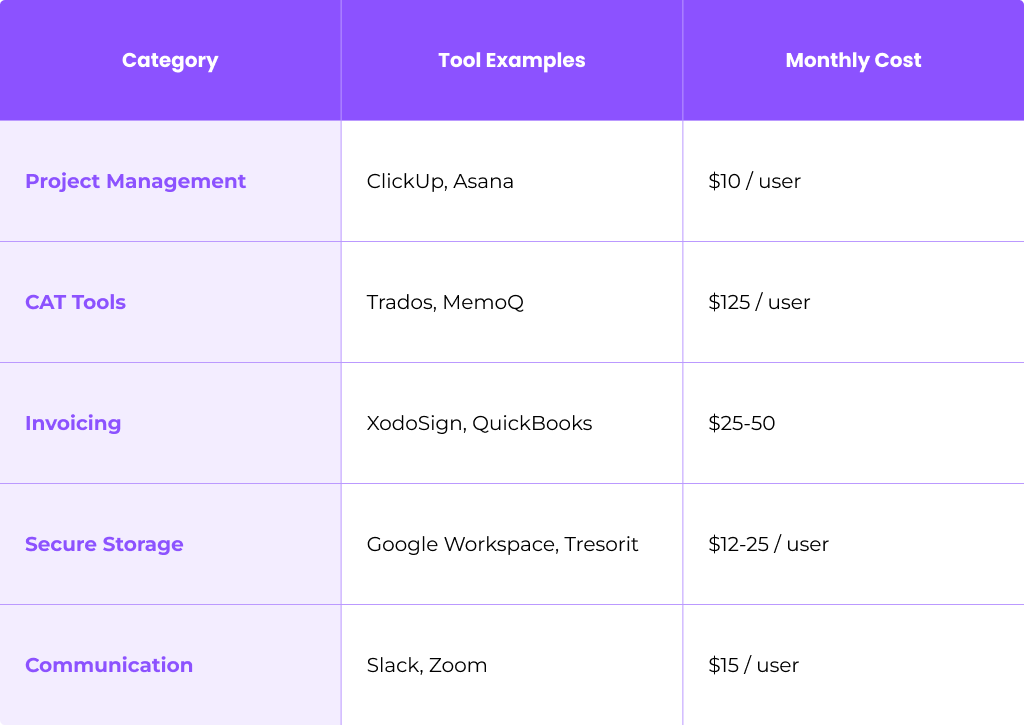
Scaling Plan (2026–2028)
Outline how to grow capacity as client demand increases:
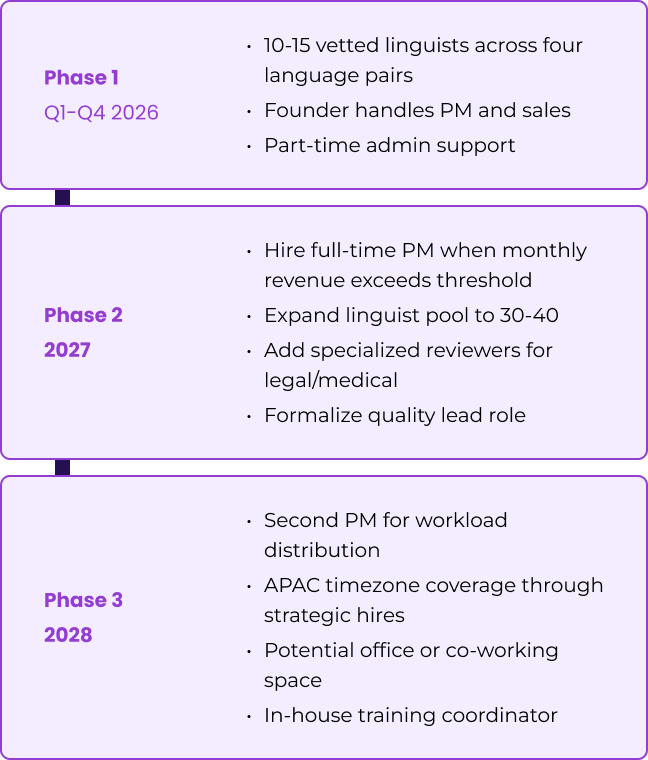
Trigger points for scaling decisions:
- Utilization exceeding 70% consistently for 3+ months
- Project rejection due to capacity constraints
- Client requests for language pairs not covered
Training and continuous improvement through:
- Client-specific glossaries and style guides (reduces errors 25%)
- Regular feedback loops with linguists
- Monthly quality audits
- Annual linguist performance reviews
Financial Plan (2026 Projections and Beyond)
Feature realistic, forward-looking financial projections tied to your 2026 launch and development assumptions for 2027–2028.
Revenue Assumptions for 2026:
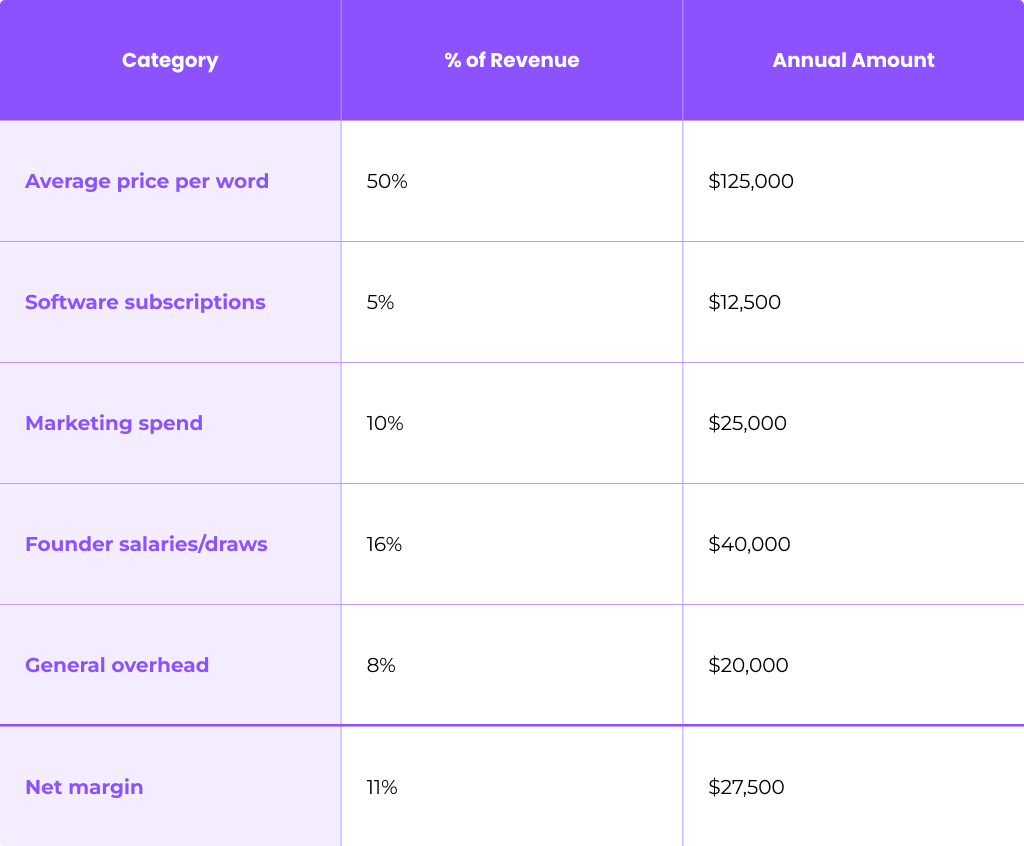
Main Cost Categories:
Funding Approach:
State clearly whether you’re self-funded (most common for small agencies), seeking a small business loan ($50K at 7% SBA-typical rates), or pursuing angel investment for technology development.
Allocate funds across first 6-12 months:
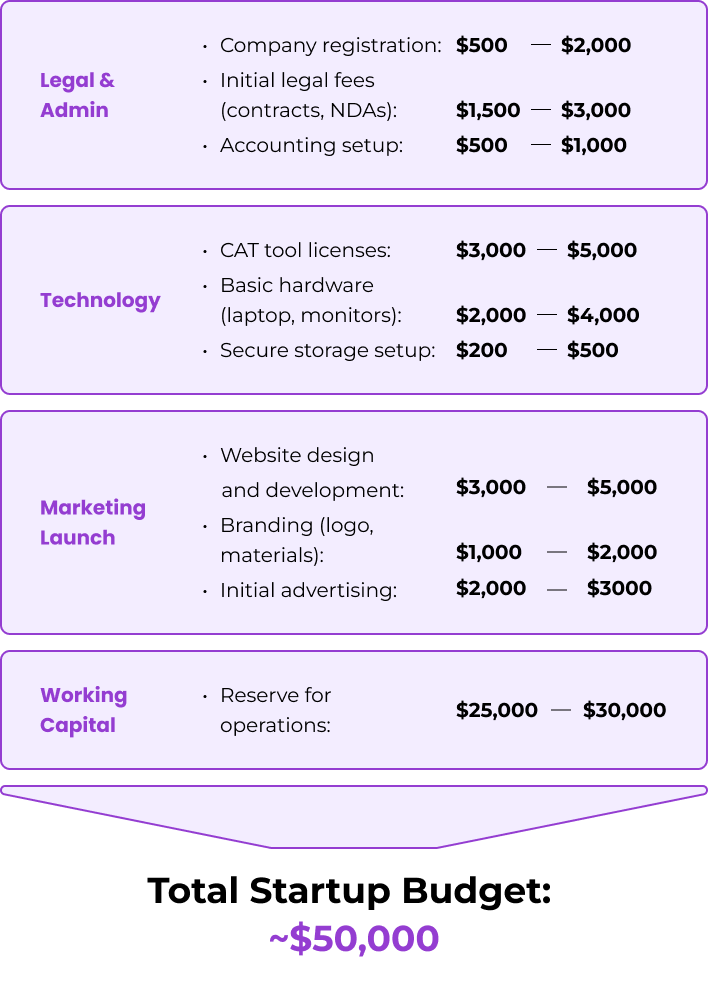
- Company setup and legal: 10%
- Technology (CAT tools, hardware): 20%
- Marketing launch: 20%
- Working capital buffer: 50%
Break-even Expectations: Aim to cover fixed monthly costs ($20K) by month 10-12, requiring approximately $22K monthly revenue. This assumes steady client acquisition and 50% gross margin on translation work.
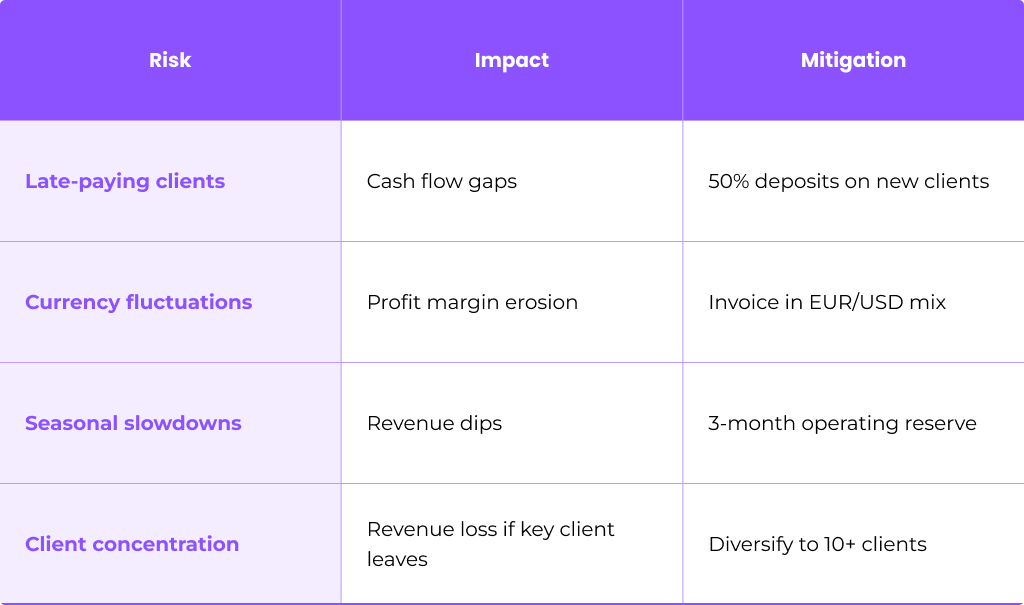
Key Financial Risks and Mitigations:
Startup Budget for 2026
List one-time setup expenses relevant for a translation agency:
Costs to minimize at launch:
- Co-working instead of private office
- Cloud tools instead of on-premise servers
- Freelance linguists instead of employees
- Template contracts instead of fully custom legal
Ongoing Operating Costs and Revenue Forecast
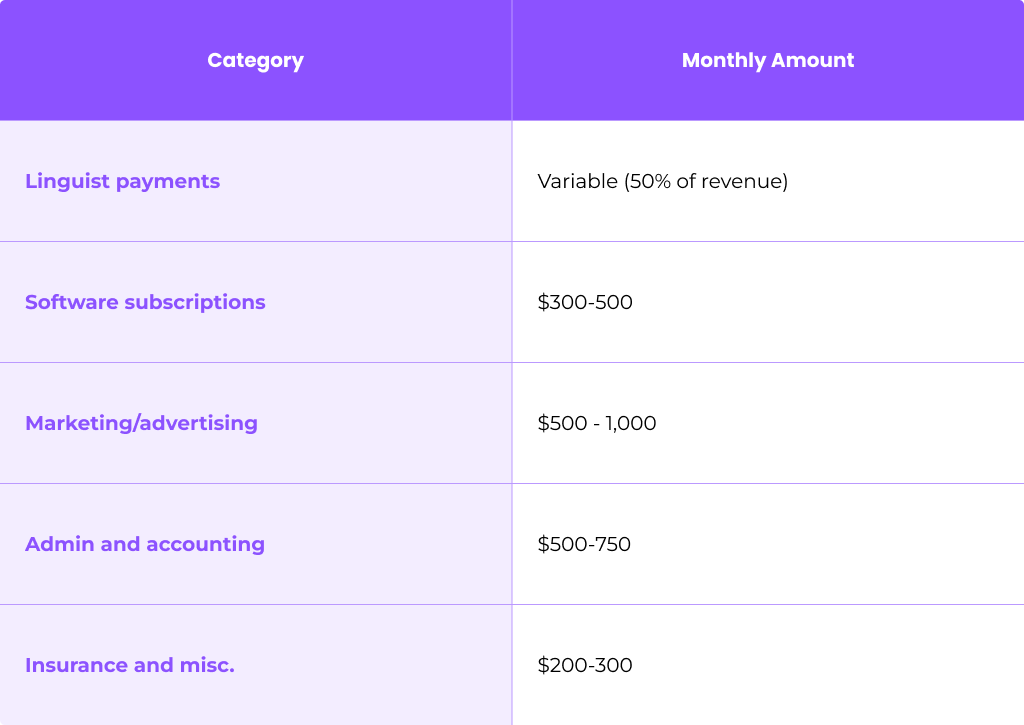
Monthly Recurring Costs from 2026:
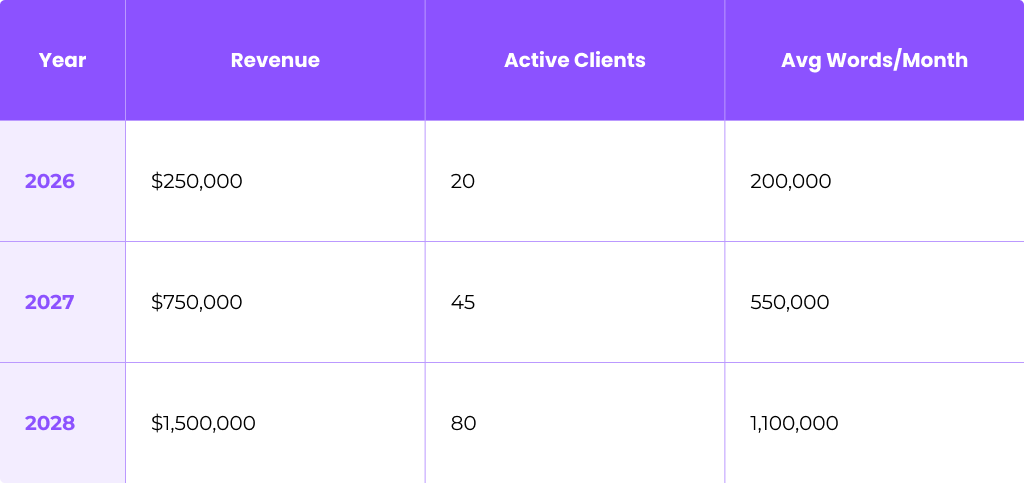
Three-Year Revenue Forecast:
Cash Flow Considerations:
- Payment terms typically net-30-45 in the industry
- Require deposits (50%) from new clients
- Build 3-month operating reserve for slow periods
- Invoice promptly upon delivery
Review and adjust financial assumptions annually. Rates may increase 5% with inflation, technology costs fluctuate, and client mix evolves. Treating these projections as starting points keeps your financial plan useful.
Appendices
Keep appendices referenced in the main document but attached separately. This keeps the core plan focused and readable while providing detail for those who want it.
Items to Include:
- Founder CVs highlighting 10+ years translation/industry experience
- Sample NDA template
- Sample client contract
- Quality and security policies (GDPR compliance documentation)
Add as Available (Late 2026-2027):
- Example project workflows (8-step MTPE process)
- Sample glossaries (e.g., fintech terminology, 1,000+ terms)
- Style guides per major client
- Anonymized case studies showing results (e.g., “30% cost savings through TM optimization”)
- Detailed financial spreadsheets with monthly projections
Full market research reports and extended competitor analysis belong here rather than cluttering the main plan sections.
Conclusion
This 2026 translation agency business plan template provides your roadmap from launch concept to sustainable business growth. Each section builds on the previous, creating a coherent strategy that connects market opportunity to services, marketing to operations, and operations to financial outcomes.
The translation industry rewards agencies that specialize, deliver consistently, and build genuine expertise. Your plan should reflect this—avoid trying to serve every market or language from day one. Focus creates the profit margins and client relationships that support expansion later.
Revisit this plan quarterly to adjust goals, target segments, and financial assumptions as the market evolves. AI tools will continue improving, client expectations will shift, and new competitors will emerge. Treat your business plan as a living document rather than a static file, updating key metrics monthly and conducting thorough annual refreshes.
The agencies that succeed in 2026 and beyond will combine human expertise with technology intelligently, not rely solely on either. Build long-term client partnerships through consistent quality and proactive communication. That combination—specialization, reliability, and smart technology use—positions you to accomplish your objectives in a competitive but growing market.
FAQ
How detailed should my translation agency business plan be if I’m self-funding in 2026?
A self-funded agency doesn’t need an overly long document. Ten to fifteen focused pages plus appendices is typically enough to guide your decisions without creating unnecessary work. Concentrate on clear revenue goals, a simple marketing and sales path, realistic capacity assumptions, and practical pricing that covers your costs.
The plan should be detailed enough for day-to-day guidance but concise enough to review monthly. Skip extensive formal SWOT analysis if you’re not seeking investors—focus instead on the five or six metrics that actually indicate whether you’re on track.
Do I need to pick a niche for my translation agency from day one?
Choosing at least one primary niche is strongly recommended for 2026 launches. Industry data shows specialist providers earn 25% higher margins than generalists, and 65% of buyers in regulated industries prefer specialists over general agencies.
Start narrow—one or two industries and language pairs where you have genuine expertise. Expand once you have case studies and stable revenue demonstrating your capabilities. Your plan should reflect this phased approach, showing how you’ll establish credibility in your initial focus before broadening.
How should I factor AI and machine translation into my 2026 business plan?
Treat AI and MT as tools that increase speed and consistency when combined with professional post-editing, not as replacements for specialized translators. MTPE workflows can reduce costs 30-50% while maintaining 98% accuracy in technical domains—but only with proper human oversight.
Your plan should describe where MT applies (high-volume internal content, routine updates) and where only human translation is acceptable (contracts, medical documentation, anything requiring certification). Include a note on educating clients about the 20-30% quality premium for human-first work versus raw MT output.
What funding options are realistic for a small translation agency in 2026?
Many small agencies start with personal savings and part-time freelancing income, reinvesting profits to grow. This bootstrapped approach keeps you debt-free but may limit how quickly you can scale.
Alternatives include small business loans (SBA-type programs at 7% interest are common), government grants for export-supporting services in various jurisdictions, or modest angel investment if you’re developing proprietary technology. Your financial plan should clearly show how any external funding will be used and repaid over a defined timeline—investors and lenders need to see the money flowing back.
How often should I update my translation agency business plan once I start operating?
Review key metrics monthly: revenue, pipeline value, linguist utilization, and client acquisition rate. These numbers tell you whether you’re tracking toward your objectives or need course correction.
Conduct more thorough quarterly reviews covering marketing effectiveness, service mix profitability, and operational efficiency. Do a full annual refresh of goals, target markets, and financial projections for each new year—revise in late 2026 to create your 2027 plan.
Treating the plan as a living document makes it far more useful than something written once and forgotten. The agencies that achieve long-term success are those that continuously adapt based on real performance data.
Table of Contents
- Executive Summary (Snapshot of Your Translation Agency in 2026)
- Company Description
- Market Analysis (Translation & Localization Landscape for 2026)
- Services Offered (Translation, Localization & Related Solutions)
- Marketing Strategy (How Your Translation Agency Will Win Clients)
- Organizational Structure and Operations
- Financial Plan (2026 Projections and Beyond)
- Appendices
- Conclusion
- FAQ
Ready to manage your Translation company easily?
Get Started for Free