Translation Agency Pricing Models: Per Word, Per Hour, or Monthly Retainer?
Key Takeaways
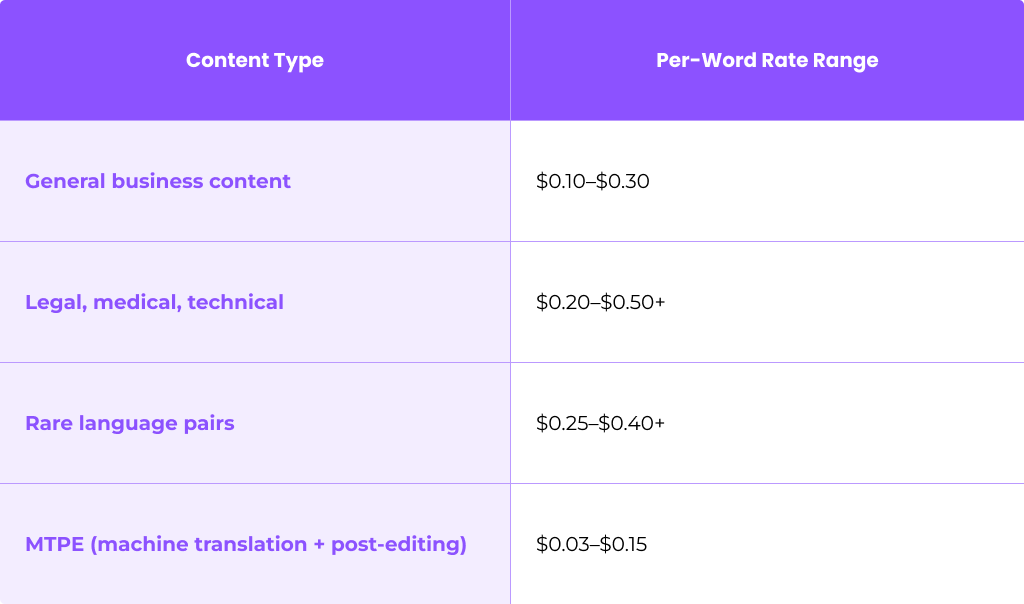
- Per-word pricing remains the most common pricing model in 2025, with typical professional rates between $0.10–$0.30 per word for standard business content and $0.20–$0.50+ for specialized fields like legal, medical, or technical documentation.
- Hourly rates ($30–$150+/hour) work best for complex projects like software localization, desktop publishing (DTP), and heavy revision cycles where word count alone doesn’t reflect the actual work involved.
- Monthly retainers and subscription-style models suit companies with ongoing translation needs—such as weekly product updates or continuous support content—offering predictable spend and priority access to dedicated teams.
- The “best” model depends on your content type, volume stability, urgency, and internal workflows; many translation agencies blend multiple models within a single client program.
- Total cost of ownership matters more than the visible rate—factor in quality, consistency, rework rates, and time to market when comparing translation service providers.
Introduction: Why Translation Pricing Models Matter for Your Budget
Understanding translation agency pricing models is critical for any organization managing global marketing, legal compliance, or international product launches in 2025–2026. Translation costs are rarely a one-time expense—for most growing companies, they represent a recurring operational line item that directly impacts your bottom line over months and years.
Consider the difference between translating a 50,000-word product manual once versus pushing out weekly website updates across eight markets versus handling urgent legal contracts with 24-hour turnaround requirements. Each scenario demands a different approach, and choosing the wrong pricing structure can mean overpaying for flexibility you don’t need or underestimating the true cost of translation services.
This article compares three core translation pricing models—per word, per hour, and monthly retainer—plus common hybrids. You’ll learn when each model is most cost-effective based on real 2025 market data and practical decision-making frameworks. The perspective here is practical: how do you actually plan a translation budget that works?
Overview of Common Translation Agency Pricing Models
Translation agencies rarely rely on a single pricing structure. Most maintain a menu of models they deploy according to project type, client relationship stage, and content characteristics.
The core models you’ll encounter include:
- Per word – Price based on source or target language word count
- Per hour – Time-based billing for non-linear tasks
- Per page – Fixed rates for standardized documents (certificates, diplomas)
- Project-based flat fees – One agreed sum for an entire initiative
- Monthly retainers/subscriptions – Fixed monthly fee for committed capacity
This article focuses on per word, per hour, and retainer models because these most directly impact how language service providers help clients plan localization budgets. Combination models are common in practice—for example, per-word translation paired with hourly DTP work, or a retainer with per-word overage charges.
In terms of predictability versus flexibility: per-word pricing offers high predictability when word counts are stable, hourly billing provides flexibility for variable scope, and retainers sit between the two—predictable in fee but flexible in how you use your allocated capacity.
Per-Word Pricing: Still the Industry Workhorse
Per-word pricing dominates the translation industry for text-heavy deliverables like blog posts, white papers, user manuals, and marketing content. It’s straightforward: your price equals the source word count multiplied by the agreed rate.
Example calculation: 8,000 English source words × $0.14/word = $1,120
Typical 2025 market ranges look like this:
Key advantages of per-word pricing:
- Easy cost estimation before project sign-off
- Scalable to large volumes without renegotiation
- Straightforward procurement approval process
- Clear benchmarking against competitive pricing from other providers
Potential drawbacks:
- Doesn’t account for non-text effort (layout adjustments, screenshots, research time)
- Can incentivize speed over depth if not paired with quality assurance processes
- Rush fees and specialized expertise required can push rates significantly higher
Per-word works best when you’re translating a 20,000-word annual report, a 100-product catalog with standardized descriptions, or archived blog content that doesn’t require heavy formatting work.
When Per-Word Pricing Works Best
Per-word pricing delivers maximum value under these conditions:
- Large, mostly plain-text documents with minimal embedded graphics
- Stable formatting that doesn’t require desktop publishing rework
- Predictable review cycles with clear approval workflows
- No heavy engineering, multimedia integration, or software localization involved
Ideal use cases include:
- Marketing articles and thought leadership content
- HR policies, employee handbooks, and corporate communications
- E-learning scripts before multimedia integration
- Knowledge base articles for support portals
- Product documentation with standardized templates
Per-word also works especially well when you can batch content into larger jobs. Many translation companies apply minimum fees ($75–$150) to cover project management overhead on tiny tasks, so consolidating multiple small files into a single submission reduces your effective cost of translation services.
Hidden Variables Inside “Per-Word” Rates
A per-word quote typically bundles several elements: translation, editing, proofreading (the TEP workflow), basic project management, and translation memory maintenance. However, the final cost often depends on variables that aren’t immediately visible.
Factors agencies use to adjust per-word rates:
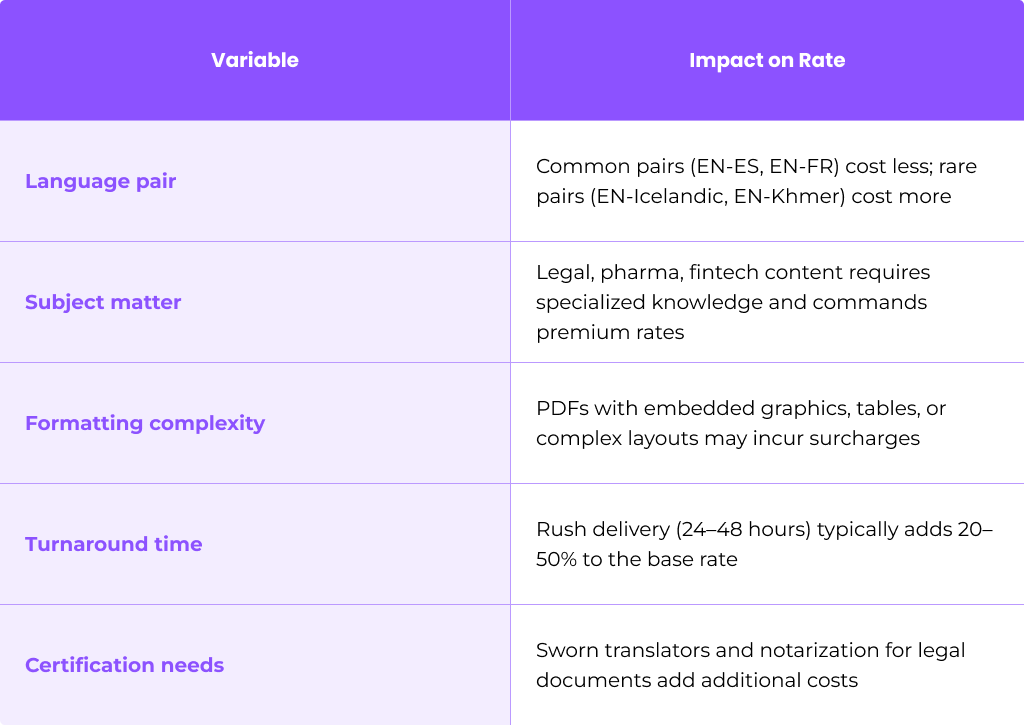
Always ask agencies exactly what’s included in their per word rate. Specifically clarify whether quality assurance, glossary development, style guide creation, and multiple revision rounds are part of the price—or whether these represent additional services billed separately.
Hourly Pricing: Best for Complex, Non-Linear Work
Hourly pricing makes sense when output cannot be meaningfully measured in words. This includes localization engineering, desktop publishing, consulting, and projects with extensive revision cycles involving multiple stakeholders.
Realistic 2025 hourly rate ranges:
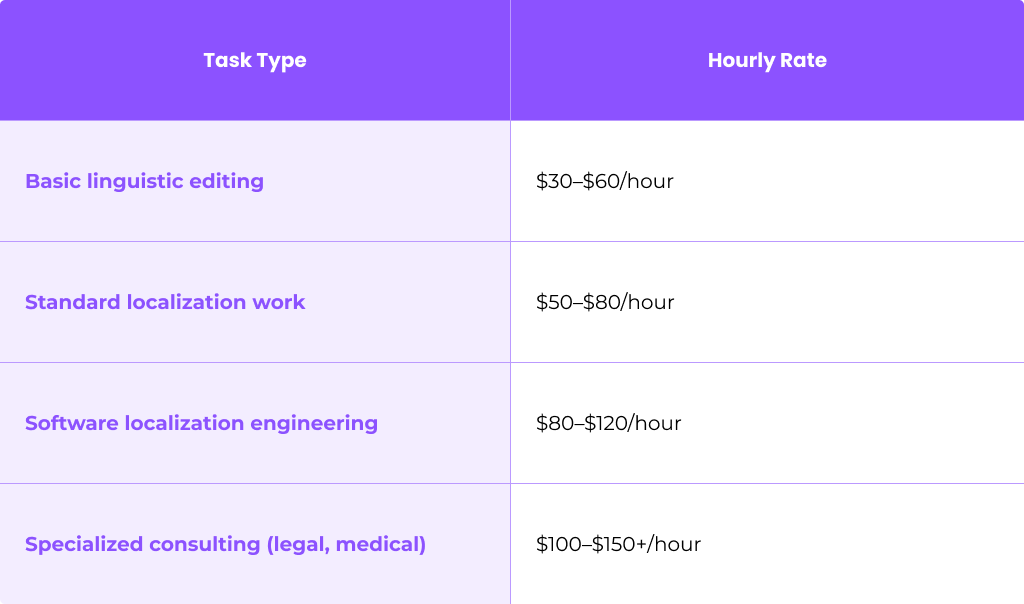
Agencies typically estimate hours based on prior similar projects, then provide either a capped number of hours or a range (e.g., 10–14 hours at $80/hour for a specific deliverable).

Hourly pricing is frequently combined with per-word translation: the translated text itself is priced per word, while layout integration, QA testing, and engineering work are billed per hour. This hybrid approach lets you optimize costs across different work types within a single translation project.
The critical success factor here is time tracking transparency. Your contract should specify that detailed timesheets or task breakdowns will be provided on request. Professional translators and service providers should have no issue providing this documentation.
Projects That Benefit from Hourly Billing
Certain project types are poor fits for per-word models. Hourly billing works better for:
- Software and app localization – UI strings in JSON, XML, or resource files where context research takes longer than translation
- Website CMS integration – Publishing translated content into complex content management systems
- Complex PDF recreation – Rebuilding documents in Adobe InDesign or similar tools
- Multilingual desktop publishing – Illustrated catalogs, brochures, or graphic translations requiring layout adjustments
- Device and OS testing – Testing localized mobile apps across multiple devices, browsers, and operating systems
- Terminology research – Building term bases from scratch for new subject domains
- Client review implementation – Incorporating feedback from multiple stakeholders across lengthy review cycles
For example, rebuilding a 40-page illustrated product catalog in Adobe InDesign for a target language that reads right-to-left (Arabic, Hebrew) involves significant non-translation work. Pricing this per word would dramatically underestimate the actual effort.
Hourly billing also fits exploratory work: initial localization audits, workflow design, or style guide creation where the scope isn’t clearly defined upfront.
Controlling Risk with Hourly Models
Hourly pricing introduces uncertainty, but you can manage this risk with concrete safeguards:
- Not-to-exceed caps – Agree on a maximum number of hours; work beyond requires explicit approval
- Pre-approved hourly blocks – Purchase 20 hours per month at a fixed rate; unused hours roll over or expire
- Mandatory sign-off before exceeding estimates – Require written approval before the agency exceeds initial projections
- Task-level breakdown – Request estimated hours by task (engineering, DTP, linguistic QA), language combination, and environment (desktop vs. mobile testing)
For long-running projects, ask for periodic status updates on hours consumed. A project manager should be able to tell you “We’ve used 12 of the estimated 20 hours and completed 60% of the work” at any point.
Pairing hourly billing with clear acceptance criteria—such as number of test cycles, browser/OS matrix coverage, or defined revision rounds—keeps expectations aligned and prevents scope creep from inflating your final cost.
Monthly Retainers and Subscription-Style Models
A monthly retainer is a fixed fee that secures a certain capacity—measured in words, hours, or projects—and typically includes priority access to a dedicated team. This model suits companies with ongoing translation needs rather than sporadic, one-off projects.
Typical use cases:
- SaaS companies translating product release notes every sprint
- E-commerce brands updating product listings weekly across multiple markets
- Support teams localizing help center articles and customer tickets continuously
- Content marketing teams publishing multilingual blog posts on a regular cadence
Example retainer structures:
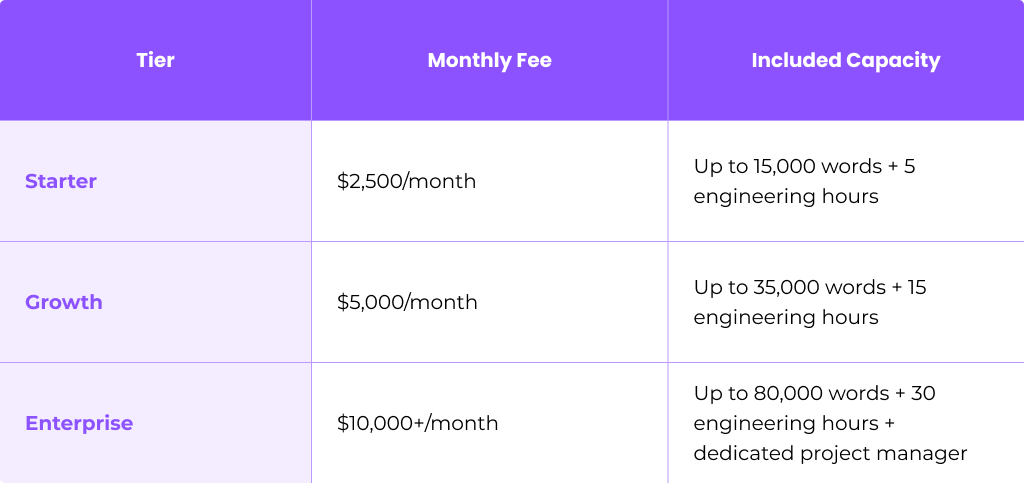
Benefits of retainer models:
- Predictable monthly invoicing simplifies translation budget planning
- Faster turnaround through reserved capacity
- Consistent teams assigned to your account improve translation quality over time
- More strategic collaboration enables better cultural and contextual nuances
Potential downsides:
- Paying for unused capacity during slow months
- Requires accurate volume forecasting based on historical data
- Contracts may lock you into suboptimal rates if demand shifts dramatically

Designing a Retainer That Matches Your Real Demand
To choose an appropriate retainer tier, start by analyzing your past translation volumes. Pull data from the last 6–12 months: average monthly word count, peak months, and the types of content you’ve translated.
Practical mechanisms to negotiate into your retainer:
- Rollover policies – Up to 20% of unused word volume carries over for one month
- Overage rates – Clear per-word or per-hour rates for work exceeding your monthly allocation
- Annual reviews – Scheduled reassessment of retainer level based on actual usage
- Quarterly adjustments – For startups and rapidly growing companies, build in flexibility to scale up or down
Define clearly what the retainer covers:
- Number of target languages included
- Types of content (marketing, product UI, legal documents)
- Whether editing/proofreading and terminology management are included
- Rush capacity allocation
- Quality assurance processes and turnaround guarantees
A well-structured retainer should reduce translation costs compared to project-by-project pricing while providing cost effective solutions for predictable, ongoing needs.
Retainers vs. Pay-As-You-Go: When to Choose Which
The decision between retainer and pay-as-you-go depends on your content pipeline stability.
Choose a retainer when:
- You translate consistently every week or month
- Predictability matters for budgeting and planning
- You need guaranteed turnaround times during peak periods
- You want a dedicated team that learns your brand voice
Choose pay-as-you-go (per word or per hour) when:
- Your translation needs are sporadic—a few projects per year
- Content types and volumes vary significantly with no clear pattern
- You’re still establishing your localization strategy and need flexibility
- You’re testing new markets before committing
Example: A company that only translates an annual report and a few legal contracts each year is better served by project-based or per-word pricing. The overhead of maintaining a retainer relationship doesn’t make sense when utilization would be minimal.
Organizations with internal localization managers often prefer retainers to secure predictable support aligned with sprint-based development cycles. Run a simple comparison: estimate your annual translation volume and compare total projected per-word costs against quoted retainer offers to see which model delivers better value.
Other Common Structures: Per Page and Project-Based Flat Fees
While per word, per hour, and retainer are the core translation pricing models, agencies also use per-page and project-based flat fees in specific contexts.
Per-Page Pricing
Per-page pricing is common for certified or legal documents where word counts are small but administrative work is fixed. This includes:
- Birth certificates, marriage certificates, diplomas
- Visa applications and immigration documents
- Notarized documents requiring sworn translators
- Short legal contracts and affidavits
Typical per-page ranges (2025): $20–$80 per page, depending on language pair and certification requirements.
Be aware that “page” definitions vary—some agencies define a page as 250–300 words, while others charge per physical PDF page regardless of content density. Clarify this upfront to avoid hidden fees.
Project-Based Flat Fees
Flat fees cover an entire initiative for one agreed amount. This works for clearly scoped projects like:
- Localizing a 30-page website into 5 languages
- Launching a mobile app into 10 markets
- Translating and adapting a 2026 product launch campaign
Flat fees typically factor in language count, approximate total word count, subject matter complexity, and required file handling. They’re attractive for clients who need a single number for budget approvals.
When Flat Fees Beat Granular Models
Flat fees work well when:
- The project is clearly scoped with defined deliverables and timelines
- Multiple components are easier to price together than separately
- Procurement processes require a fixed quote upfront
- You expect significant translation memory reuse that agencies can factor into pricing
Request a breakdown of assumptions behind any flat-fee proposal: estimated word counts, number of languages, included revision rounds, and what triggers additional costs. Change requests beyond the original scope (extra pages, new features) are typically charged per word or per hour on top of the agreed flat fee.
Total Cost of Ownership: Looking Beyond the Visible Rate
The cheapest per-word or hourly rate is not always the lowest total cost over a project lifecycle or fiscal year. Total cost of ownership (TCO) for translation includes factors beyond the line rate.
Cost components beyond visible rates:
- Internal staff time managing vendors, reviewing translations, and coordinating feedback
- Delays from poor translation quality requiring rework
- Inconsistent terminology causing brand confusion across markets
- Compliance risks for regulated content (medical, financial, legal)
- Opportunity cost of delayed time-to-market
Investing in higher-quality processes—formal glossaries, style guides, multiple review steps—can reduce long-term costs by avoiding repeated corrections across multiple markets. A translation that costs $0.12/word but requires three revision cycles may end up more expensive than one priced at $0.18/word that’s right the first time.
Evaluate pricing models alongside KPIs like:
- Rejection rates by language and content type
- Time to market for multilingual releases
- Number of review cycles required per language pair
- Customer complaints or support tickets related to localization quality
Modern translation agencies use translation memory, term bases, and QA automation to lower effective costs over time. These savings compound in long-term partnerships as more content gets captured in memory systems.

Human–AI Collaboration and Its Impact on Pricing
Machine translation plus human post editing (MTPE) is increasingly used to manage large volumes at lower costs. This approach works well for user-generated content, internal documentation, and lower-stakes materials where perfect polish isn’t critical.
Some agencies offer tiered pricing:
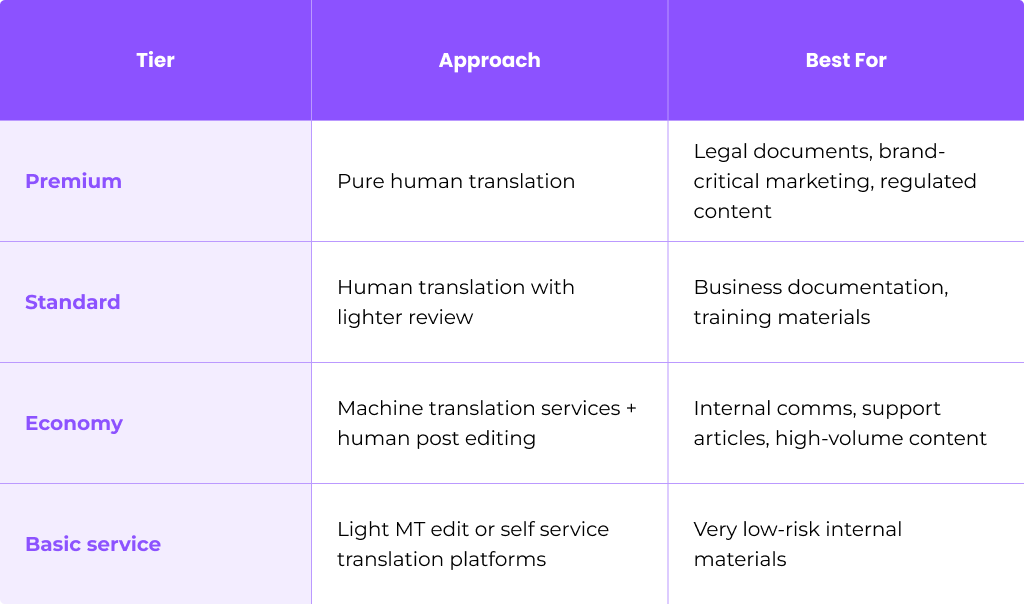
Ask how AI and translation memory savings are reflected in quotes. Common practices include:
- Discounts for repeated segments (100% matches)
- Reduced rates for fuzzy matches (75–99% similarity)
- Separate line items showing leverage analysis
While AI can reduce translation prices, human oversight remains essential for legal, medical, financial, and heavily branded content where maintaining high quality translations is non-negotiable. Human translators bring the specialized expertise required for cultural and contextual nuances that machine translation still struggles to capture.
How to Choose the Right Pricing Model for Your Organization
There is no universal “best” model. The right choice depends on your content mix, volume patterns, risk tolerance, and internal processes.
A practical step-by-step approach:
- Audit your past 12 months of content – Document content types, word counts by type, languages, and whether non-text work was involved
- Categorize by risk level – Separate legal/regulatory content from brand-critical marketing from internal documentation
- Match each category to the most suitable model – High-risk content may warrant premium human translation services; high-volume, lower-risk content may benefit from MTPE
- Consider hybrid setups – Per word for high-volume marketing and documentation, hourly for engineering and design, and a small retainer for ongoing consulting and rush capacity
- Involve stakeholders – Marketing, product, legal, and finance teams are all affected by speed, quality, and predictability of translation spend
Companies starting global expansion in 2025–2026 may begin with project based pricing and evolve into retainers once patterns stabilize and volume becomes more predictable.
When requesting quotes, provide your complete translation needs upfront: source files, target languages, desired turnaround, content type, and any existing resources (glossaries, style guides, previous translations). The more precise your brief, the closer the final invoice will be to the initial estimate—regardless of whether you’re paying per word, per hour, or under a retainer.
FAQ
Which pricing model is cheapest for a small, one-time translation project?
For a single document of a few hundred to a few thousand words (e.g., a 1,500-word contract or 3,000-word brochure), per-word pricing is typically the most economical and transparent option. Hourly minimums can make very small jobs more expensive if billed purely by time, and retainers don’t make sense for one-off needs. Ask upfront about minimum charges—many translation companies apply a minimum fee of $75–$150 to cover project management and admin for tiny jobs. Send the actual file to get a precise quote instead of relying solely on rough word-count estimates.
How much should I budget per month if I plan ongoing translations?
Start with an estimate based on expected volume. A small marketing team might need 10,000–20,000 words per month, while an actively publishing SaaS company could require 40,000–60,000 words monthly. At $0.14/word, 20,000 words per month would cost around $2,800, not including any hourly engineering or DTP work. Discuss with agencies whether a monthly retainer for that volume would unlock better rates and guaranteed turnaround times. Businesses should revisit budgets quarterly as they add new markets or increase content output.
Can I mix different pricing models with the same agency?
Mixing models is not only possible but common. For example, you might use per-word rates for documentation, hourly rates for UI integration, and a small monthly retainer for consultation and urgent jobs. This flexibility lets you optimize costs by aligning each type of work with the pricing structure that fits it best. Formalize these combinations in a master services agreement so there’s no confusion about when each model applies. Agencies may offer competitive pricing if they can plan around a predictable mix of ongoing and project-based work.
How do discounts for translation memory and repetitions work?
Translation memory (TM) stores past translations and allows agencies to reuse identical or similar segments at discounted rates. A common scheme applies full rates to new content, partial discounts for 75–99% matches, and minimal or no charges for 100% matches. Ask for a “TM leverage analysis” in quotes showing how many words fall into each match category and what rate applies. Over several years of collaboration, TM savings can significantly reduce translation costs for product documentation, legal boilerplate, and recurring marketing phrases.
What information should I provide to get an accurate translation quote?
Essential items include: original files (not screenshots), source and target language specifications, approximate total word count, desired delivery date, and whether you need certified translation or a basic service. Describe the content type—GDPR privacy policy, medical device instructions, advertising campaign—so agencies can assign qualified translators with appropriate subject-matter expertise. Share any existing glossaries, style guides, or previous translations to improve consistency and reduce prep time. The more precise your brief, the closer the final invoice will be to the initial estimate, helping you avoid additional costs and hidden fees.
Table of Contents
- Introduction: Why Translation Pricing Models Matter for Your Budget
- Overview of Common Translation Agency Pricing Models
- Per-Word Pricing: Still the Industry Workhorse
- Hourly Pricing: Best for Complex, Non-Linear Work
- Monthly Retainers and Subscription-Style Models
- Other Common Structures: Per Page and Project-Based Flat Fees
- Total Cost of Ownership: Looking Beyond the Visible Rate
- How to Choose the Right Pricing Model for Your Organization
- FAQ
Ready to manage your Translation company easily?
Get Started for Free