What Is a Translation Business Management System (TBMS)? The Complete Guide for Language Service Providers
Key Takeaways
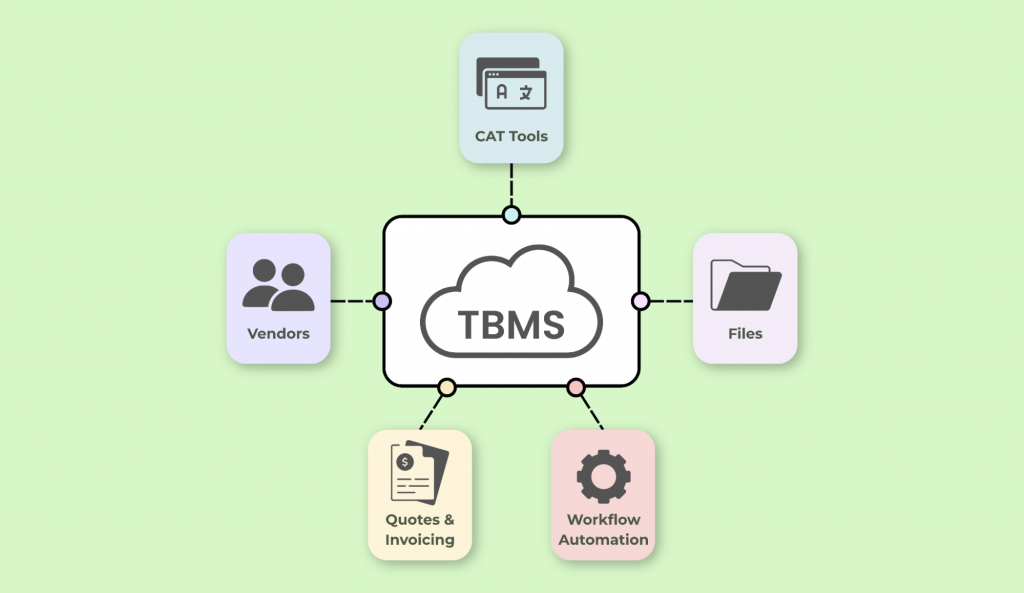
A translation business management system is the operating system of a translation agency: it manages the commercial, operational, and financial work around translation, not just the translation process itself. Awtomated is a modern TBMS built for today’s language service providers that need one centralized platform for clients, quotes, projects, vendors, finance, and reporting.
- A TBMS manages clients, quotes, translation projects, vendors, invoices, purchase orders, and profitability while integrating with a translation management system, CAT tools, and machine translation engines.
- Unlike a cat tool or translation management system tms, a TBMS sits above production and helps project managers control cost, deadlines, margins, and project status.
- A TBMS increases efficiency by automating repetitive tasks and reducing manual data entry, especially for agencies still relying on spreadsheets and email.
- For 2026, the biggest benefits are better cost control, fewer manual tasks, faster RFQ responses, stronger reporting, and scalable global growth without hiring more administrative staff.
- Choosing the best translation management system for your translation business means looking at the full stack: TBMS, TMS, CAT, machine translation, content management systems, finance, and your long-term localization strategy.
Introduction: Why LSPs Now Rely on TBMS Platforms
By 2026, the language industry is handling more global content, more language pairs, more different file formats, and more multilingual content than ever before. SaaS companies, e-commerce teams, legal departments, and global business units all expect faster turnaround, lower localization costs, and translated content that is consistent across multiple languages. The global language services market was estimated at about $71.7 billion in 2024 and is projected to keep growing toward $92.3 billion by 2029, according to market research summarized by LocReport.
That growth is good news, but it creates pressure. Traditional methods such as spreadsheets, shared inboxes, generic project management boards, and disconnected customer relationship management tools cannot easily handle client-specific rates, fuzzy matches, translation memory savings, vendor purchase orders, multiple versions of files, and finance approvals at the same time.
This is where a Translation Business Management System centralizes and automates business operations for language service providers. A TBMS handles tasks from initial client quote to final invoice, while also helping teams see which clients, services, and language pairs are profitable.
We built Awtomated for translation and localization companies that already use translation tools, machine translation, multiple cat tools, or tms tools, but need everything connected in one business layer. Think of a small translation agency that once managed 40 jobs a month in Excel. At 80 jobs, the team starts missing follow-ups, misquoting rush work, and chasing vendor invoices. Moving to a TBMS gives that agency a central hub for requests, assignments, deadlines, vendor costs, and client billing.

What Is a Translation Business Management System (TBMS)?
A translation business management system is business management software built specifically for translation and localization providers. It manages the non-linguistic side of the work: sales, quotes, orders, SLAs, project management, vendor assignment, purchase orders, invoicing, reporting, and financial performance.
A TBMS can integrate with Translation Management Systems to streamline operations, but it is not the same thing as a translation management system. A TMS automates and manages translation workflows; Translation Management Systems centralize localization processes in one platform. CAT and computer assisted translation environments support translators with translation memory, terminology management, quality assurance, and an in context editor where the actual translated materials are produced.
A modern TBMS typically helps an LSP:
- collect client requests through email, forms, or a client portal, where clients can submit requests and track progress;
- calculate pricing using word counts, service types, minimum fees, currencies, taxes, and client-specific rate cards;
- assign linguists using language pairs, subject expertise, availability, vendor-specific rates, and performance histories;
- track project status from client intake through to final delivery;
- manage vendor databases including translators' language pairs and performance histories;
- automate quotes, invoices, financial management processes, and vendor purchase order processing;
- improve data accuracy and reporting capabilities across sales, operations, and finance.
Excel, Trello, and generic CRMs can help when a business is small, but they are not built for repeat content, past translations, fuzzy matches, target language workflows, vendor margins, or the localization process. If you are just starting a translation agency, knowing when to move from spreadsheets to a TBMS is one of the earliest operational decisions you will face.
TBMS vs. TMS vs. CAT Tools: How They Work Together
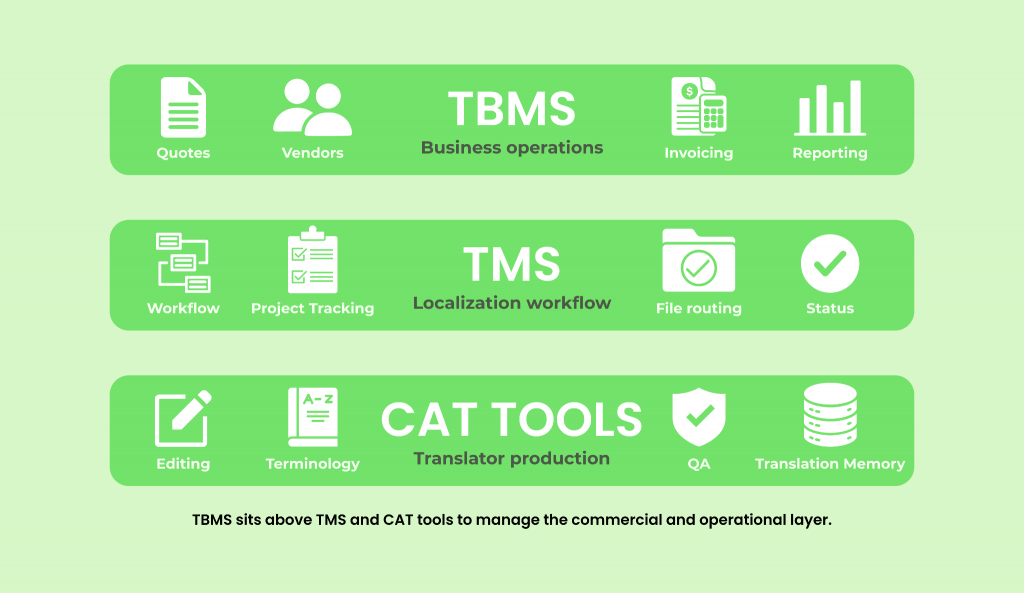
Many language service providers confuse the acronyms and end up buying software that solves only part of the problem. Most mature LSPs need a TBMS plus a TMS/CAT production stack.
Here is the simplest way to think about it:
- A TMS manages the localization workflow for content production. A TMS automates repetitive translation tasks, routes files, supports translation memory, manages term bases, connects machine translation, and often provides real-time collaboration features for teams. A TMS ensures consistent translation across multiple languages and should include quality assurance checks for translations.
- A CAT tool is translator-facing. Tools such as memoQ, Trados Studio, Phrase, and Memsource support translation memory, terminology, QA checks, different file formats, and the in context editor where linguists work. A good CAT environment helps reuse previously translated content, existing translations, and translation memories to reduce translation costs.
- A TBMS is the commercial and operational layer above both. Awtomated operates in this TBMS layer, managing leads, clients, quoting, workflow automation, purchase orders, vendor rates, profitability, and finance. If you want to compare TBMS platforms like Plunet, XTRF and Awtomated side by side, we cover that in a separate guide.
A typical stack looks like this in practice: a client brief is captured in Awtomated → a quote is generated using rate cards and word counts → the project is created in a CAT/TMS environment → translation workflows run through production → status and costs sync back to the TBMS for invoicing and reporting.
This separation matters. A TMS can save businesses approximately $80,000 in translation costs in some business cases by improving reuse, automation, and consistency. A TMS can save approximately $80,000 and dozens of hours when content volumes are high and repetitive translation tasks are automated. But cost savings in translation services can result from leveraging translation memories only if the business layer also prices, bills, and reports those savings correctly.
Core Features of a Modern TBMS
Not all TBMS platforms are equal. Awtomated focuses on automation, accuracy, and integrations tailored to language service providers of different sizes, from boutique agencies to teams managing hundreds of monthly jobs. You can explore the full Awtomated feature set on our features page.
The key features to look for include:
- CRM and client management: store contacts, communication history, service levels, client-specific price lists, and pipelines from lead to signed contract. This is customer relationship management designed for a translation business, not a generic sales database.
- Quote and order management: create automated quotes from word counts, language pairs, service types, and pricing models such as per word, per hour, per page, or per project. This is especially useful for translation + revision, MT post-editing, DTP, interpreting, and rush projects.
- Project and workflow management: define translation workflows such as translation → editing → proofreading → DTP → delivery. A TBMS tracks due dates, internal notes, milestones, files, and project status across many simultaneous projects. Explore Awtomated’s translation project management features to see how this works in practice.
- Vendor and linguist management: store translator profiles, domains, language pairs, quality scores, on-time performance, availability, and rates. Awtomated can help auto-suggest best-fit vendors based on the work, instead of leaving project managers to search spreadsheets. See how the vendor management module works in Awtomated.
- Pricing and rate cards: manage minimum fees, fuzzy discounts, service multipliers, currency rules, taxes, and client-specific margins. This is essential for maintaining consistency in complex commercial models.
- Finance and reporting: Financial tracking in a TBMS involves automated quoting and vendor purchase order processing. A TBMS automates invoicing and financial management processes, including revenue, vendor costs, aging reports, and margin tracking.
- Analytics: view profitability by client, language pair, and service type, project manager, vendor, or account. This helps identify which work supports growth and which work quietly erodes margin.
- Integrations: connect to CAT tools, machine translation engines, accounting software, content systems, CRMs, and TMS platforms through APIs where available.
Quality assurance tools in a TBMS provide pre-delivery checks and visual context for localization when paired with production tools, helping teams catch missing files, skipped steps, or incomplete reviews before delivery.

How a TBMS Supports an End-to-End Localization Workflow
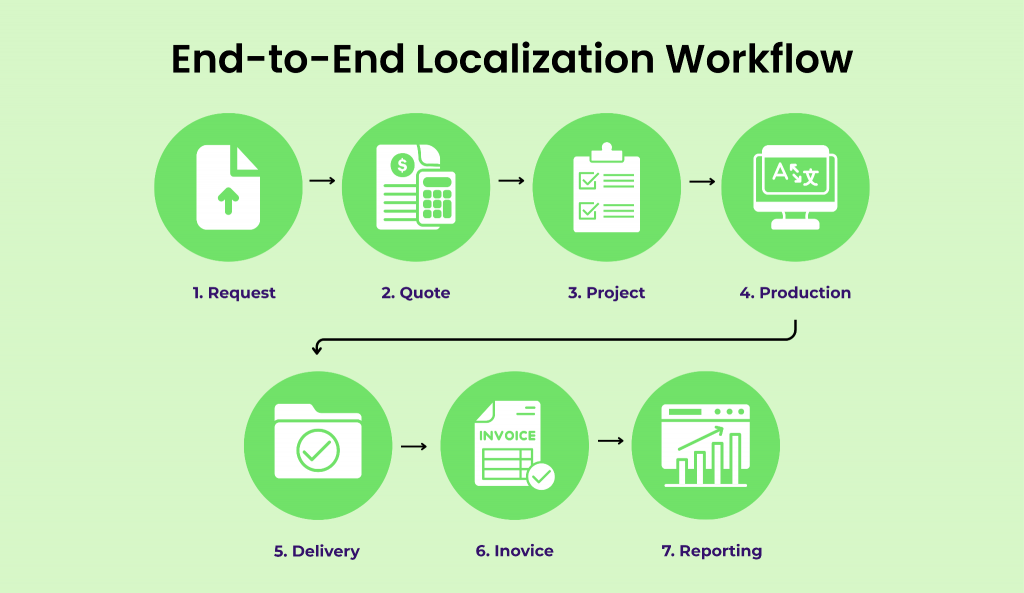
A TBMS like Awtomated does not replace the localization workflow inside a TMS or CAT tool. It orchestrates everything around it so translation projects move cleanly from request to payment.
Imagine a SaaS company preparing a March 2026 release into 10 languages. The project includes software strings, help-center articles, marketing materials, JSON files, XLIFF files, and a few urgent UI fixes from code repositories. Without a centralized system, the work spreads across email, Slack, spreadsheets, and several translation tools. With Awtomated, the operational flow stays visible.
- Request to quote: the client sends files through email or a portal. The TBMS imports the request, captures instructions, and uses analysis data such as word count, repetitions, and fuzzy matches from connected CAT tools.
- Quote to project: once the quote is approved, the TBMS creates the project, confirms service steps, assigns deadlines, and prepares tasks for translation, revision, MT post-editing, DTP, or quality assurance.
- Production: the CAT/TMS environment manages the translation process, while the TBMS monitors progress such as 67% translated or 100% reviewed. Project managers receive alerts if milestones are at risk.
- Delivery and invoicing: the TBMS logs final delivery, issues vendor POs, triggers client invoices, and records costs against the project.
- Continuous improvement: the agency reviews margin, turnaround, vendor performance, and change requests to improve future projects.
Workflow automation in a TBMS includes automatically emailing job offers and routing files. A TBMS enhances collaboration between internal teams, freelancers, and clients because everyone works from clearer assignments, deadlines, and financial rules.
The Business Benefits of Implementing a TBMS Like Awtomated
Machine translation and AI get the headlines, but TBMS platforms often deliver fast ROI because they remove administrative friction. TBMS enables scalable operations without additional administrative staff, especially when agencies manage many small jobs, multiple vendors, and frequent client updates.
The practical benefits include:
- Fewer manual tasks: automating repetitive tasks such as quoting, purchase orders, assignment emails, status updates, and invoices can save hours per project manager each week.
- Better quote accuracy: centralized rate cards reduce underquoting, missed minimum fees, wrong language pairs, and misapplied discounts.
- Stronger margin control: margin tracking by client, language pair, and service type helps leaders revise rate cards, adjust minimums, and negotiate vendor rates.
- Faster turnaround: when project managers are not chasing files and costs manually, they can focus on client communication and risk management.
- Higher reliability: standardized automated workflows reduce human mistakes such as skipping revision, assigning the wrong vendor, or delivering incomplete files.
- Better client experience: clients get faster RFQ responses, clearer delivery expectations, and more transparent progress.
A mid-sized LSP adopting Awtomated in 2025 could reasonably expect, within 6–12 months, shorter RFQ response times and better on-time delivery because many manual processes have been replaced by structured workflows. In markets where gross margins are under pressure, the ability to see profitability clearly matters; the ELIS 2026 report noted translation gross margins around 45% and interpreting margins around 21%, making cost control a daily concern. See Awtomated’s pricing to understand how the platform fits different agency budgets.
Integrations: Connecting Your TBMS to CAT, TMS, and Machine Translation
Today’s LSPs rarely use one platform. They work with CAT tools, TMS platforms, machine translation engines, accounting systems, marketing automation platforms, CRMs, support desks, content management systems, and sometimes code repositories. The role of a TBMS is to connect the business layer without forcing teams to abandon the tools that already work.
Important integration touchpoints include:
- CAT/TMS analysis: import word counts, repetitions, fuzzy matches, match categories, and final files.
- Project creation: create projects from the TBMS and push packages into connected production environments.
- Status sync: bring back progress updates, costs, delivery dates, and revision status.
- Machine translation control: select machine translation engines by client or language pair, distinguish MT post-editing from human-only work, and track MT savings.
- Business systems: connect accounting tools such as QuickBooks or Xero, generic CRMs, helpdesks, and ticketing systems so data flows from contact to invoice without retyping.
- Content operations: a TMS integrates with existing tools like CMS and CRM systems, and a TMS can automate content updates across multiple systems.
A TMS should integrate seamlessly with existing systems via APIs. A TMS integrates with existing systems via APIs to reduce duplicate data entry and improve operational visibility. A TMS must support various content formats like JSON and XLIFF, and a good TMS should support various content formats as content teams localize software strings, web pages, documentation, and apps.
A TMS must provide real-time collaboration features for teams, and TMS integration enhances collaboration among global teams. TMS enhances productivity through real-time team collaboration, while using a TMS reduces the risk of errors through automation. A TMS ensures high translation consistency across all content and speeds up time to market for new products.
For comparison, Plunet integrates with up to 15 different CAT-tools, while Crowdin offers over 600 pre-built integrations with various platforms. Those figures show how integration-heavy the ecosystem has become. Awtomated is designed to sit at the center of this stack, supporting seamless integration with preferred tools while keeping the business record accurate.

Choosing the Right TBMS for Your Language Service Provider
The TBMS market now includes older enterprise systems, lightweight agency tools, and newer cloud platforms like Awtomated built for modern localization workflows and AI-driven translation. The right choice depends less on feature count and more on fit.
When evaluating a management system, look closely at:
- Scalability: can it handle growth from a few dozen projects a month to thousands of short-turnaround jobs? Scalability is crucial when choosing a TMS, and it is just as important when choosing a TBMS.
- Usability: project managers, finance teams, vendors, and clients should understand the system after light training. Cluttered software creates resistance.
- Configurability: the system should support translation, revision, interpreting, DTP, MT post-editing, multiple currencies, taxes, client-specific rate cards, and flexible pricing model rules.
- Integrations: A TMS should integrate well with existing tech stacks, and your TBMS should connect to that ecosystem rather than creating another silo.
- Security: look for encryption, role-based access, audit trails, data residency options, and controls for regulated sectors such as legal, life sciences, and finance.
- Reporting: dashboards should show revenue, margin, utilization, vendor performance, quote response time, on-time delivery, and change requests.
- Support: reliable support, onboarding guidance, documentation, and user forums can make adoption easier.
Shortlist two or three solutions and run a 30-day pilot with real projects. Include Awtomated in that evaluation, especially if your team wants cloud based software that supports long-term localization strategy, global markets, and global growth without adding more project managers. For a deeper framework, read our guide on choosing the right TMS for your LSP.
How Awtomated Helps LSPs Run a More Profitable Translation Business
Awtomated is a TBMS built from the ground up for translation and localization companies. It is not a generic CRM or project management tool repurposed for the language industry. Its purpose is to help LSPs run a more profitable, transparent, and scalable translation business.
Awtomated helps teams by:
- automating quote creation, project setup, task routing, and vendor communication;
- suggesting vendors based on language pairs, subject domains, rates, and performance — see how vendor management works in Awtomated;
- centralizing project status, client history, files, notes, invoices, and vendor POs;
- tracking profitability by project, client, language pair, and service type — powered by Awtomated’s finance management tools;
- complementing existing TMS and CAT tools instead of replacing them;
- giving leaders a single source of truth for finance, operations, and performance.
For a large website localization program, Awtomated can help manage continuous updates from content management systems, route work into the right translation workflows, and keep each client-facing invoice aligned with delivered work. For a high-volume MT post-editing program, Awtomated can separate machine translation jobs from human translation jobs, track vendor cost, and show whether the program is truly profitable.
The result is practical: fewer scattered files, fewer manual processes, clearer margins, and a stronger foundation for future projects.
Frequently Asked Questions (FAQ)
Is a TBMS only useful for large translation agencies?
No. Large agencies adopted TBMS platforms early because they had complex operations, but cloud-based tools like Awtomated make TBMS practical for smaller agencies and even solo project managers. Smaller teams often benefit the most because a TBMS removes many manual tasks and lets them grow without immediately hiring more staff.
A small rollout can begin with clients, projects, quotes, and invoices. As the agency grows, it can add advanced workflows, vendor scoring, finance rules, client portals, and analytics.
Can a TBMS replace my existing CAT tool or translation management system?
No. A TBMS does not replace a CAT tool or translation management system. Linguists still use computer assisted translation tools, translation memory, terminology, quality assurance, and in context editors to produce translated content.
Think of the TBMS as the business brain and the TMS/CAT stack as the production engine. Awtomated coordinates quotes, assignments, vendor costs, invoicing, reporting, and performance around the translation production environment.
How long does it typically take to implement a TBMS like Awtomated?
A basic rollout for a small LSP can take a few weeks. Larger organizations with complex rate cards, many vendors, multiple integrations, and historical data migration may need several months.
The biggest timeline factors are data quality, number of integrations, custom workflows, and team training. A phased rollout works well: start new projects in the TBMS first, then gradually migrate legacy clients and processes.
Does a TBMS support machine translation and AI-driven workflows?
Yes, but usually by coordinating them rather than performing every translation action itself. A TBMS can connect to machine translation engines and TMS platforms, label MT versus human translation jobs, manage MT post-editing as a separate service type, and track MT-related savings.
This helps LSPs automate translations where appropriate while still protecting translation quality, terminology, client rules, and profitability.
What data and KPIs should I track in a TBMS to improve my business?
Track revenue and margin by client, language pair, and service type. Also monitor vendor utilization, project manager workload, quote response time, on-time delivery, cost overruns, and change requests after delivery.Awtomated surfaces these metrics in dashboards so LSPs can refine pricing, staffing, vendor selection, and localization strategy over time. That is the real value of a translation business management system: not just doing the work faster, but understanding the business better. Ready to see it in action? Book a demo with Awtomated and see how a modern TBMS can transform your agency’s operations.
Table of Contents
- Introduction: Why LSPs Now Rely on TBMS Platforms
- What Is a Translation Business Management System (TBMS)?
- TBMS vs. TMS vs. CAT Tools: How They Work Together
- Core Features of a Modern TBMS
- How a TBMS Supports an End-to-End Localization Workflow
- The Business Benefits of Implementing a TBMS Like Awtomated
- Integrations: Connecting Your TBMS to CAT, TMS, and Machine Translation
- Choosing the Right TBMS for Your Language Service Provider
- How Awtomated Helps LSPs Run a More Profitable Translation Business
- Frequently Asked Questions (FAQ)
Ready to manage your Translation company easily?
Get Started for Free