When and How to Hire Your First Project Manager for Your Translation Agency

Key Takeaways
- Most translation agencies should hire their first dedicated project manager when they reach 8–15 active linguists or once monthly revenue consistently passes around $25,000–$40,000.
- A translation PM is not just an administrator handling administrative tasks—they’re the operational owner of timelines, budgets, quality steps, and client communication who ensures timely delivery across complex projects.
- Hiring too late leads to missed deadlines, burned-out linguists, and inconsistent quality, especially when handling large multilingual projects or enterprise clients requiring smooth collaboration.
- Agencies can start with a part-time or freelance PM to test processes, then grow into a full-time in-house role as volume stabilizes and the business matures.
- This article provides a step-by-step process tailored specifically to translation agencies: when to hire, what to look for, how to structure the role, and typical cost ranges for 2024–2025.
Why Translation Agencies Need a Dedicated Project Manager
Most translation agencies start the same way: a founder with language expertise, a handful of trusted freelance translators, and a spreadsheet tracking deadlines. In the early days, this works. You know every client by name, remember each translator’s specialties, and can juggle five or six projects without breaking a sweat.
Then volume grows. Suddenly you’re managing 12 linguists across three time zones, fielding urgent requests while trying to close new business, and spending your evenings chasing file approvals instead of planning strategy. The founder-does-everything model that built the agency becomes the very thing holding it back.
Translation projects are uniquely complex compared to many service businesses. A single project might involve multiple languages, tight deadlines, subject-matter specialization (legal, medical, technical), CAT tools like memoQ or Trados, multiple QA steps, and file engineering for formats like InDesign or JSON. Each language pair needs a qualified translator, possibly an editor, maybe a proofreader. Files need preparation before translation and formatting checks after. Without someone owning this entire process, communication gaps multiply and quality becomes inconsistent.
A dedicated PM centralizes responsibility for scope, deadlines, quality, and communication between clients, translators, editors, and DTP or engineering teams. They become the single point of accountability that ensures nothing falls through the cracks.
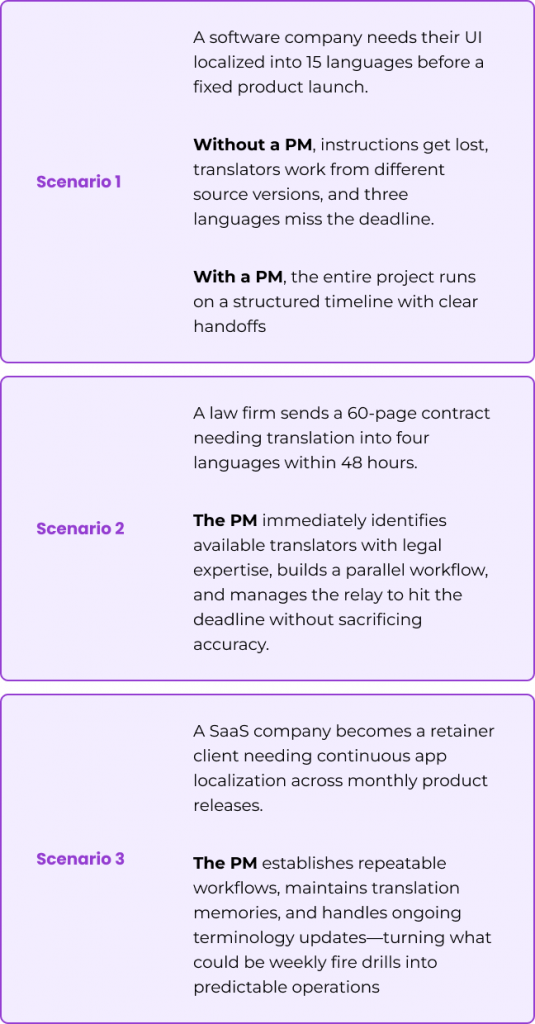
Consider three scenarios where a PM makes the difference between chaos and control:
What a Project Manager Does in a Translation Agency
The translation PM is the “owner” of project delivery from the initial quote through final delivery. This role is distinct from sales (who closes the deal) and production (the linguists doing the translation work). The PM sits in the middle, orchestrating everything that happens between a signed contract and a satisfied client.
Core responsibilities tailored to translation agencies include:
Analyzing client requests: The PM reviews source files, assesses complexity (legal terminology, technical content, marketing tone), identifies the number of languages, evaluates urgency, and gathers reference materials. They extract requirements for terminology, style guides, and any localization testing needs.
Building quotes and schedules: Using word counts, linguist rates, tool costs, and QA stages, the PM creates realistic timelines with appropriate buffers. They coordinate DTP or engineering where file formats require it.
Selecting translators, editors, and proofreaders: The PM matches linguist expertise to project requirements, checking availability and turnaround capacity. They manage the vendor pool and maintain relationships with reliable resources.
Managing CAT and TMS workflows: Setting up projects in systems like Trados, memoQ, Phrase, or Smartling; importing translation memories; managing termbases; ensuring version control; and handling file format interoperability (XLIFF, IDML, JSON, HTML).
Overseeing QA: The PM establishes quality checkpoints, runs QA tools, reviews outputs against style guides, ensures consistency across languages, and updates TMs with approved content.
Handling delivery and feedback: Ensuring final formats meet specifications, managing client review cycles, coordinating revisions, and running post-project reviews to improve future performance.

In small agencies, the PM coordinates directly with the founder on sales handoffs and may handle some vendor management themselves. As agencies grow, these functions separate—but the PM remains the operational hub connecting sales, linguists, quality assurance, and finance.
The PM also prepares and maintains translation memories and termbases, checks client style guides before projects begin, and plans technical steps for specialized file formats. Whether handling recurring work for retainer clients (monthly word volumes, ongoing product releases) or one-off projects with unique requirements, the PM adapts workflows to match.
How Translation PMs Structure Projects
Translation projects typically follow established workflows that PMs select based on content type, quality requirements, and budget:
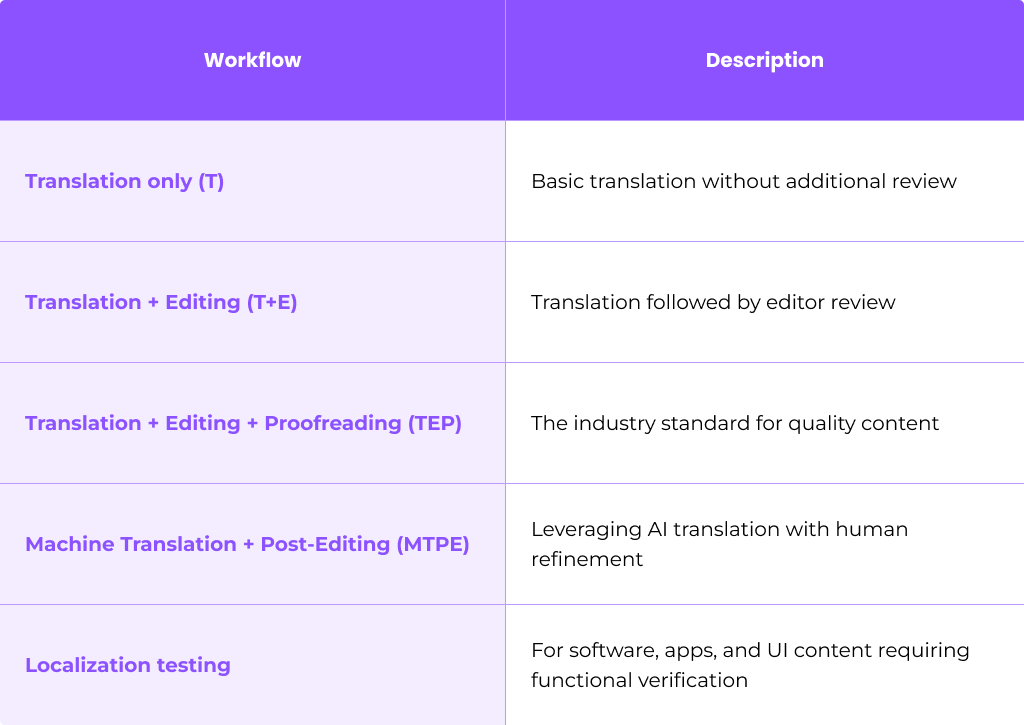
PMs break projects into phases with specific dates: file analysis, translation, editing, proofreading, DTP, internal QA, and client review. Each phase has owners, deadlines, and handoff criteria.
Example timeline for a 20,000-word marketing brochure translated into 6 languages with TEP and DTP:
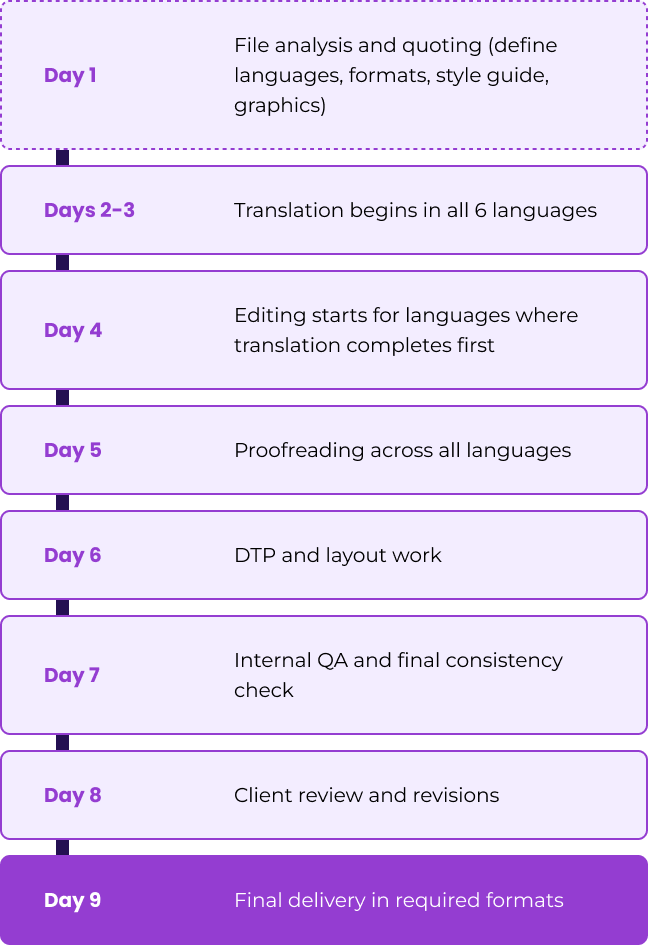
The PM manages overlaps—editing can begin on completed languages while others are still in translation. Buffers protect against unforeseen issues without derailing the launch date.
Modern PMs use CAT tools and TMS platforms to assign linguists, track progress, monitor TM usage, maintain glossaries, and generate reporting dashboards. This technology backbone enables them to manage multiple projects simultaneously without losing visibility.
PM’s Role in Quality and Client Experience
Translation quality isn’t solely a linguist issue. PMs design the processes that make quality repeatable across hundreds of projects and dozens of languages.
The PM enforces consistent use of translation memories, termbases, and style guides. When a client has established terminology (“user” versus “customer,” specific product names), the PM ensures every linguist working on that account follows the same conventions. This keeps brand voice consistent across languages and over time.
Client review cycles are another PM responsibility. They collect feedback, update TMs with approved changes, and implement systems to prevent repeated errors. If a client corrects a term in January, that correction should appear automatically in March’s project—not require another round of feedback.
For clients, the PM serves as the single point of contact during project execution. They provide status updates, manage expectations when scope changes, and handle escalations calmly. Consider these scenarios:
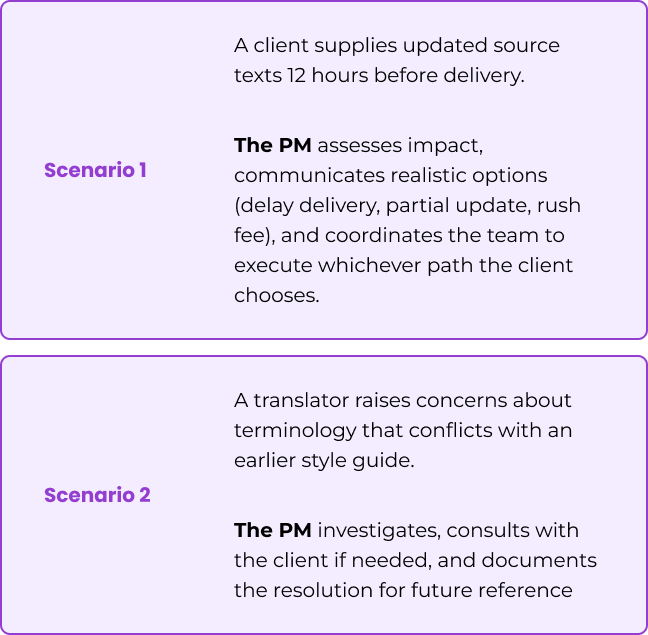
Effective communication with key stakeholders transforms a translation vendor relationship into a trusted partnership.
When to Hire Your First Project Manager for a Translation Agency
Timing your first PM hire is critical. Hire too early and you strain cash flow with an underutilized resource. Hire too late and you damage your reputation with missed deadlines, burn out your team, and lose clients to preventable quality issues.
Early stage indicators (PM may be premature):
- Founder managing everything with under 5 regular translators
- Revenue below approximately $20,000 per month
- Projects are straightforward with 1-3 languages
- Workload is manageable within normal business hours
At this stage, hiring a full-time PM may not make financial sense. The founder can still maintain visibility and control without excessive strain.
The tipping point (time to seriously consider a PM):
- 8–15 active linguists whose schedules you’re coordinating
- At least 15–20 concurrent projects per month with overlapping deadlines
- Consistent monthly revenue around $25,000–$40,000 (2024 benchmarks)
- Multi-language projects becoming the norm rather than the exception
- Introduction of enterprise clients with structured requirements
Warning signs you’ve waited too long:
Late deliveries become common rather than exceptional. The founder spends most of the week in email and file wrangling instead of sales and strategy. Translators complain about unclear instructions or missing reference materials. Clients push for status updates daily because they don’t trust the process. Rework rates climb, forcing discounts to retain unhappy customers.
If you’re landing your first enterprise client—say, a multinational needing regular localization into 8+ languages—plan your PM hire before or immediately after contract signing. Even if volumes will ramp over 3–6 months, having the PM in place early ensures smooth collaboration from day one.
Milestones That Trigger the Need for a PM
Beyond general growth indicators, specific operational milestones signal that hiring a project manager has become urgent:
Word volume threshold: When you’re processing more than 50,000–75,000 words per month in complex subject areas (legal, medical, technical), the coordination burden exceeds what founders can handle alongside other responsibilities.
Language complexity: Projects involving 10 or more languages with overlapping phases (translation, editing, proofreading, DTP all happening simultaneously) require dedicated coordination to prevent errors and delays.
Rush frequency: When urgent projects number 3-4 per week, normal workflows are repeatedly disrupted. A PM can triage priorities and protect planned work from constant interruption.
Tool implementation: Introducing a TMS or upgrading CAT workflows creates a trigger. Someone must own tool configuration, templates, terminology management, and automation. This is project management at the infrastructure level.
Major contract wins: Winning a big tender or framework agreement in 2024–2025 should come with a PM hire planned in the same quarter. Successful implementation of enterprise contracts depends on operational excellence from day one.
Here’s a practical litmus test: if you cannot take a vacation without deadlines slipping, the project manager role is overdue. Your business shouldn’t depend on your constant presence to function.
Full-time, Part-time, or Freelance for Your First PM?
Many translation agencies start with a part-time or freelance project manager before committing to a full-time hire. This approach minimizes risk while testing whether dedicated coordination actually improves operations.
When freelance project managers make sense:
- Irregular project volume with peaks and valleys
- Testing the role after signing your first large client
- Budget constraints during the first 1–2 years of scaling
- Needing specific expertise for a particular project type
Freelance or part-time arrangements offer lower fixed costs and flexibility. However, they can mean less availability during crunch periods and potentially less ownership of process improvements.
When a full-time in-house PM is justified:
- Stable monthly revenue at levels supporting US$80,000–$110,000 total compensation
- Predictable project pipeline with consistent weekly/monthly volumes
- Clear growth plans for new languages or services (subtitling, localization testing, multimedia)
- Enterprise clients requiring dedicated account-level coordination
Hybrid arrangements work well for agencies in transition. Employing a PM three days per week for the first six months allows you to test processes, document workflows, and validate ROI before committing to full-time overhead.
The key question: does your current and projected workload justify a full-time salary? If your new resources and expanding client base indicate sustained growth, full-time brings stability and deeper investment in your operations.
What to Look For in a Translation Project Manager
Translation PMs need a specific blend of linguistic understanding, technical fluency with industry tools, and strong communication skills. Generic project managers from construction project management or IT backgrounds often struggle with the unique demands of localization workflows.
Prior experience at a language service provider or in-house localization team (at a SaaS company, gaming studio, or e-commerce platform) typically matters more than years of general project management experience. These candidates understand the terminology, workflows, and client expectations specific to translation.
For a first hire in a small agency, versatility trumps narrow specialization. Your new project manager will wear many hats: scheduling, QA coordination, client communication, and basic vendor management. They need a strong understanding of the big picture rather than deep expertise in one narrow area.
While PMP or Prince2 certifications can help demonstrate structured thinking, practical hands-on experience with translation workflows, CAT tools, and managing tight deadlines typically matters more. Don’t filter out excellent candidates simply because they lack formal credentials.
Industry and Language Background
Familiarity with translation and localization fundamentals is non-negotiable. Candidates should know terms like TEP, MTPE, TM, TB, and LQA without explanation. They should be comfortable discussing project methodologies with both translators and clients.
Look for candidates who have previously worked at an LSP between 2018 and 2024, or in an internal localization team for software, gaming, e-commerce, or manufacturing companies. This experience provides understanding of real-world challenges: handling source file changes, managing terminology disputes, and coordinating cross-functional teams across time zones.
Being bilingual or having formal language education helps candidates understand translator perspectives, but the PM doesn’t need to be a top-tier linguist themselves. Their job is coordination and delivery, not translation.
Specialization matters for niche agencies. If your company focuses on legal or medical translation, experience with regulated content carries extra weight. A PM who has navigated FDA submission requirements or legal discovery processes brings valuable domain expertise.
Example candidate profiles:
- 4 years at a mid-sized LSP handling software localization for European languages, experienced with Phrase and memoQ, familiar with continuous delivery workflows
- 3 years in-house at an e-commerce company managing website and marketing localization into 12 languages, transitioned from senior translator role
Tool Skills: CAT, TMS, and File Handling
Translation PMs must be comfortable with industry-standard tools beyond email and spreadsheets. Technical skills in this domain mean knowing how localization technology works.
Essential CAT/TMS platforms include Trados Studio, memoQ, Phrase, Smartcat, Smartling, and Lokalise. At minimum, a PM should be able to:
- Create projects and configure settings
- Assign linguists and set deadlines within the system
- Manage translation memories and termbases
- Run basic QA checks using built-in tools
- Export deliverables in required formats
File engineering skills matter for agencies handling diverse content. PMs should understand handling formats like DOCX, PPTX, XLSX, IDML (InDesign), HTML, JSON, and XLIFF. They need to ensure nothing breaks during file preparation or delivery—a corrupted tag or missing placeholder can derail an entire project.
Evaluation approach: During interviews, ask candidates to explain how they would set up a multi-language project in a tool your agency actually uses. Their response reveals both technical competence and problem-solving approach.
Organizational and Communication Skills
In translation agencies, organizational skills mean juggling many small and medium projects with overlapping deadlines, multiple teams, and various language combinations. The PM must manage priorities constantly—urgent rush jobs versus larger planned projects—while communicating realistic timelines to clients.
Time management becomes critical when handling 15-20 concurrent projects. The PM needs systems for tracking project progress, identifying bottlenecks early, and optimizing resources across competing demands.
Written clarity directly impacts quality. Instructions to translators and editors must minimize ambiguity around word counts, reference materials, formatting expectations, and delivery requirements. Vague briefs create questions that delay projects and introduce errors.
Soft skills under pressure: The right project manager stays calm when things go wrong. They provide proactive status updates rather than waiting for client inquiries. They negotiate deadlines or scope changes when clients modify requirements mid-project.
Communication scenarios a strong PM handles well:
- Rush request: Client needs a 5,000-word document in 24 hours. The PM assesses feasibility, identifies available linguists, quotes appropriately, and sets clear expectations about what’s achievable.
- Quality complaint: Client flags errors in delivered content. The PM acknowledges the issue, investigates root cause, coordinates corrections, and implements process changes to prevent recurrence.
- Scope creep: Client adds two languages mid-project. The PM recalculates timeline and budget, communicates impact clearly, and adjusts resource allocation accordingly.
Risk Management and Problem-Solving in Localization
Translation projects contain predictable risks: source file changes, terminology disputes, last-minute language additions, technical issues, and linguist availability problems. Good PMs anticipate these risks through meticulous planning and build contingencies into their processes.
Risk identification strategies:
- Build buffer time into schedules (typically 10-15% of total timeline)
- Clarify review responsibilities and approval chains before project start
- Double-check file integrity before sending to linguists
- Maintain backup linguist relationships for critical language pairs
Real-world problems and effective PM responses:
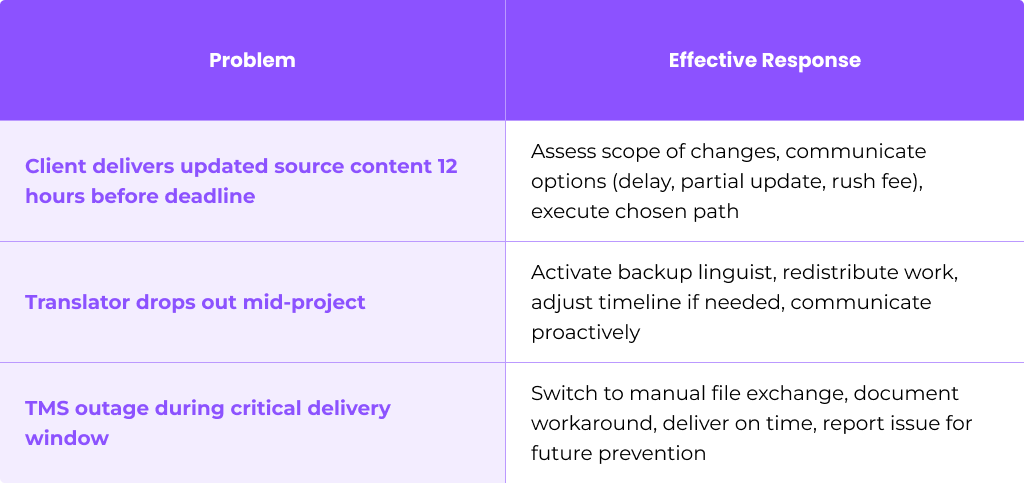
Using simple risk logs or checklists—even in Excel or basic project management tools—reduces surprises significantly. The PM who tracks potential risks and mitigation plans demonstrates the informed decisions that separate adequate coordination from excellent project management.
How to Structure the PM Role in a Growing Translation Agency
Your first PM hire shapes how operations run for years. Role design matters as much as finding the right person.
In agencies under 20–30 people, the first PM typically fills a hybrid role combining pure project coordination with vendor management, basic QA oversight, and some account management. This versatility is necessary when the executive team is small and functions overlap.
A day in the life of a translation PM at a 10–20 person agency might look like:
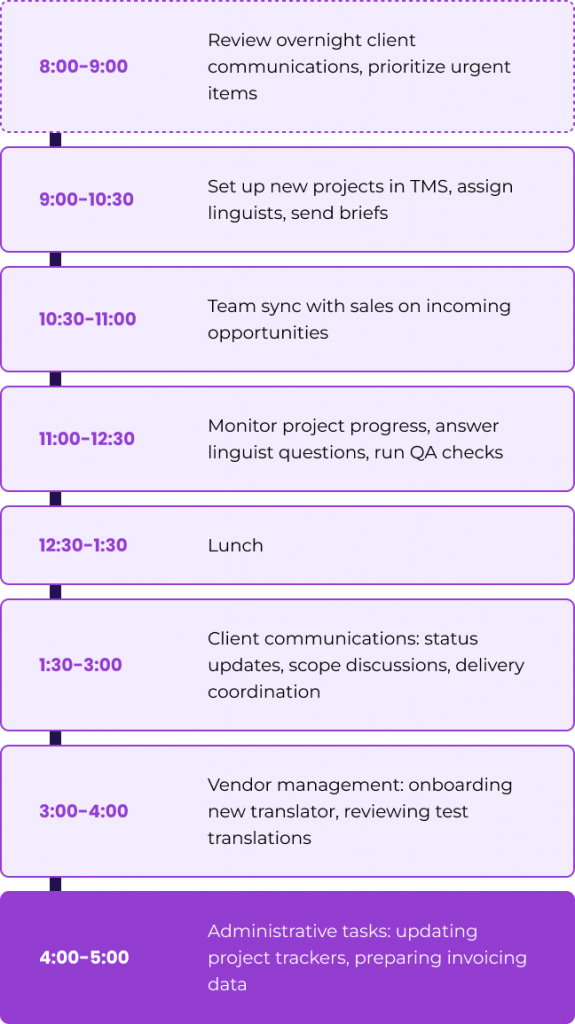
As the agency grows, responsibilities evolve. First PM does everything operational; later PMs may specialize by client vertical, language group, or service line (multimedia localization, subtitling, software localization). Documenting the project manager role clearly from the start enables this future specialization.
Even in small teams, written responsibility documentation ensures sales, founders, and linguists know exactly what the PM owns—and what falls outside their scope.
Reporting Lines and Collaboration
In agencies up to approximately 25 people, the PM typically reports directly to the founder or operations director. This provides close alignment on priorities and quick escalation paths for client issues.
As organizations grow, reporting may shift to a Head of Production or PMO, with the PM focusing more narrowly on execution while senior leadership handles strategy and major client relationships.
Daily collaboration patterns:
- Sales/Account Management: Handover meetings for new projects, scope clarification, client relationship context
- Vendor Management: Linguist availability checks, new resource onboarding, performance feedback
- Finance: Budget tracking, margin monitoring, invoicing data preparation
Weekly or bi-weekly internal pipeline meetings help the PM review upcoming projects and flag resourcing risks before they become emergencies. These meetings ensure smooth collaboration between departments.
Example escalation scenario: A major client requests significant scope changes mid-project. Clear reporting lines determine whether the PM can approve changes independently, needs sales involvement for pricing discussions, or requires founder approval for deadline adjustments. Ambiguity here creates confusion and delays.
KPIs and Success Metrics for Your First PM
Defining success early helps your new project manager focus and allows the agency to measure ROI on the hire.
Relevant KPIs for translation agencies:
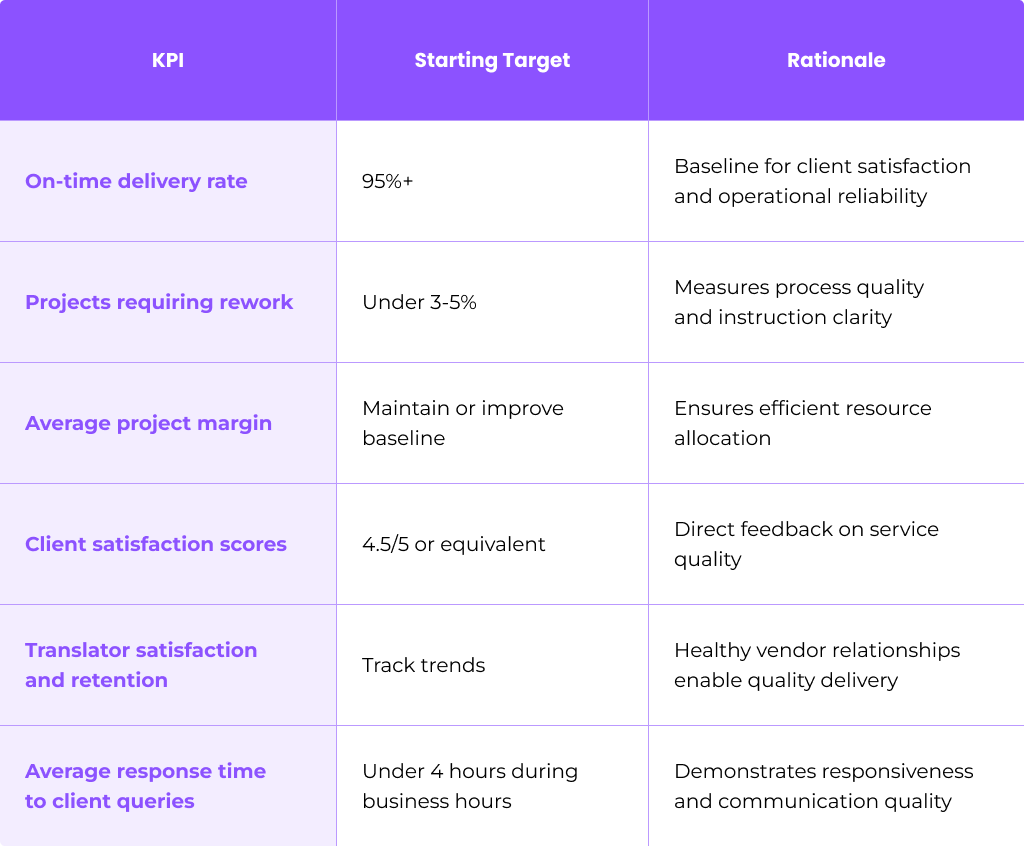
In the first 3–6 months, the most important outcome is often stability: fewer emergencies, fewer missed deadlines, and clearer communication. Revenue growth and margin improvement typically follow once operations stabilize.
Review KPIs quarterly and adjust targets as the agency introduces new services or higher volumes. A PM who consistently hits targets deserves recognition; one who struggles may need additional training, clearer processes, or in some cases, role reconsideration.

Step-by-Step: How to Hire Your First Translation Project Manager
Treat your first PM hire as a strategic decision, not a quick back-office addition. A rushed hire can create more chaos rather than solving it.
The main steps in the hiring process:
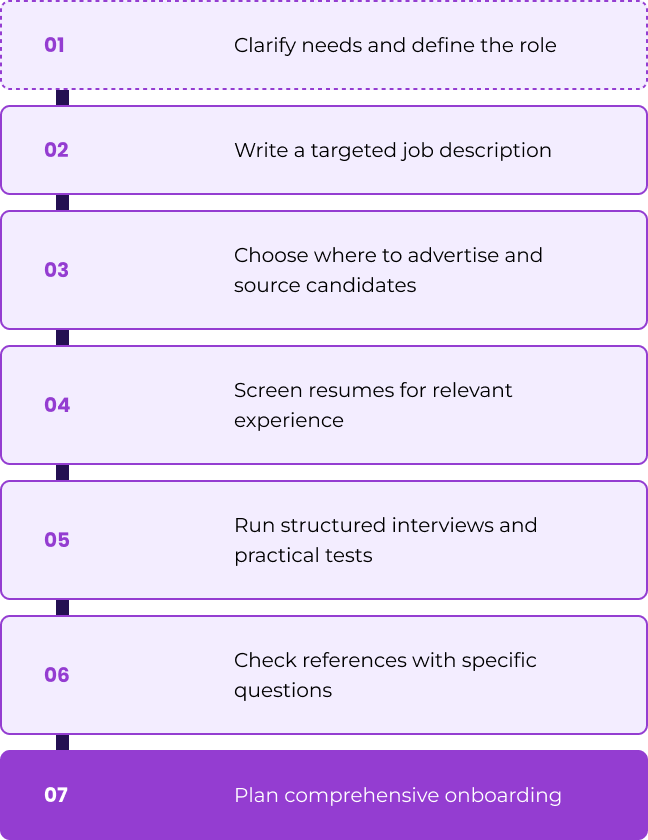
Expect this process to take 4–6 weeks from job posting to accepted offer, plus 2-4 weeks for notice periods. Planning ahead prevents desperate hiring when you’re already overwhelmed.
Define the Role and Requirements
Start by translating agency pain points into clear role objectives. If late deliveries are the primary problem, emphasize scheduling and deadline management. If quality inconsistency is the issue, prioritize QA coordination and linguist instruction clarity.
Create a one-page role summary specifying:
- Scope of responsibility (which clients, project types, languages)
- Key workflows the PM will own (marketing localization, legal translation, software strings)
- Tools used (specific CAT/TMS platforms)
- Expected workload (projects per week, languages handled)
- Reporting structure and collaboration requirements
Prioritize requirements:Example requirements for a 2024 tech/marketing focused translation agency:
- 3+ years localization or translation PM experience
- Demonstrated experience using Phrase, Trados, or memoQ
- Familiarity with JSON, XLIFF, and software resource file workflows
- Experience handling projects in 5+ languages simultaneously
- Experience with continuous delivery clients (SaaS, product updates)
- Vendor management experience with freelance linguist pools
- Based in or willing to work European or US time zone hours
Set a clear seniority level with realistic expectations. A junior PM needs more supervision and handles smaller projects; a mid-level PM should operate independently within defined processes.
Write a Targeted Job Description
Transform your role definition into a job description that attracts experienced translation PMs while filtering out generic applicants.
Include these elements:
Agency introduction: Brief description of your niche, key languages, typical clients, and company culture. Translation PMs want to know what kind of work they’ll manage.
Main responsibilities: Specific tasks using concrete language. Instead of “manage projects,” write “coordinate TEP workflows for marketing content across 8 European languages.”
Tool stack: Name the specific platforms (Phrase, memoQ, Trados) used since at least 2020. Candidates self-select based on their expertise.
Required and preferred experience: Distinguish must-haves from nice-to-haves clearly.
Working model: Remote, hybrid, or in-office expectations, including time zone requirements.
Compensation: Include salary range if possible; this saves time for everyone.
Sample job description paragraph:
“We’re a growing translation agency specializing in tech and marketing content for European and APAC markets. You’ll manage 15-25 projects monthly using Phrase TMS, coordinating translators across 12 language pairs. The ideal candidate has 3+ years at an LSP, can structure complex projects from complex briefs, and communicates clearly with both clients and linguists. This is a remote role requiring 4+ hours of overlap with Central European time.”
Highlight growth opportunities: building the PM function, implementing new project management tools, or leading junior PMs as the team expands.
Where and How to Find Candidates
Specialist sourcing channels:
- Localization job boards: Localization Jobs, ProZ Jobs, TranslatorsCafe, L10nJobs
- Professional networks: LinkedIn localization groups, GALA member directories
- Industry forums: ProZ forums, Reddit r/localization, Slack communities
- Referrals: Ask existing linguists for PM recommendations; translators often know skilled project managers
Many experienced translation PMs work remotely across Europe, Latin America, and Asia as of 2024–2025. Opening your search beyond local candidates significantly expands the talent pool and can optimize costs.
Direct outreach on LinkedIn works well for passive candidates. Search for people with “localization project manager” or “translation PM” titles who have handled similar content and language combinations. A personalized message referencing their specific experience outperforms generic job blast emails.
Industry events—both in-person conferences and virtual meetups related to localization and translation technology—provide networking opportunities. Attendees at LocWorld or GALA conferences are often experienced PMs open to new opportunities.
Interviewing and Testing Translation PM Candidates
Structure interviews around real translation project scenarios rather than generic PM theory. You need to assess whether candidates can handle your specific challenges.
Two-step interview process:
Effective interview questions:
- “Walk me through how you handled a situation where a client changed the source file significantly just before the deadline.”
- “Describe a time when a translator and editor disagreed about terminology. How did you resolve it?”
- “Your TMS goes down 3 hours before a major delivery. What do you do?”
- “A new enterprise client wants to start with a 50,000-word project in 10 languages in two weeks. How do you assess feasibility?”
Practical task example:
Provide a mock brief: “Client needs 15,000 words translated from English into German, French, Spanish, and Japanese. Content is a software user manual. Deadline is 10 business days. They’ve provided a glossary and previous translations in TM.”
Ask candidate to:
- Create a project timeline with phases
- Identify key risks and mitigation strategies
- List questions they would ask the client before starting
- Draft the project kickoff email to the client
Use a consistent scoring rubric comparing candidates on communication clarity, realism of schedules, risk awareness, and tool familiarity.
Onboarding Your First PM Effectively
Even top talent needs structured onboarding to understand your clients, tools, and workflows. Don’t assume experience elsewhere translates immediately to your environment.
30-60-90 day onboarding plan:Documentation priorities:
Create or refine standard operating procedures for quoting, project setup, QA steps, and delivery. Have the new PM help improve these documents—fresh eyes often spot inefficiencies that insiders miss.
Early feedback loops:
Schedule weekly check-ins during the first 2–3 months to remove roadblocks, align expectations, and address issues before they become problems. These conversations also help founders release control gradually rather than micromanaging.
Example 90-day progression for a PM joining a 10–15 person translation agency:
- Week 1-2: Tool training, client portfolio review, shadow existing project workflows
- Week 3-4: Manage 3-5 small projects end-to-end with founder oversight
- Week 5-8: Take ownership of 8-10 projects weekly, begin direct client communication
- Week 9-12: Manage full project load independently, identify first process improvement initiative
How Much Does It Cost to Hire a Translation Project Manager?
Compensation varies significantly by region, experience level, and remote versus on-site arrangements. Plan realistically to attract capable candidates.
2024-2025 annual salary benchmarks:
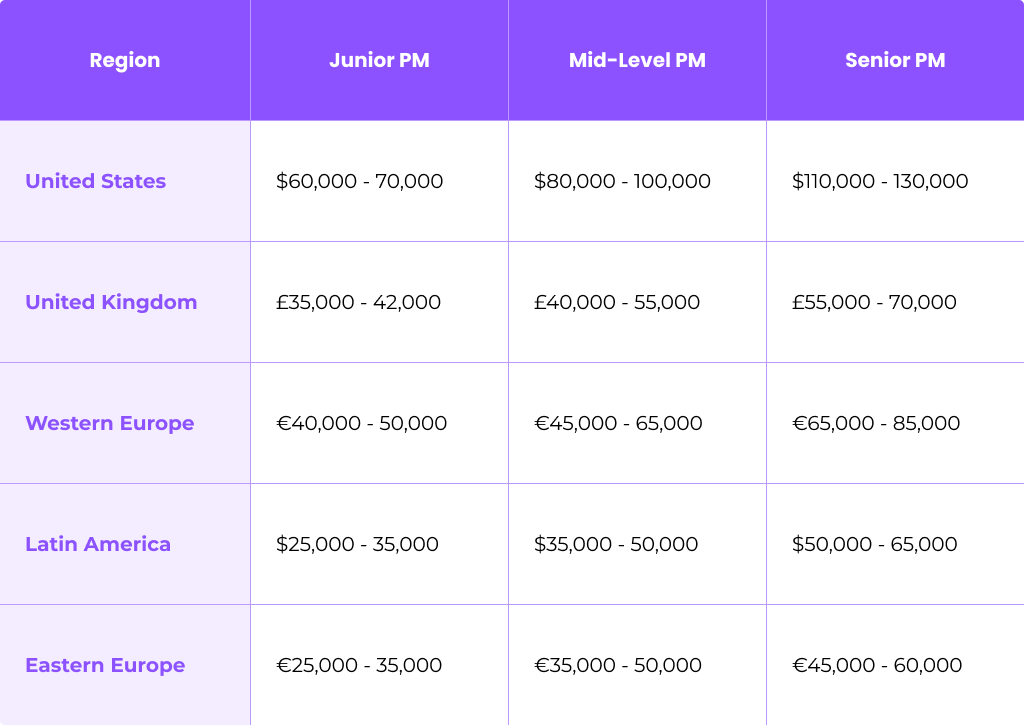
Remote hiring from Latin America, Eastern Europe, or Asia can optimize costs while accessing experienced talent. Time zone management becomes the primary challenge rather than compensation.
Freelance and part-time alternatives:
Experienced freelance PMs in the US and Western Europe typically charge $40-70 per hour for part-time work. Rates in lower-cost regions are proportionally lower. This model works well for testing the role or handling peak periods without full-time commitment.
Total cost considerations beyond base salary:
- Employer taxes and benefits (typically 20-30% on top of salary)
- Software licenses and tool access
- Training and professional development
- Remote work stipends if applicable
- Potential bonuses tied to project margins or client satisfaction
Including these factors, a full-time PM may cost 1.2–1.5× the base salary in total cost burden.
Evaluating ROI on Your First PM Hire
Track whether your PM is “paying for themselves” within the first 6–12 months through operational improvements and founder time liberation.
ROI indicators to monitor:
- Fewer missed deadlines: Track on-time delivery rate before and after hire
- Less founder involvement: Measure hours spent on project coordination weekly
- Improved client retention: Monitor client churn and satisfaction scores
- Higher project margins: Analyze profitability with reduced rework and discounts
Time value calculation:
If the PM frees 15-20 hours per week of founder time, and that time is worth $100-150/hour in sales activities or strategic work, the freed capacity equals $6,000-12,000 monthly. A PM costing $7,000-9,000 monthly in total compensation is justified if they enable this shift.
Numeric example:
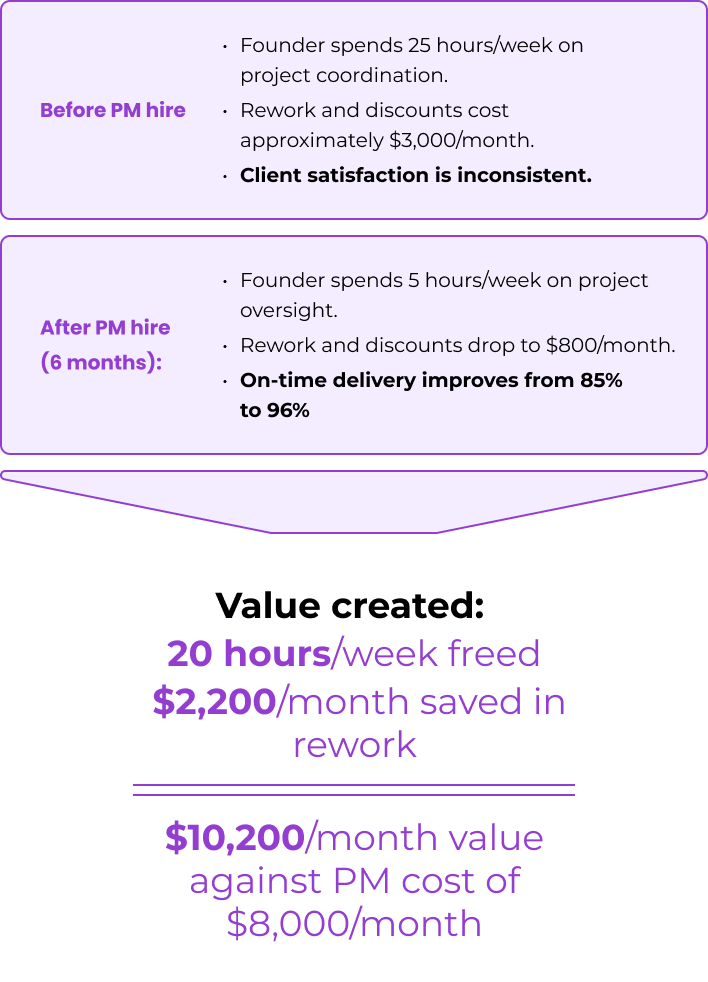
Review these metrics at 6 months and adjust responsibilities or processes if ROI isn’t yet visible. Some agencies need process documentation before PM impact materializes fully.
FAQ
Do I need a project manager if my translation agency is still under 10 people?
For agencies under 10 people, hiring a full-time PM is optional but can be justified if projects are complex, span many languages, or involve heavily regulated fields like legal or medical content. The real trigger is workload and complexity, not headcount alone.
Monitor how much time founders spend on coordination versus sales and strategy. If coordination consumes more than 50% of the founder’s week, a part-time or freelance PM may be appropriate even at smaller scales. Otherwise, the investment may be premature.
Should my first PM be local or can they work fully remotely?
Many experienced translation PMs work effectively across time zones in remote work arrangements. Remote hiring can be highly effective if you have clear communication tools, documented processes, and reasonable expectations for availability during client business hours.
Local or similar-time-zone PMs are particularly helpful when most clients are in one region and expect real-time communication. If your clients are primarily in Europe but your only PM candidate is in Asia with minimal overlap, responsiveness may suffer.
Is a formal project management certification necessary for a translation PM?
Certifications like PMP or Prince2 demonstrate structured thinking and theoretical knowledge, but they’re not mandatory for translation PM roles. Hands-on experience in a translation or localization environment typically matters more for a first PM hire.
Prioritize candidates who can share specific project stories, demonstrate practical tool skills, and explain how they handled real challenges. Someone with five years of successful implementation at LSPs but no certification often outperforms a certified candidate with no localization experience.
Can a senior translator transition into the project manager role?
An experienced translator who understands workflows, tools, and client expectations can successfully transition to PM if they enjoy coordination, communication, and managing team dynamics rather than doing translation work themselves.
Test the transition gradually: assign partial PM responsibilities like scheduling, client updates, and quality coordination. Observe how they handle the shift from individual contributor to coordinator. Some excellent translators discover they prefer production work; others thrive in the expanded role.
How long does it usually take for a new PM to become fully effective?
Most translation PMs need approximately 2–3 months to learn an agency’s tools, clients, and processes well enough to operate with minimal supervision. Full effectiveness—handling complex projects, making informed decisions independently, and driving process improvements—typically requires closer to 5–6 months.
During this period, provide structured onboarding with clear goals, regular feedback sessions, and access to documented procedures. Agencies that invest in thorough onboarding see faster PM productivity and better retention. Rushing this phase often leads to costly mistakes and PM frustration.
Table of Contents
- Why Translation Agencies Need a Dedicated Project Manager
- What a Project Manager Does in a Translation Agency
- When to Hire Your First Project Manager for a Translation Agency
- What to Look For in a Translation Project Manager
- How to Structure the PM Role in a Growing Translation Agency
- Step-by-Step: How to Hire Your First Translation Project Manager
- How Much Does It Cost to Hire a Translation Project Manager?
- FAQ
Ready to manage your Translation company easily?
Get Started for Free