How to Set Up a Translation Agency from Scratch in 2026: The Step-by-Step Operational Playbook
Key Takeaways
- You can launch a lean translation business in 30–60 days with a laptop, clear niche, professional website, and small remote team.
- Choosing the right business structure, pricing model, and technology stack, including a TMS like Awtomated, is critical to profitability.
- Specialization in legal, technical, financial, medical, or literary translation beats trying to serve every client, market, and language.
- This step by step guide is for future Language Service Providers building scalable translation services, not just freelance translation work.
- Quality, security, client communication, and automation are now core to business success.
Introduction: Why 2026 Is a Prime Year to Start a Translation Agency
Translation is not shrinking because of AI. It is changing shape. The global language services market is forecast to keep growing, with some industry projections putting the market above $90 billion before 2029; meanwhile, translation services will grow by 19% annually by 2028, and by 2028, translator demand is expected to grow by 19% annually. AI, machine translation, and human review are becoming one workflow.
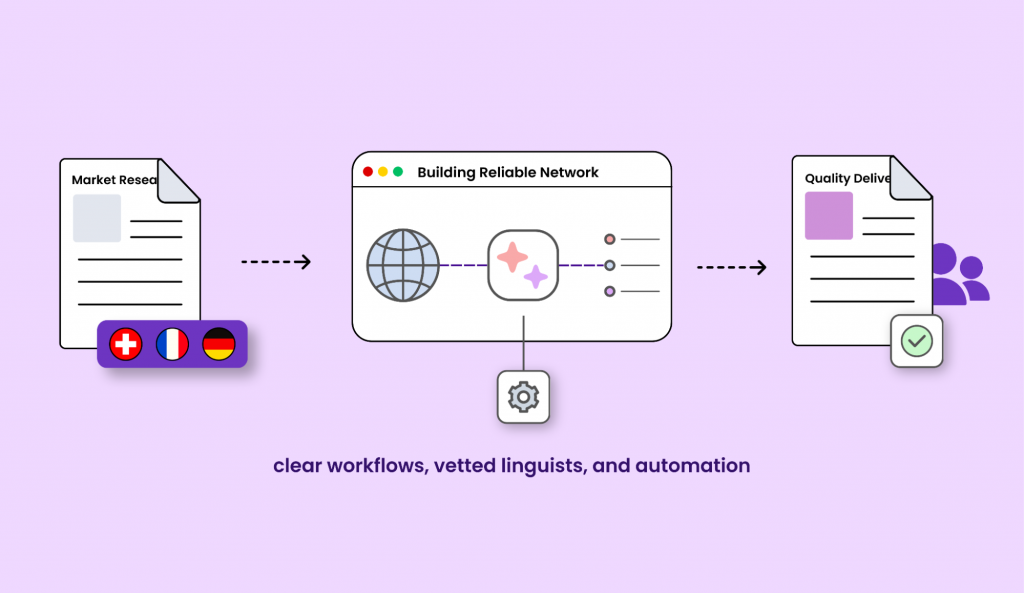
From Awtomated’s perspective, the barrier to entry is lower than ever: remote teams, SaaS tools, CAT tools, global demand, and access to language professionals everywhere. But the main thing separating a successful translation business from a fragile one is operational excellence: clear workflows, verified translators, quality assurance, and secure handling of sensitive client information.
A translation agency, or LSP, manages clients, translators, editors, files, deadlines, reference materials, and quality across many projects. With focus, a basic agency can be operational in 4–8 weeks; full maturity usually takes 12–24 months.
Decide If Running a Translation Agency Is Really Your Own Business Goal
Running your own business is different from being a freelance translator. A solo literary translation freelancer may translate poems, novels, and plays per word. An agency owner may coordinate 20 linguists across legal translation, marketing localization, and financial translation projects.
The upside: scalable revenue, employees, larger contracts, a sellable business asset, and the ability to work with larger customers or other translation agencies. The downside: margins are often 8–20%, clients expect high-quality translations from agencies, and you carry responsibility for deadlines, inaccurate translations, professional negligence, and communication.
Ask yourself:
- Do I enjoy sales, delegation, and problem-solving?
- Do I have language skills, language proficiency, and business acumen?
- Can I protect quality while managing cost, pay, and workload?
- Am I ready to build systems, not just translate?
Superior communication skills are crucial for client relations, and client communication is crucial for ensuring clarity in translation expectations.
Choose Your Translation Agency Model and Niche
Single-language vendors translate text into one language only. An SLV might focus on EN–ES and sell to regional clients or larger MLVs. Multilingual vendors translate text into multiple languages simultaneously, often adding localization, DTP, subtitling, and testing.
Choose a specialization for your translation agency early because choosing a niche influences your workflow and client expectations. Legal translation includes court transcripts and notarized documents. Technical translation covers manuals and safety data sheets. Financial translation requires knowledge of industry-specific terms. Literary translation involves translating poems, novels, and plays.
Validate demand by checking RFP portals, LinkedIn posts, ProZ, Upwork, and 5–10 competitors. The translation market is highly fragmented with thousands of vendors, so specializing in a niche can differentiate your services from competitors. Specializing in high-value fields can command higher translation rates if you price your services correctly from the start.
Define Services, Quality Levels, and Business Structure
Before registration, define what the translation company will sell: translation, editing, proofreading, MTPE, interpreting, desktop publishing, localization testing, transcreation, and certification support.
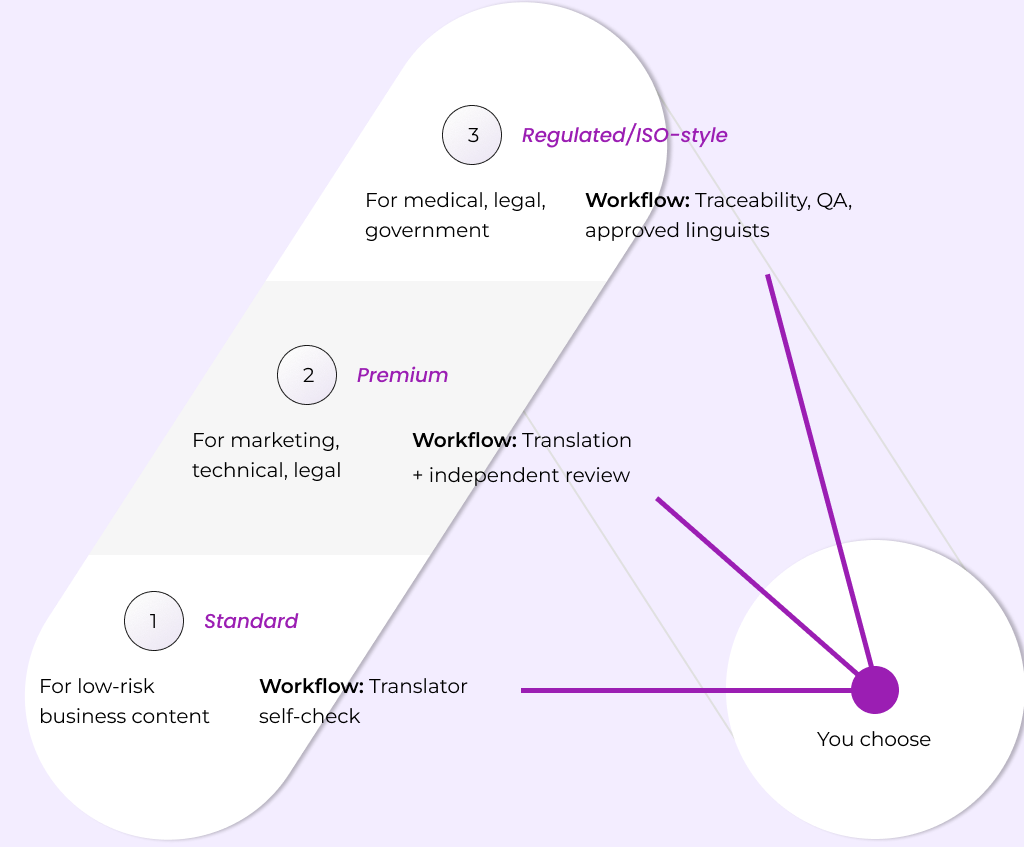
ISO 17100:2015 is a standard for translation service quality, and ISO 17100:2015 is the industry standard for translation services. Quality assurance processes enhance the reliability of translation services.
Choosing a business structure is essential when starting a translation agency. A sole trader has full control over operations, and sole traders must register for Self Assessment with HMRC. Limited companies provide limited liability for business debts, and limited companies can access tax-saving benefits. In the US, many founders choose an LLC or S-Corp; in the EU, GmbH or SRL equivalents are common. Choosing a business structure affects liability and credibility, so consult a local accountant.
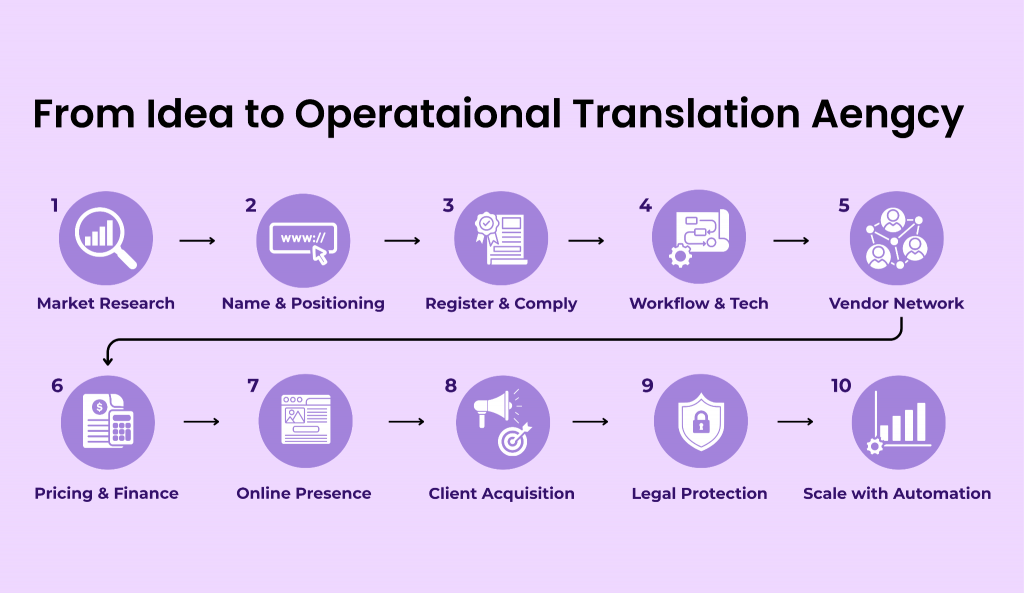
Step-by-Step Guide: From Idea to Operational Translation Agency
This is the practical path from idea to first B2B clients. Starting a translation agency requires a mix of linguistic expertise and operational workflows. We mention Awtomated where a modern TMS can reduce admin.
Step 1: Conduct Market Research and Draft a Focused Business Plan
Research demand using LinkedIn Sales Navigator, ProZ, Upwork, tender portals, and industry reports. Define target market, geography, language pairs, buyer personas, pricing, and financial goals. Map 5–10 competitors, note their services, rates, and positioning. Include hiring milestones for your first PM, vendor manager, and sales support.
Step 2: Choose a Name, Brand Positioning, and Domain
Choose a name that is easy to pronounce, available as a domain, and not locked to one language. Create a positioning line: “We help EU fintech teams localize compliance content into German and French.” Buy the domain, create branded email, and keep the logo simple but professional. A business card still helps at conferences.
Step 3: Register the Business, Handle Taxes, and Compliance
Register your business to comply with legal requirements, obtain necessary permits and licenses for your agency, open a bank account, and set up tax IDs such as EIN or VAT. Use written contracts, NDAs, and a service agreement for every client and supplier. Include intellectual property rights, confidentiality, acceptance rules, and payment terms.
Step 4: Design Your Core Translation Workflows and Use Technology
Design the path: request → quote → PO → assignment → CAT tool → review → QA → delivery → invoice. CAT tools improve productivity and save translations for reuse. Translation management systems track project status and workload. Machine translation post-editing tools help reduce costs. Awtomated can centralize jobs, vendors, client updates, and workload.
Step 5: Build a Reliable Network of Translators and Editors
Sourcing experienced translators involves verifying credentials and skills. Recruit through ProZ, TranslatorsCafe, LinkedIn, associations, and referrals. Only 1% of translators who apply are granted a placement; only 1% of translators applying to agencies are accepted in strict vendor programs. Screen for native speakers, certified translators, CAT skills, language proficiency, subject matter expertise, solid samples, test translations, and reliability. For a detailed approach to building your linguist vendor pool, see our dedicated guide. Hiring reliable translators ensures high-quality translations.
Joining a recognized association boosts credibility. Joining professional associations boosts credibility for translators. Certification exams validate skills and enhance professional profiles.
Step 6: Set Up Pricing, Payment Terms, and Financial Tracking
Common models include per word, per page, per hour, per project, and retainer. Benchmark rates by pair and niche; legal or medical may justify higher rates than general content. Track freelancer cost, PM time, software, taxes, and desired margin. Use deposits for new clients, net-30 for trusted B2B clients, and multi-currency tools. Payment automation solutions streamline freelancer payments. When you are ready to send your first proposal, our guide on writing your first translation quote will help you structure it in a way that wins clients.
Step 7: Create a Minimal But Effective Online Presence
A professional website enhances credibility for translation services. Include services, industries, language pairs, about page, contact form, case stories, and sample ideas. Use SEO phrases like “translation agency,” “translation services,” and “legal translation in London.” LinkedIn is effective for promoting translation services, and content marketing is crucial for attracting translation clients.
Step 8: Launch a Focused Marketing Strategy to Win First Clients
Develop a marketing strategy to attract clients. Build a list of 50–100 potential clients in your niche. Send tailored outreach referencing a real translation need, such as a product page, investor deck, or support center. Offer a paid pilot, localization audit, or fixed-price bundle. Track all leads in a CRM and align promises with what your tools can deliver.
Step 9: Put Legal Protection and Insurance in Place
Get professional indemnity insurance to protect your agency. Professional indemnity insurance protects against translation errors, and cyber liability insurance helps with data breaches, cyber attacks, and confidentiality failures. Ask brokers about errors and omissions, professional negligence, inaccurate translations, and insured insurance documentation suitable for your jurisdiction.
Step 10: Systematize Operations and Scale with Automation
Move from scrappy agency to repeatable LSP. Automate file routing, PO creation, status emails, assignment suggestions, invoicing, and QA reminders in Awtomated. Awtomated’s vendor management tools make it easier to assign, track, and pay linguists at scale. Track KPIs: on-time delivery, client satisfaction, margin per project, translator performance, and revision rates. Review workflows twice a year to prepare for the future.
Choosing and Implementing Your Translation Technology Stack
In 2026, efficient agencies are tech-enabled service companies. Your stack should include CAT tools, a TMS, client portal, vendor portal, QA tools, terminology, and machine translation.
Awtomated acts as the operational layer: it helps LSPs create projects, connect translators, route work, manage deadlines, and give project managers real-time visibility. See how Awtomated’s project management features work in practice. Selection criteria should include API access, cloud security, pricing, scalability, and integrations.
Example: a client uploads files; Awtomated verifies project details, routes translation work to approved linguists, shows status to PMs, stores reference materials, and triggers invoicing after delivery.
Compliance, Data Protection, and Risk Management for Translation Agencies
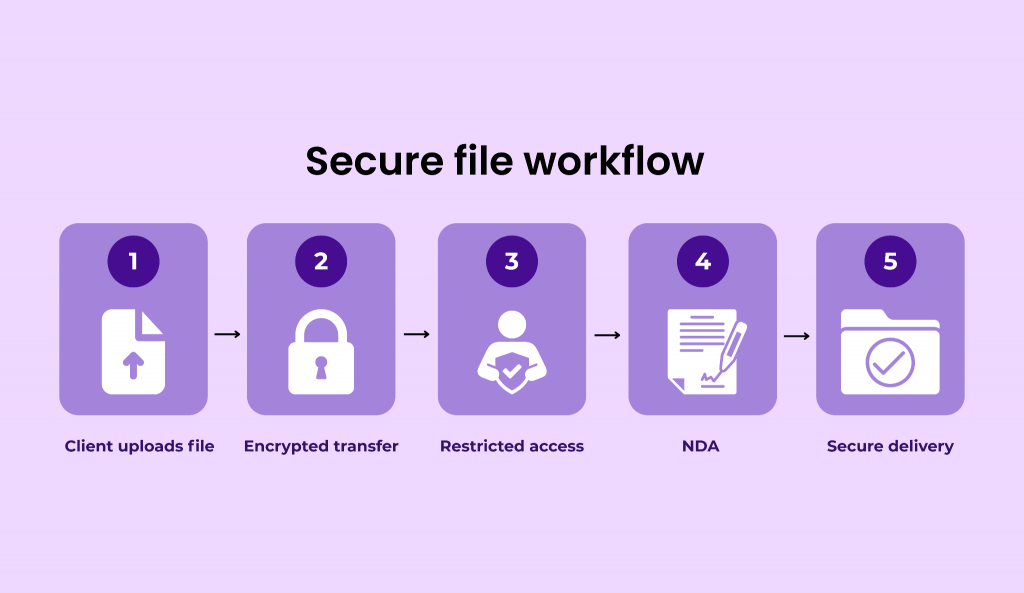
Translation companies handle contracts, HR files, patents, medical records, and sensitive client information. Security is part of the service, not an afterthought.
Use GDPR-aware storage, retention policies, restricted access, NDAs, two-factor authentication, encrypted transfer, and clear rules for public machine translation. ISO 27001 may matter for enterprise buyers. ISO 17100 supports process quality.
Also plan for web security. A client portal may show messages like “performing security verification” or “security verification” when a security service verifies a visitor. If verification successful appears, the system can allow access; if malicious bots trigger a block, support may ask the user to respond ray id for troubleshooting. This protects files, customers, and the agency from data breaches.
Hiring, Training, and Managing Your Translation Agency Team
Beyond freelancers, hire project managers, vendor managers, sales reps, and operations leads. A strong PM has communication skills, basic linguistic awareness, tool fluency, and calm under pressure. If you are still working out how to vet your first translators, our guide on hiring your first freelance translator covers the screening and onboarding process in detail.
Train people through SOPs, mock projects, Awtomated walkthroughs, QA checklists, and feedback reviews. Keep learning through webinars, standards updates, MTPE courses, and industry events. Language proficiency is essential for running a translation agency, but business acumen is necessary for successful agency management.
Scaling Your Translation Business Beyond Year One
After you prove the model, shift from survival to sustainable growth. Add language pairs, deepen one niche, or expand into subtitling, interpreting, DTP, or localization testing. Our guide on how agencies scale beyond the solo stage covers the specific decisions involved in that transition.
Move upmarket by targeting RFPs, preferred vendor lists, enterprise buyers, and partnerships with web agencies, law firms, publishers, SaaS firms, and other translation companies. Review your business structure, security, tools, contracts, pricing, and agency positioning every year. Translation companies should prioritize quality over price to remain competitive in the long run.
FAQ: Practical Questions About Starting a Translation Agency in 2026
How much does it really cost to start a small translation agency in 2026?
A lean launch can cost roughly $3,500–$15,000 for registration, website, branding, software, insurance, and marketing. The bigger challenge is cash flow: you may pay translators before clients pay you. Choosing tools with transparent, scalable pricing helps — see Awtomated’s pricing for an idea of what to budget for your TMS.
Do I personally need to be a certified translator to run a translation company?
No, not in most countries. But certification exams validate skills and enhance professional profiles. If you are not certified, work with certified translators and build strong QA, especially for legal, medical, and government work.
Can I run a translation agency part-time while keeping my current job?
Yes, if the niche is narrow and volume is low. But responsiveness, deadlines, and conflict-of-interest rules can become limits. Consider going full-time when recurring revenue, pipeline, and workload justify it.
How do I compete with cheap agencies and machine translation tools?
Do not race to the bottom. Focus on legal risk, confidentiality, terminology, workflow integration, and subject matter expertise. Explain when raw machine translation is acceptable and when human translation or MTPE is necessary.
When should I start investing in certifications or ISO standards for my agency?
Not on day one for most founders. First, document workflows, QA, vendor qualification, and traceability. In year two or three, consider ISO 17100 if enterprise, government, or regulated clients demand it.Starting a translation agency in 2026 is not just about languages. It is about trust, systems, people, and the ability to connect the world across language barriers. If you want to build an agency that scales with less chaos, Awtomated was built to help LSPs manage the operational layer from the first project to the thousandth. Book a demo to see how Awtomated can support your agency from day one.
Table of Contents
- Key Takeaways
- Introduction: Why 2026 Is a Prime Year to Start a Translation Agency
- Decide If Running a Translation Agency Is Really Your Own Business Goal
- Choose Your Translation Agency Model and Niche
- Define Services, Quality Levels, and Business Structure
- Step-by-Step Guide: From Idea to Operational Translation Agency
- Choosing and Implementing Your Translation Technology Stack
- Compliance, Data Protection, and Risk Management for Translation Agencies
- Hiring, Training, and Managing Your Translation Agency Team
- Scaling Your Translation Business Beyond Year One
- FAQ: Practical Questions About Starting a Translation Agency in 2026
Ready to manage your Translation company easily?
Get Started for Free