Translation Agency Growth Stages: How to Scale from Solo Translator to 7- Figure LSP
Key Takeaways
- Most translation agencies move through 4–5 predictable stages: solo translator, micro agency, boutique LSP, scaling LSP, and mature 7-figure language service provider.
- Each stage demands different priorities: direct clients first, then human translators, repeatable operations, stronger project management, and finally enterprise-grade reporting.
- The global translation services market is still expanding: Fact.MR valued the translation services market at USD 42.2 billion in 2024 and projects it to reach USD 54.1 billion by 2034.
- Agencies that standardize the translation process early and adopt Translation Business Management Software like Awtomated can scale faster, protect margins, and reduce operational stress. This roadmap starts where every agency must: with the operational foundation every agency needs first.
- This roadmap gives practical stage-by-stage guidance, financial milestones, and technology recommendations for language service providers.
Introduction: Why Translation Agency Growth Looks Different in 2026
Translation agency growth in 2026 looks very different from what it looked like in 2015. Back then, growth often meant more word volume, more emails, and more freelancers. Today, clients expect rapid turnaround times and lower costs due to advancements in technology, while still demanding high quality translations, cultural relevance, security, and accountability.
The opportunity is real. The global translation services market is valued at USD 41.78 billion in 2024, while another widely cited estimate says translation services market is valued at USD 42.2 billion in 2024. Fact.MR projects the global translation services market to reach USD 54.1 billion by 2034, with translation services expected to grow at a CAGR of 2.5% from 2024 to 2034. Some broader language industry forecasts also expect the translation industry to surpass USD 100 billion by 2029.
But modern growth is not simply “sell more language translation.” Translation agencies now coordinate human translators, artificial intelligence, machine translation, neural machine translation, translation memory, content management systems, website translation, multimedia content, interpretation services, and localization services. Many translation companies get stuck around $200k–$500k because the founder’s inbox becomes the operating system. Awtomated exists to change that: we are a Translation Business Management Software platform built to help language service providers move from reactive delivery to scalable, profitable operations.

Stage 1: Solo Translator – From Freelancer to Micro Translation Agency
At Stage 1, you are usually one professional translator working in one language pair or a few language pairs, often subcontracting for larger translation service providers while building direct client relationships. The average age of US translators is 41 years, and translator availability peaks between ages 28-38 in OECD countries, so strong positioning matters early.
Typical profile:
- Revenue: up to about $80k–$120k per year.
- Services: document translation, written translation services, basic content translation, simple website translation, and occasional legal translation or medical translation.
- Clients: small businesses, local law firms, clinics, agencies with overflow, and companies needing language translation services in one language or multiple languages.
- Challenges: feast-or-famine demand, manual quoting, Excel invoices, email-only project management, and no central database.
At this stage, professional translation services depend heavily on human expertise. Machine translation often fails to capture tone and essence, especially where precise translation, brand consistency, or legal documents are involved. Even so, integrating AI and Translation Memory tools boosts output speed, and AI tools are integrated into translation workflows for efficiency.
A simple Awtomated setup can help solo translators track clients, quote faster, manage each translation project, and recover 5–10 hours per week from admin.
Stage 1 Priorities: Proving Demand and Building a Repeatable Offer
Before you “go agency,” prove that clients want a repeatable offer from you.
Focus on:
- Choose 1–2 niches, such as legal translation services, SaaS localization, technical translation, or life sciences.
- Track monthly revenue, average project size, active clients, revision rate, and referral sources.
- Build translation memories and term bases using computer assisted translation tools.
- Standardize estimates, delivery timelines, onboarding emails, and basic quality assurance.
- Start thinking like a translation service provider, not only a linguist.
This is also where you learn what your target audience actually buys. Clients search for localization solutions using specific digital intents, not generic phrases. Using localized keyword research and correct page structures helps capture organic traffic, especially for website localization and international markets.
Stage 2: Micro Agency – Hiring Your First Freelancers and Project Manager
At Stage 2, you may have 2–10 regular freelance translators, an editor, and perhaps a part-time project manager. Revenue often sits around $120k–$350k per year, and the offer expands into more complex document translation, language solutions, website translation, and small localization services projects.
The barrier is familiar: everything still lives in emails, spreadsheets, shared folders, and the founder’s memory. This creates quality concerns, missed deadlines, inconsistent pricing, and poor visibility into margin.
This is usually when translation agencies begin presenting themselves as language service providers rather than individual freelancers. It is also when building a globally distributed network of vetted language service providers enhances scalability. Implementing automated vetting for new freelance linguists maintains quality control as the vendor network grows.
Early hires usually follow this sequence:
- Reliable editor or reviewer.
- Part-time project manager.
- Additional specialist human translators.
- Vendor coordinator or admin support.
Insufficient pay leads to reduced translation service quality, so scaling cannot mean squeezing translators. Growth depends on fair rates, clear briefs, and predictable payment.
Stage 2 Systems: From Chaos to Basic Structure
At this stage, structure becomes a growth engine.
Put these systems in place:
- Standard intake form.
- Quote template.
- Client contract and NDA template.
- Uniform file naming conventions.
- Vendor database with rates, skills, subject expertise, availability, and performance history.
- TEP workflows: translation, editing, proofreading.
- Client feedback loops.
Awtomated centralizes translator data, assigns jobs, creates purchase orders, tracks invoices, and records margin per project — which is essential for tracking profitability as you scale. That matters because strategic scaling, technological integration, and client retention drive the growth of translation agencies.
Machine Translation Post-Editing can lower costs and speed up turnaround times, but only when the risk level is appropriate. A blended approach using human and machine translation maximizes scale and speed. Integrate machine translation that learns from real-time human edits to reduce turnaround time while preserving quality.
Stage 3: Boutique LSP – Process-Driven Growth to Mid 6 Figures
Boutique LSPs often reach $350k–$800k per year before moving toward Slator’s boutique range of $1M–$8M. The founder shifts toward sales and key accounts, while 1–2 project managers coordinate 30–100 freelancers and sometimes in-house linguists.
Services expand into:
- Legal document translation.
- Medical device and life sciences content.
- Software and website localization.
- Marketing transcreation.
- Multilingual content workflows.
- Interpreting services and interpretation services where relevant.
At this level, translation agencies help businesses reach international markets effectively. They also help clients communicate effectively across language barriers, facilitate communication in cross border communication, and support global communication for multinational corporations.
The problem is that manual coordination does not scale. Without integrated translation management systems, CAT tools, secure portals, and a TBMS, margins become inconsistent and capacity planning becomes guesswork.
Stage 3 Operations: Standardization, Specialization, and Data
Process standardization becomes the main lever.
Prioritize:
- Separate workflows for legal translation, technical translation, medical translation, marketing content, and software localization.
- Awtomated as the central hub for quoting, project tracking, vendor payouts, client invoicing, and profitability by service line. If you are wondering when to upgrade to proper project management software, Stage 3 is usually the answer — it is where manual processes start costing more than a platform does.
- Specialization in regulated industries like life sciences or fintech.
- Dashboards for recurring revenue, client retention, average delivery time, on-time delivery, and revision rate. To understand what Awtomated costs at each growth stage, see Awtomated’s pricing.
- Clear localization guidance for clients, including regional color preferences and layout conventions for localization.
Agencies should target regulated industries like life sciences or fintech because agencies focusing on highly regulated fields command higher profit margins. Agencies should target complex verticals with strict compliance needs for higher margins.
This is also where client relationships mature. Treating buyers as strategic growth partners can improve client relationships and revenue stability. Continuous software localization can secure recurring monthly revenue for agencies, especially with SaaS clients that ship product updates every week. Winning retainer clients at growth stage two is the milestone that separates agencies that plateau from those that keep compounding.
Stage 4: Scaling LSP – Breaking the 7-Figure Barrier
A 7-figure language service provider usually generates $1M–$3M+ annually, with multiple project managers, dedicated sales, vendor management, and account management. The service portfolio now includes enterprise document translation, multilingual SEO, multimedia localization, subtitling, and continuous product localization.
The competitive environment changes. You now compete with large global translation service providers, tech-led platforms, and the best translation agencies in specialized verticals. Differentiation must go beyond price, language pairs, or “native speaker quality.”
Market demand supports this move. Europe is the largest market for translation services, expected to grow significantly, while Asia-Pacific is the fastest-growing region for translation services. Written translation services account for 70% of the market share in 2024, while some market research and analysis report segments state that interpretation services dominate the service type segment in translation. Machine translation is the most popular operation type in translation services, and machine translation dominates the operation type segment in translation services.
Still, clients notice poor work. 75% of consumers prefer purchasing in their native language. 40% of consumers experienced translation problems on websites. 40% of consumers reported translation issues on websites. 28% of consumers avoid purchasing from poorly translated websites. Translation agencies ensure accuracy and cultural relevance in translations, which is why human translation and human expertise remain essential.
Stage 4 Strategy: Productized Services and Enterprise Readiness
Scaling LSPs must productize.
Examples:
- SaaS Localization Program.
- Legal Translation Retainer.
- E-learning Globalization Package.
- Multilingual customer support content program.
- Regulated document translation workflow.
Enterprise buyers expect security, NDAs, data processing agreements, role-based access, secure portals, and reporting. Legal translation services are critical for accurate legal document translation, and legal translators must handle legal documents with traceability.
They also expect integrations with content management systems, code repositories, marketing automation, and help desk platforms. Awtomated becomes the operational backbone: one place for vendors, client records, workflows, POs, invoices, reporting, and performance data.
At this stage, translation agencies must shift to a tech-driven, value-centric partner model. The language service provider that can report turnaround time, defect rate, on-time delivery percentage, and margin is easier to trust. This is also the stage where building client relationships at scale with a CRM becomes essential — generic tools no longer hold the detail you need per account.

Stage 5: Mature 7- Figure + LSP – Optimizing Market Share, Margins, and Leadership
Beyond $3M–$5M, the question changes from “How do we grow?” to “How do we grow profitably and strategically?” Mature LSPs may operate regionally or globally with distributed teams, multiple offices, several currencies, and several business units.
The leadership structure typically includes heads of operations, sales, vendor management, marketing, finance, and technology. All of them need centralized TBMS data for forecasting, capacity planning, and scenario planning.
This is where market definition matters. The broader language services market includes translation, interpretation, software, and adjacent language service lines. Market size, market share, and future trends influence whether an LSP expands into banking medical tourism, life sciences, fintech, e-learning, or government work. Government initiatives and eu language translation facilities can also create demand for compliant language translation services.
Europe faces an aging population and declining birth rates among translators, and scarcity of qualified translators is expected to increase by 2035. Mature LSPs need a strong vendor strategy now, not later.
Stage 5 Levers: Automation, AI, and Strategic Positioning
Mature LSPs use automation and AI carefully.
Use tiered workflows:
- Pure human translation for high-risk legal, medical, and regulatory content.
- MT + human post-editing for repeatable, medium-risk content.
- Machine translation with review for low-risk internal content.
- Hybrid workflows for high-volume localization.
AI and ML enhance the quality of machine translation services. Neural machine translation is a key innovation in translation technology. Machine learning can improve routing, quality estimation, and terminology suggestions.
Awtomated supports automation through vendor selection rules, auto-PO creation, automatic reporting, smart alerts for margin issues, and workflow templates — exactly the kind of automating operations to scale without adding headcount that most growing LSPs need at Stage 3–4. It also supports market research by showing which sectors, languages, and clients produce the best margins. If a client calls its internal reviewers the partner es team, that terminology can be captured in briefs and workflows so everyone stays aligned.
Technology Foundation: Why a TBMS Like Awtomated Is Critical at Every Stage
A Translation Business Management Software platform is not the same as a CAT tool, a TMS, or generic project management software. Translation management systems and CAT tools support the linguistic production layer: files, memories, terminology, and workflow. A TBMS manages the business layer: CRM, quotes, jobs, vendors, rates, invoices, reporting, approvals, and financial visibility.
Awtomated is built for language service providers that need one source of truth. It supports translation agencies from early quoting and client tracking through advanced workflows, multi-branch reporting, vendor management, integrations, and executive dashboards.
Think of TBMS as infrastructure for scalable language translation services in a $50B+ global market. It reduces admin time, improves margin visibility, prevents errors, improves translator utilization, and supports customer satisfaction.
Some buyers now argue ISO standards for translation quality are becoming obsolete as a differentiator unless paired with real operational evidence, security, reporting, and continuous improvement. Awtomated helps provide that evidence.
Recommended Tech Stack by Growth Stage
- Stage 1–2: CAT tool, secure file sharing, basic financial system, and Awtomated for quotes, simple workflows, client records, and project tracking.
- Stage 3: Awtomated integrated with CAT/MT tools, vendor database, automated POs, client portal, and structured quality assurance.
- Stage 4–5: custom workflows per client, API integrations, SSO, custom reporting dashboards, multiple currencies, multi-entity support, and compliance controls.
- All stages: secure communication, documented processes, and clear data ownership.
Technological innovation should simplify the operation, not add noise. The goal is to consolidate scattered tools into a TBMS-supported ecosystem.
Financial Milestones and Metrics at Each Stage
Translation agency owners need to know their numbers because growth without margin is just busier stress.
| Stage | Revenue band | Team shape | Metrics to watch |
| Solo | up to $80k–$120k | Founder only | Revenue, active clients, average project size |
| Micro agency | $120k–$350k | Founder + freelancers | Margin, deadlines, vendor reliability |
| Boutique LSP | $350k–$800k+ | PMs + vendor pool | Retention, MRR, revision rate |
| Scaling LSP | $1M–$3M+ | Sales, PMs, vendor management | Revenue per PM, SLA performance |
| Mature LSP | $3M–$5M+ | Leadership team | Market share, concentration risk, profitability by vertical |
Track these in Awtomated:
- Average project margin.
- On-time delivery percentage.
- Revision rate.
- Client retention.
- Revenue per project manager.Revenue concentration by top clients.
- Profitability by service line.
These metrics prevent agencies from scaling unprofitable language translation work or underpricing high-risk legal, medical, or technical content.
Common Growth Pitfalls for Translation Agencies (and How to Avoid Them)
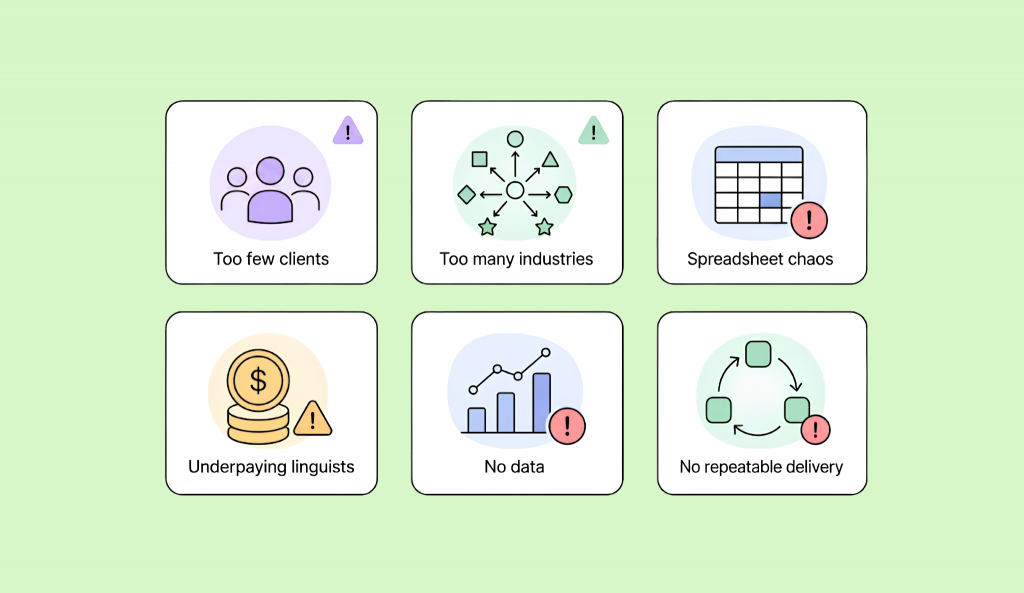
The same mistakes appear again and again. They are understandable. But they are expensive.
Avoid:
- Relying on one or two large clients.
- Serving every industry and every language pair.
- Managing beyond $200k–$300k in email and spreadsheets. This is often the clearest signal that it is time for auditing your operations at each growth inflection point — before the inefficiencies compound.
- Underpaying or overworking professional translators.
- Ignoring data until quality drops.
- Treating localization as word replacement instead of customer experience.
- Failing to build repeatable delivery for professional translation and localization services.
Awtomated helps by centralizing information, enforcing workflows, tracking client and vendor data, revealing dependency risks, and giving leaders an operational picture before problems become visible to clients.
How to Plan Your Next Growth Stage with Awtomated
Here is a practical 90-day plan.
- Diagnose your current stage. Use revenue, team size, active clients, service mix, and bottlenecks in sales, delivery, and admin.
- Choose 2–3 priorities. Examples include niche focus, hiring a project manager, building a vetted vendor network, or implementing a TBMS.
- Implement Awtomated in phases. Start with quoting and project tracking, then vendor management and financial reporting, then integrations.
- Review after 60–90 days. Measure time saved, fewer errors, improved capacity, faster quoting, and better margin visibility.
- Treat clients as partners. Ask what markets they want to enter, which workflows slow them down, and where multilingual content can support global growth.
If you are ready to scale without turning your inbox into your operations department, book a demo to explore how Awtomated can map your current workflow into a TBMS-backed model.

FAQ
These FAQs address practical decisions agency owners face while planning translation agency growth.
When should I move from solo freelancer to registered translation company?
Consider formalizing when you consistently exceed $5,000–$8,000 per month, manage subcontractors, or work with corporate and government buyers. Company structure helps with liability, contracts, taxes, and buyer confidence.
At minimum, create a legal entity, business bank account, standard terms, and basic data protection practices. If you already have repeat clients and several projects per month, Awtomated can help you look and operate like a professional LSP from the start — including with client relationship management tools designed for the translation industry.
How many regular clients do I need before hiring my first project manager?
A good trigger is when the founder spends more than 40–50% of their time on emails, quotes, scheduling, and coordination instead of sales or strategy.
Many agencies around $150k–$250k annual revenue, or 30–50 active projects per month, benefit from a dedicated PM. Awtomated’s project management tools can delay unnecessary headcount by automating quotes, reminders, POs, and workflow tracking.
Will AI and machine translation make it harder to build a 7-figure LSP?
AI will pressure generic per-word translation, but it will also create new demand for MTPE, quality assurance, terminology management, localization strategy, and multilingual operations. Evolving your pricing as you grow — from per-word rates to value-based and retainer models — is how agencies stay competitive at each stage.
Agencies that combine human translators, machine translation, artificial intelligence, and strong processes can still grow significantly through 2030. Awtomated supports human, MT, and hybrid workflows so LSPs can adapt as the services market changes.
What markets and service lines are most promising for new translation agencies in 2026?
Strong opportunities include e-learning, SaaS and fintech localization, life sciences, legal and regulatory document translation, and multilingual customer support. These sectors often need ongoing work, compliance, and subject expertise.
East Asia and Asia-Pacific show rising demand, while Europe remains a major global market. Use Awtomated reports to see which inquiries, clients, languages, and sectors generate the best repeat revenue in your region.
When is the right time to invest in a TBMS like Awtomated?
Usually, the right time is when you manage several translators, more than 5-10 active projects a month, or when spreadsheets and email threads are causing delays or quality issues.
Earlier adoption at Stage 2–3 often pays off faster because it prevents bad habits from becoming permanent. Awtomated can start simple and scale as your LSP grows, so you do not need to wait until 7 figures to see value. For a structured framework on choosing the right TBMS for your current growth stage, see our dedicated buyer’s guide.
Table of Contents
- Key Takeaways
- Introduction: Why Translation Agency Growth Looks Different in 2026
- Stage 1: Solo Translator – From Freelancer to Micro Translation Agency
- Stage 2: Micro Agency – Hiring Your First Freelancers and Project Manager
- Stage 3: Boutique LSP – Process-Driven Growth to Mid 6 Figures
- Stage 4: Scaling LSP – Breaking the 7-Figure Barrier
- Stage 5: Mature 7- Figure + LSP – Optimizing Market Share, Margins, and Leadership
- Technology Foundation: Why a TBMS Like Awtomated Is Critical at Every Stage
- Financial Milestones and Metrics at Each Stage
- Common Growth Pitfalls for Translation Agencies (and How to Avoid Them)
- How to Plan Your Next Growth Stage with Awtomated
- FAQ
Ready to manage your Translation company easily?
Get Started for Free