ISO 17100 Compliance for Small Translation Agencies: What It Is and How to Manage It Without a Dedicated Team
Key Takeaways
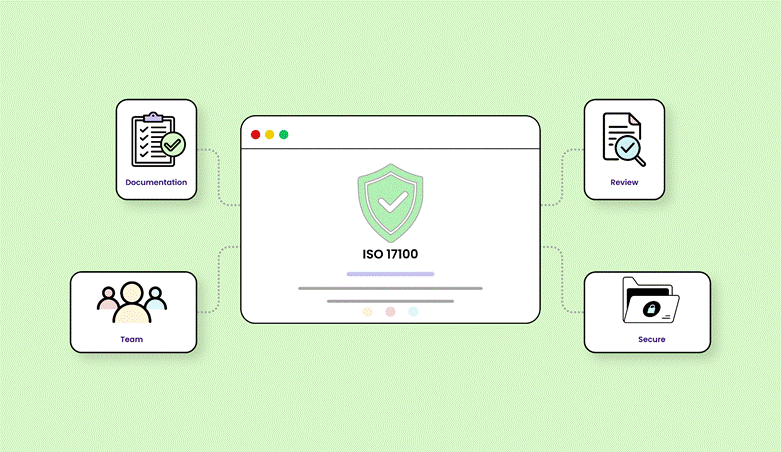
- ISO 17100:2015 is the internationally recognized standard for translation services, defining a structured translation process from pre production to post production.
- Even very small translation agencies and solo LSP owners can build iso 17100-aligned workflows without hiring a full-time compliance or quality assurance team.
- Awtomated helps automate translator qualification records, project traceability, documented project management, and client feedback management.
- iso 17100 does not cover machine translation plus post editing; that belongs under ISO 18587, but both workflows can be managed separately.
- External audit, conformity assessment, and work with a certification body become easier when your quality management system is centralized.
Introduction: ISO 17100 for Small and Growing LSPs
ISO 17100:2015 is an international standard for professional translation services, created by the International Organization for Standardization through a technical committee and subcommittee sc focused on translation and related services. Many clients now ask for an “ISO 17100 translation agency” because ISO 17100 increases credibility and trust with clients, especially in regulated sectors. It is also one of the most effective ways of using ISO as a differentiator to win retainer clients who want documented quality assurance from their language partner.
At Awtomated, we work with small and mid-size Language Service Providers who are often juggling sales, vendor management, file preparation, project managers’ duties, and delivery. This article is for agencies with fewer than 20 people that want an iso 17100-ready process without building a compliance department. The next revision is being prepared, so flexible systems matter now.

What ISO 17100:2015 Actually Requires (Without the Legalese)
In plain terms, iso 17100 2015 defines requirements for translation services across core processes: pre production processes, production process, post production, resources, project management, translator qualifications, and a quality management system. ISO 17100 ensures high translation quality and consistency, enhances client satisfaction through documented processes, and gives a competitive advantage in international markets.
The standard covers human translation, not interpreting services and not the raw output of machine translation with post editing, which is addressed by ISO 18587. It includes provisions for documented project management and client communication, but it does not require a mountain of paperwork. A TBMS such as Awtomated can hold project specifications, content resources, communication, quality checks, and records digitally.
A common myth is that only large translation companies can comply. Not true. Freelance translators and individual translators are allowed if properly vetted, documented, and assigned correctly.
Core ISO 17100 Process: From Pre-Production to Post-Production
The translation workflow starts before anyone translates. Pre production involves analyzing source documents and client requirements: source language, target language, subject field, deadline, terminology, confidentiality, style, format, and client expectations. ISO 17100 emphasizes the importance of pre-production project analysis, and pre production tasks should include feasibility, quote, resource selection, and risk review.
Then comes production. A qualified translator performs the translation and self-checks. ISO 17100 requires independent revision by a qualified linguist; every translation must be revised by a second qualified linguist, and every translation must be revised by a second person who is not the original translator. This independent revision by a second linguist helps ensure accuracy and quality translation. Optional review or proofreading can be added, but final verification before delivery is required. Every translation must be verified before final delivery.
After delivery, post production means structured client feedback, corrections, customer satisfaction records, and updates to terminology or instructions. For example, a 10,000-word legal translation project should move from source review and quote, to qualified legal translator, to independent legal reviser, to final verification, delivery, and logged client satisfaction.
How Awtomated Can Map Your Workflow to the ISO 17100 Stages
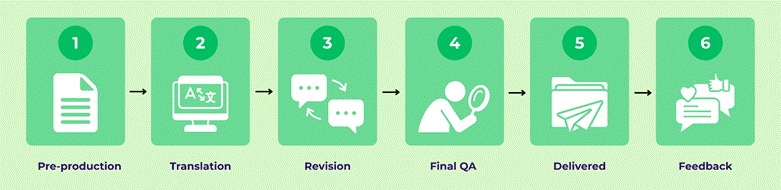
In Awtomated, an LSP can mirror iso standards with statuses such as “Pre-production,” “In Translation,” “In Revision,” “Final QA,” “Delivered,” and “Awaiting Client Feedback.” The system can require a reviser different from the translator before a translation project is marked delivered. See Awtomated’s project management tools to understand how these workflow controls are configured.
For a multilingual SaaS localization example, Awtomated can store project specifications per locale, assign professional translators, attach glossaries, track computer aided translation tools, and preserve time-stamped logs. Those logs show the translation process directly affecting delivery quality during an external audit by a certification body.
Professional Translators and Vendor Management Under ISO 17100
ISO 17100 defines minimum qualification requirements for professional translators. Translators must have a recognized translation degree. Translators need two years of experience in another field when they hold a degree in another discipline plus professional translation experience. Five years of full-time translation experience is required as another route. Translators must have a recognized translation degree or five years experience, and qualified translators must have relevant education or experience.
Competence also covers linguistic skills, culture, research, domain knowledge, related technology, and technical skill. Proofreaders must meet the same qualifications as translators, and revisers should work at the same level or higher. Project managers must have in-depth knowledge of the translation industry and the translation process.
Using Awtomated to Maintain ISO-Ready Vendor Records
Awtomated acts as a vendor database for translation service providers. Profiles can store degrees, CVs, NDAs, language pairs, domains, test results, years of extensive experience, and past performance. Tags such as “ISO 17100-approved translator,” “Medical EN>DE,” or “Legal reviser” make resource selection faster during pre production. For a full guide on managing a compliant vendor pool, see our dedicated vendor management guide.
Agencies must maintain secure information systems to protect client data as per ISO 17100. Awtomated supports data security practices by centralizing access to sensitive information, contracts, and vendor documents instead of scattering them across inboxes. Awtomated’s vendor management tools keep all qualification records, NDAs, and performance data in one auditable place.

Project Management, Traceability, and Quality Management System
ISO 17100 expects competent project managers to oversee each job, document requirements, assign resources, and confirm completion of checks. Translation projects must include documented project management processes, and a Quality Management System ensures documented project management processes.
A lean QMS should include quote templates, purchase orders, revision logs, delivery checklists, and client feedback handling procedures. Quality Management Systems must include client feedback handling procedures. Traceability means you can show who translated, who revised, what version was delivered, which terminology applied, and what client change requests occurred.
Awtomated becomes the operational layer of the QMS for many small translation service providers. It stores communication, files, project specs, quality data, and other aspects that prove control. See how Awtomated’s project management workflows support compliance across the full translation lifecycle.
Automating ISO 17100 Documentation in Awtomated
Set up templates for quotes, briefs, order confirmations, and final QA. Attach client-approved terminology, style guides, reference files, and content resources to each project. A simple “ISO 17100 final verification checklist” can ask whether revision is complete, files are correct, target language deliverables are present, and client instructions were followed.
This matters because ISO 17100 enhances client trust and satisfies external compliance audits for regulated sectors. Compliance with ISO 17100 is often a requirement in government tenders and multinational RFPs. A client portal also gives enterprise buyers a transparent window into your documentation practices, which directly supports ISO audit readiness.
Machine Translation, Post Editing, and ISO 17100 vs ISO 18587
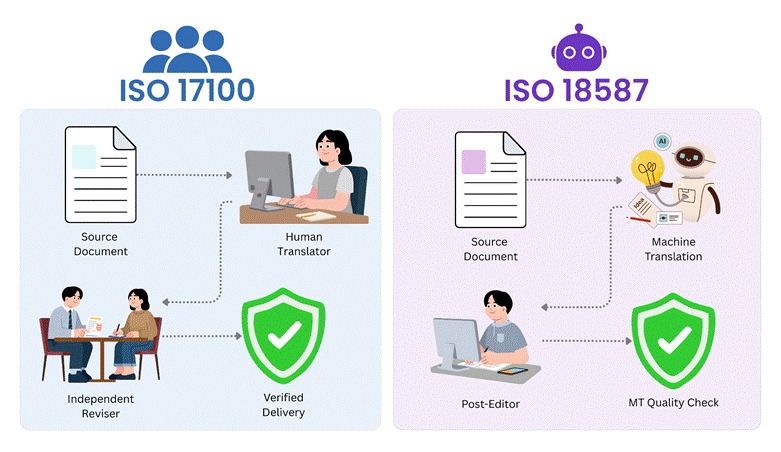
ISO 17100 does not ban machine translation, but it does not treat MT plus post editing as ISO 17100 human translation. Small agencies should label services clearly: “ISO 17100-compliant human translation” and “MT with human post editing, ISO 18587-aligned.”
In Awtomated, you can define different job types, pricing, instructions, and quality expectations. This protects clients' confidence and prevents MT-based work from being marketed as high quality translations under the wrong global standard.
Configuring Mixed Workflows (Human + MT) in Awtomated
Create one workflow for professional translation: translator, self-check, reviser, final verification. Create another for MT: machine translation, post editor, MT quality checks, client approval. Reports can show how much volume is human translation versus MT post editing, supporting transparency and strategy.
For instance, a SaaS client may order marketing pages as a quality translation service under iso 17100, while low-risk support articles follow ISO 18587-aligned post editing.
Preparing for ISO 17100 Certification and External Audit Without a Dedicated Team
ISO 17100 certification provides a validation tool for Language Service Providers. Formal certification involves a certification body, conformity assessment, an internal audit before the external audit, and evidence that the strict framework is used consistently.
The usual path is gap analysis, procedure setup, training, internal audit, several months of compliant projects, then external audit. Auditors look for professional translators’ evidence, revision records, documented client communication, and feedback handling. Before reaching that stage, auditing your operations for compliance gaps is a smart first step — our operations audit guide walks through exactly what to check. ISO 17100 certification is valid for three years. ISO 17100:2015 certification is valid for three years with regular audits.
Even before certification, working this way improves quality, reduces rework, and builds client trust.
Practical 90-Day Action Plan Using Awtomated
- Weeks 1–4: document your process, configure statuses, create brief, quote, revision, and feedback templates.
- Weeks 5–8: migrate client and vendor records, upload qualifications, train PMs and freelance translators. Our guide on vetting translators to ISO 17100 standards covers the qualification check process in detail.
- Weeks 9–12: run live projects, review evidence, perform an internal audit, export reports, and approach a certification body.
A five-person LSP can realistically reach iso 17100 readiness by using Awtomated as the single place for vendors, jobs, files, QA, and feedback. Awtomated is actively developed — check the changelog to see the latest compliance-related features added to the platform.

FAQ
Do I need to be formally certified to say I follow ISO 17100?
You may say your process is based on iso 17100 or works in conformity with it if that is accurate. Do not claim certified status until an accredited certification body has completed the external audit.
How many people do I need on my team to comply with ISO 17100?
There is no minimum team size. The key rule is role separation: the same person cannot translate and revise the same text. Small LSPs can use freelance translators and revisers.
Does ISO 17100 force me to stop using machine translation?
No. It simply separates human translation under ISO 17100 from machine translation plus post editing under ISO 18587.
What happens if my client gives negative feedback on an ISO 17100 project?
The project manager should log the client feedback, coordinate corrections, update terminology if needed, and store the resolution inside the quality management system.
How long does ISO 17100 certification usually take for a small agency?
Several months is realistic, depending on your current documentation and maturity. Awtomated can shorten preparation by structuring evidence from day one.
If your agency wants the gold standard of professional translation without adding bureaucracy, start by making the workflow visible. Awtomated helps small LSPs turn ISO expectations into daily habits clients can trust. Book a demo to see how Awtomated can support your ISO 17100 preparation from day one.
Table of Contents
- Introduction: ISO 17100 for Small and Growing LSPs
- What ISO 17100:2015 Actually Requires (Without the Legalese)
- Core ISO 17100 Process: From Pre-Production to Post-Production
- Professional Translators and Vendor Management Under ISO 17100
- Project Management, Traceability, and Quality Management System
- Machine Translation, Post Editing, and ISO 17100 vs ISO 18587
- Preparing for ISO 17100 Certification and External Audit Without a Dedicated Team
- FAQ
Ready to manage your Translation company easily?
Get Started for Free