Machine Translation Post-Editing (MTPE) Workflow: How Smart LSPs Are Combining AI and Human Review
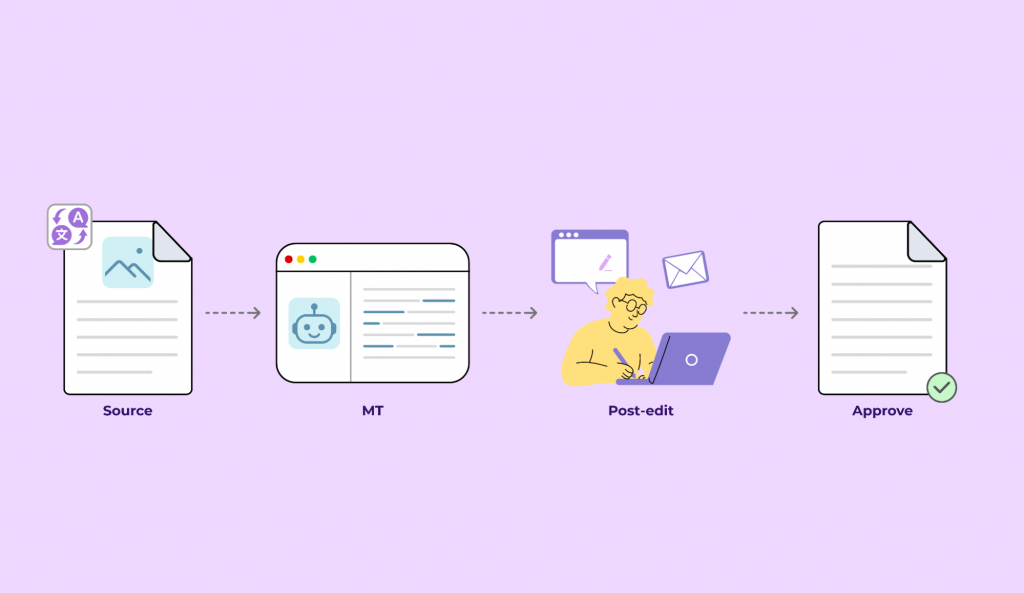
The translation industry has changed more in the past few years than in the preceding two decades. At the center of that shift is machine translation post editing-a workflow that has gone from experimental add-on to core production method for many organizations handling multilingual content at scale.
The numbers tell the story clearly. MTPE adoption surged from 26% in 2022 to 46% in 2024, and 62.6% of LSPs had over 30% of their projects running through MTPE workflows in 2024. Even more telling, 45.2% of LSPs used MTPE for at least 50% of their projects in 2024. MTPE is now the dominant mode of production for many LSPs, not an edge case.
But here's what matters: MTPE is not "cheap translation." It's a structured translation workflow that combines machine translation speed with human expertise-one that demands deliberate design, clear quality expectations, and operational tooling to manage well. MTPE is effective for high-volume, fast-turnaround content such as technical documentation, product descriptions, knowledge bases, tickets, FAQs, and other support content where speed and consistency drive value.
At Awtomated, we build end-to-end Translation Business Management Software (TBMS) specifically for LSPs. This article lays out how a TBMS manages MTPE projects end to end-replacing the spreadsheets, email threads, and guesswork that hold most LSPs back from realizing the real value of post editing machine translation.

What Is Machine Translation Post-Editing (MTPE)?
Machine translation post editing is a workflow where a machine translation engine produces a first version of translated content, and human linguists then improve those machine translated segments to a defined quality level. The underlying principle is straightforward: let AI handle the heavy lifting of producing a draft, and let human judgment handle what machines still get wrong.
This sits between two extremes. Pure human translation means a translator works from scratch with no MT output-the traditional translation approach. Raw machine translation post with no human review means shipping whatever the engine produces, errors and all. MTPE occupies the practical balance between these, focusing on optimizing post editing effort so that linguists spend time only where the MT output genuinely needs fixes.
To run an effective MTPE process, you first select the best machine translation engine for the specific language pair and domain, then run the source text through the selected MT engine to generate the raw translation. Human editors then refine the output across several quality dimensions: accuracy, terminology, style, tone, formatting, and locale conventions.
Here's what the difference looks like in practice:
| Stage | Example Output |
| Raw MT | "The device is not valid the warranty period after purchase." |
| Light post editing | "The device is no longer covered by the warranty after the purchase date." |
| Full post editing | "This device will no longer be covered by warranty after the purchase date." |
The first version is intelligible but broken. Light editing fixes meaning and grammar. Full editing adds fluency, correct register, and brand voice.
Light vs. Full Post Editing: Choosing the Right Level
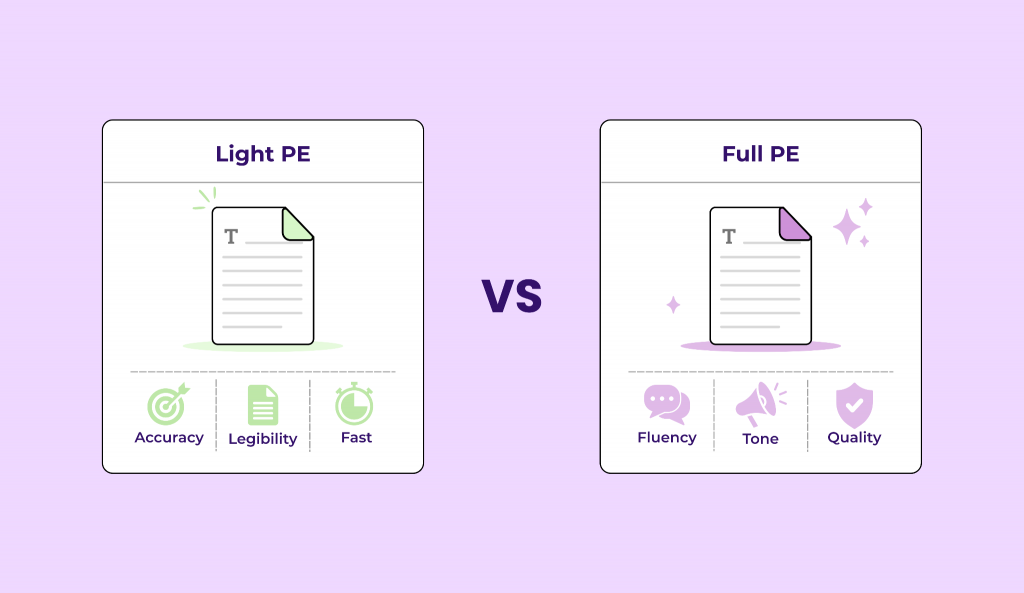
Most MTPE workflows distinguish between light post editing and full post editing, and the choice between them is strategic. It depends on content risk, audience expectations, budget, and turnaround requirements. Getting this decision right is where many LSPs either unlock efficiency or waste it.
One critical point: over editing is a real risk. Over-editing can slow down MTPE workflows significantly, erasing the efficiency gains that made MTPE attractive in the first place. When linguists treat every machine translated segment as if it needs a complete rewrite, you've essentially paid for human translation at a discounted rate-and nobody wins.
A useful decision framework: operational or internal content routes to light post editing; external, brand-sensitive, or legal content routes to full post editing or even traditional translation. Technical manuals work well for machine translation while highly creative marketing copy does not.
Light Post Editing (LPE)
Define light post editing as focusing strictly on accuracy and basic legibility. Light Post-Editing corrects only major errors to ensure accuracy-mistranslations, terminology violations, numbers and units, and any grammar that changes meaning. Style and rhetorical polish are left alone unless they actively confuse the reader.
Content types that fit LPE well:
- Internal knowledge base articles and knowledge bases
- Support macros and support content
- Low-risk product listings and product catalogs
- FAQ templates
- User-generated content normalization
In Awtomated, LSPs can standardize LPE by attaching checklists to each job-"must fix vs. nice to fix" rules inside job instructions. Project managers can configure separate service types and price lists for LPE, ensuring quotes reflect the actual scope of editing involved. Client-specific glossaries and style guides attach directly to jobs, giving translators the context they need without searching through email.
Full Post Editing (FPE)
Define Full Post-Editing as delivering human-quality translation with natural flow and style. Full Post-Editing corrects all errors and refines style, tone, and syntax. The goal is text indistinguishable from professional human translation-fluent, stylistically consistent, and aligned with brand language.
Content types that demand FPE:
- Marketing websites and landing pages
- In-app UI strings and onboarding flows
- Legal notices and regulatory documents
- Customer-facing help centers
- Advertising and brand voice content
Here's the operational reality: full post editing effort can approach that of human translation when MT output is weak or the domain is highly specialized. If edit distance consistently exceeds 40-50%, LSPs need to question whether FPE is still cost effective or whether switching engines-or reverting to human translation-makes more sense.
Awtomated helps by tracking post-editing metrics over time: edit distance, time per word, and quality scores per client and language pair. These numbers make the light-vs-full decision data-driven rather than instinctive.
Designing an MTPE-Ready Workflow in an LSP
MTPE is more than toggling machine translation inside a cat tool. It's a deliberately designed workflow from intake to delivery, with each stage serving a specific purpose. The LSPs getting the most from MTPE treat it as a pipeline-content qualification, engine selection, machine translation, human post editing, QA, and delivery-orchestrated as a single end-to-end process.
Awtomated orchestrates all these stages within one platform instead of scattering them across separate tools and email threads.
Pre-Project Setup: When and How to Use MTPE
Project managers in 2025 typically decide whether to use MTPE based on content type, language pair, and turnaround requirements. Consider two scenarios:
- MTPE candidate: A client needs 50,000 words of product catalog updates translated into 10 EU languages within two weeks. Repetitive structure, controlled terminology, high volume content-ideal for MTPE.
- Not an MTPE candidate: High-stakes regulatory submissions in Japanese with strict compliance requirements and complex technical terms. Here, the risk profile favors human translation.
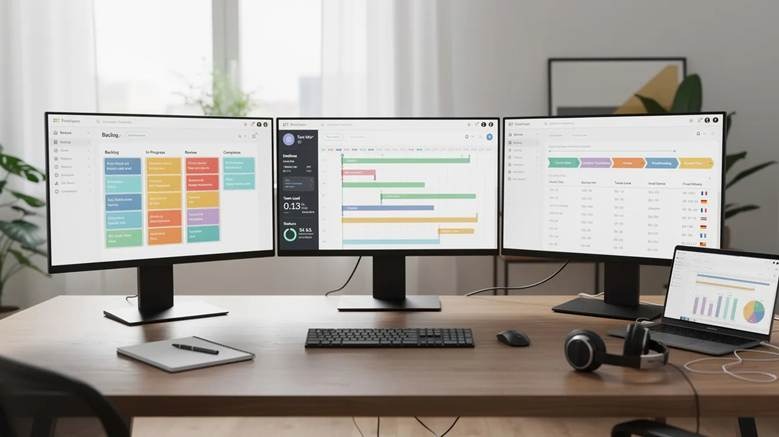
In Awtomated, PMs configure workflows per client or vertical. They select whether an order uses MTPE, choose light or full post editing, specify which MT engines are allowed, and attach client-specific rules. For example: "No machine translation for Japanese legal content" or "Light post editing allowed for Tier-3 markets only."
A typical workflow sequence looks like this: intake → content type classification → engine benchmark lookup → route through selected MT engine → assign post editing level → post editor assignment from your vendor pool → QA checks → delivery. For some clients, an in-country reviewer step sits between QA and delivery.
It's worth noting that ISO/CD 18587.2 will define requirements for post-editing non-human translation output, which means formalizing these workflows now positions LSPs ahead of coming standards.
In-Project Execution: From MT Output to Human Review
Once a quote is approved, Awtomated automatically routes files through the chosen machine translation engine to produce MT output. You assign raw MT output to professional human translators trained in post-editing-not general translators unfamiliar with the discipline.
Inside the CAT environment, post editors see machine translated segments clearly labeled as MT drafts, alongside translation memory matches, term base suggestions, and style guide notes. This layered view helps them avoid unnecessary over editing by showing what resources already exist. They focus on fixing what needs fixing rather than rewriting from scratch.
Coordination features keep the process moving:
- Task assignment with clear PE-level instructions
- Deadline and SLA enforcement
- Status tracking per segment (edited, reviewed, approved)
- Clean handoffs between post editor, reviewer, and in-country approver
After editing, you run edited text through automated QA tools to catch errors and inconsistencies. Then conduct a final human check to ensure context and cultural appropriateness. Finally, implement Linguistic Quality Assurance (LQA) steps on edited texts before delivery.
One thing that's easy to overlook: poor source text results in poor MT output. If source content is ambiguous, poorly structured, or inconsistent, no engine will produce clean results. Smart LSPs flag source quality issues before they enter the MT pipeline.
Post-Project Analysis: Measuring Post Editing Effort
The only way to sustainably run MTPE workflows is to measure what happened after each project. Without measurement, you're guessing-and guessing at scale gets expensive.
What to measure:
- Linguist time per word: How long did the post editor actually spend?
- Edit distance: Measure how much text the linguist changed using edit-distance metrics (TER, Levenshtein) between MT output and final translation
- Quality scores: Error counts by category and severity
- Client feedback: Satisfaction ratings, revision requests
Awtomated consolidates data from CAT tools and MT engines to produce per-client and per-language MTPE performance reports. Over a 3-to-6-month review cycle, these reports reveal patterns: maybe French technical docs consistently show low edit distance (good engine fit), while Italian marketing content shows high editing effort (bad engine fit or wrong PE level).
Save the final human-approved translations into the client's Translation Memory so future projects benefit from past work. These reports also help LSPs refine engine choices, workflow steps, and rate cards-adjusting discounts where post editing effort is demonstrably high.
Integrating MT Engines and AI Into MTPE Workflows
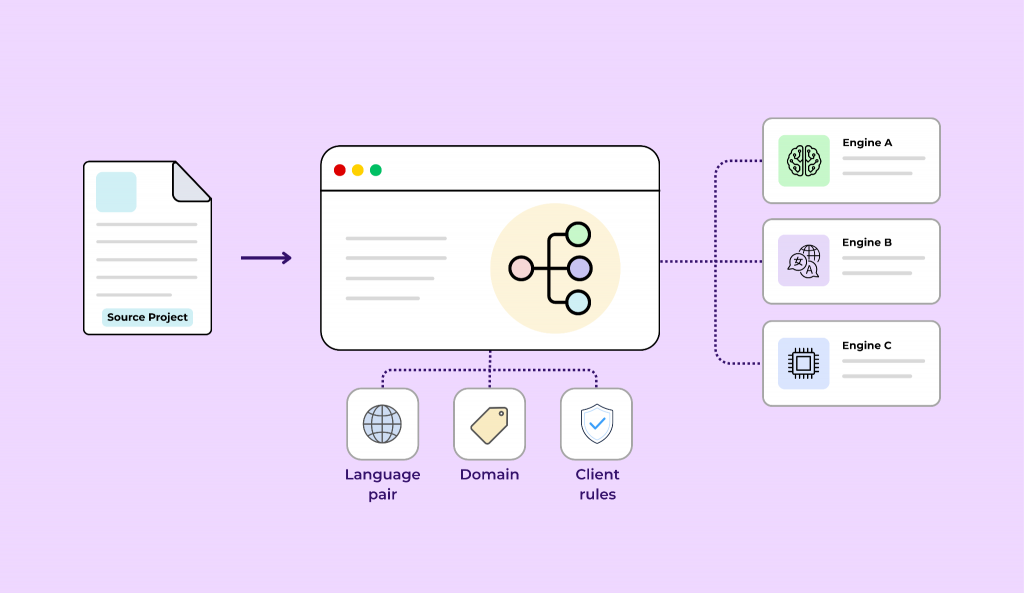
Modern MTPE workflows rarely rely on a single generic engine. Smart LSPs mix neural machine translation engines, domain-adapted models, and large-language-model-based translation tools, routing content to whichever engine performs best for a given domain and language pair. See Awtomated’s AI translation tools to understand how MT engine connections work in practice. On top of engine selection, new technologies like quality estimation and automatic post-editing are reshaping how much content even needs human review.
Selecting and Routing to the Right MT Engine
Engine selection shouldn't be a gut feeling. Benchmark outputs by testing multiple MT engines on sample files for language pairs-most LSPs evaluate 1,500 to 2,000 segments per language pair and content type, comparing machine translation quality, fluency, and post editing effort.
In Awtomated, PMs store engine preferences per client and domain. For example:
| Content Type | Preferred Engine | Rationale |
| E-commerce product descriptions | Engine A (domain-adapted) | 15-20% lower edit distance vs. generic |
| IT support content | Engine B (custom-trained) | Strong terminology handling |
| Internal communications | Engine C (generic NMT) | Adequate quality, lowest cost |
You can train custom engines using client-specific translation memories to enhance translation quality, and inject client-specific terminology and translation memories into the MT engine to improve accuracy. Centralized routing avoids PMs manually picking mt providers per project and keeps machine translation costs transparent in quotes.
When corrections are consistently needed in the same patterns, feed corrections back into trainable MT engines to improve future translation accuracy. This creates a virtuous cycle: better engines → less editing → lower costs → higher margins.
Quality Estimation, AutoPE, and Reducing Human Effort
Quality estimation models predict translation quality before human review. These AI models score each machine translated segment for risk without needing reference translations. Quality estimation models analyze machine translation output for errors at the sentence or word level, and quality estimation scores help prioritize segments for human review.
Inside Awtomated, these scores can drive selective post editing: high quality segments are accepted or lightly touched, while high-risk segments route to human linguists for thorough review. Research on English-Chinese MTPE found that introducing sentence-level quality estimation reduced post-editing time significantly across both medium- and high-quality MT output. MTQE can reduce human involvement in MTPE by over 50%, and when combined with MTPE and AutoPE, many LSPs report cost and human effort reductions exceeding 50%.
AutoPE can automate minor corrections in MTPE workflows-fixing repetitive errors, applying terminology corrections, and adjusting style before any human sees the text. But a warning: automated edits can introduce unnecessary changes in MTPE. Research shows that even the best automatic post-editing systems degrade output quality in roughly 20-30% of modified segments when MT quality is already high.
The practical approach is a phased rollout. Start by auto-accepting a small percentage of high quality segments flagged by quality estimation, monitor results over several months, and expand gradually. Automating the MT submission step and combining automated AI-driven workflows with human linguists for effective MTPE-but never removing human oversight entirely. Generative AI is a powerful tool in this space, but it works best as an assistant, not a replacement.

Managing Human Linguists Within MTPE Workflows
Even with advanced technologies handling the initial draft and quality scoring, skilled human linguists remain central to every MTPE workflow. They bring context, cultural awareness, and the kind of human judgment that no engine replicates reliably. But MTPE changes their role, and LSPs need to manage that shift with transparency. For guidance on hiring translators who specialise in post-editing, see our dedicated hiring guide.
Training, Guidelines, and Avoiding Over Editing
Many MTPE inefficiencies come from translators treating the process like translating from scratch. Train translators to edit rather than re-translate from scratch to improve efficiency. The shift from "I would say it differently" to "does this communicate accurately?" is fundamental.
Common issues that erode MTPE productivity:
- Inconsistent terminology is a frequent issue in MTPE workflows, especially when glossaries aren't enforced
- Context errors can lead to incorrect translations in MTPE, particularly with ambiguous source text
- Style drift occurs when editors apply personal preferences inconsistently across segments
- Over editing: rewriting acceptable output because it doesn't match personal style
LSPs should create clear MTPE guidelines per client specifying what to fix, what to leave, and how much stylistic freedom is allowed. In Awtomated, these guidelines attach directly to each job, so linguists see consistent instructions in their editing environment alongside term bases and style guides.
Run calibration sessions quarterly. Pull a sample of edited segments across clients and languages, bring post editors and reviewers together, and align on what "good enough" means for light post versus full post editing. Use before/after examples that illustrate the difference between appropriate and excessive editing.
Pricing, Productivity, and Translator Experience
Three main MTPE pricing models are currently used: hourly, per-word, and edit distance. Each has trade-offs:
| Model | How It Works | Consideration |
| Per-word | The per-word rate model typically offers a 25-40% discount for MTPE compared to full human translation rates | Simple but may not reflect actual effort |
| Hourly | Hourly rates for MTPE can vary based on individual translator agreements | Fair but harder to estimate project costs |
| Edit distance | Edit distance pricing measures the amount of text edited post-translation | Precise but requires tooling to track |
MTPE pricing models lack industry-wide consensus, leading to varied practices across the translation industry. What matters is that pricing aligns with real post editing effort. If linguists spend nearly the same level of time as full translation work, discounting too heavily will hurt quality, morale, and retention.
Awtomated’s TBMS capabilities help LSPs track productivity metrics-words per hour, effective hourly rate after discounts, actual edit distance-and adjust pricing with data rather than guesswork. These same metrics reveal where translation memory leverage is reducing post-editing volume and where it isn’t. By late 2024, many mid-size LSPs renegotiated MTPE rate cards based on data collected across thousands of projects, increasing pay for language pairs and content types where manual effort remained high.
Transparency about what MTPE work entails-and how pay reflects that effort-is what keeps freelance linguists and in-house teams engaged long-term.
Measuring Quality and Continuous Improvement in MTPE Workflows
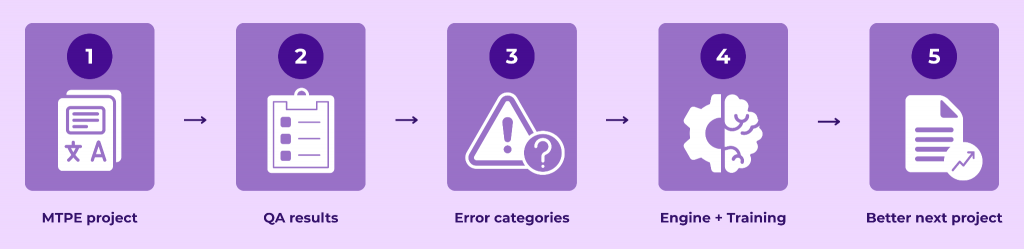
MTPE success isn't measured by speed and cost alone. Without consistent quality, you lose clients. The growing volumes of content flowing through MTPE pipelines make systematic quality assessment non-negotiable.
Main quality signals to track: human review scores, automated QA checks, client feedback, and business KPIs like support ticket deflection or customer satisfaction. A TBMS like Awtomated centralizes these signals and ties them back to specific MT engines, linguists, and workflows. This is what separates project management software that supports MTPE from a generic task tracker that just tracks deadlines.
Quality Frameworks for Machine Translation Post Editing
Many LSPs use MQM-style error categories, dividing issues into accuracy, terminology, style, fluency, locale, and formatting, with severity ratings of critical, major, and minor. This structured quality assessment gives you actionable data rather than vague impressions.
MTPE quality measurement should distinguish between issues caused by poor MT output (suggesting engine problems) and issues introduced during post editing (suggesting guideline or training problems). This distinction matters because the fix is different for each.
Set numeric targets. For example: no more than 2 critical errors and 5 major errors per 1,000 words in full post editing content. For light review content, tolerances are higher. Run regular sample audits-quarterly at minimum-across a cross-section of MTPE projects.
Awtomated can store error annotations and quality scores at segment level. Here's a hypothetical: over two quarters, your German medical translation projects show a spike in terminology errors. Segment-level data reveals the errors cluster around a specific MT engine that was recently updated. You switch engines for that domain, and the next quarter's error rate drops by 35%. That's the kind of pattern you can only identify patterns with when quality data is granular and centralized.
Maintain consistency by embedding translation management systems and terminology glossaries into workflows so that every project starts with the same foundation.
Using Data to Optimize MTPE Workflows Over Time
Language Service Providers can integrate automation and clear quality tiering into workflows, but the real gains come from iterating over time. Use Awtomated's reporting to compare post editing effort and quality across languages, domains, and clients.
Concrete optimization actions based on data:
- Switch MT engines when edit distance for a language pair consistently exceeds 40%
- Tighten source content guidelines when poor source text drives repeated MT failures
- Adjust PE level when light post editing projects show unacceptable error rates
- Re-train linguists when specific editors consistently over-edit or introduce style drift
Formalize continuous improvement loops. Run bi-annual MTPE reviews with key accounts, using the prior 3-6 months of production data. Historical data from 2022-2025 helps forecast savings and set realistic turnaround expectations for new MTPE programs. For instance, if engine tuning and better terminology management reduced post-editing time by 20% over a six-month span, set your new baseline accordingly.
Why MTPE Belongs in a Unified TBMS Like Awtomated
The argument is simple: translation post editing MTPE delivers its full value only when orchestrated inside a single Translation Business Management Software. Without unified tooling, LSPs are left stitching together scattered CAT reports, manually routing content to MT providers, tracking linguist performance in spreadsheets, and managing quality through email.
With Awtomated, the entire MTPE pipeline lives in one place:
- Workflow automation: intake rules, content classification, automatic routing to engines, task assignment, SLA enforcement
- MT engine management: stored benchmarks per client and domain, automatic engine selection, performance tracking per engine
- Cost and margin tracking: actual vs. estimated effort, rate cards per service type (LPE vs. FPE), discount management, visibility into human involvement and labor costs
- Linguist performance dashboards: words per hour, edit distance, quality scores, error type breakdowns, over-editing detection
- Client reporting: edit distances, quality metrics, cost savings, turnaround times, MT engine performance by domain
Smart LSPs are shifting from ad-hoc MT usage to deliberate MTPE workflows that treat MT output as one resource among many-alongside translation memory, term bases, style guides, and human expertise. The companies winning with this hybrid method aren't the ones with the fanciest engines. They're the ones with the tightest processes around those engines. A new wave of advanced technologies is making this easier, but technology without process is just expensive noise.
Here's what we'd suggest as a next step: review your 2024-2025 production mix. Look at volume by content type and language. Pick a manageable pilot-100,000 to 500,000 words of a single content type-and run it through a full Awtomated-driven MTPE workflow over a fixed period. Measure your baseline: edit distance, time per word, quality scores, cost per word. Then iterate.
Your clients are already expecting faster, more cost effective multilingual content. The question isn't whether to adopt MTPE-it's whether you'll do it with a system that scales, or keep patching it together manually. Book a demo with Awtomated to see how an MTPE-ready TBMS works in practice.
Table of Contents
- What Is Machine Translation Post-Editing (MTPE)?
- Light vs. Full Post Editing: Choosing the Right Level
- Designing an MTPE-Ready Workflow in an LSP
- Integrating MT Engines and AI Into MTPE Workflows
- Managing Human Linguists Within MTPE Workflows
- Measuring Quality and Continuous Improvement in MTPE Workflows
- Why MTPE Belongs in a Unified TBMS Like Awtomated
Ready to manage your Translation company easily?
Get Started for Free