Why Translation Agencies Outgrow Trello, Asana and Monday.com
The Challenge of Managing Translation Business with Generic Tools
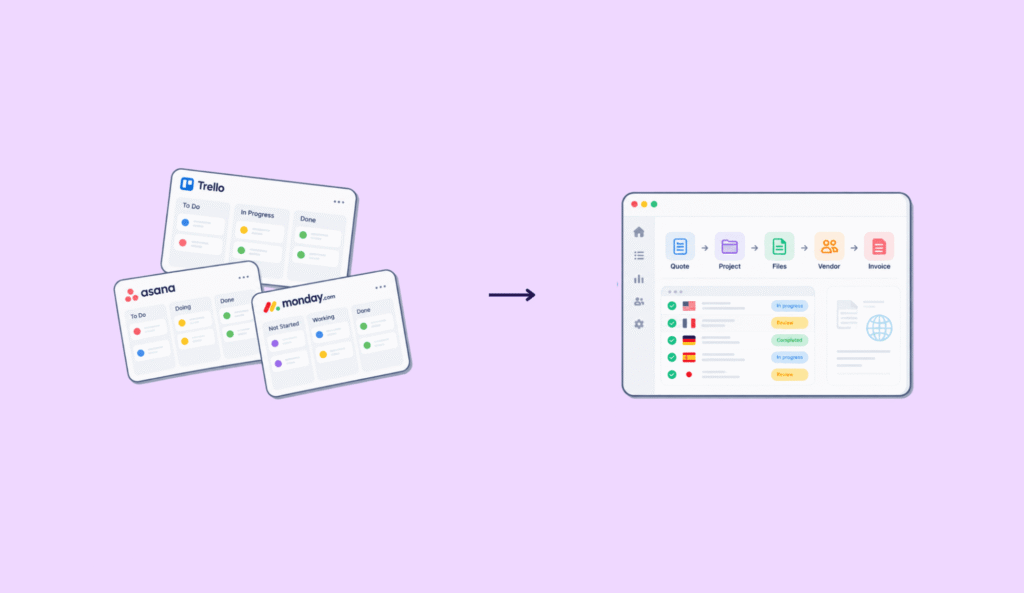
Most translation agencies start the same way: a Trello board for tracking projects, an Asana workspace for assigning tasks, or a Monday.com dashboard to monitor deadlines. These project management tools work well enough when you have a handful of clients, a few freelance translators, and straightforward language pairs. But translation operations are not straightforward for long.
As your agency grows - more clients, more vendors, multiple languages, tighter margins - generic project management software starts breaking down. Translation projects demand specialized workflow stages, vendor management with rate cards and certifications, integrated financial tracking across currencies, and professional client portals for quotes and approvals. Trello, Asana, and Monday.com were never designed for any of this. One agency owner on Reddit described the reality bluntly: "4 different sheets just to track: client quotes, vendor assignments, invoices, and project deadlines. All manually updated. Every day."
This article compares generic PM tools against purpose-built Translation Business Management Systems (TBMS) across the dimensions that actually matter to language service providers - and shows you exactly when it's time to make the switch.
The Short Answer
Translation agencies outgrow Trello, Asana, and Monday.com because these tools lack translation-specific workflows, vendor and freelancer management, integrated financial operations, and branded client portals - the key features that language service providers need to operate efficiently at scale. Generic tools force agencies into manual workarounds that multiply errors, waste hours, and erode margins as project volume grows.
A comprehensive translation management system like Awtomated addresses these gaps directly. It unifies the full translation lifecycle - from client request through quoting, translation, review, and delivery - with built-in vendor portals, automated invoicing, multi-currency billing, and real-time margin tracking. Many LSPs that onboard to Awtomated report being fully off spreadsheets within a couple of weeks.
What Are Generic Project Management Tools?
Trello, Asana, and Monday.com are general-purpose collaboration tools designed for organizing tasks, tracking project progress, and coordinating teams across any industry. They excel at making work visible and keeping people aligned.
Their core strengths for basic project organization:
- Low-friction onboarding: Drag-and-drop interfaces, intuitive boards and lists, minimal training required
- Flexible customization: Custom statuses, tags, formula columns, templates, and multiple view types (boards, timelines, calendars)
- Broad integrations: Connections to Slack, Google Drive, email, and hundreds of other collaboration tools
- Affordable entry pricing: Free tiers and modest per-seat costs that work for small translation teams
These strengths serve solo translators and small teams well. But they become less relevant - and sometimes counterproductive - as translation project management demands grow in complexity.
What Are Translation Business Management Systems?
A Translation Business Management System is translation management software built specifically for language service providers to run their entire business operations. Unlike generic project management tools, a TBMS covers the full spectrum of what translation agencies actually do daily.
The defining features that separate a TBMS from general-purpose tools:
- Quote and pricing engine: Generate estimates based on language pair, word count, service level, deadline urgency, and file formats - not just flat task budgets
- Vendor portal and management: Structured onboarding, rate cards per service and language pair, performance tracking, certifications, and availability calendars for freelance translators and professional translators
- Integrated financial operations: Client invoicing, vendor payments, purchase orders, multi-currency billing, and real-time margin tracking - all tied to actual project data
- Client portals: Branded interfaces where clients submit requests, approve quotes, track project progress, and download deliverables
Translation management software simplifies project management for localization teams by replacing disconnected stacks of spreadsheets, email, generic PM tools, and separate accounting software with one coherent platform. Over 30 translation management systems exist today, each addressing the operational complexity that generic tools simply cannot handle.
Generic PM Tools vs Translation Business Management Systems: How They Compare at a Glance
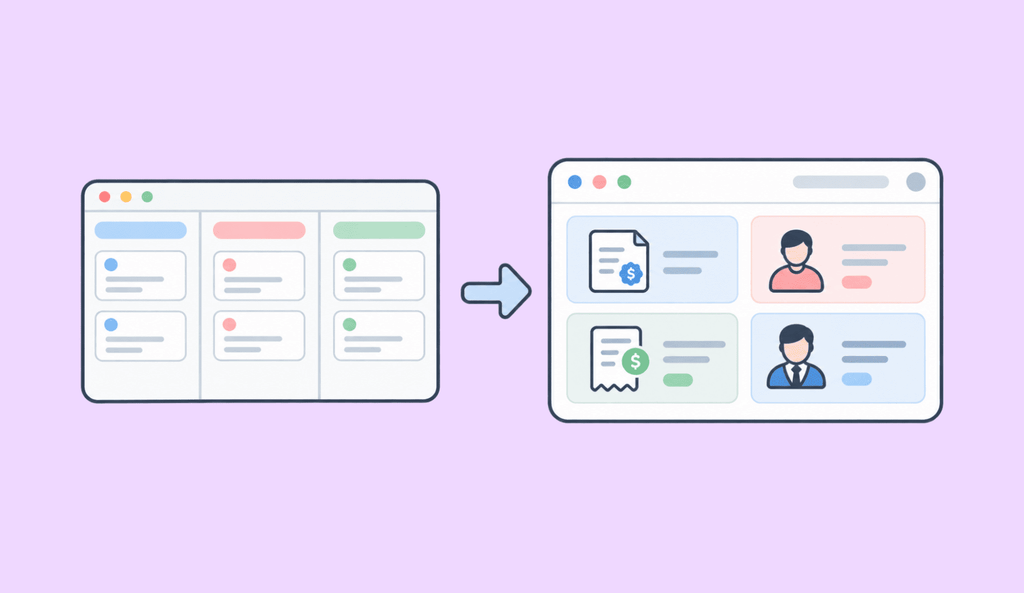
| Factor | Generic PM Tools (Trello / Asana / Monday.com) | TBMS (Awtomated, Plunet, XTRF, Protemos) |
| Best for | Solo translators, small teams, simple projects with limited vendor networks | Scaling agencies with multiple vendors, multiple language pairs, and need for financial visibility |
| Pricing | Low per-seat entry cost; but requires separate accounting tools, file storage, and CAT tool subscriptions | Higher per-seat or per-transaction cost; but consolidates multiple tools and reduces administrative labor |
| Vendor Management | Basic user accounts and task assignments; no rate cards, skills tracking, or performance analytics | Native vendor portals with rate management, certifications, delivery history, and performance metrics |
| Financial Tracking | Budget columns or third-party integrations (QuickBooks, Xero); margin tracking is manual | Integrated quoting, invoicing, vendor payments, multi-currency support, and real-time profitability dashboards |
| Client Portals | Guest access to boards or tasks; limited branding; no structured approval flows | Branded portals with quote approvals, progress visibility, feedback workflows, and version control |
Generic tools get you started. But when translation companies need structured workflows, vendor and financial accuracy, branded client communication, and scalable operations, a translation management platform becomes essential.
Translation Workflow Management
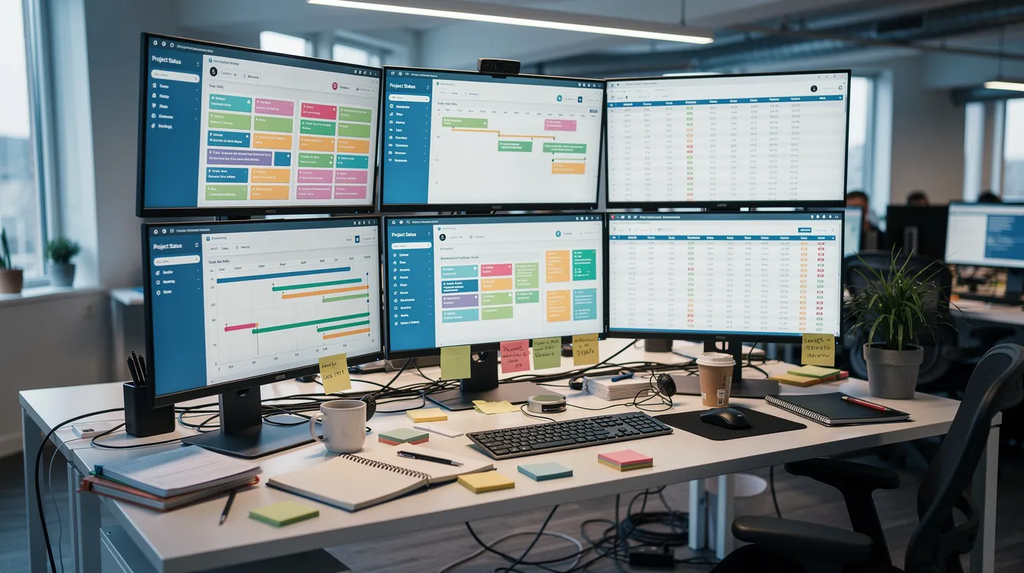
Translation projects follow a precise sequence that generic task boards were never designed to support: request intake → quote generation → client approval → source file preparation → translation → editing/review → proofreading → quality assurance → formatting → delivery. Each stage often depends on the previous one completing, and many involve specialized tools like CAT tool integrations and translation memory databases.
In Trello, Asana, or Monday.com, agencies model these stages through custom statuses, multiple boards, or elaborate tag systems. Project managers manually move cards between columns, send assignment emails, and track dependencies in their heads or in separate spreadsheets. Repetitive tasks pile up. A translation project manager coordinates the entire translation lifecycle, but without purpose-built software, that coordination happens through sheer manual effort.
A TMS integrates translation memory and machine translation features directly into the workflow. Effective TMS can reduce project setup time by at least 30%. When Global Textware migrated to XTRF, the team found they could reflect how they already worked rather than forcing their translation processes into generic templates. Automated workflows reduce repetitive tasks in translation projects - routing files to the right translator, triggering notifications at each stage, and advancing tasks through the pipeline without manual intervention. Effective translation project management prevents missed deadlines and escalating costs by making every stage visible and accountable.
Winner: TBMS - Translation management systems win decisively on workflow management. The trade-off is more initial configuration time and a steeper learning curve than simple boards, but the time saved scales directly with project volume. Automated workflows can cut project management time significantly, and one in five SMB employees find automation enhances task accuracy.
Vendor and Freelancer Management
Translation agencies typically manage dozens to hundreds of freelance translators and editors across multiple language pairs, domain specialties, and service levels. Each vendor has different rates, certifications, turnaround speeds, and quality track records. Effective vendor management reduces miscommunication and duplicated work - but only if the system supports it.
In generic project management tools, vendors are added as users or guests. Assignments are tasks. There are no built-in rate cards, no way to track subject matter expertise or certifications, no vendor-facing portal where linguists can view their assignments, upload deliverables, or track payment status. Using performance data helps assign projects based on track records, but in Trello or Asana, that performance data lives in someone's head or a separate spreadsheet.
A centralized system improves vendor management across multiple locations. TBMS platforms like Awtomated provide dedicated vendor portals so professional translators see their tasks, deadlines, and past performance in one place. Rate cards are structured per service level, language pair, and domain. Automated vendor selection can save around 1,000 hours annually by matching the right linguist to each job based on availability, rates, and quality history. When Maven International evaluated TBMS platforms, they chose XTRF because it "stood out for its stronger focus on the client experience, particularly in how it supports transparent, professional interactions at the point where trust is won or lost" - and that transparency extended to vendor management as well.
Winner: TBMS - Specialized translation project management tools win clearly for vendor and freelancer management. The trade-off is more upfront data entry (vendor profiles, rate sheets, performance criteria), but the return comes with consistent quality, fewer missed deadlines, and better margins across complex projects.
Financial Operations and Invoicing
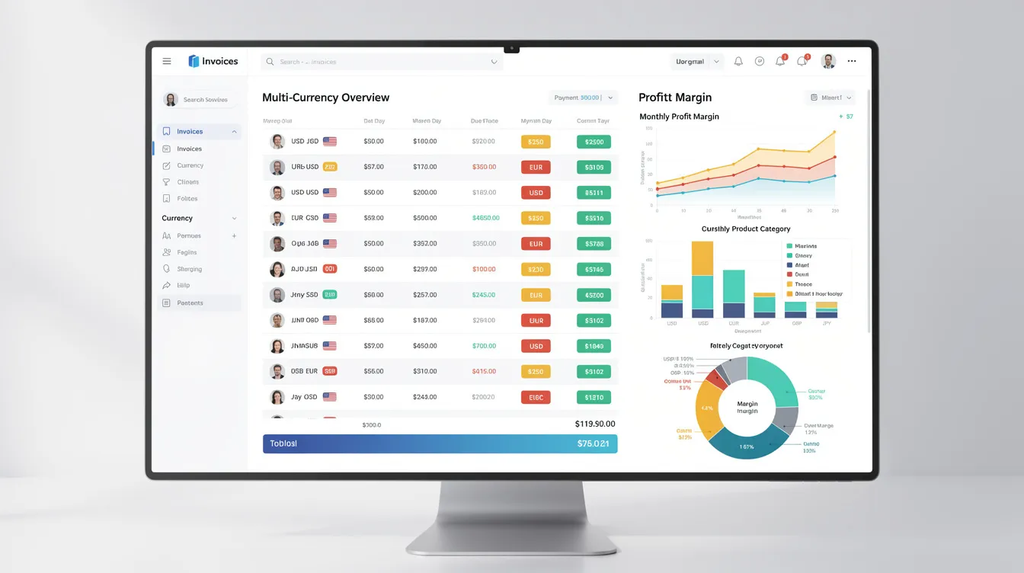
Translation costs are uniquely complex. Agencies must quote clients based on word counts, language pairs, service tiers, and rush fees. They must pay vendors in different currencies at different rates. They need to track margins per project, per client, and per language pair. And 41% of companies struggle to stick to project budgets - a problem that compounds when financial data is scattered across disconnected tools.
Asana, Trello, and Monday.com do not include native invoicing, vendor payment modules, or purchase order generation. Budget tracking is typically limited to formula columns or basic cost fields. Financial operations rely on integrating separate systems like QuickBooks or Xero, which creates duplication, sync issues, and delayed visibility. Multi-currency billing, a standard need for translation services operating globally, requires entirely separate workarounds.
TBMS platforms integrate quoting, invoicing, vendor payments, and margin tracking into the same system where projects are managed. XTRF cut monthly invoicing time from 10 hours to 2 hours - an 80% reduction - by connecting financial data directly to project records. ALT Translations, managing over 1,200 linguists across 35+ languages, achieved over 85% cost reduction in license, support, and maintenance costs after adopting Plunet. Automated invoicing reduces back-and-forth over mismatched totals, and translation project management systems help track budgets effectively in real time. Multi-currency billing facilitates financial tracking across different currencies without manual conversion or reconciliation.
Winner: TBMS - Translation management software wins by a wide margin on financial operations. The trade-off is higher licensing costs and the effort of migrating financial data, but savings on administrative labor, error correction, and improved cash flow typically deliver payback within 6–18 months.
Client Communication and Portals
Clients expect professionalism from their translation agencies: clear quotes with visible cost breakdowns, progress updates without having to email, structured approval workflows, and organized file delivery with version control. In regulated industries, audit trails and compliance documentation may also be required.
Generic tools offer guest or viewer access, file attachments, and comments. But there are no structured quote approval flows, no branded client portals, and no side-by-side source/target review capabilities. Client communication typically defaults to email - which means critical information slipping through cracks. Collaboration tools reduce duplicated work and miscommunication, but only when they're designed for the actual communication patterns of translation services.
Client portals streamline communication and project submissions by giving clients a single place to request work, approve quotes, monitor project progress, and access deliverables. Maven International found that after switching to a TBMS, their quote documents became "clearer and more structured, with direct confirmation links and visible cost breakdowns" - helping clients decide faster. Terminology management allows for consistent use of client-specific terms across all translated content, and real-time suggestions help translators make on-brand choices. Collaborative tools provide centralized visibility into project progress for everyone involved.
Winner: TBMS - Purpose-built translation management platforms win on client communication and portals. The trade-off is more setup effort to configure branding and approval workflows, but the result is a more professional client experience that can become a genuine competitive differentiator for translation agencies.
Scalability and Business Growth
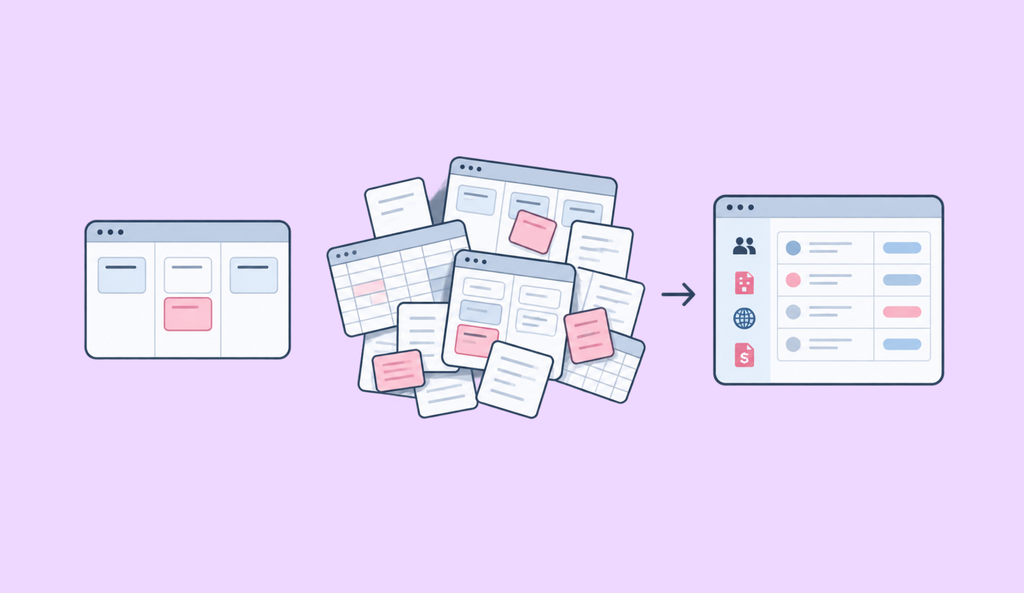
Growth stresses every system. As translation agencies add clients, languages, vendors, revision cycles, file formats, and domain specialties, generic tools buckle under the weight of information they were never structured to hold. Localization project managers find themselves spending more time managing the tools than managing the work. Complex projects involving multiple language pairs and continuous localization require centralized systems that scale without proportional increases in administrative overhead.
In Trello or Asana, scaling means more boards, more custom fields, more manual processes, more room for error. Enterprise localization programs with multiple office locations, varied workflows, and dozens of active localization projects cannot run effectively on tools that treat every task the same way.
TBMS platforms are built for this complexity. Global Textware, established in 1997, moved to XTRF specifically to reduce technical debt and consolidate systems across operations, reporting, and vendor management. ALT Translations operated across 100 countries with over 1,200 linguists - scale that would be unmanageable without automated workflows, centralized vendor data, and integrated financial reporting. Many TMS platforms support over 100 file formats for localization, handling the diversity of content types that growing agencies encounter. AI and machine translation features enhance translation productivity at scale, with Nimdzi research showing that 62.6% of LSPs now use machine translation post-editing for more than 30% of their projects, up from just 29.1% in 2022. Managing this complexity - AI translation, quality assurance for MT output, cost tracking for hybrid workflows - demands a system designed for it.
Winner: TBMS - Translation business management systems win clearly on scalability. For very small agencies, generic tools may suffice in the early stage. But as soon as there are multiple full-time project managers, recurring high-volume work, or demand for financial visibility and margin forecasting, a translation management system TMS becomes nearly inevitable for sustainable growth. Automation can save translation teams significant time and effort that compounds with scale.
Which Should Your Translation Agency Choose?
- Choose generic PM tools if you're a solo translator or a team of fewer than five people, working with a limited set of clients, few language pairs, a minimal vendor network, and straightforward projects that don't require integrated quoting or financial tracking. A free plan on Trello or Asana combined with a CAT tool and simple spreadsheets can work at this stage.
- Choose a Translation Business Management System like Awtomated if you're scaling beyond basic task management: increasing client volume, managing multiple freelance translators across multiple language pairs, needing multi-currency billing, seeking real-time margin visibility, or wanting to present a professional client portal experience. Translation project management includes planning, budgeting, and quality control - all of which should live in one system rather than scattered across five.
The ideal translation management software consolidates your operations before technical debt makes migration painful. Adopting a TBMS earlier preserves historical data, reduces transition friction, and makes it easier to introduce optimizations like machine translation workflows, translation memory leverage, and vendor performance analytics. The best translation management software isn't the one with the most features - it's the one that matches where your agency is heading, not just where it is today.
Frequently Asked Questions
When should a translation agency switch from generic tools to a TBMS?
Concrete indicators that you've outgrown generic project management tools:
- You're managing more than 10–20 active translation projects simultaneously across multiple language pairs
- You work with more than 20 vendors and struggle to track availability, rates, and quality
- You need multi-currency billing or vendor payments
- Clients are asking for quote breakdowns, approval workflows, or visibility into project progress
- You're losing track of margins because invoices and vendor payments aren't clearly aligned
- Project managers spend significant hours on repetitive tasks - resending reminders, correcting version errors, reconciling spreadsheets
- Translation project management systems organize and track projects effectively; if your current setup doesn't, it's time
Effective translation project management tools automate routing and notifications, replacing manual coordination that eats your team's capacity.
Can generic project management tools be customized for translation workflows?
To an extent. Through custom boards, status flows, tags, automations, and integrations (like Zapier), you can approximate many functions of translation workflow management. You can set up columns for service levels, use labels for vendor assignments, and build automations for status changes.
But limitations persist. There are no vendor portals with rate cards. Financial features aren't embedded - they're bolted on. Translation memory integration is weak or nonexistent. Computer assisted translation tools don't connect natively. Quality assurance checks for translated strings aren't part of the workflow. And much of this customization grows fragile as underlying board structures change. Software localization and managing translations at scale expose every gap in a system that wasn't designed for the localization process.
How difficult is it to migrate from Trello/Asana/Monday.com to a TBMS?
Migration involves several challenges: moving project histories, client and vendor lists, and file attachments; documenting existing workflows to replicate or improve them; training staff and updating standard operating procedures; and reworking integrations with CAT tools and accounting systems.
That said, many agencies report transitions taking weeks rather than months. Awtomated provides onboarding support and migration assistance, and many LSPs are fully operational on the new platform within a couple of weeks. The key is treating migration as process improvement, not just tool replacement - mapping your current workflow, identifying what you want to automate, and letting the TBMS handle what spreadsheets and generic tools never could. AI tools can automate repetitive translation tasks from day one, accelerating the transition.
What's the cost difference between generic tools and specialized TBMS?
Direct subscription costs for generic tools start lower - often $10–$25 per seat per month, with free tiers available. Popular translation management software like TBMS platforms typically cost more per seat or per transaction.
But total cost of ownership tells a different story. Hidden costs of generic tools include administrative time spent on manual processes, errors from spreadsheet formula mistakes (studies show 0.8–1.8% of formula cells contain errors), delayed invoicing, missed vendor payments, and client dissatisfaction from unprofessional workflows. ALT Translations reduced license, support, and maintenance costs by over 85% after consolidating into a TBMS. Machine translation can reduce translation costs significantly when integrated properly - but tracking those savings requires the financial infrastructure that only management software purpose-built for translation provides. Expect payback periods of 6–18 months for small to mid-sized agencies, depending on volume and complexity. Over 30 translation management systems utilize AI features, and AI can enhance translation accuracy and efficiency - savings that compound over time but only materialize when your system can track them.

Building software that helps small and medium-sized language service providers run their business.
About Rishi →Table of Contents
- The Challenge of Managing Translation Business with Generic Tools
- What Are Generic Project Management Tools?
- What Are Translation Business Management Systems?
- Generic PM Tools vs Translation Business Management Systems: How They Compare at a Glance
- Translation Workflow Management
- Vendor and Freelancer Management
- Financial Operations and Invoicing
- Client Communication and Portals
- Scalability and Business Growth
- Which Should Your Translation Agency Choose?
- Frequently Asked Questions