Purchase Orders in Translation Agencies: Why the PO Is Your Source of Truth for Vendor Payments
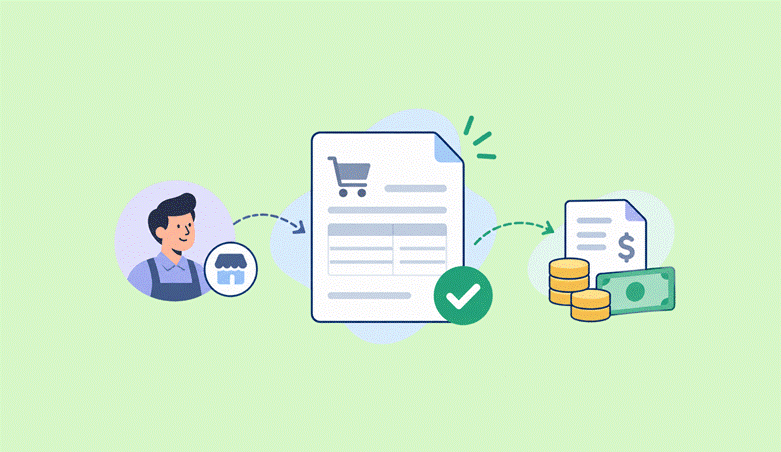
In any translation agency, the purchase order is the document that keeps vendor payments, project scope, and profitability tracking honest. Without it, you are guessing. This article gives you concrete, operations-focused guidance for making POs the backbone of your translation workflow.
Key Takeaways
- In a translation agency, the purchase order is the binding reference for vendor payments, project scope, and margin control. Awtomated treats each PO as the single source of truth tying together the translation project, vendor tasks, agreed rates, and client billing.
- Poorly managed purchase orders lead directly to margin leakage, vendor disputes, and delayed payments - especially for agencies handling hundreds of translation projects per month.
- A purchase order is required to process invoices for translation services. No PO, no payment.
- Using a Translation Business Management System (TBMS) like Awtomated automates PO creation, approval, and invoice matching, reducing admin work and payment errors.
- Purchase orders streamline procurement without a formal RFP process, making it faster to order translation services across languages.
Why Purchase Orders Matter in Translation Agencies
A purchase order in language services is not the same as a quote or an invoice. It is the operational "contract snapshot" that locks in word count, rates, service types, deadlines, and special conditions. You can learn more about this distinction here. A purchase order must be provided before starting a project - this protects both the agency and the translator.
POs connect project managers, vendor managers, and freelance linguists across document translation, localization, and interpretation services. Professional interpreters are available for on-site appointments, and growing LSPs now routinely handle dozens of POs per day for translation, editing, DTP, and interpreting - often in multiple currencies.
Experience with procurement terminology is valuable for translating purchase orders, and precision in translation is crucial for purchase orders since errors in part numbers or quantities can cause severe supply chain issues. Consider the scale: Taika Translations has delivered over 102,000 projects since 2009, and agencies like them rely on structured PO data to keep operations running.
The difference between a client purchase order (issued by corporate, state agencies, or federal agencies to the LSP) and internal vendor POs (issued by the LSP to translators and interpreters) is critical. Awtomated manages both in one system.
From Client Request to PO: Mapping the Translation Project Lifecycle
Here is a concrete example. In January 2026, a state health department submits a 25,000-word document translation request in Spanish, Vietnamese, and Chinese, referencing Title VI compliance for public notices aimed at residents who do not speak English.
The steps:
- Intake - The PM gathers source files, checks file formats, and identifies whether services include translation, editing, proofreading, or DTP.
- Scoping - Word count analysis, target language identification, and review of any client-specific glossary for consistent terminology.
- Quote - Professional translation services are priced per word, per language pair, with rush or weekend surcharges noted.
- Client approval - The client issues a purchase order referencing their NASPO ValuePoint contract and participating addendum.
- Vendor POs - The agency mirrors terms internally, generating vendor POs for each translator and editor.
Existing agreements allow purchase orders for translation services without extensive paperwork. In Awtomated, an accepted quote converts into a structured translation project with preconfigured vendor purchase orders automatically.
What a Good Translation Purchase Order Must Include
A PO that serves as a reliable source of truth must contain structured data, not free text. Here are the minimum fields:
| Field | Example |
| Project ID | PROJ-2026-0142 |
| Client name & PO number | State DOH, PO#SH-4421 |
| Language pairs | EN→ES-MX, EN→VI, EN→ZH-CN |
| Services | Translation, editing, proofreading, DTP |
| Word count (with TM breakdown) | 25,000 total; 18,450 new words |
| Per-word rate | $0.12 translation; $0.04 review |
| Deadline | 7 business day turnaround |
| File formats | Word, InDesign, XLIFF |
| Compliance metadata | Title VI, ADA / Disabilities Act notes, contract number |
Different languages or formats require careful localization in purchase order translations. Purchase orders often require formatting preservation due to tabular data. Agencies need to accurately manage numeric and structured data in translations.
Agencies should maintain a client-specific glossary to ensure terminology consistency. Two linguists handle each translation project for quality assurance - one for translation, one for review. Agencies should also provide secure file transfer methods for handling sensitive documents, since data security is essential when handling purchase orders due to sensitive information.
Translation quality standards such as ISO 17100 are important for translation agencies and should be referenced where applicable.
The PO as a Financial Source of Truth for Vendor Payments

Vendor invoices should always be reconciled against POs - not email threads. A PO locks in quantities (e.g., 18,450 billable words after translation memory analysis) and unit prices, becoming the benchmark for vendor billing checks. Document translation costs are typically based on word count, making this alignment straightforward.
Common inconsistencies: vendors invoicing higher word counts, omitting volume discounts, or billing out-of-scope tasks. A purchase order is required to process invoices for translation services, and verification of pricing models is important when comparing translation services from multiple vendors.
Awtomated calculates expected vendor costs from the PO and flags mismatches when invoices exceed PO terms. For recurring document translation services under government contracts, consistent PO–invoice matching simplifies audits. Implementing PO-gated workflows can improve net margin by 2–4 percentage points for mid-size agencies.
Operational Risks of Weak or Missing POs
Without enforced POs, agencies face real pain:
- Overpaying vendors due to missing translation memory discounts or unapplied TM tiers
- Underbilling clients because internal costs were never tied to a client purchase order
- Scope confusion when no one knows which version of the agreement is final
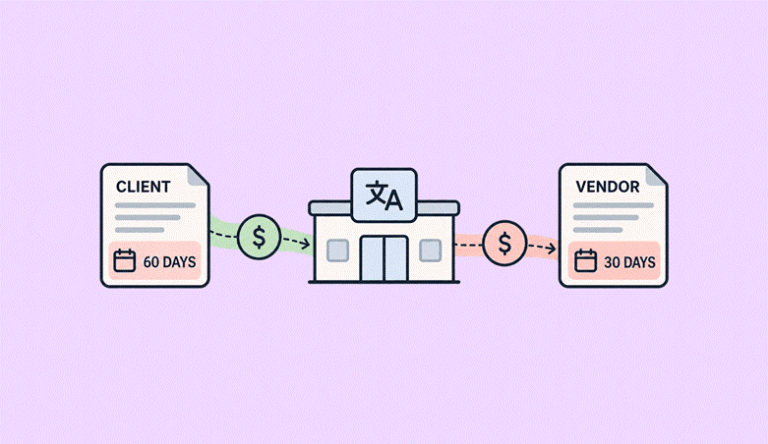
- Vendor mistrust - delayed payments cause top linguists to leave; finding a new vendor costs time and relationships
- Compliance failures for government agencies, state agencies, or federal agencies that require documented procurement trails
Agencies should offer human review processes to ensure translation quality, and when those review steps happen outside a PO, cost tracking breaks down. Admin inefficiencies pile up: PMs hunting through email attachments and spreadsheets to reconstruct what was agreed for a project.
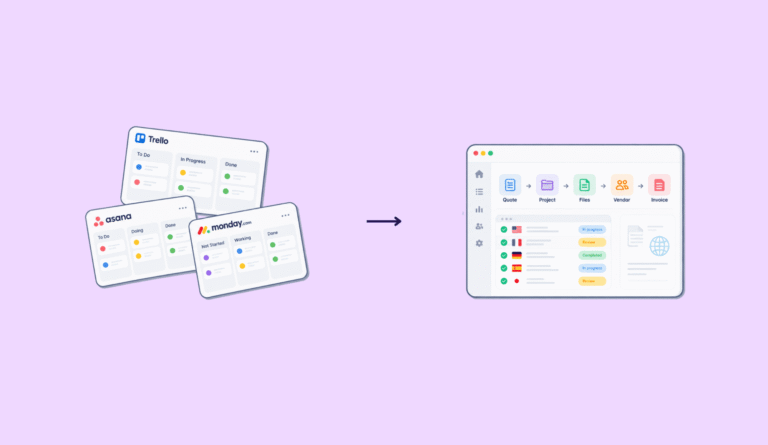
Awtomated mitigates these risks by centralizing vendor management, linking POs to each project, and maintaining a complete audit trail.
Automating Purchase Orders in Awtomated TBMS
Awtomated handles purchase orders end-to-end for translation agencies:
- Templates - Predefine PO structures by client type (corporate, healthcare, federal agencies) and service mix (document translation services, interpretation services, localization).
- Auto-generation - When a project is created, vendor tasks (translation, editing, proofreading, QA, DTP) automatically generate corresponding POs with correct rates and currencies.
- Integration - Client purchase order numbers are automatically copied onto internal POs and invoices. API integration can streamline submissions for high-volume purchase orders.
- Dynamic data - POs pull real word counts from CAT-tool analyses, applying translation memory tiers and client-specific discount rules.
- Finance - The finance module uses POs to drive vendor payment schedules, accruals, and cash-flow forecasting without extra spreadsheets.
Turnaround times are critical for urgent translation of purchase orders, and automation removes the bottleneck of manual PO creation.
Compliance, Contracts, and Purchase Orders (NASPO, Title VI, and More)
Translation services must comply with Title VI and ADA standards. Government translation services help ensure compliance with ADA standards, and federal regulations require translation of vital documents like legal documents, public notices, and vital documents for people facing language barriers in their native language.
NASPO ValuePoint offers pre-negotiated translation contracts for public entities. Over 150 languages are supported for government translation services - for example, Avantpage provides interpreting services in 150 languages, and Propio offers 21 short forms for informed consent. These frameworks cover eligible entities and other eligible entities such as school districts.
Awtomated stores contract identifiers (Master Agreement numbers, participating addendum references) at the client level so every related PO carries the correct compliance metadata. This also benefits private-sector clients - banks, insurers, and healthcare providers - who require clear procurement trails. You can contact your organization's compliance team to review how PO metadata maps to your specific agreement requirements.
Best Practices for PO-Driven Translation Operations
Here are repeatable habits for LSP owners:
- Always create a vendor PO for every external task - even a 300-word rush job or video remote interpreting session. Video remote interpretation and phone calls for interpreting should be tracked just like document translation.
- Standardize naming conventions - Align project codes, client purchase order numbers, and internal PO IDs to simplify search and reporting.
- Enforce version control - Any scope change (extra 5,000 words, added DTP) requires a PO update. No verbal adjustments.
- No PO, no pay - Vendor invoices that do not reference a valid PO are not processed. Submit only with a matching PO number.
- Monthly margin reviews - Examine projects where vendor POs exceed client-side purchase orders. Track agency KPIs to detect systemic issues.
These practices make your website and materials cost effective to manage and keep your company's processes accessible and complete.
How POs Connect to Translation Memory, Technology, and Profitability
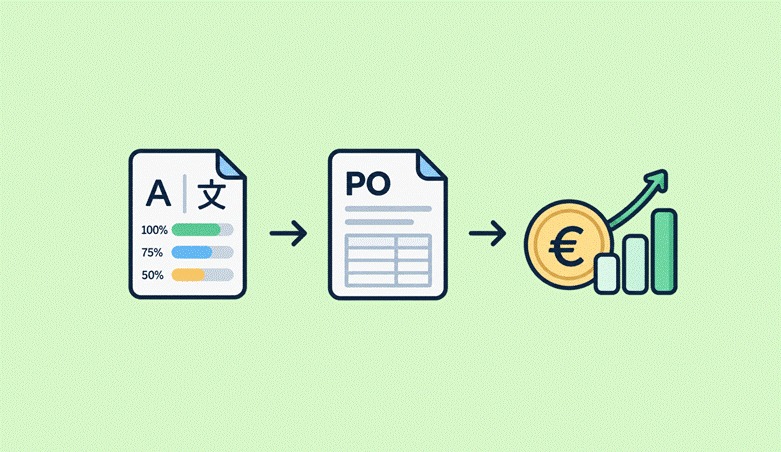
Modern document translation services rely heavily on CAT tools and translation memory. Translation Memory tools are useful for maintaining consistency across recurring orders. TM analyses generate match categories that translate into different payable rates on POs - for example, 100% matches at 10% of the base rate, fuzzy bands at 25%.
When POs are aligned with TM analysis, agencies scale document translation while protecting margins. Awtomated pulls TM-based word counts from integrated tools like Trados or memoQ exports and embeds them directly into PO line items, enabling precise profitability tracking per match band, language pair, or client.
As AI and machine translation become part of the workflow, POs should specify when post-editing of MT is used and at what rates. Upload documents through your CAT tool, let the analysis run, and Awtomated maps results to your PO. This keeps your web content localization and translated documents accurate.
FAQ: Purchase Orders and Vendor Payments in Translation Agencies
Do I really need a vendor PO for every small translation job?
Yes. Even a 300-word urgent document translation benefits from a PO because it standardizes scope, rates, and payment expectations. In Awtomated, creating a PO from an existing project or quote takes seconds. The admin burden is minimal compared to the clarity it provides. You can order translation services by issuing a purchase order regardless of job size.
How should I handle changes in scope after a PO is issued?
The safest approach is to either revise the original PO with tracked changes and timestamps, or issue a separate PO for the additional work. Awtomated keeps a full change history so finance teams can see what was added, when, and which vendor invoices relate to updated scope.
Can I manage client purchase orders and internal vendor POs in one system?
This is exactly what Awtomated is designed for: storing client POs, linking them to projects, and generating internal vendor POs from the same data. One client PO can map to several vendor POs - critical for tracking margins on complex multilingual translation projects.
How do POs help with government and public-sector translation work?
For entities operating under NASPO ValuePoint contracts, POs document that pricing, languages, and services match agreed contract terms. Having all POs and related translation projects in Awtomated simplifies demonstrating Title VI and ADA-related language access efforts during audits, with resources readily available for review.
What if my vendors invoice in different currencies than my clients?
POs should always specify the payment currency for each vendor, separate from client billing. Awtomated supports multi-currency POs and converts costs for profitability reporting while paying vendors in their preferred currencies. This is an event-driven process - each invoice triggers an automatic exchange rate check.

Building software that helps small and medium-sized language service providers run their business.
About Rishi →Table of Contents
- Why Purchase Orders Matter in Translation Agencies
- From Client Request to PO: Mapping the Translation Project Lifecycle
- What a Good Translation Purchase Order Must Include
- The PO as a Financial Source of Truth for Vendor Payments
- Operational Risks of Weak or Missing POs
- Automating Purchase Orders in Awtomated TBMS
- Compliance, Contracts, and Purchase Orders (NASPO, Title VI, and More)
- Best Practices for PO-Driven Translation Operations
- How POs Connect to Translation Memory, Technology, and Profitability
- FAQ: Purchase Orders and Vendor Payments in Translation Agencies