Translation Agency Cash Flow: When Clients Pay in 60 Days but Vendors Expect 30
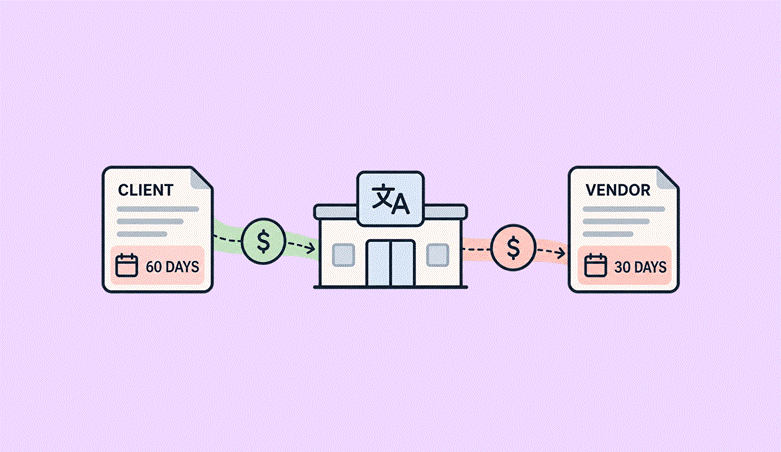
If you run a translation agency, you already know this tension: your enterprise client signs off on the deliverables, you send the invoice, and then you wait. Sixty days. Sometimes ninety. Meanwhile, your freelance linguists expect payment in fifteen to thirty days, your CAT tool subscription renews next week, and rent is due on the first. Your income statement says you're profitable. Your business bank account says otherwise.
This is the structural cash flow problem that most translation companies face, and it doesn't fix itself with more sales. Let's break down exactly where the money gets stuck, how to spot the problem in your financial statements, and what you can do about it.
Key Takeaways
- Translation agencies operate as intermediaries between clients and freelance linguists, creating a built-in timing mismatch: enterprise clients often pay on net-60 or net-90 terms while vendors expect payment in 15–30 days.
- Cash flow management in a translation agency involves tracking money inflows and outflows by date, not just by amount. A profitable income statement can mask a dangerously negative cash position.
- The 60/30 gap shows up clearly in your cash flow statement, even when your loss statement shows healthy margins. Accounts receivable aging tracks how long clients actually take to pay invoices, often beyond contractual terms.
- Practical fixes include cash flow forecasting, renegotiating payment terms, milestone invoicing, and controlling operating expenses.
- Awtomated, as a Translation Business Management System, helps LSPs centralize vendor costs, client invoices, and payment schedules so you can see project-level cash requirements before they become a crisis.
Understanding the 60/30 Cash Flow Gap in Translation Agencies
Cash flow dynamics in translation agencies have unique friction points due to payment cycles. The core issue is simple: the people you pay (translators, reviewers, DTP specialists) expect money faster than the people who pay you (corporate clients) are willing to send it.
Here's a concrete scenario. Your agency wins a €40,000 multilingual financial translation project. The client is a listed company commissioning translation of their annual reports into six languages. You deliver the final files on January 31, 2026, and invoice the client under net-60 terms. That means cash arrives around March 31-if they pay on time.
Your vendor costs for this project-professional translators, reviewers, a DTP specialist-total €25,000. Freelance translators expect to be paid on predictable cycles, often on net-30 terms. So those invoices are due by late February at the latest. Some of your best finance-specialist linguists expect net-15.
The result: €25,000 leaves your account a full month before €40,000 arrives. You're profitable on paper. You're cash-negative in reality.

This isn't a sign of bad management. It's a structural issue in B2B language services, especially with large legal, financial, and healthcare clients who impose standard 60–90 day terms. Translation agencies face delayed payments from clients while needing to pay freelancers promptly-and solving this gap is about cash flow management, not simply "getting more sales."
How Financial Statements Reveal (or Hide) Your Cash Flow Problems
Your agency's financial statements tell three different stories depending on which one you read. Here's how each relates to the 60/30 problem:
- Income statements (P&L): Show revenue from translation, localization, and professional translation services minus operating expenses like linguist fees, project manager salaries, CAT tools, office space, and marketing. Revenue is recognized when earned, not when cash arrives. A financial forecast helps assess future profitability and cash flows, but the P&L alone won't tell you whether you can make payroll next month.
- Balance sheets: Reveal the buildup. Large accounts receivable from corporate clients sit on one side; accounts payable to linguists and deferred revenue from retainers sit on the other. If receivables grow faster than cash, you have a problem-even if net assets look fine.
- Cash flow statements: This is where the 60/30 mismatch becomes visible. It shows the actual timing of cash in and cash out. Financial documents include balance sheets and cash flow statements, but only the latter reveals your real liquidity position.
Consider this example: in Q2 2026, your income statement shows €80,000 profit from two enterprise clients. But both are on net-90 terms. Your cash flow statement shows negative operating cash flow of −€70,000 because you've already paid vendors, staff, and overhead while €200,000 in receivables remains uncollected.
Cash Flow Statement 101 for Translation Agencies
If you're only reviewing your P&L each month, you're flying blind. Here's what a proper cash flow statement breaks down:
- Operating cash flows: Cash received from translation, interpretation, and financial translation services minus cash paid to linguists, in-house staff, software vendors, and overhead. This is the key line for agencies. Cash flow forecasts show how much cash the agency actually generates-not how much it earns on paper.
- Investing cash flows: Purchases of translation servers, annual CAT tool licenses, MT engines, or even an acquisition of a smaller boutique agency. These appear as cash outflows separate from operating expenses and reflect investment in growth.
- Financing cash flows: Bank loans, credit line drawdowns, equity injections from partners, and repayments. Many agencies bridge the 60/30 gap with external financing, and this is where that activity shows up.
Historical accounting data is crucial for existing agency forecasts. A robust monthly cash flow statement-not just an annual one-lets owners see whether each major client or service line is a net cash driver or a drain, given its specific payment terms.
Why Translation Agencies with Strong Revenue Still Struggle with Cash Flow
The global language services market exceeded $56 billion in 2023, and the language services industry is projected to reach $98 billion by 2032. Growth is real. But growth without cash flow discipline creates bigger problems, not smaller ones.
Here's why profitable agencies still run into trouble:
- Revenue concentration: An agency where 65% of revenue comes from three enterprise clients on net-60 faces chronic receivables buildup. One delayed payment from a single client can cascade.
- Rising costs on faster schedules: Inflation in linguist rates after 2022, higher subscriptions for CAT tools, machine translation providers, and TBMS solutions-all usually on monthly or annual prepay terms. Translation agencies must monitor cash flow closely to mitigate the impact of high variable costs.
- Seasonal swings: Seasonal demand fluctuations can complicate cash flow planning for translation agencies. Heavy legal and financial document demand around Q1 and Q3 reporting seasons creates uneven monthly cash flows.
- Currency exposure: Translation agencies may deal with currency fluctuations and cross-border transaction fees. Agencies invoicing in USD or EUR but paying linguists in BRL, PLN, or INR face foreign currency cash flows risk, where exchange rates move between invoicing and vendor payment. The reporting currency on your books may not match the currencies flowing through your accounts.
Mapping Client and Vendor Terms: Your Cash Flow "Risk Map"
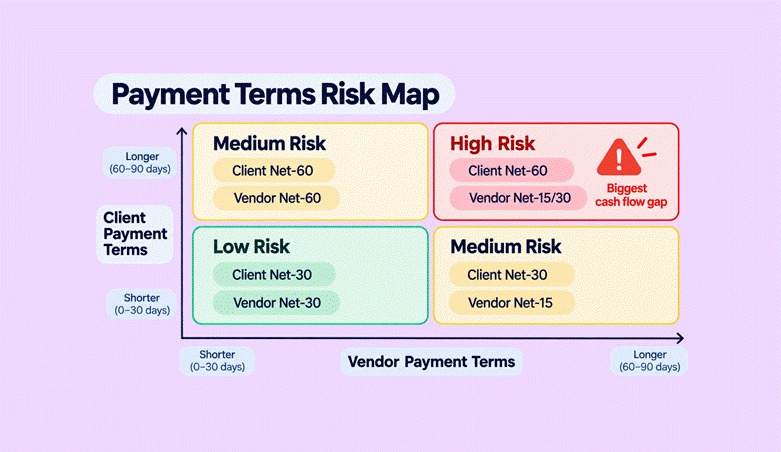
The first practical step is to inventory who pays you when versus whom you have to pay when. Create a simple table:
| Entity | Type | Avg. Invoice | Terms | Actual Avg. Payment |
| GlobalBank plc | Client | €18,000 | Net-60 | Day 68 |
| MedTech GmbH | Client | €6,500 | Net-45 | Day 52 |
| Linguist A | Vendor | €2,200 | Net-30 | Paid day 30 |
| DTP Studio | Vendor | €1,500 | Net-15 | Paid day 15 |
Look for high-risk combinations: long client terms paired with short vendor terms on high-volume accounts. Segment your vendors by type-freelance translators, reviewers, DTP specialists, tech providers, interpreting subcontractors-since each has different payment expectations.
Successful agencies implement strict credit checks to mitigate bad debt risks before onboarding new enterprise clients. And watch for scope creep: unbilled work from expanded project scope can erode cash flow stability without ever appearing as a formal invoice.
Awtomated can tag projects by client, payment terms, and vendor costs so project managers can see projected cash requirements for each account in a given month.
Strategies to Manage the 60/30 Cash Flow Squeeze
Optimizing payment terms can significantly enhance liquidity for translation agencies. Here's your toolkit:
- Renegotiate client terms: Move a long-standing client from net-60 to net-45 on new framework agreements. Implementing early payment discounts (e.g., 2% for payment within 10 days) can encourage clients to pay invoices sooner.
- Renegotiate vendor terms: Preferred freelancers may agree to net-30 or bi-monthly payments when they receive consistent volume and transparent reporting through vendor portals.
- Milestone invoicing: Instead of invoicing only on final delivery for a €60,000 localization project, split into kickoff (30%), mid-project (30%), and completion (40%) to smooth cash inflows. Agencies often require upfront deposits for large projects to manage cash flow.
- Retainer models: Agencies benefit from offering retainer models for clients with consistent translation needs. Retainers create predictable monthly income that offsets lumpy project-based cash flows.
- Price in your funding cost: Build the cost of long payment terms into rates for complex projects. A net-90 client should pay more than a net-30 client for the same work. You don't need to label it "financing"-just reflect it in your per-word or per-project pricing.
- Cull unprofitable accounts: Use project-level profitability data to identify clients with chronically late payments and low margins. Some contracts aren't worth the cash they tie up.
- Automate invoicing: Automated invoicing can reduce delays in billing and improve cash flow management. Every day your invoice sits unsent is a day added to your cash gap.

Cash Flow Forecasting and Scenario Planning for LSPs
Forecasting cash flow helps translation agencies anticipate shortfalls and manage timing gaps before they become emergencies. Maintaining a rotating cash flow forecast-updated monthly, with 12–18 months of forward visibility-can help agencies manage liquidity effectively.
Inputs your forecast should include:
- Booked projects and their invoicing schedules
- Typical win rates on open quotes
- Seasonality patterns from prior years
- Known retainer contracts
- Historical average payment delays per major client
Build three scenarios:
- Base case: Clients pay on contractual terms
- Pessimistic: Your largest client pays 20 days late; a second client disputes an invoice
- Growth case: New financial translation contract signed in Q1 2026, adding $120,000 in revenue but also $75,000 in upfront vendor costs
Cash reserves are essential for translation agencies to cover operational costs during payment delays. Set trigger thresholds: if projected cash dips below a defined floor, delay new hires or slow software investments. Projected profit and loss statements indicate future agency profitability, but it's the cash forecast that tells you whether you'll survive long enough to realize it. Financial forecasts also help secure financing from banks and investors when you need external capital.
Using Awtomated to Track Margins, Cash Flows, and Payment Cycles
At Awtomated, we built our Translation Business Management System specifically to give LSPs the visibility they need to manage cash flows alongside projects.
Here's how it works in practice:
- Linked financial workflow: Awtomated connects quotes, purchase orders, vendor assignments, and client invoices in one system. Each project's expected cash inflow and outflow dates are visible from the moment you create the quote.
- Real-time profitability tracking: Per-project and per-client margin reports include vendor costs, PM time, MT usage, and other operating expenses. You can identify accounts that look profitable on the P&L but drain cash due to long terms.
- Client and vendor portals: Clearer communication of invoicing milestones and payment expectations reduces administrative delays that worsen the 60/30 gap.
- Multi-currency support: Awtomated tracks project revenue and costs in different currencies, helping agencies anticipate FX impacts on future foreign currency cash flows and manage exchange rates risk across various countries.
Imagine a dashboard view showing upcoming receivables versus payables by week. You'd see immediately that in the third week of February, €25,000 in vendor payments come due but no client payments are expected until mid-March. That's the kind of understanding that prevents crisis.
Financial Translation Projects: A Special Case for Cash Flow Risk
Financial translation and accounting translation projects-annual reports, balance sheets, income statements, cash flow statements-are often the largest, most deadline-driven contracts a translation agency handles. They're also the most dangerous for cash flow.
Consider this scenario: a listed company commissions full-year 2025 annual report translation into eight languages. Total contract value: $120,000. The client insists on net-60 terms. Your vendor costs-specialized linguists with expertise in financial terminology, reviewers with knowledge of international accounting standards, DTP-hit heavily in Q1 2026.
Financial translation ensures compliance with international accounting standards like IFRS and GAAP. Accurate financial translations build trust with international investors who rely on translated documents for investment decisions across international markets. Expertise in financial terminology is crucial for accurate translations, and mistranslations can lead to severe financial consequences for businesses-from regulatory compliance failures to lost confidence among investors.
Structure these contracts defensively: milestone invoicing after translating management discussion and analysis, then balance sheet and income statement sections, then the final cash flow statement and notes. This reduces your exposure and keeps cash flowing during the project rather than all arriving months after completion.
Operational Levers: Controlling Operating Expenses Without Hurting Growth
Managing operating expenses is as critical as managing payment terms when cash is constrained.
- Audit software subscriptions: Review CAT tools, QA tools, MT engines, translation memory systems, terminology databases, and communication platforms. Consolidate or right-size licenses based on actual usage. Translation technologies should scale with your revenue, not ahead of it.
- Flexible staffing: Use a mix of in-house project managers and vetted freelancers to align costs with revenue patterns. This keeps your cost base variable during slow periods, helping you remain competitive without overextending.
- Track overhead by segment: Link rent, marketing spend, sales commissions, and training costs to revenue per client segment. Awtomated's reporting and KPI tracking can help allocate project management time and vendor costs properly, revealing true operating expense drivers by client, industry vertical, or service type.
Financing Options to Bridge Persistent Cash Flow Gaps
Operational fixes should come first. But many agencies will need external financing to bridge the 60/30 gap during growth spurts or when landing large new contracts.
- Business overdrafts or credit lines: Translation agencies can justify facilities based on predictable corporate contracts and repeat business. Working capital loans for LSPs typically range from $10,000 to $500,000. SBA 7(a) loans can support amounts up to $5 million for larger needs.
- Invoice financing or factoring: Invoice financing can unlock 80 to 90 percent of invoice value immediately. A Canadian translation services provider used accounts receivable financing specifically because large clients took 60–90 days to pay while vendor payments were due in 30–60 days. Use this selectively on large invoices from reputable enterprise clients.
- Match financing to need: Avoid long-term loans for short-term cash mismatches. Keep borrowing horizons aligned with client payment cycles.
Clean, structured financial data exported from Awtomated-client lists, historical revenues, margins, and payment patterns-strengthens your case when presenting to lenders or investors seeking confidence in your agency's financial health.
Monitoring, Reporting, and Governance for Healthy Agency Cash Flow
Cash flow discipline isn't a one-time fix. It's an operating system.
- Monthly cash flow review: Leadership and finance teams should review updated cash flow statements, aging of receivables, and vendor payment schedules together.
- Track these KPIs: Days sales outstanding by client, average vendor payment days, operating cash flow margin, and cash conversion cycle-all calculated from your financial statements.
- Internal policies: Set minimum cash reserve levels, approval rules for extending client credit, and escalation procedures when invoices cross 45 or 60 days past due. High quality translations delivered on time mean nothing if the cash to fund them never arrives.
Awtomated's dashboards and exportable reports can prepare concise monthly packs for owners and investors, combining operational and financial data into a clear plan for ongoing liquidity management.

Frequently Asked Questions
How much cash reserve should a translation agency keep if clients pay in 60 days?
A reasonable target is enough cash to cover at least two to three months of fixed operating expenses plus average monthly vendor payments, based on your current cost structure. The exact number depends on revenue volatility, client concentration, and access to credit lines. Using Awtomated to track actual monthly outflows helps you calculate a realistic reserve level rather than guessing. A rolling 12-month cash flow forecast is the best way to refine this target over time.
How do I reflect long client payment terms in my cash flow forecast?
Assign each project's revenue a cash date based on contract terms and historical payment behavior-for example, "invoice date + 65 days" for a client that usually pays five days late on net-60. Model cash flows at least monthly. For agencies exceeding $1M annual revenue or working with large enterprise clients on net-60 or net-90, weekly granularity is worth the effort. Awtomated stores invoice dates and actual payment dates, letting you derive realistic average lags per client to feed into forecasts.
What's the difference between being profitable and having positive cash flow as an LSP?
Profitability on the income statement counts revenue when it's earned and expenses when incurred, regardless of when money moves. Positive operating cash flow means actual cash from clients exceeds cash paid to vendors and for operating expenses during the same period. A translation agency can show €50,000 quarterly profit but negative operating cash flow because €200,000 is tied up in unpaid invoices while vendor bills have already been settled. Companies in every industry face this, but the agency model-where you're an intermediary paying vendors faster than clients pay you-makes it especially acute.
How can Awtomated help if I'm still using spreadsheets for finance?
Awtomated doesn't replace your accounting software. It centralizes operational data-quotes, projects, vendor POs, client invoices, and payment terms-that spreadsheets usually track inconsistently. You can export structured, project-level and client-level data from Awtomated into your accounting system or forecasting spreadsheet, improving the accuracy of your income statements, balance sheets, and cash flow statements. This reduces manual work, errors, and missing information like forgotten purchase orders or late vendor invoices that undermine cash flow planning.
Do I need specialist financial translation expertise to win better-paying corporate clients?
For sectors like banking, insurance, and listed companies expanding into new markets, offering high quality financial translation services-covering annual reports, balance sheets, income statements, cash flow statements, regulatory filings, and tax returns-is often a prerequisite to winning large contracts. Such clients typically pay more per word but also demand accuracy, compliance with financial reporting standards across various countries, and may insist on longer payment terms. Agencies using Awtomated can tag and track financial translation projects separately to measure their profitability and cash impact versus other service lines, guiding decisions about whether to expand this specialization or manage its capital demands differently.

Building software that helps small and medium-sized language service providers run their business.
About Rishi →Table of Contents
- Key Takeaways
- Understanding the 60/30 Cash Flow Gap in Translation Agencies
- How Financial Statements Reveal (or Hide) Your Cash Flow Problems
- Cash Flow Statement 101 for Translation Agencies
- Why Translation Agencies with Strong Revenue Still Struggle with Cash Flow
- Mapping Client and Vendor Terms: Your Cash Flow "Risk Map"
- Strategies to Manage the 60/30 Cash Flow Squeeze
- Cash Flow Forecasting and Scenario Planning for LSPs
- Using Awtomated to Track Margins, Cash Flows, and Payment Cycles
- Financial Translation Projects: A Special Case for Cash Flow Risk
- Operational Levers: Controlling Operating Expenses Without Hurting Growth
- Financing Options to Bridge Persistent Cash Flow Gaps
- Monitoring, Reporting, and Governance for Healthy Agency Cash Flow
- Frequently Asked Questions