The Complete Translation Agency Sales Funnel: Lead to Long-Term Client
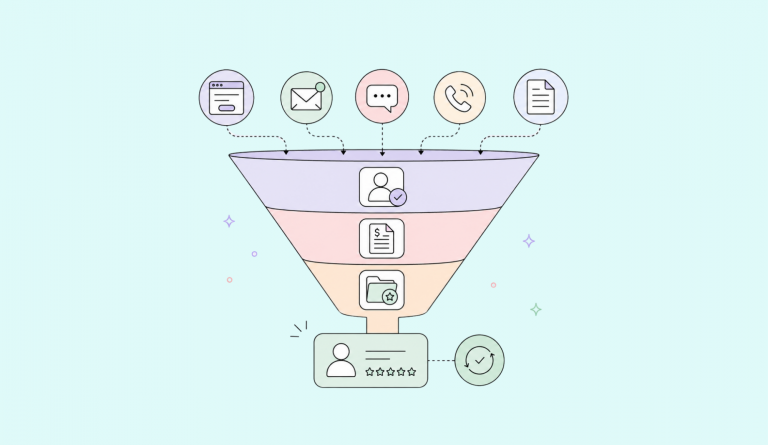
Translation agencies are no longer competing only on price per word. In 2026, language service providers are competing on speed, specialization, visibility, security, and the ability to guide potential clients from uncertainty to trust.
The market is still growing: the global translation services market was valued at roughly US$41 billion in 2024 and is projected to pass US$55 billion by 2032, driven by localization, AI-assisted translation, multilingual SEO, and regulated global expansion. At the same time, buyers expect faster quoting, clearer pricing models, stronger proof, and smoother delivery.
That is why every translation agency needs a dedicated agency sales funnel. A translation agency sales funnel is not a generic e-commerce path. It is the sales process that moves someone from initial awareness, such as Googling “legal translation English to Spanish,” to becoming a multi-year retainer client for website localization, legal translation, marketing transcreation, subtitling, MTPE, or interpreting.
At Awtomated, we see the entire sales funnel as one connected operating system: lead capture, customer relationship management, quoting, project delivery, invoicing, retention, and expansion. This article gives you a practical funnel strategy you can implement this quarter, not abstract theory.

What Is a Translation Agency Sales Funnel? (And How It Differs From Generic Funnels)
A sales funnel is defined by the customer's journey to purchase. For translation agencies, that journey begins when prospective customers first discover your agency and continues through discovery calls, test translations, project delivery, repeat purchases, and renewal.
A strong sales and marketing funnel for an LSP must account for the way translation is actually bought:
- Frequent repeat needs: product releases, legal updates, campaign launches, technical documentation, and multilingual SEO updates create recurring revenue.
- Multiple languages and workflows: one buyer may need Spanish legal translation today and Japanese app localization next quarter.
- Complex quoting: word counts, file formats, subject matter, certification, urgency, review rounds, and MTPE all affect price.
- Vendor qualification: buyers often need NDAs, ISO 17100 or ISO 9001 proof, term bases, style guides, and linguist credentials.
- Delivery quality: the funnel does not end when someone signs. The onboarding stage focuses on streamlining the new client experience.
A generic digital marketing funnel may stop at “lead → call → sale.” A translation-specific funnel must handle RFPs, test translations, vendor onboarding, terminology management, and project management. That is why a Translation Business Management Software like Awtomated goes beyond basic customer relationship management and connects sales with delivery.
For LSPs, the entire sales funnel usually looks like this:
Awareness → Discovery Call → Test Translation → First Small Project → Ongoing Retainer → Expansion to New Languages or Markets.
The sales funnel typically consists of five to six stages, though the classic model has four main stages: Awareness, Interest, Decision, Action. In translation, we add onboarding and retention because client lifetime value depends on what happens after the first job.
The Core Stages of a Translation Agency Sales Funnel
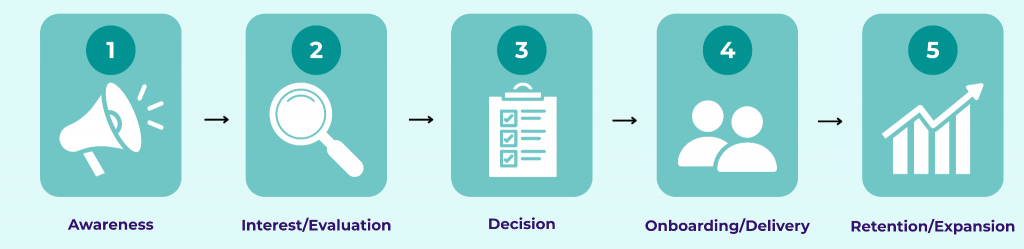
An effective sales funnel moves potential clients from awareness to partnership. In practice, your sales funnel stages should mirror the real buying process of localization managers, legal teams, marketing departments, procurement teams, and founders expanding internationally.
A useful model is:
- Awareness
- Interest and Evaluation
- Decision
- Onboarding and Delivery
- Retention and Expansion
This is also where the ladder sales funnel is helpful. You can offer free value first, such as a localization checklist or free ebook, then a paid audit, then a pilot project, then a full localization program. Done well, this sales funnel strategy helps potential customers take the next step without feeling forced.
The typical buyer journey might include searching “ISO 17100 translation provider,” downloading a glossary template, booking a sales conversation, requesting a quote, testing a vendor, signing an MSA, and expanding into new regions. Later in this article, you will see how Awtomated supports each step with CRM, pipeline tracking, quotes, marketing automation, and analytics tools.
Stage 1 – Awareness: Getting on the Radar of Global Buyers
Many corporate buyers begin research months before sending an RFP. The awareness stage aims to generate visibility for potential clients, and the awareness stage builds brand recognition through social media and ads.
For translation agencies, the strongest awareness marketing channels usually include:
- SEO and content marketing around specific needs: “clinical trial translation ISO 13485,” “Shopify store localization services,” or “CE-mark documentation translation checklist.”
- LinkedIn content for localization managers, product marketers, legal counsel, and export teams.
- Webinars on market entry, such as “Entering Germany in 2026: Localization, Legal, and SEO Readiness.”
- Industry events such as LocWorld, GALA, and niche legal or medical conferences.
- paid advertising for bottom-funnel terms where the buyer already has urgency.
SEO, PPC ads, and social media marketing are key components for visibility. google ads can work especially well for high-intent phrases like “medical translation agency ISO 13485” or “certified legal translation Spanish,” as long as those leads flow directly into Awtomated as contacts and opportunities.
Full-funnel marketing engages prospects at every buyer journey stage. This means your blog post should not exist alone. It should lead to a lead magnet landing page, a quote request, a webinar signup, or a localization readiness review. Full-funnel marketing focuses on revenue goals rather than just lead generation.
At this stage, brand consistency matters. Show certifications, client testimonials, vertical specialization, turnaround expectations, and success stories clearly. If your target audience is regulated healthcare, do not hide your compliance expertise three clicks deep.
Stage 2 – Interest & Evaluation: Turning Visitors Into Qualified Leads
This is where anonymous website visitors become named contacts with companies, roles, language needs, and urgency. Lead generation involves capturing potential clients' information, and translation agencies should treat that information as the beginning of a relationship, not just a form fill.
Sales funnel agencies create lead magnets to capture potential customer interest. Lead magnets can significantly increase email list growth and sales when they solve a real internationalization problem. Good examples include:
- “2026 Global Expansion Launch Timeline Template”
- “GDPR Multilingual Policy Checklist”
- “Glossary Template for SaaS UI Localization”
- “MT Readiness Checklist for Marketing Teams”
- “EU MDR Multilingual Documentation Guide”
The interest stage captures leads by offering valuable content or free trials. Your landing pages should make the offer specific: who it is for, what pain it solves, and what happens next. A lead magnet landing should not be vague. A strong lead magnet landing page might say, “For marketing leaders expanding to France and Germany who need campaign copy localized without losing brand voice.”
Best-practice landing pages for agencies include:
- One clear CTA: “Request a quote” or “Book a 20-minute localization audit”
- Industries served
- Languages covered
- Turnaround times
- Security and certification proof
- Relevant client testimonials
- A short intake form that improves lead quality without creating friction
Optimizing landing pages can significantly boost conversion rates, especially when your traffic volume is modest but each qualified client is valuable.
Email marketing then keeps the relationship alive. 80% of new B2B leads never turn into sales without nurturing, and 80% of new B2B leads never turn into sales due to follow-up breakdowns. That is too expensive to ignore. Companies that excel at nurturing generate 50% more sales-ready leads, nurtured leads make 47% larger purchases than non-nurtured leads, and effective lead nurturing can reduce customer acquisition costs by 33%.
Agencies create personalized email sequences to nurture leads. In Awtomated, engagement data can update lead scoring, move contacts between funnel stages, and notify your team when quality leads are ready for outreach.
Stage 3 – Decision: From Quote to First Project
The decision stage is where friction becomes visible. Buyers compare vendors, gather approvals, worry about errors, and negotiate timelines. Removing friction in the sales process facilitates closing deals.
Fast, accurate quoting matters. A proposal should itemize:
- Word count and file type
- Language pairs
- Service type: translation, editing, MTPE, transcreation, interpreting, subtitling
- Subject-matter expertise
- Turnaround time
- Review rounds
- Project assumptions
- Payment terms
The decision stage involves delivering tailored sales pitches. The decision stage educates prospects on product benefits to encourage purchases. The action stage involves finalizing the sale with compelling offers or discounts, though for translation agencies this may look more like a fixed-fee pilot, a discounted test translation, or a low-risk first market launch.
With Awtomated, agencies can auto-generate quotes from uploaded files, apply client-specific price lists, and send polished proposals within hours instead of days. This matters because long sales cycles are common: small and mid-sized translation deals may close in 2–6 weeks, while enterprise and regulated buyers can take 2–6 months or more.
Include proof inside proposals. Short success stories reduce risk. For example, a legal translation proposal can highlight accuracy, compliance, and deadline performance; a SaaS localization proposal can show reduced time-to-market or higher German sign-ups. Research on MTPE also shows that post-editing can be much faster than human translation in some contexts; one large study found post-editing was 66% faster at the translation stage on average, though results vary by language pair and content type.
Stage 4 – Onboarding & Delivery: Proving Your Value Quickly
The first 60–90 days often determine whether a client becomes a one-off buyer or a long-term account. Seamless onboarding and performance reporting maximize client lifetime value.
A structured onboarding process should include:
- NDAs and security requirements
- Vendor forms and approval workflows
- Style guides and terminology lists
- Brand voice references
- Communication channels
- SLA expectations
- Feedback process
- Billing and invoicing setup
Inside Awtomated, internal teams can see the handoff from sales to production, so project managers are not guessing what was promised during the sales conversation. This protects customer satisfaction and reduces rework.
Set clear KPIs from the beginning: turnaround time, on-time delivery, revision rates, quality feedback, and response time. Elite agencies often aim for on-time delivery around 95–97%, while many agencies operate closer to 80–90%. In translation, late delivery can undo months of marketing efforts.
Use email sequences and in-app notifications to keep clients informed: project received, linguists assigned, files in review, delivery complete, feedback requested. Customer engagement is not just a marketing metric; it is how buyers decide whether they trust you with more work.
Stage 5 – Retention & Expansion: From One-Off Job to Long-Term Client
Translation revenue is built on recurring work: product releases, legal updates, campaign launches, documentation refreshes, and new market entry. Established agencies often see 60–80% of revenue from recurring clients.
Retention strategies help sustain long-term client relationships. Companies with aligned sales and marketing see 36% higher retention, and companies with strong sales and marketing alignment report 36% higher customer retention. Organizations with aligned sales and marketing generate up to 208% more revenue, and companies with strong sales and marketing alignment generate 208% more revenue.
Use account plans for key clients. Track:
- Languages used
- Content types
- Decision-makers and stakeholders
- Upcoming launches
- Regulatory deadlines
- Glossary maturity
- Margin by service line
- Expansion opportunities
Cross-sell paths should be useful, not pushy. A client who buys document translation may need website localization. A SaaS company may need SEO localization. A law firm may need interpreting. A marketing team may need transcreation.
Awtomated can trigger quarterly check-ins, termbase reviews, reminders when volume drops, and prompts to request client testimonials after milestones. Loyal customers often become your strongest referral channel.

Designing a Full Funnel Marketing Strategy for Translation Agencies
Full funnel marketing for LSPs means coordinated campaigns that cover awareness, consideration, purchase, retention, and expansion. It is not the same as running isolated paid ads to a generic sales page.
A full funnel marketing agency might help design campaigns, but a translation agency also needs operational follow-through. Some specialist sales funnel agencies deliver over 682 funnels for clients, and 682+ marketing and sales funnels have been delivered by agencies that specialize in repeatable funnel systems. The lesson is not that you need a generic sales funnel agency. The lesson is that repeatable systems beat improvisation.
Use this structure:
- TOFU: Educational content on multilingual SEO, LinkedIn posts by agency leaders, PR in localization magazines, webinars such as “January 2026 Localization Trends Webinar.”
- MOFU: Industry case studies, ROI calculators, “internal translators vs. specialized agency” guides, MT vs. human translation explainers.
- BOFU: Tailored proposals, procurement-ready documentation, pilot project offers, personalized content for buying committees.
Your marketing strategy should reflect the target audience's pain points. A legal buyer worries about enforceability and accuracy. A marketing department worries about brand voice. A product team worries about release velocity. A procurement team worries about price, risk, and vendor governance.
Aligning Sales, Project Management, and Marketing Around One Funnel
Many agencies lose leads at handoff points. Marketing captures interest, sales promises a workflow, and production later discovers missing glossaries, unrealistic deadlines, or unclear quality expectations.
Awtomated keeps the sales pipeline visible to everyone. Marketing can see which campaigns generate leads. Sales can see opportunities and quote status. PMs can plan linguist capacity before work lands.
Use standardized stages:
New Lead → Marketing Qualified → Sales Qualified → Proposal Sent → Test Project → Active Client → Expansion.
Companies with strong sales and marketing alignment generate 208% more revenue. That number matters because alignment is not a motivational idea; it changes forecasting, staffing, client experience, and revenue.
Hold weekly or bi-weekly funnel reviews. Look at upcoming deals, resource constraints, margin risks, and blockers. A structured funnel supports accurate forecasting of growth.
Lead Generation for Translation Agencies: Practical Tactics That Fill the Funnel
Lead generation tools only work when they are connected to a clear offer and a clear next step. To generate leads that become paying customers, focus on specificity.
SEO and content ideas:
- “How to prepare your SaaS for the German market in 2026”
- “CE-Mark documentation translation checklist”
- “When to use MT vs. human translation”
- “How to build a multilingual glossary before website localization”
- “Certified Spanish legal translation: what law firms should check”
Targeted google ads keyword groups:
- “marketing translation agency London”
- “legal translation certified Spanish”
- “multilingual SEO agency”
- “medical translation ISO 17100”
- “website localization for Shopify”
LinkedIn works best when agency owners and salespeople lead with insight, not a pitch. Share localization mistakes, market-entry checklists, regulatory updates, and practical examples. Then invite prospective clients to a short readiness review.
Partnerships are also powerful. Web agencies, international law firms, export consultants, and software implementation partners can refer potential clients who already have an international project underway.
Creating High-Value Lead Magnets for Translation Buyers
Lead magnets must solve specific internationalization problems. A generic free ebook about “why translation matters” will not perform as well as a tool that helps someone avoid a painful mistake.
Examples:
- “2026 Global Expansion Launch Timeline Template”
- “GDPR Multilingual Policy Checklist”
- “Glossary Template for SaaS UI Localization”
- “Legal Translation Intake Checklist for Cross-Border Litigation”
- “Multilingual SEO Keyword Mapping Sheet”
Each landing page should name the audience and the outcome. For example: “For product marketers preparing a French and German launch who need consistent UI terminology across web, app, and help center.”
After download, contacts should enter Awtomated with tags for vertical, region, service type, and language needs. Then add a soft CTA: “Book a 20-minute Localization Readiness Review.” This creates a natural path from free value to pipeline.
Email Marketing & Nurture Sequences for Translation Prospects
Translation projects often begin months after the first interaction. That makes nurture essential.
A simple 6–8 email sequence can include:
- Welcome and resource delivery
- Educational content about translation workflows
- Case study by industry
- Pricing transparency and pricing models
- Quality process explanation
- Objection handling: price, quality, speed, security
- Invitation to a strategy call
- Re-engagement with a new resource or event
Email marketing can drive more conversions through personalized campaigns. Segment by role: marketers, legal teams, product managers, localization managers, and procurement teams should not receive the same message.
Awtomated integrations can track opens, clicks, replies, and quote requests. That data updates scores and helps your team prioritize leads most likely to become paying clients.
Conversion Rate Optimization for Translation Agency Funnels
Conversion rate optimization means improving the moments where people either move forward or disappear: homepage to service page, service page to quote request, quote to approval, first project to repeat work.
Effective sales funnels improve client acquisition through measurable strategies. Sales funnel agencies improve conversion rates through data-driven insights, and sales funnel agencies optimize conversion rates using data-driven insights. Your agency can use the same discipline inside Awtomated.
Common leaks include:
- High traffic but low form fills
- Many forms but poor lead quality
- Many quotes but few first projects
- First projects delivered but no repeat purchases
- Strong revenue but weak margins
Mapping the funnel identifies drop-off points for potential clients. Analyzing the funnel helps optimize conversion rates for agencies.
Track these metrics:
- Lead-to-quote rate
- Quote-to-project rate
- Average sales cycle length
- Average revenue per new client over 12 months
- Source-to-retention rate
- Margin by client and service
A/B Testing Your Key Funnel Assets
A/B testing helps determine the best design for conversion rates. Even small changes matter when one new client can be worth tens of thousands over several years.
Test landing pages:
- Industry-specific headline vs. generic headline
- Short form vs. detailed intake form
- “Request a quote” vs. “Book localization audit”
- Certification proof above vs. below the fold
Test email subject lines:
- Urgency framing
- Educational framing
- Language-specific framing
- Outcome-focused framing, such as “cut time-to-market by 30%”
Test proposals:
- Good/better/best options
- Pilot project vs. full rollout
- Different payment terms
- Case study placement
Awtomated can capture outcomes through pipeline reports, win/loss tags, and proposal status. Continuous maintenance and optimization are required for funnels; they are never “done.”
Using Analytics Tools to Understand Buyer Behavior
Analytics are non-negotiable for agencies competing globally. Combine website analytics, heatmaps, google ads data, and Awtomated CRM/project data to understand customer behavior across the entire buyer journey.
Track source for every new client:
- Organic search
- paid ads
- LinkedIn outreach
- Referral
- Conference meeting
- Partner introduction
- Webinar
Then compare not just leads, but retained revenue. A channel that produces fewer leads may produce better clients. Quarterly reviews help decide where to scale marketing spend and which campaigns to pause.
Operationalizing Your Funnel Inside Awtomated
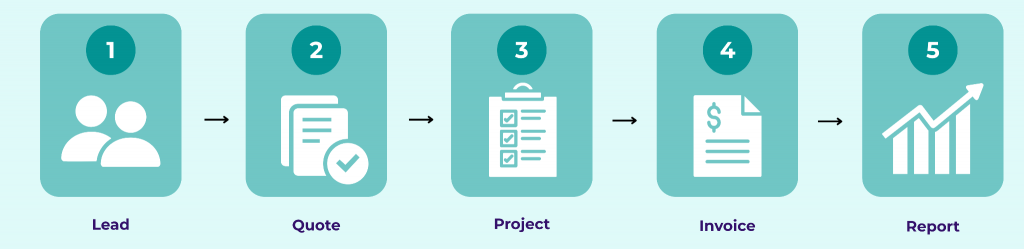
A funnel strategy only works when it becomes daily behavior. Awtomated turns the plan into workflows your team can repeat.
Inside Awtomated, you can:
- Set up a pipeline matching your funnel map
- Capture inbound leads from forms, email, events, and campaigns
- Assign contacts automatically to salespeople or agency owners
- Generate quotes from files and price lists
- Create linguist tasks and project milestones
- Track status from first contact to invoice
- Keep client history in one place
This is where the sales funnel works best: when marketing, sales, project management, and finance are not scattered across disconnected tools.
Automations That Protect Your Funnel From Human Error
Many agencies lose deals because of simple follow-up failures. Sales funnel agencies automate repetitive tasks to save time, and translation agencies should do the same.
Useful automations include:
- Reminder when a quote has not been approved after 5 days
- Follow-up after a test translation is delivered
- Alert when a key client’s volume drops
- Task creation for PMs after deal approval
- Reminder to request feedback after first delivery
- Re-engagement campaign after 90–180 days of inactivity
Lead scoring rules can prioritize contacts who visit multiple service pages, attend webinars, request quotes, or download more than one resource. This helps your team focus on qualified leads instead of guessing.
Build repeatable playbooks so new sales reps and PMs can follow the same process. That consistency is how a successful business scales without losing quality.

Turning Happy Clients Into Long-Term Advocates
Happy clients should not disappear into your project archive. They should become retained accounts, referral sources, and proof for future buyers.
Proactive account management includes:
- Quarterly business reviews
- Quality reviews
- Upcoming release planning
- Termbase updates
- New market discussions
- Dedicated linguist team planning
- Priority support for high-value clients
Client testimonials and case studies should be requested systematically once milestones are achieved, such as 12 months of successful cooperation, 100 projects delivered, or a major launch completed.
Offer value-adds when clients reach thresholds: dedicated linguist teams, priority turnaround, early access to AI-assisted workflows, or annual localization planning sessions. This turns customer satisfaction into expansion.
Referral programs can also work in B2B translation. Ask satisfied clients for introductions to other departments, regional offices, partner companies, or portfolio businesses.
Measuring Lifetime Value and Churn in Your Agency Funnel
The real asset of a translation agency is its portfolio of stable, recurring clients. Gross revenue retention of 85–100% is healthy; below 75% is a warning sign.
Use Awtomated invoicing and project data to calculate client lifetime value over multiple years. Then segment your top 20% of clients by revenue and margin. Ask: How did they enter the funnel? Which message attracted them? Which offer converted them? Which service kept them?
Track churn by identifying clients who have not sent a job in 90–180 days. Trigger win-back campaigns based on sector, region, and previous service. These insights should refine your targeting for 2026 and beyond.
Common Sales Funnel Mistakes Translation Agencies Make (And How to Avoid Them)
Most funnel problems are not mysterious. They are visible once you look.
- Relying only on word-of-mouth. Referrals are valuable, but ignoring structured digital marketing and funnel marketing limits growth.
- Saying “we translate everything into every language.” Generic positioning weakens your message. Specific verticals win trust faster.
- Slow quote response. If a buyer expects a quote within hours and receives it days later, another agency may already be shortlisted.
- Weak handoff from sales to PMs. Missing glossaries, unclear expectations, and unmanaged feedback damage retention.
- No nurture. 80% of new B2B leads never turn into sales due to follow-up breakdowns.
- No measurement. Without lead source, conversion rate, CLV, and margin data, agency owners are guessing.
- Treating the funnel as a campaign. Ongoing optimization is required because buyer behavior, channels, and competition change.
Fixing these issues does not require a bigger team first. It requires a clearer process, better data, and one system where the full client journey is visible.
Conclusion: Building a Repeatable Translation Agency Sales Machine With Awtomated
A well-designed translation agency sales funnel turns random one-off projects into predictable, compounding revenue. It gives your team a shared path from initial awareness to quote, delivery, retention, expansion, and advocacy.
The strongest agencies align their marketing efforts, sales, project management, and account growth around one measurable pipeline. In short:
- Use focused lead generation to attract the right buyers.
- Use nurture to turn interest into sales-ready conversations.
- Use fast quoting and proof to improve closing deals.
- Use onboarding and reporting to build trust.
- Use retention workflows to create recurring revenue and more sales.
Awtomated is built to be the central operating system for that journey. Instead of juggling separate tools for CRM, quoting, project management, invoicing, marketing automation, and reporting, agency owners can manage the entire funnel in one place.
If you want a clearer pipeline, better forecasting, stronger retention, and a repeatable path from prospective clients to long-term partners, schedule a live demo of Awtomated or start a free trial this month. Map your existing leads and clients into a structured, data-driven sales funnel, and build the agency growth system your next stage requires.
Table of Contents
- What Is a Translation Agency Sales Funnel? (And How It Differs From Generic Funnels)
- The Core Stages of a Translation Agency Sales Funnel
- Designing a Full Funnel Marketing Strategy for Translation Agencies
- Lead Generation for Translation Agencies: Practical Tactics That Fill the Funnel
- Conversion Rate Optimization for Translation Agency Funnels
- Operationalizing Your Funnel Inside Awtomated
- Turning Happy Clients Into Long-Term Advocates
- Common Sales Funnel Mistakes Translation Agencies Make (And How to Avoid Them)
- Conclusion: Building a Repeatable Translation Agency Sales Machine With Awtomated
Ready to manage your Translation company easily?
Get Started for Free