GDPR and ISO 27001 for Translation Companies: What Enterprise Clients Ask Before Signing
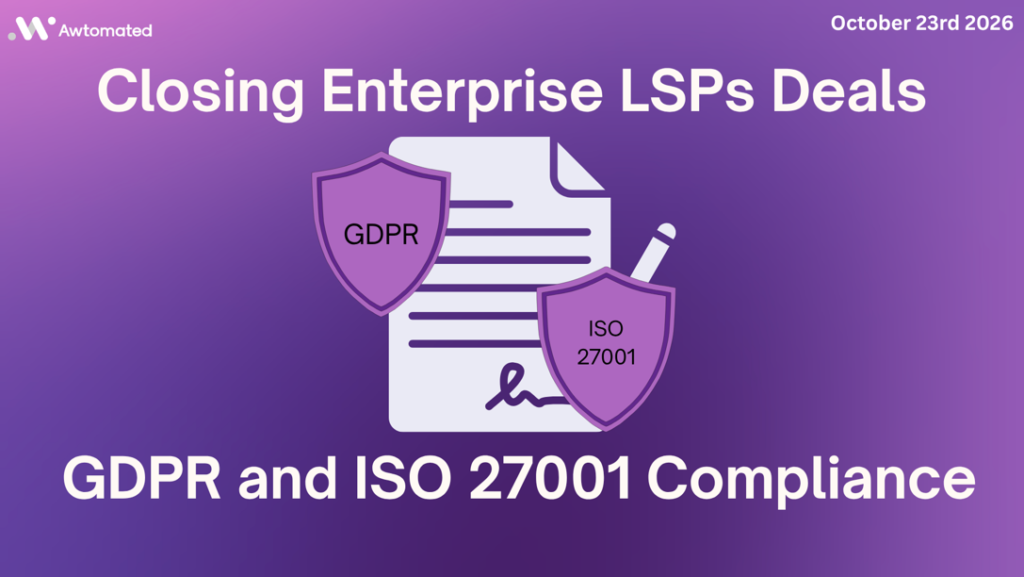
Enterprise buyers now routinely ask detailed questions about GDPR and ISO 27001 before onboarding a translation agency or a TBMS like Awtomated. If your agency cannot answer those questions with documented evidence, you risk losing the deal before it even starts.
Key Takeaways
- GDPR compliance is mandatory for translation agencies processing personal data. Translation is considered data processing under GDPR regulations, making every language service provider a data processor by default.
- The General Data Protection Regulation has been fully enforceable since 25 May 2018, and ISO/IEC 27001:2022 is the information security benchmark most enterprise procurement teams now expect.
- Translation companies must prove GDPR compliance and robust data protection across workflows, tools, and their vendor network-including freelancers and MT engines.
- A proactive approach-documented policies, security controls, and an auditable Translation Business Management System such as Awtomated-reduces the risk of non compliance, fines, and failed vendor assessments.
- This article provides a practical checklist of the GDPR and ISO 27001 questions enterprises ask, and how a translation agency can prepare convincing answers.
1. Why GDPR and ISO 27001 Matter So Much to Translation Buyers
The data protection regulation GDPR was approved on 24 May 2016 and became enforceable on 25 May 2018. ISO 27001 was first published in 2005, with the latest version-ISO/IEC 27001:2022-now required across enterprise RFPs after the 2013-version transition deadline passed on 31 October 2025.
The translation industry handles personal data constantly: names and addresses in legal documents, medical history in clinical trial files, payroll data in HR policies being rolled out across international markets. Banks, insurers, pharma companies operating in the European Union, and SaaS providers now treat GDPR compliance and an ISO 27001–aligned security system as preconditions-not differentiators-when selecting the right translation partner.
Non-compliance with GDPR can result in fines up to €20 million or 4% of global annual turnover, whichever is higher, plus reputational damage and contract termination. For translation companies, strong security controls shorten vendor reviews and speed up deal closing. In a digital age where most deals fail during the security review rather than during proof-of-concept, that competitive advantage is real.
2. How GDPR Applies to Translation Companies and Their Workflows
Under the general data protection regulation, most translation agencies are data processors, while clients-enterprises, law firms, hospitals-are typically the data controller. A GDPR translation agency specializes in translating documents containing personal data, which means GDPR requires handling that data with the same legal rigor as any other data processor.
Here is a step by step explanation of the core principles every translation service must embed into its data protection work:
- Lawful basis: processing usually rests on contract. GDPR requires explicit consent or another lawful basis for processing personal data of natural persons.
- Data minimisation: only necessary personal data should flow through the translation process.
- Purpose limitation: data is used strictly for translation purposes.
- Storage limitation: GDPR mandates clear retention and deletion policies for personal data after project completion.
- Integrity and confidentiality: encryption, access controls, and secure deletion protect sensitive information.
- Accountability: compliance involves transparent data processing practices and subprocessors management.
Common documents that include personal data in translation work: employment contracts with client's personal information, clinical trial reports with medical history, customer support tickets, and financial statements. Each step in the supply chain-project managers, in-house linguists, freelance translators, reviewers, and MT engines-must remain GDPR compliant.
Translation agencies must sign Data Processing Agreements when processing personal data and must inform clients about where their documents will be stored and processed. Even non-EU agencies are covered when they offer services to EU individuals or process data about European Economic Area residents.
3. What Enterprise Clients Ask About GDPR Before Signing
Enterprise procurement, InfoSec, and legal teams use detailed security questionnaires. Here are the question themes your translation agency should be ready for:
Legal basis and contracts: Will you sign our DPA? Do you offer your own templates? How do you define controller vs. processor? Translation agencies must sign NDAs for sensitive projects, and buyers expect guaranteeing non disclosure agreements across the vendor chain.
Data handling and residency: Where is data stored-EU data centers or third countries? Which sub-processors or translation service providers have access? Are Standard Contractual Clauses in place for transfers outside the European Economic Area?
Operational security: How do you receive files-secure portals or email? GDPR translation agencies should use secure file transfer systems with encryption, both in transit and at rest. Translation agencies must implement secure file transfer systems and should limit data access to identified translators assigned to a project.
Incident and risk management: How are incidents and data breaches detected and reported within 72 hours? Do you run penetration tests? How do employees receive training on GDPR and data protection? A privacy breach without proper follow up can end a client relationship permanently.
GDPR documents and terminology: Enterprise buyers look closely at GDPR translation of their own compliance materials-privacy notices, DPAs, internal policies. Legal documents must be accurately translated for GDPR compliance, and translation quality in GDPR documents must ensure legal terminology accuracy and clarity across different languages and different cultures.
MT and AI usage: GDPR translation agencies should avoid using open machine translation tools due to data privacy risks. Translation agencies must maintain compliance with GDPR when using AI and machine translation tools. Buyers ask whether data is used to train models and whether logs are zero-retention.
Awtomated helps agencies answer many of these questions with system-backed evidence: access logs, retention settings, encryption of stored files, and structured vendor permissions inside the TBMS.
4. ISO 27001 Expectations for Translation Companies
ISO 27001 certification indicates secure information management practices in translation services. The 2022 version reorganized controls into four themes-organizational, people, physical, and technological-and added new controls for cloud security, threat intelligence, and data leakage prevention.
Enterprise clients commonly ask:
- Are you an ISO certified company or in the process of certification?
- Can you share your Statement of Applicability?
- How do you manage vendor access to confidential data?
- How does your company's security system handle secure development of tools?
These controls map directly to daily operations: role-based access to projects, secure backup of translation memories, monitoring of system access, and vendor screening and onboarding.
Consider a pharma client insisting on ISO 27001 evidence for any provider handling clinical trial translations. They require encryption at rest, EU-only data centers, documented incident response, and proof that no restrictive content or sensitive or confidential data is retained inside MT engines. Agencies using a cloud-based Translation Business Management System like Awtomated can centralize their security posture-one controlled system instead of scattered spreadsheets and ad-hoc file sharing.
5. Building GDPR- and ISO-Ready Processes with Awtomated
At Awtomated, we provide a TBMS that helps translation companies operationalize GDPR compliance and ISO 27001–style controls across the entire translation business. Here is how:
- Centralized project storage and access control: access to sensitive data is controlled by role-based permissions, so only assigned linguists see relevant files. Every action is logged for audit trails.
- Secure file handling: files flow through encrypted channels rather than email attachments or shared drives, keeping sensitive or restrictive content and sensitive information contained within a controlled environment that is equally important for GDPR standards and ISO expectations.
- Vendor management: vendor profiles store NDAs and DPAs, track training records, and restrict which translators can access sensitive legal documents or medical files-an important component of any GDPR-ready translation service.
- Retention and deletion: agencies can configure retention policies per client or project and automate archival or deletion of old projects and translation memories, supporting GDPR requirements and storage limitation principles.
- MT integration: secure connectors to MT engines ensure personal data flows through monitored, logged channels rather than being copy-pasted into unmanaged tools on digital or physical devices.
- Finance and invoicing: client and vendor billing is handled in a single system with clear permissions, helping reduce costs of compliance overhead while keeping data completely safe within one platform.
Reports and dashboards give enterprise clients real-time visibility into project flows, vendor usage, and profitability-while also evidencing controlled access and compliance at the same level they expect from any technology partner.
6. Preparing for Security Questionnaires, Audits, and Ongoing Compliance
For mid-sized translation agencies, the bottleneck is often not compliance itself but proving it. Translation providers must have documented data protection policies under GDPR, and translation agencies must have those policies ready to share on request.
Must-have artifacts for every translation agency targeting enterprise work:
- Up-to-date privacy policy and information security policy
- Records of processing activities listing what personal data is processed, where, and by whom
- List of sub-processors with locations and DPA status
- Sample DPIAs for high-risk projects that entail sensitive personal data
- Evidence that employees receive regular GDPR and security training
- Incident response playbook covering detection, assessment, the 72-hour notification window, and remediation
Use Awtomated data to respond to questionnaires: extract access logs, show project permission structures, demonstrate how legal documents are assigned only to vetted linguists, and provide configuration evidence related to data retention.
Enterprises increasingly expect continuous security-not just a DPA at signing, but annual re-attestations, updated penetration tests, and confirmation that systems are patched and monitored. New technologies like the EU Data Act and evolving national data protection laws will keep raising the bar. Building a repeatable, tool-supported compliance framework today avoids reactive firefighting later and helps you win potential customers in regulated sectors across European companies and beyond.

FAQ
These are common follow-up questions from enterprise-oriented translation companies planning their GDPR and ISO 27001 roadmap.
Do I need to be ISO 27001 certified to win enterprise translation work?
Formal ISO 27001 certification is not legally required, but many large enterprises strongly prefer it-especially in finance, healthcare, and technology. A small or mid-sized translation agency can still pass security reviews without certification if it demonstrates ISO-aligned controls, documented policies, and a robust TBMS like Awtomated that enforces access control and logging. Treat certification as a medium-term goal: start by mapping controls, closing gaps, and documenting processes, then pursue external audit when target clients demand the certificate and the ROI is clear.
How long should a translation company keep client files under GDPR?
The data protection regulation does not specify exact retention periods but requires storage limitation: personal data must not be kept longer than necessary. Agree specific retention periods with each client in the DPA-commonly 12 to 36 months after project closure-taking into account quality claims, regulatory obligations, and backup cycles. Tools like Awtomated help enforce these rules by allowing agencies to configure retention policies and automate archival or deletion of old projects and translation memories.
Are machine translation engines compatible with GDPR?
MT can be GDPR compliant if configured correctly: use enterprise-grade engines with EU data centers, disable training on client data, and ensure DPAs are in place with the MT provider as a sub-processor. Never paste personal data into free, consumer-facing MT tools that lack contractual guarantees. Awtomated integrates with selected MT providers through controlled, logged channels, helping agencies document and limit where client data flows through new technologies and advanced technology platforms.
How should we handle freelancers outside the EU from a GDPR standpoint?
Giving freelancers outside the EEA access to documents containing EU personal data is an international data transfer under GDPR. Use Standard Contractual Clauses and ensure freelancers sign NDAs and data protection addenda that mirror obligations in the main DPA. A TBMS like Awtomated helps by enforcing per-project access controls, tracking which vendors worked on which files, and limiting downloads-supporting compliance and auditability for EU citizens' data regardless of where your experience providing translation services extends.
What is the fastest way to start becoming GDPR ready as a small translation agency?
Start with a focused gap analysis: list what personal data you handle, where it is stored, who can access it, and which tools and vendors touch your translation workflow. Implement high-impact measures first-secure file transfer instead of email, standard NDAs and DPAs, basic access control, and clear retention rules. Adopt a TBMS such as Awtomated early so that process and evidence live in one system rather than scattered across email and spreadsheets, making future ISO 27001 alignment and client audits far easier for a certain volume of enterprise work.

Building software that helps small and medium-sized language service providers run their business.
About Rishi →Table of Contents
- 1. Why GDPR and ISO 27001 Matter So Much to Translation Buyers
- 2. How GDPR Applies to Translation Companies and Their Workflows
- 3. What Enterprise Clients Ask About GDPR Before Signing
- 4. ISO 27001 Expectations for Translation Companies
- 5. Building GDPR- and ISO-Ready Processes with Awtomated
- 6. Preparing for Security Questionnaires, Audits, and Ongoing Compliance
- FAQ