Agentic AI for Translation Companies: What AI Agents Will Actually Automate in LSP Operations
The translation industry has talked about AI for years. In 2026, agentic AI is no longer a slide in a conference deck. It is running inside real LSP workflows, handling file intake, drafting quotes, routing vendors, and flagging quality issues before a project manager opens their inbox. But it is not replacing project managers or human translators. Not yet, and not soon.
This article walks through what agentic AI systems actually automate inside translation companies today, where human oversight remains essential, and how a TBMS like Awtomated fits as the operational hub for these AI agents.
Key Takeaways
Agentic AI in 2026 is real, but it mostly operates as a "co-pilot" inside LSP workflows. It enhances operational efficiency in translation processes by handling structured, rules-based decisions while humans retain control over strategy, relationships, and final linguistic sign-off. Agentic AI uses multiple specialized agents for translation tasks, each focused on a narrow operational goal rather than acting as a single monolithic engine.
Here is what AI agents can already automate in translation companies today:
- File intake and triage, including language detection, word counts, and content classification
- MT and LLM routing based on domain, language pair, and client preferences
- Quote drafting using historical rates, price lists, and margin rules
- Vendor pre-selection based on skills, workload, ratings, and past performance
- Basic quality assurance checks such as terminology consistency, tag integrity, and number validation
- Finance prep including draft purchase orders and invoices tied to delivered volumes
Agentic translation still requires human oversight for sensitive content, brand voice decisions, and final sign-off in regulated industries. According to McKinsey, agentic AI reduces review cycles by 20–60%, but that speed gain only works when humans set the thresholds and policies that agents follow.
At Awtomated, our perspective is practical and operations-focused. We are not building a standalone "magic" AI engine. We are building the Translation Business Management System where agentic systems plug in, read master data, and make safe, business-aligned decisions. The rest of this article walks through concrete workflows inside an LSP, step by step, showing what AI agents can and cannot safely automate in the next two to five years.
What We Mean by "Agentic AI" in Translation Operations
When we say agentic AI at Awtomated, we mean multiple AI agents that can perceive context beyond just source text (files, clients, deadlines, vendor history), reason about goals (translation quality, margin, turnaround), and act across tools without requiring manual micromanagement at every step. Agentic AI can execute complex multi-step workflows and make independent decisions. It operates autonomously to achieve broad goals without step-by-step human prompts.
This is fundamentally different from traditional translation methods. Machine translation and large language models give you a sentence-level or document-level translation. Agentic translation orchestrates entire workflows: it decides whether to use MT, assigns a human translator, runs QA, and prepares an invoice. Agentic AI enhances translation by shifting from single-pass models to interactive, context-aware processes. It can process information dynamically and retain contextual memory across an entire project lifecycle.
Here is a concrete example. A 5,000-word EN>DE technical manual arrives at 17:00 CET. An agentic system inside Awtomated automatically parses the file, detects the language pair, classifies it as technical content, checks client-specific workflow rules, identifies available MT engines and post-editors with domain expertise, and prepares a draft plan-before a PM ever touches it. The PM reviews and approves. That is agentic translation in practice.
This article is written from Awtomated's vantage point as a TBMS for LSPs, not as a generic artificial intelligence vendor explaining abstract concepts.
From MT to Agentic Translation: How We Got Here
Translation technology has evolved through distinct phases. Translation memory systems in the early 2000s delivered reuse and consistency but required heavy manual maintenance. Neural networks powering NMT around 2016 solved speed and basic translation quality but created heavy post-editing workloads, especially with specialized terminology. LLMs in 2023–2024 added better context awareness and emotional tone control but remained "single-shot" systems. They could translate a document, but they could not manage the whole localization workflow or enforce LSP business rules.
Agentic AI emerged as a response to operational pain. LSPs needed AI that could manage tasks across systems-file routing, vendor selection, QA, and finance-rather than just generating target language text. Agentic AI improves translation speed and accuracy significantly by connecting these steps into coherent workflows. Smartling reported 218% year-over-year growth in AI and AI-human translation volume, signaling that enterprises are pushing agentic approaches into production.
Here is how each generation stacks up by what it automates:
- Machine translation: automates word and segment translation; limited domain adaptation; heavy post-editing
- LLM-based AI translation: automates document-level translation with better context; still largely text-level, fewer workflow automations
- Agentic AI: automates end-to-end workflows including intake, routing, quoting, QA, vendor selection, and finance tasks, enforcing business rules with human oversight where necessary
What an AI Translation Agent Actually Is (In an LSP Context)
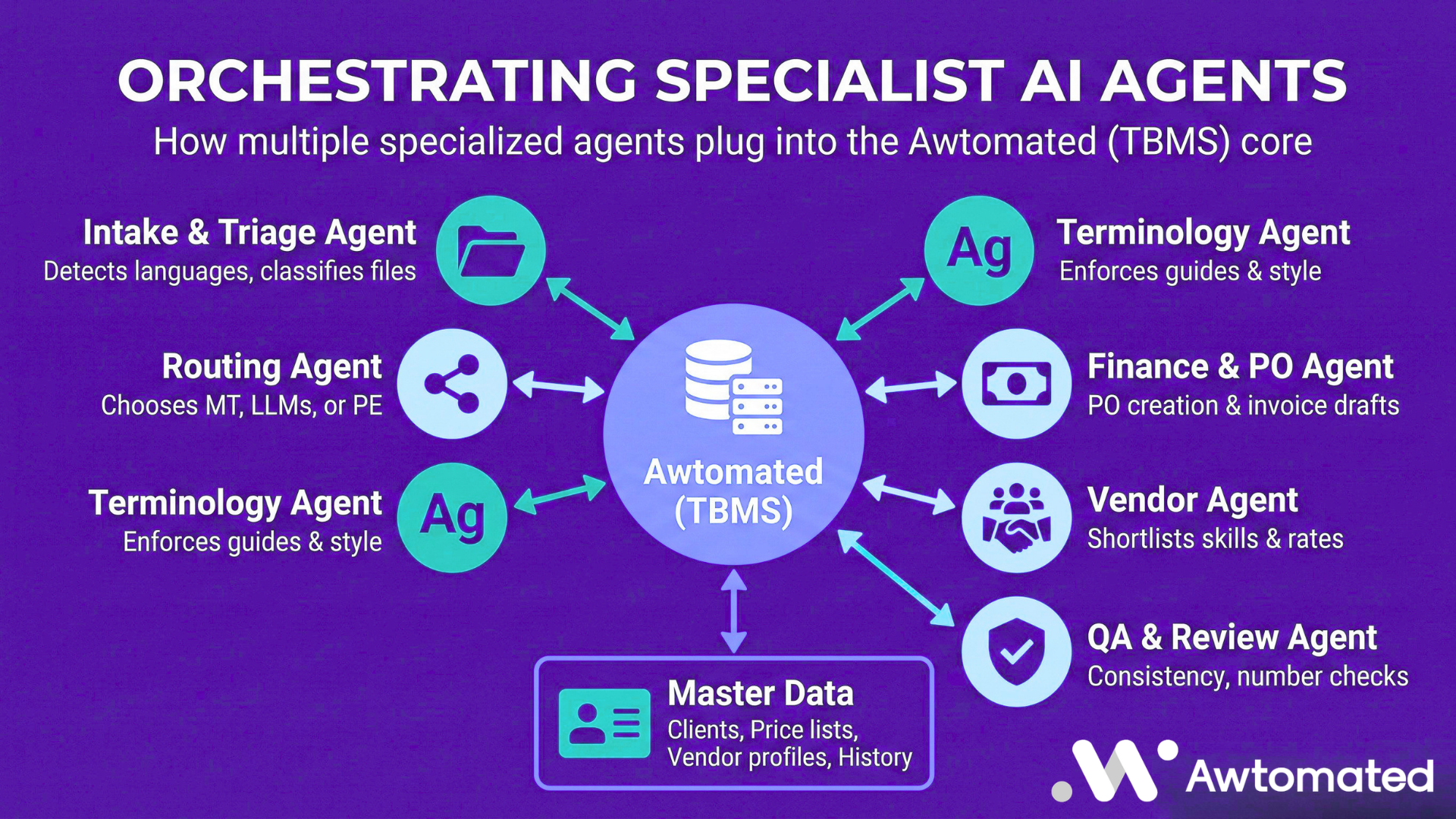
An AI translation agent is a software component that can read project data and files from Awtomated, decide what to do next (pre-translate with MT, call a terminology checker, flag a compliance issue), and write the results back to the TBMS. Agentic translation uses multiple AI agents for specialized tasks, each handling a narrow operational goal.
Typical specialized agents inside a translation company include:
- Intake/triage agent: classifies content type, detects languages, flags problematic file formats
- MT/LLM routing agent: selects the right engine per language pair and domain, applies translation memory first
- Terminology and style enforcement agent: checks output against glossaries and client style guides
- QA agent: runs consistency checks, hallucination detection, and risk scoring
- Finance/logistics agent: prepares draft invoices, vendor POs, and margin alerts
These differ from monolithic "AI translation engines." Each agent is narrow and goal-driven-for example, "maximize reuse of TMs while protecting margin"-and connected to the rest of the workflow via an API key or integration layer. Context awareness works at the operations level: agents look at client metadata, domain, language pair, service type, deadlines, historical profitability, and vendor performance-not just the text itself.
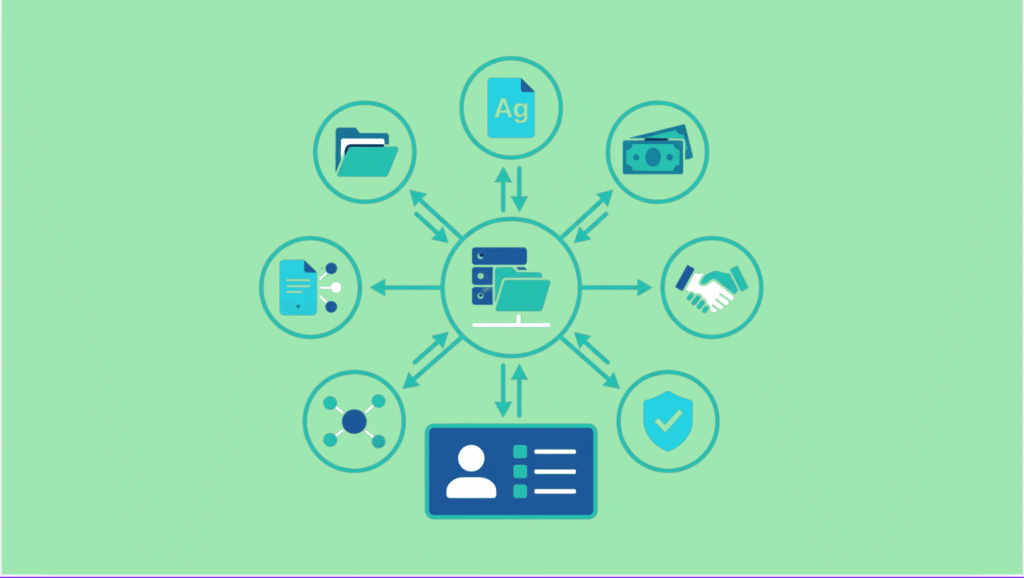
Awtomated is the orchestration layer. It holds the master data (clients, price lists, vendors, projects, POs) that agentic AI needs to make safe decisions. A multiagent system only works when each agent has clean, structured data to work from.
Where Agentic AI Will Touch the LSP Workflow First
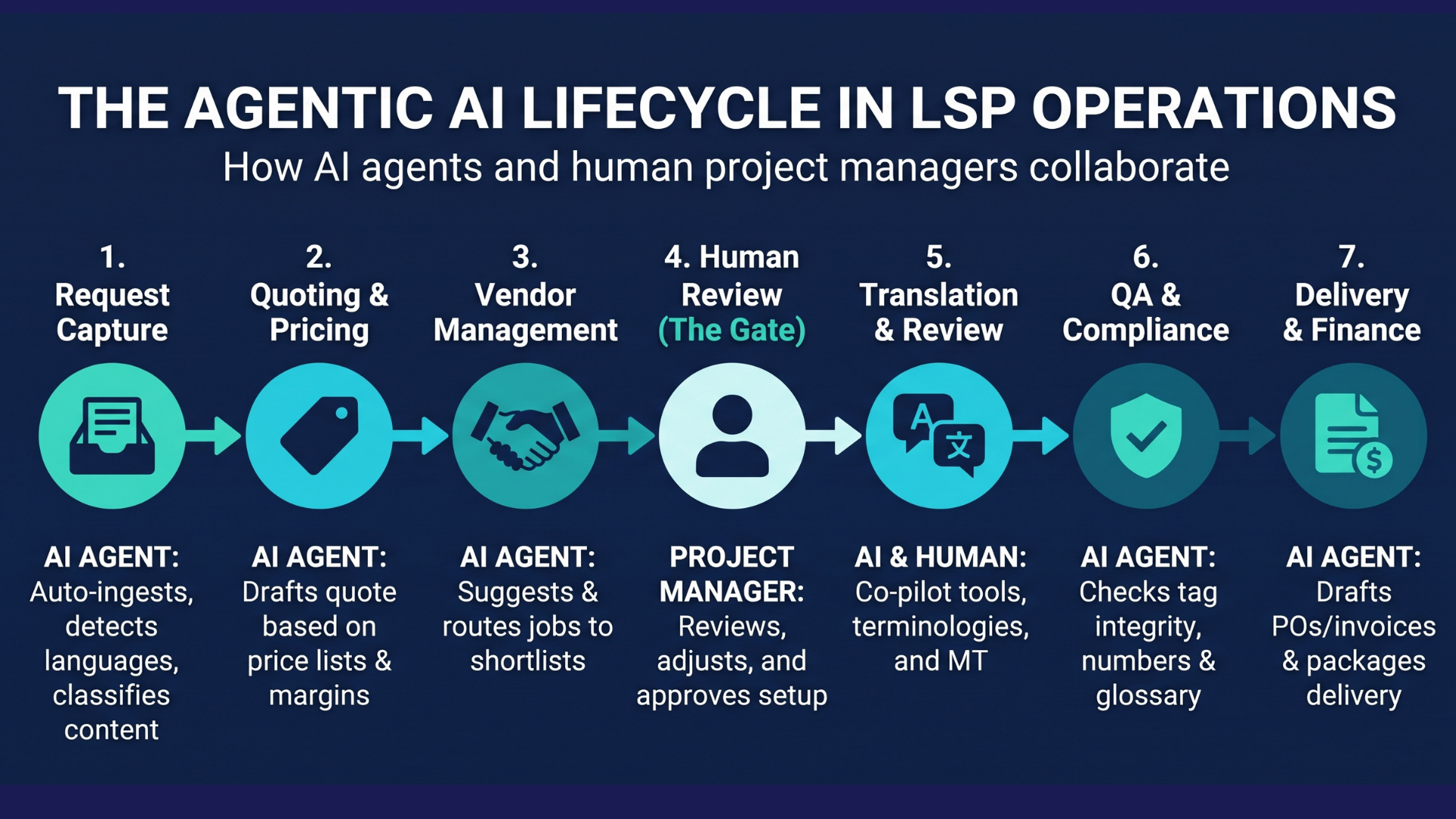
Agentic AI will not transform every part of an LSP overnight. Here is where AI agents realistically fit inside the standard LSP lifecycle as of 2026. Automation through agentic AI can enhance the scalability and speed of multilingual content processing, but the gains are uneven across workflow stages.
- Request capture and qualification: AI agents classify, triage, and suggest workflows based on content type and client rules
- Quoting and pricing: agents draft quotes using price lists, word counts, and margin targets; agentic AI can lower localization costs by up to 67%
- Project planning and vendor management: agents propose vendor shortlists, clone workflow templates, estimate timelines
- Translation and review: agents handle pre-translation, MT routing, terminology enforcement; agentic translation automates repetitive tasks in workflows
- QA and compliance: agents run automated checks, flag risk, and route high-stakes content to senior reviewers
- Delivery and client communication: agents package files, send status updates, and mark milestones
- Finance and reporting: agents prepare draft invoices and POs, watch for margin anomalies
For now, agentic AI is strongest in repetitive tasks and rules-based steps. It is weaker where deep cultural nuance or client politics are involved. The following sections zoom into each stage.
Agentic AI at Intake: File Ingestion, Triage, and Request Qualification
The typical LSP pain today: requests arrive via email, shared folders, Slack, and client portals. PMs manually download files, check word counts, guess complexity, and figure out which workflow applies. For a growing agency handling high volumes, this eats hours every day.
An intake AI agent connected to Awtomated can automatically ingest files and emails, detect languages, count words and characters, classify content type (marketing materials vs. legal vs. technical), and flag potential issues such as poor scans, missing fonts, or non-editable PDFs. It can distinguish plain text from multimedia content and route them accordingly.
The agent applies business rules stored in Awtomated. If client X has an MT-only SLA for internal docs, the agent suggests that workflow. If client Y requires human translation for HR content, the agent routes accordingly. Consider the difference: a scanned 2018 medical PDF gets flagged for manual review and potential OCR issues, while a clean 2026 product description in Microsoft Word format moves straight to automated quoting.
The limits are clear. For new strategic accounts, unusual content, or politically sensitive campaigns aimed at diverse audiences, human oversight should always validate the agent's suggested workflow before confirmation.
Quotes, Margins, and Timelines: What Agents Can Automate Safely
Quoting today eats PM time. Checking client price lists, applying rush surcharges, estimating DTP hours, calculating vendor costs-much of it still happens in spreadsheets. A pricing and planning agent inside Awtomated can automatically use existing price lists and service packages, pre-calculate quotes based on word counts, language pairs, and services (translation, review, layout), apply client-specific discounts, estimate vendor costs based on historical rates, and predict turnaround based on vendor availability patterns.
The UI still shows humans a full breakdown-units, margins, suggested deadline-so PMs can adjust edge cases like sensitive press releases or end-of-quarter capacity crunches. Agentic AI can lower localization costs by up to 67% when fully applied to routine quoting and routing decisions.
This is one of the most concrete near-term wins. Within one to two years, most mid-size LSPs could automate 60–80% of routine quote creation with agentic systems, requiring only PM review and approval. But humans remain responsible for final commercial decisions: discounting to win a strategic deal, negotiating with key accounts, or overriding agent recommendations when relationship realities demand it. 82% of businesses plan to integrate AI agents by 2025, and quoting is the natural starting point for many.
Project Setup and Vendor Management: Agents as Operational Co-Pilots
Today, a PM creates a project in the TBMS, sets up language pairs, imports files, creates tasks, searches for suitable vendors, sends job offers, tracks acceptances, and manages time zones. The AI monitors and manages large translation projects, improving efficiency and consistency across all of these steps.
A vendor and workflow agent can read project metadata from Awtomated-domain, client, language pairs, budget, due date-and automatically clone the right workflow template, propose service combinations (MT+PE vs. human-only), shortlist vendors based on skills, ratings, past performance for that client, and current workload, and send out automated job offers through vendor portals or email integrations.
Here is a concrete scenario. A Friday 16:30 rush request arrives: EN>JA software strings, 3,000 words. The agent suggests using the existing MT engine plus a senior post-editor with weekend surcharge, pre-populates POs in Awtomated, and sends the offer. The PM reviews the recommendation, confirms, and the job is live in minutes instead of the next Monday morning.
Safeguards matter. PMs can override vendor selection, lock specific vendors for VIP accounts, or force human-only workflows when required by NDAs or compliance rules. Over time, feedback loops from vendor quality scores and profitability metrics inside Awtomated let the agent continuously refine its vendor recommendations through continuous improvement.
Inside Production: How Agentic AI Supports Human Translators
Agentic AI inside production is not about replacing human translators. It is about reshaping what they spend time on. Agentic translation enhances human roles by automating repetitive tasks and delivering context aware translations, so linguists focus on creative and complex work.
Ways an AI translation agent enhances translator workflows:
- Auto-pretranslation using the right MT or LLM per language and domain, consulting translation memory first
- Enforcing specialized terminology by live-checking against glossaries and term bases; agentic AI can retrieve real-time domain-specific terminology from external databases
- Suggesting consistent tone based on client style guides and brand voice requirements
- Flagging segments where context is ambiguous for human review
- Adapting translations based on cultural context and tone, including local idioms and local customs
The agent coordinates between systems: it calls MT engines through Awtomated integrations, applies translation memory, then runs LLM-based refinement only on segments below a given quality threshold. Multiple large language models can be orchestrated simultaneously-one agent might route medical content to a specialized NMT engine while sending marketing materials to a generative AI model optimized for creative fluency.
Context awareness means agents pull reference files, older projects for the same product line, and client-specific instructions so translators see contextual relevance without hunting through folders. Agentic translation systems dynamically check local cultural nuances and verify semantic accuracy as part of this process. Agentic AI also optimizes content based on engagement metrics for specific regional audiences when past performance data is available.
Post-editing effort data flows back into Awtomated, where another agent uses it to refine engine selection, pricing assumptions, and future workflow templates. That is a practical feedback loop. Translated cut research time by 70% by integrating specialized AI agents for linguistic research and term validation-proof that agentic systems deliver real world impact.
Quality Assurance, Compliance, and Human Oversight
Quality assurance is where agentic systems shine-and where human oversight is non-negotiable for regulated content in pharma, finance, legal, and government tenders. Agentic AI reduces review cycles by 20–60% in translation, but that efficiency depends on well-defined thresholds.
What QA agents can already automate:
- Terminology consistency checks against client glossaries
- Number and unit validation
- Tag and markup integrity verification
- Basic linguistic patterns such as missing negatives or doubled words
- Comparison against translation memories and reference materials
Quality assurance in agentic translation includes autonomous error correction and verification. Agentic AI achieves 90.5% subtitle accuracy for media localization, demonstrating that specialized agents can handle domain-specific QA at scale. Agentic AI automates nuanced tasks for higher translation accuracy, and it improves translation quality through specialized agents assigned to each check type.
Agents classify risk: they flag projects with high error probability (new translator, new domain) and automatically route them to senior reviewers, while letting low-risk internal content follow a lighter QA path. For compliance, agents check that required disclaimers are present, detect personal data that must be anonymized before sending to external MT providers via data encryption protocols, and log all AI decisions in Awtomated for auditability.
Agentic AI requires careful oversight to ensure accountability and accuracy in high-stakes translations. Human translators and reviewers must still approve final output in regulated scenarios, shaping policies and thresholds that agentic systems follow-not the other way around. Agentic AI also enhances educational content accessibility through efficient translations, but even in lower-risk domains, maintaining quality requires human checkpoints.
Delivery, Client Communication, and Finance Automation
The end-of-project admin burden is real: packaging files, updating client portals, writing status emails, logging POs, creating invoices, and matching vendor bills. For a 6-language project with three vendors, this can take hours.
Agents integrated with Awtomated can automatically generate delivery packages in the right formats and folder structures, update client portals or send branded delivery emails based on templates, mark project milestones as complete, and prepare draft client invoices and vendor POs using agreed price lists and actual delivered volumes. One agent can generate a multi-currency invoice for a multilingual content project or auto-split vendor POs for a multi-vendor job according to tracked tasks.
AI agents also watch for anomalies: negative margins, high number of corrections from the client, unusual vendor costs. They proactively alert PMs or operations managers through Awtomated's real-time profitability tracking. Agentic AI improves customer support with real-time multilingual chatbots that can handle delivery status inquiries from international markets.
While AI agents can prepare financial documents and alerts, human finance staff still validate them and handle exceptions like disputes, credit notes, or strategic price adjustments.
What Agentic AI Will Not Replace (At Least Until 2030)
This section counters the hype. Human translators and PMs remain critical in several areas that sit far beyond current AI capabilities.
Agentic AI lacks lived experience and cannot reliably handle:
- Nuanced transcreation and cultural adaptation for high-visibility global content and marketing materials targeting a specific target audience
- Strategic account management, complex negotiations, and quarterly business reviews
- Culturally sensitive messaging involving cultural references, political nuance, or subtle humor
- Governance decisions: which content is safe to send to third-party MT, how to treat personal data, when to decline work on ethical grounds
Agentic AI brings potential risks, such as compounding errors and issues with cultural sensitivity when operating without human checks. It cannot adapt content for specific localization challenges that require deep understanding of local markets. Human translators transition to roles as reviewers and supervisors, overseeing agent workflows rather than being replaced by them. Agentic AI generates culturally adapted travel guides for tourists, but even that use case benefits from human editorial review.
In Awtomated's view, 2026–2030 is the decade of "agentic co-pilots," not fully autonomous localization managers. The most successful LSPs will pair strong human leadership with well-governed agentic AI systems.
How to Prepare Your LSP for Agentic AI (With Awtomated as the Hub)
LSPs do not need to build their own agentic stack from scratch. You need a solid TBMS and a clear plan for integrating AI agents into existing translation workflow automation.
Concrete steps to get started:
- Centralize operations in a TBMS like Awtomated-move away from spreadsheets and email
- Clean up client and vendor data, standardize price lists and workflows
- Ensure all translation assets (TMs, term bases, style guides) are structured and accessible via the platform
- Map your current tools and identify where an AI agent could remove copy-paste work or duplicated configuration
Awtomated acts as the "control plane" for agentic systems. AI agents plug into its APIs to read and write projects, tasks, vendor info, and finance data using a standard API key, making it easy to introduce new AI capabilities without disrupting operations. AI models improve over time as more operational data flows through the system.
Start with low-risk pilots: automated quoting for lower-tier clients, MT routing for internal documents, or QA pre-checks for certain language pairs. Measure impact on turnaround and margin. Design human oversight checkpoints explicitly inside Awtomated workflows-mandatory PM review before sending quotes, linguist approval before delivery-so agentic AI becomes a safe extension of the team rather than a black box. Agentic translation builds on your existing processes; it does not demand you rebuild from zero.
FAQ
Will agentic AI translation make human translators obsolete?
No. AI agents will increasingly automate repetitive tasks like pretranslation, terminology checks, and basic QA, but human translators remain essential for complex, creative, and sensitive content. In Awtomated's approach, agentic systems feed better drafts and context to humans, shifting their work toward higher-value activities like transcreation, quality leadership, and client consulting. Clients in regulated industries will continue to require documented human oversight for many years, ensuring sustained demand for expert linguists. The goal is to position linguists as AI-augmented experts who use intelligent decisions from agentic tools to deliver better quality faster-beyond mere translation and into strategic language consulting.
Do I need in-house data scientists to benefit from agentic AI in my LSP?
Most small-to-mid-sized translation companies will rely on SaaS platforms like Awtomated and integrated AI translation tools rather than building custom agent frameworks. What LSPs really need is process clarity, clean data (clients, price lists, workflows), and someone responsible for AI governance-deciding where AI is allowed and how it is supervised. Awtomated's goal is to expose agentic capabilities through configuration and no-code workflows, so PMs and operations managers can benefit without coding or ML expertise. Start with vendor questions about integrations and governance, not hiring a machine learning team.
How does agentic AI fit with existing MT engines and CAT tools we already use?
Agentic systems orchestrate and enhance existing tools-MT engines, CAT tools, terminology databases-instead of replacing them. They add an intelligent routing and decision layer on top. In an Awtomated setup, translation agents can choose between multiple MT engines per language pair, consult translation memories, and push content into whatever CAT editor the LSP prefers. This protects past investments: you keep your MT licenses and translator environments while Awtomated and its agents reduce manual handoffs. Agentic AI systems can even coordinate with AI systems from different providers, ensuring workflow efficiency without vendor lock-in. A good first step is to map which tools are connected today and identify where one agent could remove duplicated configuration.
Is agentic AI translation safe for confidential or regulated content?
Safety depends on how data flows are configured: which MT or LLM providers are used, where AI models are hosted, and how Awtomated and agents handle access control and logging. Use enterprise-grade providers with clear data retention policies, and configure Awtomated so only allowed content types are sent to external engines-with sensitive content and video content staying on secure infrastructure. Agentic systems can actually improve compliance by automatically detecting sensitive fields and enforcing stricter workflows or anonymization before processing. Involve your clients and legal teams in setting AI usage policies, and use Awtomated's audit trails to document who and what processed each project. Analyzing data flows and potential improvements in your security posture is a key feature of well-implemented agentic systems.
How soon should a growing LSP start investing in agentic AI capabilities?
Once your PMs spend most of their day on manual quoting, vendor assignment, and file juggling, it is already time to plan for agentic automation. Take a phased approach: first centralize operations and data in a TBMS like Awtomated, then connect MT and LLM engines, and finally layer in specialized AI agents for specific workflows. Awtomated is actively building and integrating agentic features, so early adopters can start small in 2026 and expand capabilities over the next two to three years without large upfront investments. Waiting too long risks losing margin and responsiveness against competitors who are already using agentic AI to preserve meaning at scale while operating leaner, serving international markets with multilingual communication that reaches the right target audience faster.

Building software that helps small and medium-sized language service providers run their business.
About Rishi →Table of Contents
- What We Mean by "Agentic AI" in Translation Operations
- From MT to Agentic Translation: How We Got Here
- What an AI Translation Agent Actually Is (In an LSP Context)
- Where Agentic AI Will Touch the LSP Workflow First
- Agentic AI at Intake: File Ingestion, Triage, and Request Qualification
- Quotes, Margins, and Timelines: What Agents Can Automate Safely
- Project Setup and Vendor Management: Agents as Operational Co-Pilots
- Inside Production: How Agentic AI Supports Human Translators
- Quality Assurance, Compliance, and Human Oversight
- Delivery, Client Communication, and Finance Automation
- What Agentic AI Will Not Replace (At Least Until 2030)
- How to Prepare Your LSP for Agentic AI (With Awtomated as the Hub)
- FAQ