How to Choose a Translation Management System in 2026: The Ultimate Buyer’s Guide for LSPs
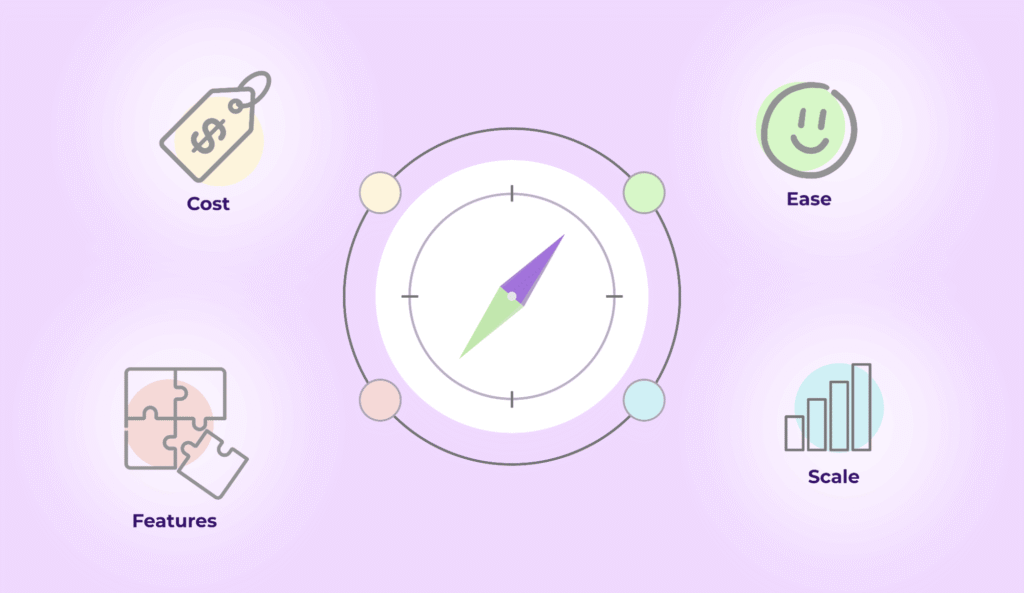
If you're running a language service provider in 2026, the translation management system you select this year will shape your margins, your client relationships, and your ability to grow for the next three to five years. That's not hyperbole. It's the reality of a market where artificial intelligence maturity, exploding global content volumes, and tighter client SLAs have converged into a single pressure point: your technology stack.
The global language services market hit USD $71.7 billion in 2024, growing roughly 5.6% year-over-year, with predictions pointing toward $90–100 billion by 2029. Enterprise clients now expect translation tools that learn, adapt, and deliver governed AI workflows. Meanwhile, 74% of enterprise leaders say AI-driven automation is a top priority, and 65% already use AI and MT workflows as standard practice. The window for "we'll upgrade eventually" has closed.
This guide is practical, not theoretical. We wrote it from Awtomated's perspective as a translation management platform built specifically for LSPs, but the evaluation framework applies regardless of which vendor you ultimately choose. Here's what the right translation management system does for your business:
- Margins: Translation memory and automation can save approximately $80,000 over time by eliminating repeated translations, reducing post-editing effort by 15–30%, and cutting manual processes that drain PM hours.
- Translation quality: Enforced terminology management, automated QA, and visual context reduce errors, iterations, and client rejection risk.
- Global revenue growth: Faster time-to-market across multiple languages and content types opens new enterprise verticals and geographies.
By the end, you'll know exactly how to evaluate and compare TMS platforms step by step.

What Is a Translation Management System (TMS) in 2026?
A translation management system TMS in 2026 is a cloud-native, end-to-end management system that automates, orchestrates, and connects every stage of the localization workflow-from content ingestion and AI drafts to human post-editing, quality assurance, and delivery. It centralizes localization workflows in one platform, serving as the single source of truth for all translated content, linguistic assets, and project data across clients, languages, and domains.
How does a modern TMS differ from basic computer assisted translation tools? A CAT tool is a linguist workbench focused on segment editing, translation memory leverage, and terminology. A TMS includes CAT capabilities but extends far beyond:
- Translation memory: Segment-level storage and reuse of previously translated content, with real-time fuzzy matching across projects.
- Terminology management: Central repository for approved terms, brand voice enforcement, and per-client glossaries.
- Workflow automation: Configurable pipelines with conditional branches, automatic task assignment, and SLA tracking.
- Visual context: Screenshots tied to segments, live in-context editors, and layout previews for documents and apps.
- Integrations: Native connections to content management systems, code repositories, design tools, and marketing automation platforms.
- Analytics and AI/MT governance: TM leverage stats, profitability dashboards, machine translation engine management, and data privacy controls.
Do LSPs Really Need a Dedicated Translation Management System?
Think back to 2023. Many LSPs still managed translation tasks via email chains, shared Excel files, and manual vendor coordination. It worked-barely-when you had a handful of clients and a short target language list. Fast forward to 2026, and those manual processes are breaking down under the weight of volume, complexity, and client expectations that no spreadsheet can handle.
Here are the pain points that signal it's time for a dedicated translation management system:
- Fragmented translation workflow: Content slips through cracks, versions conflict, and nobody knows which file is current.
- Billing delays: Reconciling vendor invoices manually, calculating fuzzy match discounts, and tracking TM leverage eats hours every week.
- No translation quality visibility: Without centralized QA data, you can't see revision rates, client feedback patterns, or error trends across projects.
- Unknown profitability: Without tying vendor costs, PM time, MT usage, and revisions together, you may lose money on accounts that look profitable on paper.
Once your LSP manages more than 3–5 enterprise accounts or translates into 10+ languages regularly, a TMS moves from "nice to have" to operational requirement.
Consider a concrete scenario: a SaaS client releasing weekly product updates in 20 languages. Each update touches UI strings, release notes, help center articles, and marketing materials. Manually collecting strings, sending them to freelancers, reviewing vendor work, handling feedback, and coordinating deployment across all those languages? That's where truncation errors appear in mobile apps, deadlines slip, and you overpay vendors because you can't track fuzzy matches. A dedicated translation management software platform fixes that with continuous sync, visual previews, automated QA, and TM reuse.
Core Capabilities Every LSP-Focused TMS Must Have
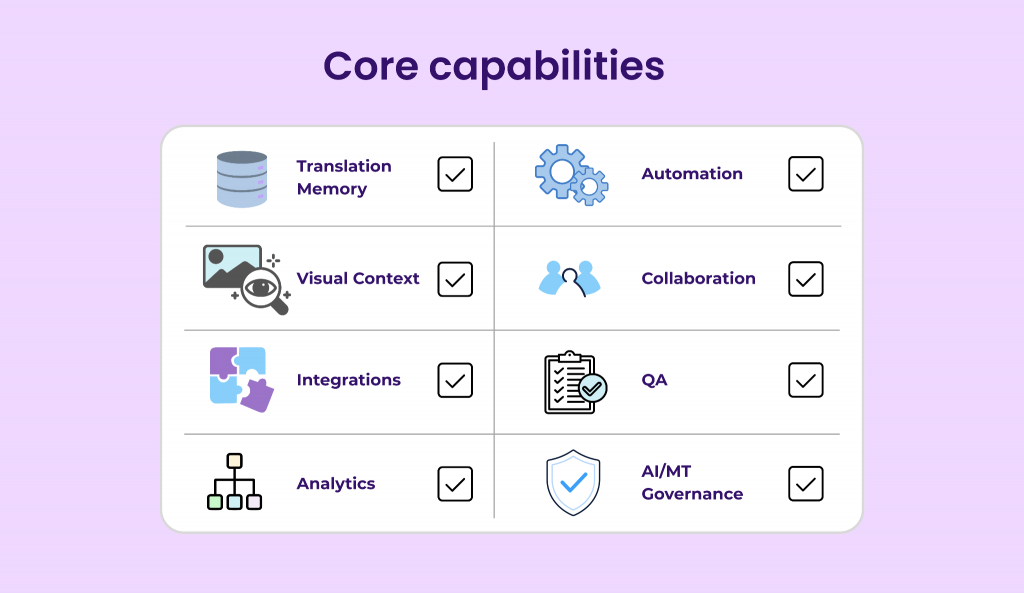
This section defines the baseline. If a translation management platform lacks these capabilities, it's a non-starter for LSPs operating in 2026. Each capability is elaborated below with practical evaluation questions. Examples reference how Awtomated implements these features, without turning the section into a pitch.
The core capability groups every LSP should evaluate:
- Translation memory and linguistic assets
- Workflow automation for modern localization
- Visual context and in-context translation
- Collaboration and team management
- Integrations and localization workflow connectivity
- Translation quality management and QA
- Analytics, reporting, and profitability insights
- AI and machine translation governance
Translation Memory and Linguistic Assets
Translation memory stores previously translated content for reuse at the segment level-and in 2026, real-time TM leverage is non-negotiable for LSP margins. Translation memory reduces the volume of new translation required over time, improves consistency across different types of content, and was the most commonly used technology by language professionals as of 2022. Using translation memory can save approximately $80,000 in costs by eliminating the need to pay for repeated translations.
Must-haves for any serious localization platform:
- Shared and client-specific TMs, with the ability to tag by domain while respecting confidentiality between end-clients
- Translation memory stores that support fuzzy match thresholds with configurable penalty and bonus rates
- TMX import/export for migration and interoperability with existing translations
- Glossaries and term bases supporting TBX standard, per-client terminology rules, forbidden terms, and brand voice enforcement
- Terminology management that maintains a central repository for approved terms across projects
Awtomated lets LSPs maintain separate TMs and glossaries per end-client and domain while still enabling cross-project reuse where confidentiality allows. The result: previously translated content is leveraged automatically, keeping consistent translations across every project.
Questions to ask vendors: How is TM updated-real-time with approvals or batched? Can you enforce forbidden or required terms automatically? How do glossaries integrate with MT engines?
Workflow Automation for Modern Localization
A typical localization workflow in 2026 looks like this: source content ingestion → content classification → machine translation or human first draft → human post-editing → review → QA → layout checks → client review → delivery. Every one of those steps needs to be configurable, not hard-coded.
A TMS automates repetitive translation tasks to improve efficiency. Workflow automation minimizes manual errors and bottlenecks in project management, and automation features reduce manual tasks that drain PM bandwidth. Specifically, look for:
- Customizable workflow steps with conditional branches per content type (e.g., legal content routes human-only; marketing goes MT first)
- Automatic task assignment based on linguist availability, language pair, and specialization
- Deadline tracking and SLA alerts that prevent missed deliveries
- Continuous localization support: auto-sync from Git, CMS, and design tools instead of batch file uploads
- Automated workflows that remove email back-and-forth and manual status tracking
Awtomated allows reusable workflow templates per client, language pair, or content type. Once configured, these standardized workflows reduce PM overhead dramatically. Automation minimizes human error in translation processes, and a TMS automates the translation process for efficiency-freeing project managers to optimize rather than coordinate.
Visual Context and In-Context Translation
Visual context matters because it directly reduces UI truncation issues, improves translation quality, and eliminates unnecessary client change requests. When translators can see what they're translating in situ, iterations drop and approval cycles accelerate.
Features to look for in any translation management tools suite:
- Screenshots linked to segments so translators see the exact UI or page context
- Live in-context editors for websites, mobile apps, and help centers
- Layout previews for documents (InDesign, PDF, PowerPoint)
- Warnings for text expansion and overflow in the target language
Example: When translating a mobile app button labeled "Save" into German ("Speichern"), Awtomated shows the button length in preview and triggers a warning for text expansion. The translator immediately sees the issue and can choose a shorter alternative-no back-and-forth with the developer needed.
Questions to ask vendors: Does your platform support in-context editors for web and app content? How are screenshots or UI assets handled? Can translators see layout previews for documents and designs?
Collaboration and Team Management for Multi-Vendor LSPs
LSPs work with internal linguists, freelance translators, sub-vendors, and client reviewers simultaneously. A TMS enhances team collaboration through centralized communication tools and allows for real-time team collaboration across global teams-which means fewer emails, less confusion, and faster turnaround.
Must-have team management features:
- Role-based access control with vendor portals, client reviewer access, and shared style guides
- Built-in commenting and messaging at segment level for resolving questions in context
- Linguist profiles with language pairs, domains, specialization tags, rates, and performance history
- Capacity tracking to prevent overloading and ensure backup coverage
A TMS enhances collaboration among translation teams by centralizing all communication and feedback. Awtomated lets a localization manager or PM assign work by language pair plus subject-matter expertise (legal, gaming, software) while tracking vendor capacity and quality scores-all from a single dashboard.
Integrations and Localization Workflow Connectivity
In 2026, a TMS must plug into where content lives. A TMS integrates with existing systems like CMS and CRM, including platforms like WordPress, Contentful, Drupal, GitHub, GitLab, Figma, and help desk tools. A TMS should support integrations with existing content management systems and marketing automation platforms. Integration capabilities enhance interoperability and scalability of a TMS, and a TMS allows seamless content transfer between translation and publishing systems.
Evaluation points:
- Number and depth of native integrations (for reference, over 600 pre-built integrations are available in Crowdin as an industry benchmark)
- Webhooks and open REST API-a robust TMS should have a well-documented API for custom integrations
- Support for file formats: XLIFF, JSON, PO, HTML, InDesign, Markdown, YAML
- True continuous sync vs. one-off import/export-keeping translated versions aligned with evolving source content
Example: Awtomated connects a client's product docs in GitHub and auto-creates translation tasks when new branches are pushed to code repositories. Changed strings are detected automatically; obsolete strings are deprecated. No manual file export required.
Before shortlisting vendors: Audit your current tech stack. List every content source, design tool, developer tools integration, and customer relationship management system your team touches. Then verify which TMS platforms connect natively.
Translation Quality Management and QA
Translation quality is a process, not just a final spell-check. It must be embedded across the entire localization workflow. A TMS enhances translation quality through consistent terminology management, and automated quality assurance checks catch errors before publication.
Quality-related features to evaluate:
- Automated QA checks: terminology violations, missing placeholders, punctuation mismatches, number format inconsistencies
- Configurable QA profiles per client or content type (legal vs. marketing vs. technical)
- Style guides accessible within the editor
- LQA workflows and scorecards for tracking quality trends
- Human review stages built into the workflow, not bolted on afterward
Awtomated can enforce client glossaries and automatically flag brand term violations across every localization project. When a brand term is mistranslated, missing, or when placeholder syntax is broken, the system catches it before delivering translations to the client.
Analytics, Reporting, and Profitability Insights
In 2026, LSPs need data to make decisions. Using a TMS can increase productivity and speed up turnaround times, but only if you can measure where the gains come from and where bottlenecks remain.
Essential dashboards and metrics:
- Project status, turnaround times, and deadline adherence
- Linguist productivity (words per hour, segments per day)
- TM leverage rates and savings from translation memory reuse
- MT post-editing effort and revision rates
- Per-client, per-language, and per-content-type profitability
- Translation quality trends and error type distribution
The TMS should support exporting data (CSV, BI connectors) so operations teams can run custom analyses. Awtomated helps LSPs see which clients, languages, and content types generate the best margins-and where localization costs are silently eroding profit.
AI and Machine Translation Governance
AI and machine translation are default expectations in 2026, but LSPs need control, not just speed. Machine translation reduces costs by handling large text volumes, and machine translation integration speeds up translation workflows. But without governance, you're introducing risk.
Requirements for effective translation management of AI and MT:
- Support for multiple machine translation engines, custom MT models, and AI-powered suggestions
- MT quality estimation to decide whether human review is needed
- Content-type routing rules defining what can and can't go through MT
- MT glossaries, do-not-translate lists, and data privacy controls ensuring client content is not used to train public engines
- Machine translation capabilities that include per-client policies and audit trails
Awtomated allows per-client MT policies: legal content flagged human-only, marketing content routed through MT with human post-edit, support tickets processed via MT first with QA flagging. Machine translation integration connects to engines for faster turnaround while maintaining the governance enterprise clients demand.
Key Factors to Consider When Choosing a Translation Management System
Beyond core capabilities, choosing a translation management system requires evaluating broader decision factors that determine long-term fit. Choosing a translation management system requires evaluating existing technology stack compatibility, team readiness, and growth trajectory. This section provides the decision framework.
Evaluation factors to examine:
- Scalability for volume, languages, and clients
- Ease of use for PMs, linguists, and clients
- Fit for LSP business model and team management
- Pricing models and real ROI
- Security, compliance, and client requirements
- Onboarding, training, and ongoing support
- Migration from existing tools and data portability
Scalability for Volume, Languages, and Clients
Scalability is essential for growing localization efforts. LSPs must plan for growth: more clients, more channels, seasonal volume spikes like Black Friday or major product launches. A TMS should support multiple languages for future expansion-going from 5 target locales to 50 in a 12-month period shouldn't require replatforming.
Look for: performance with millions of segments, support for hundreds of concurrent localization projects, robust user and role management, and regional hosting options. Awtomated is architected to support horizontal scaling, handling tens of thousands of jobs per month for LSPs that are growing aggressively.
Ease of Use for PMs, Linguists, and Clients
A powerful TMS is useless if project managers, translators, and client reviewers hate using it. Ease of use reduces training time for translators and project managers, and a user-friendly interface helps localization teams adopt a TMS quickly.
Evaluate: clean dashboards, intuitive navigation, minimal click count for core actions (job creation, assignment, delivery), and role-specific experiences-PM console vs. translator view vs. client portal. Awtomated's interface is designed around LSP workflows, reducing PM onboarding time to days, not weeks. Run pilot projects or trials to validate usability before committing.
Fit for LSP Business and Team Management
An LSP-centric TMS is not just a tool for translation-it must support vendor management, rate cards, quotes, purchase orders, and invoicing flows tied to projects. This is where generic localization software falls short.
Look for: linguist profiles with language pairs and specializations, rate management, availability calendars, and performance metrics. Awtomated connects project tasks with rate cards and time tracking to auto-generate cost and revenue estimates, giving you real-time profitability per project and per client.
Pricing Models and Real ROI
TMS providers structure their fees differently, affecting localization budgets significantly. Common pricing structures in 2026 include per-user, per-project, per-word, usage tiers, and hybrid models. Usage-based fees depend on the total number of words translated.
Model total cost of ownership: licenses, integrations, onboarding costs, minus automation savings, reduced QA rework, and increased TM leverage. A TMS can save approximately $80,000 over time through translation memory alone. If TM leverage saves 20% of volume and MT plus post-editing saves 40% on certain content, the payback period for most LSPs is measured in months, not years. Awtomated's pricing aligns with how LSPs bill their clients and doesn't punish growth in translated content volume.
Security, Compliance, and Client Requirements
LSPs increasingly support regulated industries-finance, healthcare, legal-and must meet strict security demands. Data security must comply with privacy standards like GDPR or HIPAA. Translation management systems reduce human error significantly, but they must also protect the data flowing through them.
Verify: data encryption in transit and at rest, SSO/SAML support, role-based permissions, audit logs, and backup and disaster recovery policies. Certifications that matter: ISO 27001, ISO 17100 alignment, GDPR compliance, and regional data residency options relevant under frameworks like the EU AI Act. Awtomated supports enterprise security requirements while remaining accessible to smaller LSPs.
Onboarding, Training, and Ongoing Support
Even the best translation management system fails if onboarding drags on for months or support is slow when a translation project is on fire. Evaluate: dedicated customer success, SLA-backed support response times, documentation, and training materials.
A realistic 30–60–90 day rollout with Awtomated for a mid-size LSP: first month, one client fully configured with streamlined workflows and documented processes; second month, expand to 2–3 additional clients; third month, full production with all active accounts. Advisory support on designing localization strategy and best practices-not just troubleshooting bugs-is what separates a partner from a vendor.
Migration from Existing Tools and Data Portability
The fear of switching TMS is real: years of translation memory, glossaries, and workflow setups feel irreplaceable. But migration doesn't have to be catastrophic.
Look for: import of TMX, TBX, and XLIFF files; mapping of legacy workflows; bulk user creation; project cloning; and coexistence strategies that let you run old and new systems in parallel. Awtomated typically migrates LSPs from legacy translation tools in phases-start with 1–2 key clients, validate, then roll out to the rest. Critical step: clean and normalize old translation memory during migration. Remove low-quality segments, deduplicate, and filter misaligned entries so legacy data doesn't poison future translation quality.
Step-by-Step Process to Evaluate and Select Your Next TMS
This section turns all criteria into a concrete 6–8 week evaluation plan built for 2026 realities: hybrid teams, AI usage, multiple content systems, and demanding enterprise clients.
High-level steps:
- Map your current and future localization workflow
- Build a shortlist of TMS platforms
- Run structured demos with realistic scenarios
- Pilot with real projects
- Compare results, negotiate, and decide
- Plan rollout and change management

Step 1: Map Your Current and Future Localization Workflow
Document everything: content sources, file formats, roles, approval chains, pain points, and turnaround times. Ask: How many languages now? What's planned in 12–24 months? Which content types (legal, marketing, UI, video)? What SLAs do clients demand? What are your worst bottlenecks?
Consider growth: new languages, new verticals, new content types. Awtomated's team can run this discovery with your LSP in a dedicated workshop session, ensuring nothing gets missed before you start evaluating.
Step 2: Build a Shortlist of TMS Platforms
Before making a final choice, shortlist 2 to 3 platforms for hands-on demos. Use the criteria from earlier sections-integrations, AI governance, team management, pricing-to filter providers quickly. Prioritize TMS solutions built primarily for LSPs (like Awtomated) over generic localization tools when your business model is vendor-based.
Use peer recommendations, case studies, and independent reviews. Feature checklists alone are not enough-look for evidence from clients similar in size, vertical, and complexity.
Step 3: Run Structured Demos with Realistic Scenarios
Prepare 2–3 concrete demo scenarios: a marketing website update, a product UI release, and an urgent legal translation. Ask each vendor to walk through them using a consistent script.
Observe: speed of job creation, ease of assigning linguists, handling of translation memory, visibility into translation workflow status, and how QA feedback flows. Invite project managers, lead translators, and at least one client representative. Awtomated typically conducts demos around real LSP use cases rather than generic product tours.
Step 4: Pilot Projects and Proof of Value
A 4–6 week pilot with 1–2 real clients is more valuable than any marketing material or static RFP answer. Measure: turnaround time vs. baseline, translation quality feedback, TM leverage, PM time saved, and error rates.
Set clear success criteria upfront-20% faster delivery, 30% fewer review iterations-and review these jointly with vendors. Awtomated supports pilots with hands-on onboarding, configuration, and weekly check-ins to ensure you're measuring what matters.
Step 5: Compare, Negotiate, and Decide
Summarize pilot results: capabilities vs. expectations, user feedback, projected savings, and risk factors. Negotiation points go beyond price: contract terms, data ownership, roadmap alignment, support SLAs, and custom advanced features for LSP workflows.
Look at 2–3 year total value, including improved translation quality, higher client retention, and new service offerings (like MT plus post-editing) enabled by the TMS. Awtomated positions itself as a long-term partner willing to co-evolve with LSPs, not a static software vendor.
Step 6: Plan Rollout and Change Management
A successful TMS rollout requires change management: communication to internal teams, training for PMs and linguists, and phased adoption. Start with 1–2 flagship clients or one content type across clients (e.g., help center articles).
Prioritize early wins-faster turnaround, fewer review cycles-to build internal momentum. Awtomated supports rollouts with templates, best-practice workflows, and live training sessions. Those early wins are what turn skeptics into advocates.
How Awtomated Compares: Built for LSPs from Day One
While this guide is vendor-agnostic in methodology, Awtomated maps closely to every evaluation factor outlined above. It was designed from day one as the best translation management system for language service providers-not adapted from a product-team tool or a generic localization platform.
Key strengths for LSPs:
- Deep vendor management: Manage hundreds of linguists with specialization tags, performance history, rate cards, and automated assignment
- Flexible workflows: Template-based, conditional logic per content type and client; continuous localization from Git, CMS, and design tools with advanced automation features
- Strong translation memory: Per-client and per-domain memories with real-time leverage, TMX import/export, and cross-project reuse where confidentiality allows
- AI governance: Multiple MT engine support, per-client policies, do-not-translate lists, quality estimation, and full traceability
- LSP profitability analytics: Dashboards showing TM leverage, MT usage, cost per project, linguist productivity, and margin per client
- Seamless integration: Connects with CAT environments, CRMs, accounting tools, and developer tools to avoid duplicate data entry
Mini-case 1: A mid-size European translation agency migrated from spreadsheets and email to Awtomated. Within three months, they reduced average turnaround by 35% and cut QA revision cycles in half-while onboarding four new enterprise clients simultaneously.
Mini-case 2: A North American LSP specializing in SaaS localization used Awtomated's continuous localization pipeline to reduce localization costs by 28% across 30+ languages, leveraging adaptive MT with governed human post-editing for multilingual content delivery.
Checklist: Questions to Ask Every TMS Vendor in 2026
Use this as a practical, copy-paste-ready checklist for RFPs and demo meetings.
Translation workflow and automation:
- How do you support conditional workflow branches based on content type (e.g., legal vs. marketing)?
- Can workflows be templated per client and reused across localization projects?
- How does your platform handle continuous localization from Git, CMS, or design tools?
Translation quality and QA:
- What automated QA checks are included (terminology, placeholders, number formats)?
- Can QA profiles be configured differently per client or content type?
- How do you support LQA scorecards and quality trend reporting?
Translation memory and terminology:
- How do you handle translation memory sharing across multiple end-clients while respecting confidentiality?
- Do you support TMX and TBX import/export for migration?
- Can you enforce forbidden terms and brand terminology automatically?
Integrations:
- How many native integrations do you offer, and is there a well-documented API for custom connections?
- Do you support true continuous sync or only batch import/export?
AI and machine translation:
- Can I set per-client MT policies, including human-only routing for specific content types?
- How do you ensure client data is not used to train public machine translation engines?
Visual context:
- Does your platform support in-context editors and layout previews for web, app, and document content?
Reporting:
- Can I see TM leverage rates, MT post-editing effort, and per-client profitability from a single dashboard?
Security, pricing, and support:
- What certifications do you hold (ISO 27001, GDPR, data residency)?
- How are fees structured-per user, per word, or hybrid?
- What does your onboarding plan look like for a mid-size LSP with 10+ active clients?
Conclusion: Future-Proof Your LSP with the Right Translation Management System
In 2026, choosing a translation management system is a strategic decision that directly affects translation quality, client satisfaction, and global revenue growth. The localization needs of your clients will only intensify-more languages, more content types, more speed, more governance. Your TMS must keep pace.
Prioritize a translation management system aligned with your localization workflow, scale, and AI roadmap-not just the longest feature list. Apply the step-by-step selection process outlined here: map your workflows, shortlist with intention, pilot with real data, and negotiate for long-term value. An effective translation management approach built on the right centralized platform pays back through automation, consistency, and better margins.
If you're ready to see how a TMS purpose-built for LSPs handles your specific clients, content types, and growth goals, schedule a tailored Awtomated walkthrough. Bring your toughest use case. We'll show you exactly how it works.
Table of Contents
- What Is a Translation Management System (TMS) in 2026?
- Do LSPs Really Need a Dedicated Translation Management System?
- Core Capabilities Every LSP-Focused TMS Must Have
- Key Factors to Consider When Choosing a Translation Management System
- Step-by-Step Process to Evaluate and Select Your Next TMS
- How Awtomated Compares: Built for LSPs from Day One
- Checklist: Questions to Ask Every TMS Vendor in 2026
- Conclusion: Future-Proof Your LSP with the Right Translation Management System
Ready to manage your Translation company easily?
Get Started for Free