How to Pay Freelance Translators: Payment Terms, Methods and Automation for LSPs

Key Takeaways
- Most LSPs pay freelance translators per word (0.10–0.22 for common language pairs), per hour (35–75 for non-specialist work), or per project, with Net 30 as the standard payment schedule.
- Written payment terms covering currency, rush surcharges, minimum fees, and late-payment interest prevent the disputes that fragment vendor relationships.
- Payment methods for freelance translators depend on geography and transaction size; Wise, PayPal, Payoneer, and local ACH/SEPA transfers each serve different corridors at different cost levels.
- A Translation Business Management System like Awtomated automates quotes, purchase orders, vendor invoices, and bulk payouts, cutting manual re-entry and reconciliation errors.
- Transparent, on-time payments and a supportive community of freelancers turn one-off contractors into a loyal, high-quality translator network.
Introduction: Why Translator Payment Processes Matter for LSPs
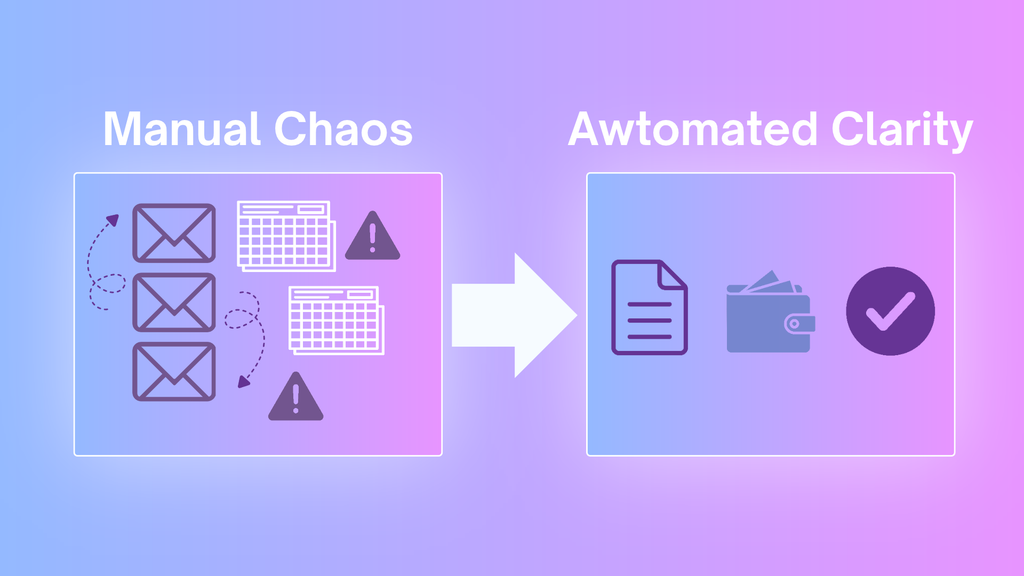
Paying freelance translators is one of the most error-prone tasks in running a translation business. Agencies that rely on email threads, spreadsheets, and separate invoicing apps regularly encounter missed payments, incorrect word counts, and currency mismatches. Freelance translators cite these mismatches as a top source of dispute with clients, and the resulting friction drives qualified linguists to work with competitors who pay reliably. At Awtomated, we work with small and mid-sized LSPs managing dozens to hundreds of freelancers each month, often across multiple currencies. Between 2024 and 2026, the shift toward remote work and cross-border hiring has made this problem worse: more countries, more payment rails, more room for error. This article covers how to set payment terms, choose payment methods, keep costs predictable, and automate the full workflow from quote to payout.
How LSPs Typically Pay Freelance Translators Today
Most LSPs pay freelancers on a per-job basis, with rates defined before work starts. The specific pricing unit varies by task type.
- Per-word rates remain the industry default. For common pairs like English to Spanish, French, or Portuguese, general translation rates fall between USD 0.10–0.22 per word. Specialized legal, medical, or technical content starts at about $0.15 and can reach 0.40–0.50.
- Per-hour rates suit tasks where word count does not reflect effort: revision, MT post-editing, consulting, and meetings. U.S. rates for non-specialist work typically run 35–75 per hour; specialist topics push that to 75–120.
- Fixed project fees make sense for small jobs under 300 words, flat-fee marketing campaigns, or complex DTP work where per-word billing would yield very low totals.
- Minimum fees of USD 25–40 protect translator income on tiny assignments where overhead (formatting, email, invoice prep) would otherwise consume the payment.
Freelancers are paid per project via secure payment systems, and agencies convert these units into purchase orders and vendor invoices at month-end or project completion. Awtomated lets you define price lists per client, language pair, and service type, then calculates vendor pay from project word counts without manual re-entry.
Designing Clear Payment Terms for Freelance Translators
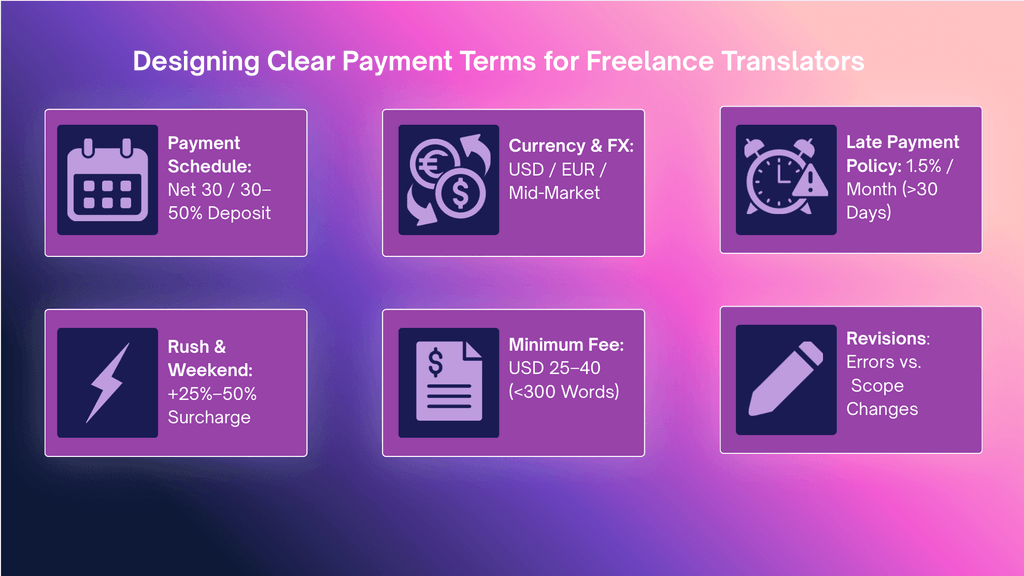
Clarifying rates and terms in writing prevents misunderstandings in freelance agreements. Every vendor onboarding pack should include a payment agreement that spells out the following:
- Payment schedule. Payment terms often standardize around Net 30 as common practice. Some LSPs use Net 15 for new vendors or require a 30%–50% deposit on large projects. Specify whether the clock starts from invoice date or client approval.
- Currency and FX rules. State the currency (USD, EUR, or translator's local currency). Define who bears conversion fees and whether the rate is mid-market or includes a bank markup.
- Late payment policy. A standard clause: 1.5% interest per month on invoices overdue beyond 30 days, or the maximum rate permitted by law. Send a proactive notice before escalating.
- Rush and weekend surcharges. Jobs delivered outside business hours or under 24-hour deadlines typically carry a 25%–50% surcharge. Define these as percentages in the agreement.
- Minimum fee. USD 25–40 for jobs under 300 words.
- Revisions. Separate unpaid "corrections" (fixing genuine errors) from paid "scope changes" (new content or stylistic rewrites).
Here is an example clause in plain text:
"Payment is due Net 30 days after delivery of the final approved file. Currency: USD. Translator invoices using the source-word count. Invoices unpaid beyond 30 days incur 1.5% monthly interest. Weekend or sub-24-hour delivery carries a 50% surcharge. Jobs under 300 words carry a minimum fee of $35. Scope changes are quoted separately."
Invoicing requirements should include details like invoice number and project description to streamline accounting. Awtomated stores standard payment terms per vendor and applies them automatically to each purchase order and vendor invoice, so project managers do not need to re-enter terms manually.
Choosing How to Calculate Translator Compensation (Rates and Pricing Models)
Good pricing models balance client budgets, translator expectations, and agency margins. The figure you pay a translator depends on several factors.
CAT tool leverage and match tiers. Many LSPs apply discounts based on translation memory: 100% new text at full rate, fuzzy matches (95–99%) at 60–80% of full rate, and exact matches at lower rates. CAT tools enhance efficiency in Translation Management Systems, but translators push back when match calculations differ between source and target word segmentation. Agree on the counting method before work starts, and store it in vendor profiles. Awtomated can import word counts from CAT tools, apply rate cards, and show real-time profitability before you confirm a quote.
Service type. Translation commands the highest base rate. Revision and proofreading fall slightly lower. MT post-editing is often discounted, though the ELIS 2026 survey found that over 60% of independent translators now use MT or MTPE in their workflows, and many contest deep discounts. DTP and certified translation carry premiums.
Language pair scarcity. English to Nordic languages (Swedish, Finnish, Danish) commands 0.18–0.40 per word for general content because fewer professionals specialize in those pairs. Common pairs like English to Spanish or Portuguese fall in the 0.10–0.25 range. For a broader look at translation agency pricing models, see our dedicated guide.
Subject matter. Legal, medical, financial, and technical documents push rates up by 25–100% over general business content due to terminology risk, required certification, and liability.
Platforms like Gengo automatically add translation payments to your account, and Gengo translators earn based on customer demand and job availability. Larger agencies, however, need rate card control across a broad range of services and industries rather than marketplace-driven pricing.
Payment Methods for Freelance Translators (Domestic and International)
In 2026, most LSPs send money to freelance translators across multiple countries and must weigh banking fees, compliance, and settlement speed. Payment methods for freelance translators largely depend on geography and transaction size.
- Domestic bank transfer (ACH / SEPA). Using local ACH transfers can eliminate international wire fees for regional contractors. ACH in the U.S. costs under $5 and settles in 1–2 business days. SEPA in the EU settles in one business day. Best when the translator's bank account shares a country with the LSP's legal entity.
- International wire (SWIFT). For freelance translators in countries without local rails. Banks typically charge 25–50 per outgoing wire, and the recipient's bank may deduct additional fees. Settlement takes 2–5 business days.
- Wise. Mid-market FX rate plus a transparent fee of roughly 0.4–1% depending on the corridor. Freelancers can withdraw funds to their local bank accounts. Wise tends to be the lower-cost option for most cross-border corridors.
- PayPal. Widely known but higher in fees, both per-transaction and in FX markup. Useful for small, one-off payments or where the translator has no bank integration.
- Payoneer. Payoneer allows payments in multiple currencies like EUR and USD. FX markup runs 1–3% plus potential withdrawal fees of 1–4%. Free to register, but low-activity accounts may incur an annual fee of about $29.95.
- Virtual or prepaid cards. Available in some markets for small, frequent payouts. They avoid banking delays but may carry their own FX and withdrawal fees.
Geographic location affects the choice of payment method for translators; some individuals in certain countries cannot access PayPal or Payoneer. Transparent exchange rates and low transaction fees are critical for international payments to translators, and freelance translators often prefer payment methods that are predictable and easy to reconcile. Freelance translators can receive payments in multiple currencies, so always confirm each vendor's preference during onboarding.
Awtomated centralizes translator payables and lets you export payment batches by due date and currency, which you then execute via your chosen bank or provider.

Handling Multi-Currency, Tax, and Compliance Issues
Paying freelance translators across borders involves managing FX margins, tax forms, and regulatory checks.
- Local currency vs. base currency. Translators prefer receiving payment in their local currency because FX volatility can erode income. Agencies often quote in USD or EUR. Specify in the agreement who bears FX risk and how often rates are reviewed.
- FX margin visibility. Wise's all-in cost runs approximately 2–3% per transfer. Payoneer's total cost, including hidden FX markup, can reach 3–5% depending on the corridor. Know the real cost before choosing a rail.
- Tax documentation. Contractors in the U.S. must collect appropriate tax information before payments are made: W-9 for domestic vendors, W-8BEN for non-U.S. vendors. In the EU, check whether the translator is VAT-registered and whether reverse-charge rules apply. This is not legal advice; consult a tax professional for your specific country.
- Secure storage. Store legal names, bank account details, tax IDs, and currency preferences in your vendor database. Data protection laws like GDPR may require encryption or restricted access.
- Record-keeping. Maintaining consistent records of payments and contracts eases reconciliation and tax reporting. Keep invoices, purchase orders, approval logs, and CAT-tool word-count reports for audits.
Awtomated is not a tax advisor, but it stores tax data fields for each freelance translator and maintains a vendor ledger in multiple currencies.
Automating Translator Payments with Awtomated (From Quote to Payout)
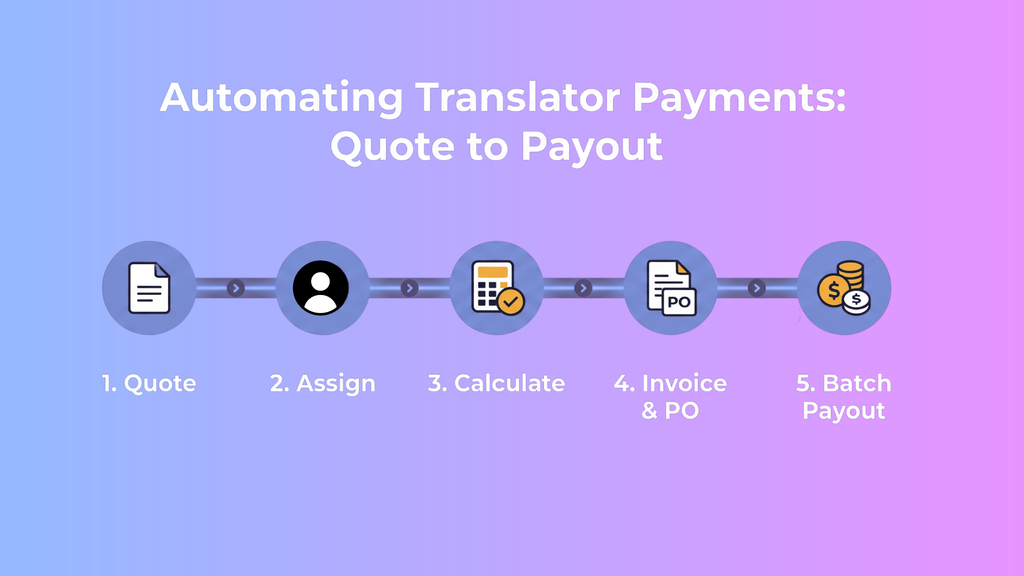
A Translation Business Management System manages the full translation lifecycle, from client request to vendor payout. Translation Management Systems streamline project workflows for translators and integrate with email and machine translation tools, replacing the scattered software and spreadsheets most agencies rely on.
Here is how automation works in Awtomated:
- A client request is captured in the system. A quote is generated from word counts, target language, services, and stored price lists.
- Once accepted, tasks are created and assigned to freelance translators from your vendor pool.
- Awtomated tracks progress. When the project is completed and approved, it calculates payables for each translator based on the agreed rate card.
- Vendor purchase orders and invoices are generated from the same data. No manual re-entry.
- Your finance team exports a payment batch (CSV or bank upload file) by due date, paying multiple freelance translators in one go.
Translation Management Systems support real-time profitability tracking: as client invoices and vendor costs are created, Awtomated shows margin per project, per client, and per translator. Automation in managing payments reduces overhead for ongoing projects with translators, cutting the hours your team spends on month-end reconciliation.
For a deeper look at finance management features, visit our product page.
Building a Reliable, Supportive Translator Community Around Fair Payment
Effective management of payments helps build strong relationships with freelance translators. Consistent, transparent payment turns one-off contractors into long-term partners.
- Onboard with clarity. Communicate payment terms, rates, and revision policies during onboarding. Store agreements centrally in Awtomated's vendor management records.
- Provide visibility. Give translators access to a portal or status updates so they can track which projects are approved and when they will be paid. This cuts down on follow-up emails.
- Pay on time. Prompt payment is emphasized for freelance translators' work. If a client is slow to approve, explain the delay proactively. Offering early payment discounts can enhance relationships with translators and build loyalty with newer vendors.
- Create a supportive community. Involve translators in feedback loops and professional development. Share performance data. Invite input on quality standards. Companies like LanguageLine pay freelancers reliably and fairly for every project, and that reputation helps them attract top-tier linguists. The same principle applies to your agency.
- Respect their flexible schedule. Freelancers choose this work for its convenience and control over their hours. Avoid sending payment-related requests outside their time zones or on short notice.
Practical Tips to Streamline Translator Payments Month by Month
This checklist is for agency owners and project managers hoping to reduce payment-related admin each month.
- Standardize rate cards and payment terms per vendor in Awtomated before assigning the first job. Do not leave terms undefined for even one assignment.
- Close projects promptly in your system so translator payables are triggered on schedule. Delayed closing pushes payables into the next month and creates end-of-month surprises.
- Group payouts by due date and currency to minimize transaction fees. Bundling five USD payments into one batch costs less than sending five separate wires.
- Reconcile bank statements with your vendor ledger weekly to catch misapplied payments or missing invoices early.
- Run monthly reports on average vendor cost per word, days from invoice to payment, and outstanding payables. Use the data to refine rate cards and identify vendors whose performance and salaries warrant adjustment.
FAQ
These questions cover common issues LSPs face when paying freelance translators that were not fully addressed above.
How often should I pay my freelance translators?
Most LSPs use monthly or twice-monthly cycles. A common setup: pay all approved invoices on the 10th and 25th of each month. Very small agencies sometimes pay per project on completion, but this becomes inefficient as volume grows. Awtomated lets you filter vendor payables by due date and create regular payment batches aligned with your chosen schedule.
Is it better to pay freelance translators by word or by hour?
Per-word payment is standard for translation and MT post-editing. Hourly rates fit revision, consulting, glossary development, interpreting, and meetings where output is not measured in words. Agree in advance which tasks are word-based and which are time-based, and store these rules in vendor profiles. Awtomated supports multiple service types, so you can mix per-word and per-hour lines in the same project while still tracking profitability.
How do I handle payment disputes with freelance translators?
Review the original agreement. Compare CAT-tool word counts with the invoice. Check whether scope changes occurred during the project. Document all communication. Awtomated maintains project logs, cost calculations, and file history, making it easier to connect the dispute to a specific data point and adjust invoices if needed.
What information do I need from a new freelance translator before I can pay them?
Collect: full legal name, email, preferred currency, bank account or payment service details (IBAN, SWIFT, Wise ID, or Payoneer email), tax ID or relevant tax form (W-9 or W-8BEN for U.S.-based agencies), agreed rates by service type, and expertise areas (for example, culturally adapted marketing content or technical manuals). Update this information at least once per year. Awtomated provides vendor profiles with custom fields so agencies can store all payment-critical data securely in one place.
Can I automate currency conversions when paying translators in different countries?
Currency conversion is handled by the bank or payment provider, not by the TBMS itself. The system records which currency each invoice is in. Agree with each translator whether rates are fixed in USD, EUR, or local currency, and how often those rates will be reviewed in light of FX changes. Awtomated supports multi-currency projects and vendor invoices, allowing you to see margins even when client and translator currencies differ. To sign up for a free trial and see how this works, visit Awtomated's FAQ page for onboarding details.

Building software that helps small and medium-sized language service providers run their business.
About Rishi →Table of Contents
- Introduction: Why Translator Payment Processes Matter for LSPs
- How LSPs Typically Pay Freelance Translators Today
- Designing Clear Payment Terms for Freelance Translators
- Choosing How to Calculate Translator Compensation (Rates and Pricing Models)
- Payment Methods for Freelance Translators (Domestic and International)
- Handling Multi-Currency, Tax, and Compliance Issues
- Automating Translator Payments with Awtomated (From Quote to Payout)
- Building a Reliable, Supportive Translator Community Around Fair Payment
- Practical Tips to Streamline Translator Payments Month by Month
- FAQ
Related articles

Quotes, Invoices, Vendor Payouts and Margins in One Place: Rethinking Finance for Translation Agencies

Google Sheets Was Never Built for Vendor Rates: Where Translation Agency Spreadsheets Break Down