Quotes, Invoices, Vendor Payouts and Margins in One Place: Rethinking Finance for Translation Agencies

Most translation agencies in 2026 still run their financial operations across four or five disconnected tools. Awtomated brings quotes, vendor payouts, client invoices and margin tracking into a single platform built for language service providers. This article explains how that works in practice, especially for agencies focused on financial document translation.
Key Takeaways
- Most translation agencies still manage quotes, invoices, vendor payouts and margin tracking in separate tools. Awtomated unifies them in a single TBMS connected to every translation project.
- Centralizing financial translation services operations (from annual reports to audit reports) with project data gives real-time visibility into project- and client-level profitability.
- Awtomated connects quotes, purchase orders, client invoices, vendor payments and multi-currency handling directly to financial documents, eliminating spreadsheet-based reconciliation.
- Agencies gain tighter control over margins on complex financial translations (e.g., multi-language investor relations reports and income statements) by standardizing rate cards, surcharges and vendor terms.
- AI translation and workflow automation reduce admin time, accelerate cash flow and enable agencies to scale financial document translation without proportional headcount growth.
Why Translation Agency Finance Is Broken in 2026
Picture a small translation agency handling financial reports for three listed companies. The project manager builds estimates in Excel, sends quotes from Gmail, invoices through QuickBooks, pays vendors via bank transfer, and only calculates margins in a spreadsheet weeks after delivery. Financial terminology varies across banking, accounting, and investment sectors, yet all the pricing logic lives in one person's head. Translation agencies deal with complex billing models and manage global clients, but their finance stack looks like it was assembled by accident.
For agencies handling financial documents (annual reports, income statements, audit reports, investor relations decks), scattered finance data creates specific damage: missed rush surcharges on earnings-season deadlines, unbilled change requests when auditors revise footnotes, late vendor payments that erode linguist relationships, and inconsistent pricing for specialized terminology. Financial translation requires knowledge of local currency and formatting conventions; formatting differences alone lead to frequent errors in financial documents. Finance software must support complex vendor and freelance payment structures, and translation agencies often manage diverse billing cycles from clients.
A 2025 AutoRek survey found 90% of firms rely on spreadsheets in financial operations. A Rossum study the same year reported 58% of finance leaders still call Excel their most-used automation tool. CAT tools and AI translation engines have matured, but back-office finance in LSPs has not. The gap between production sophistication and finance management is where agencies lose money. This article shows how putting quotes, invoices, vendor payouts and margin tracking in one connected platform reshapes a translation agency's financial health.

From Spreadsheets to TBMS: How Awtomated Reframes Agency Finance
A Translation Business Management System is a cloud platform where client intake, quoting, project workflow, vendor management, file formats, invoices, purchase orders and payments are all connected. It is not a CAT tool and not a TMS; it manages the business layer. For a clear breakdown, see TBMS vs TMS vs CAT.
Awtomated is built for language service providers: native support for language pairs, per-word and per-page pricing, minimum fees, domain-specific rate cards for financial expertise, and multi-currency billing. Financial translation services cover over 100 languages; GTS Translation alone specializes in over 80 languages for financial documents. When agencies serve that breadth, the flow from project quoting to invoicing must be seamless to avoid errors.
Consider a concrete scenario: a client sends you their 2025 consolidated annual report for translation into German, French and Japanese. In Awtomated, the quote links directly to the project. When you assign translators, POs generate from the same rate data. When tasks complete, the client invoice pulls actual volumes. No copy-paste. No reconciliation spreadsheet. Integration allows agencies to scale operations without increasing administrative burden. A boutique LSP that adopted this approach cut quote creation time from 45 minutes to under 10 and reduced DSO from 52 to 31 days.
Building Profitable Quotes for Financial Translation Projects
Financial translation quotes are more complex than general translation quotes. They include multiple service tiers (translation, revision, desktop publishing), strict deadlines tied to earnings releases, and risk premiums for sensitive content like audit reports and regulatory filings. Linguists are selected based on financial subject matter expertise, and financial translators must have over 5 years of experience to handle all the nuances of compliance-grade work.
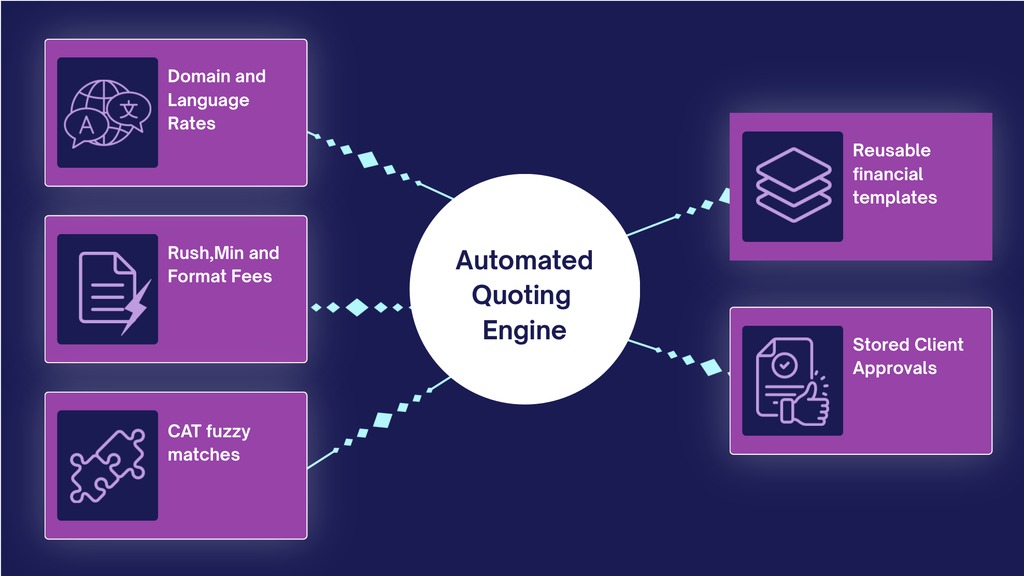
Awtomated's quoting engine handles this granularity:
- Per-word rates by language pair and domain (e.g., "EN→DE financial translation" vs. "EN→DE marketing content")
- Minimum fees for small financial documents like bank statements or loan agreements
- Rush fees for earnings calls, press releases and year-end filing deadlines
- Surcharges for complex file formats: InDesign layouts, XBRL exports, Excel-based financial models
Quotes can pull from CAT analyses uploaded into Awtomated. Integration with CAT tools is important for accurate quoting and project costing, because translation memories and fuzzy match percentages determine what the agency actually pays vendors. Financial translation requires precise terminology for different markets, and effective finance software aids in budgeting and forecasting for translation agencies. Reusable quote templates for recurring financial translation services (quarterly income statements, investor relations press releases, fund fact sheets) make each reporting cycle faster. Approvals are stored alongside the quote, reducing disputes about scope creep at invoice time.
Connecting Projects, Financial Documents, and Finance Data in One Workflow
Each client request in Awtomated (translating 2025 annual reports, interim financial statements, investor presentations) becomes a project that links tasks, files, budgets and finance events. Finance software can connect income from a client project with incurred expenses, and agencies should monitor project profitability down to individual job levels.
Project managers break a financial document translation into tasks (translation, revision, quality assurance, desktop publishing, in-market review) and assign them to vendors. The system generates internal cost estimates from each vendor's rate card. All financial documents (PDFs, Word files, Excel-based financial models, InDesign layouts) are stored against the project with version history. Quality checks include verifying figures, currencies, and formatting at each stage.
Real-time dashboards provide visibility into cash flow and outstanding receivables. Project-level KPIs show quoted revenue, projected vendor costs, actual POs issued, and live margin before and after change requests. Financial visibility improves decision-making in translation agencies, especially for large financial translations where scope evolves as auditors or regulators request late changes. Agencies can attach compliance notes or client-specific financial terminology glossaries so that professional translators, reviewers and finance teams work from the same context.
Vendor Payouts That Match Real Work (Without Spreadsheet Reconciliation)
The traditional vendor payment process is a grind: dozens of expert translators and reviewers send separate invoices for different financial translations, forcing agencies to manually reconcile word counts and currencies. Translation agencies pay freelance translators across different countries and currencies, and the reconciliation burden grows with every language pair and project.
In Awtomated, vendor costs are generated from the same data that powers the client quote: language pair, volume, agreed rate for financial expertise, translation memory discounts, and rush multipliers. Purchase orders are created when tasks are assigned, and vendor payouts calculate when tasks complete. Finance software should automate contractor payouts and reduce manual data entry; automated systems can track payment statuses and send reminders for overdue accounts.
Agencies can benefit from automation in managing vendor invoices and payments. Multi-currency invoicing is essential for translation agencies operating internationally. Vendor management in Awtomated tracks payment status by project and by vendor, showing which linguists working on financial document translation have been paid and which payments are pending. Consolidated vendor statements can be exported into the agency's accounting tool for a clean, reconciled view.
Invoicing Clients for Financial Translations Faster and With Fewer Disputes
Invoicing for financial documents gets delayed by complex scopes (translation plus back-translation of audit reports, sworn translation for regulatory submissions), late internal approvals, and the difficulty of summing all change requests. Automated client invoicing can include milestone or recurring billing; real-time insights are crucial for managing translation project cash flow.
Awtomated lets project managers generate invoices directly from confirmed quotes and completed tasks. The invoice automatically includes actual delivered word count, rush surcharges, weekend work, and desktop publishing charges for tables and charts. Finance systems can track receipts and categorize expenses for efficiency. Invoice templates can be customized for financial institutions, including PO numbers, regulatory references, or investor relations cost centers, and reflect different tax rules per country. Partial invoicing is available for long-running projects (multi-quarter investor relations programs, ongoing fund reporting), so agencies bill milestones instead of waiting for full completion.
Seeing Margins Clearly: Real-Time Profitability for Financial Translation Work
Margin visibility matters most where projects are large, involve multiple vendors and review rounds, and pricing pressure from banks, asset managers and listed companies is constant. Awtomated calculates margins at project, client, and service-type levels by comparing billed revenue against vendor payouts and internal costs, updated as tasks and invoices change.
Agencies can generate KPI reports showing top profitable financial translation clients, least profitable language pairs for annual reports, or margin trends for investor relations work across quarters. This helps spot unprofitable patterns: underpriced languages, overuse of expensive senior reviewers, or unbilled rework. Financial terminology must remain precise across various sectors, and numbers must stay aligned with the source in translations; when errors occur, they eat directly into margin.
The competitive landscape for reliable translations is crowded. Stepes provides certified translations for financial documents. Tradutec has over 30 years of experience in financial translation. Smartling combines professional translation with AI technology for efficiency. To compete, agencies need to know their margins on every project, not discover them weeks later. Profitability views can be exported for management without exposing vendor-specific rates.
AI Translation, Automation, and Financial Accuracy in Agency Finance
Agencies in 2026 increasingly use AI translation for lower-risk financial content (internal training materials, recurring market commentaries) while retaining human review for high-stakes documents. A 2019 study on NMT post-editing in banking and finance found that neural MT post-editing delivered time savings with equal or better quality even for rare language pairs.
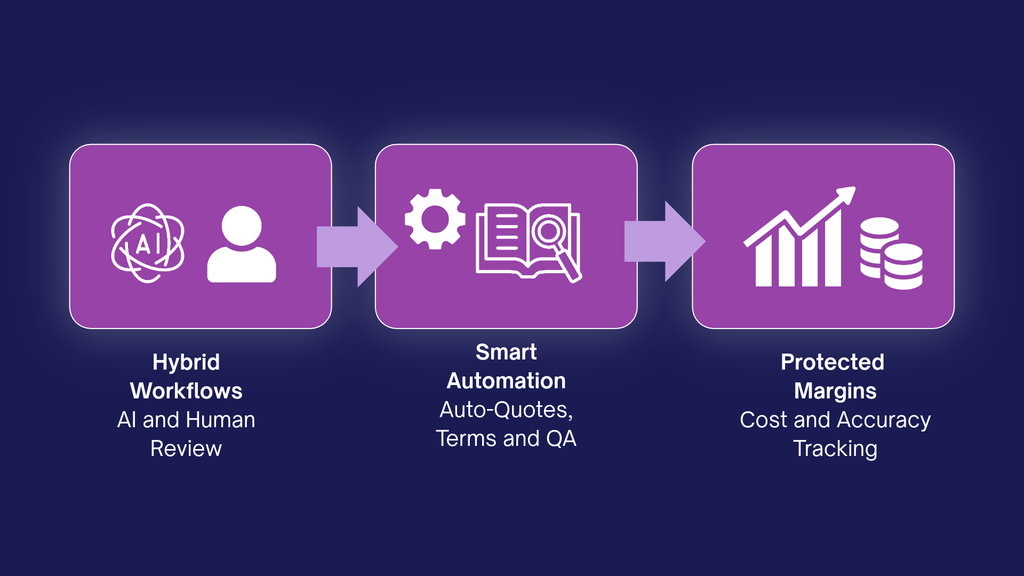
Awtomated does not decide when to use AI translation; it tracks how AI vs. human workflows impact time, translation costs and margins at the project level. Quality assurance is critical in financial translation to prevent errors. Quality assurance processes are essential to prevent translation errors. Quality assurance processes prevent translation errors in financial documents. Automated tools flag inconsistencies in financial translations, and a structured quality assurance process ensures numeric and linguistic accuracy remain under expert control.
Automation features include auto-creating projects from client portals, generating draft quotes based on historical financial document translation patterns, and triggering invoice creation when all tasks are marked delivered. Awtomated stores client-specific financial terminology preferences (IFRS vs. US GAAP wording, local banking terms, account terms for specific markets) to reduce rework, improve terminology consistency, and protect margins.
Multi-Currency, Multi-Market Reality for Financial Translation Agencies
Agencies translating financial documents for global financial markets often bill asset managers in EUR, banks in USD, and insurers in GBP while paying linguists in PLN, BRL or JPY. Specialized finance software automates real-time currency conversions. Finance software for translation agencies should include multi-currency management.
Awtomated supports multi-currency quotes, invoices, and vendor payouts, recording base-currency equivalents so agencies understand true margins despite exchange rate movement. Finance software enhances compliance with tax regulations and reporting requirements: VAT or GST is added to client invoices based on jurisdiction, tax IDs are captured, and clean records simplify year-end accounting. Translators must understand jurisdiction-specific financial regulations, and the same applies to the finance layer of the agency.
Reporting by market segment (banking sector vs. asset management vs. insurance policies) reveals which types of financial translation services and which geographies drive the healthiest margins. Consistent currency and tax handling also reassures sophisticated clients in financial institutions, whose internal accounting teams expect audit-ready invoices from their language partners. Financial communication across multiple languages and markets demands both linguistic and financial precision in every document.
Implementing Awtomated Without Disrupting Ongoing Financial Translation Cycles
Agencies busy with Q3 and year-end financial reports can adopt Awtomated incrementally. No need to halt ongoing translation projects.
A practical three-step rollout:
- Move new quotes and basic project tracking into Awtomated. Let your team learn templates and rate cards on live projects.
- Start issuing vendor POs and tracking payouts for those projects. Onboard your linguist pool with profiles, rates and language skills.
- Switch client invoicing and profitability reporting once the team is comfortable. Migrate or archive historical data for reference.
For a small agency (3-10 staff), initial setup takes a few days. Full adoption, including finance reporting and margin dashboards, typically completes in 4-6 weeks. Awtomated provides data import for clients and vendors, help mapping existing financial translation services and rate cards, and guidance on configuring profitability dashboards. Reader expectations for turnaround time on setup are realistic: Awtomated focuses on clear defaults tailored to translation agencies, not heavy IT projects.
If your agency's core business is financial documents, investor relations content, and specialized translation for the banking sector, request a demo of Awtomated to see how the quote-to-cash cycle works in practice.
FAQs
These FAQs address practical questions about using Awtomated for finance in translation agencies, with a focus on financial document translation and investor relations content.
Can Awtomated handle recurring financial translations like quarterly reports and earnings releases?
Awtomated supports recurring project templates. Agencies can clone previous quarterly or annual report projects, including services, languages, rates and workflows, so each new financial reporting cycle can launch in minutes. Templates preconfigure typical financial documents (income statements, balance sheets, cash-flow notes, investor relations presentations) and associated tasks, keeping pricing consistent across cycles. Previous translations and previous reports feed directly into template logic.
Does Awtomated replace my accounting system (e.g., Xero, QuickBooks, Sage)?
Awtomated is a translation business management system focused on operational finance: quotes, project-level costs, vendor payouts and margin tracking. It complements, not replaces, general accounting software. Invoices and payout data can be exported or synced into existing accounting tools, so the agency's finance team still closes books and handles statutory reporting (including local guidelines and legal obligations) in their preferred system. Accounting terminology and financial standards are respected through configurable export formats.
How does Awtomated support compliance for sensitive financial documents?
Awtomated offers role-based permissions, secure cloud hosting and data security controls so only authorized staff and linguists can view confidential financial documents like audit reports or pre-release earnings materials. Agencies can log access and keep all project-related communication, files and approvals in one place, which helps demonstrate process control to demanding financial services customers. Financial regulations and commercial standards are supported through configurable compliance fields.
Can I track profitability by client or service type (e.g., banking vs. asset management)?
Awtomated lets agencies categorize clients and projects by segments (banking, asset management, insurance, fintech) and generates profitability reports at both client and segment levels. This helps agencies see whether annual report translation for listed banks is more or less profitable than ongoing investor relations newsletters for asset managers, and adjust rates for investment materials or legal translation work accordingly. In depth knowledge of where margin comes from changes how agencies price their business.
Does Awtomated support AI translation or CAT tools I already use?
Awtomated is CAT-agnostic and AI-agnostic. It connects to or works alongside existing CAT tools, translation memories and MT/AI engines, focusing on automating the business side (quotes, workflows, finance) rather than the linguistic editing environment. Agencies can configure workflows marking which projects are AI-assisted vs. fully human-translated and track time, cost and margins uniformly. This separation ensures that the best financial translator on your roster and the source file they work from stay within the tools built for linguistic work, while Awtomated handles everything around it.

Building software that helps small and medium-sized language service providers run their business.
About Rishi →Table of Contents
- Why Translation Agency Finance Is Broken in 2026
- From Spreadsheets to TBMS: How Awtomated Reframes Agency Finance
- Building Profitable Quotes for Financial Translation Projects
- Connecting Projects, Financial Documents, and Finance Data in One Workflow
- Vendor Payouts That Match Real Work (Without Spreadsheet Reconciliation)
- Invoicing Clients for Financial Translations Faster and With Fewer Disputes
- Seeing Margins Clearly: Real-Time Profitability for Financial Translation Work
- AI Translation, Automation, and Financial Accuracy in Agency Finance
- Multi-Currency, Multi-Market Reality for Financial Translation Agencies
- Implementing Awtomated Without Disrupting Ongoing Financial Translation Cycles
- FAQs
Related articles

Google Sheets Was Never Built for Vendor Rates: Where Translation Agency Spreadsheets Break Down

HubSpot, Trello and QuickBooks: Why Translation Agencies Run Their Business on Five Tools Built for Other Industries