HubSpot, Trello and QuickBooks: Why Translation Agencies Run Their Business on Five Tools Built for Other Industries

Most translation agencies in 2026 still run on a patchwork of generic software - HubSpot for leads, Trello for projects, QuickBooks for invoicing, a CAT tool for production, and email for everything in between. This article shows what a modern translation agency tech stack should actually look like, why fragmentation costs more than anyone budgets for, and how one purpose-built platform can replace four or five tools that were never designed for localization.
Key Takeaways
- The majority of small and mid-sized translation agencies still operate on five or more generic tools stitched together by copy-paste and email. This creates hidden costs in admin time, errors, and lost profitability that compound as you add multiple languages, vendors, and demanding sectors like e-commerce and life sciences.
- A modern translation agency tech stack needs purpose-built components: CRM, quoting, project management, vendor management, finance, client portals, and reporting - ideally unified in a single Translation Business Management System (TBMS) rather than scattered across HubSpot, Trello, and QuickBooks.
- Linguistic assets - translation memory, termbases, style guides - and client data are strategic assets. Agencies must own and control them, avoiding vendor lock-in from isolated tools that make global growth harder, not easier.
- This article is written from Awtomated's perspective, based on years of working with small and mid-sized LSPs that have outgrown spreadsheets and generic SaaS. We provide practical recommendations: a reference architecture for your tech stack, concrete integration examples, and a checklist to decide when it's time to consolidate.
- Translation agencies use a technology stack to manage multilingual content end-to-end; the question is whether that stack is built for translation or borrowed from other industries.
Why So Many Translation Agencies Run on "Franken-Stacks"
Picture a typical translation agency in 2026. The owner tracks prospects in HubSpot, manages jobs through Trello boards, keeps vendor rates in Google Sheets, runs document translation and review through a CAT tool, and issues invoices in QuickBooks. Everything is connected by email threads and manual copy-paste.
This "Franken-stack" didn't happen by design. It evolved from early-stage survival - founders grabbing whatever was free or familiar right now, without a long-term localization strategy. The most common tool categories we see across agencies:
- CRM: HubSpot, Pipedrive, or Gmail plus spreadsheets
- Project/task management: Trello, Asana, Jira
- CAT/TMS: Trados, memoQ, Phrase, Smartcat
- Accounting: QuickBooks, Xero, Excel
- File storage & communication: Google Drive, Dropbox, Slack, email
The systemic problems are predictable: duplicated data across systems, no single source of truth for project status or profitability, manual status updates, and real difficulty scaling to global scale workloads. These tools are excellent for their own industries. HubSpot is a great CRM for SaaS companies. Trello is a great task manager for marketing teams. But none of them were built for the translation process - and that gap gets wider with every new language pair, vendor, or compliance requirement.

The Hidden Costs of Running Translation on Generic Tools
Hidden costs are not subscription fees. They are the admin hours burned, the errors introduced, the margins obscured, and the deadlines missed because your tools don't talk to each other.
Here's what we see daily at Awtomated when agencies come to us for help:
- Slower quote turnaround: Project managers pull word counts from CAT tools, look up vendor rates in a spreadsheet, calculate margins manually, and email a PDF quote. What should take minutes takes an hour.
- Poor profitability visibility: No system aggregates client revenue versus vendor costs per job in real time. Margin analysis happens retroactively at month-end - if it happens at all.
- Inconsistent use of linguistic assets: When jobs are managed outside the TMS, translation memory leverage drops. Terminology management systems ensure consistency in translations across projects, but only if they're actually connected to the workflow.
- Weak client data control: Free and generic tools often lack granular access rights, versioning, and audit trails, creating information security risks.
According to research from Protemos, project managers at early-stage agencies spend roughly 40% of their working time acting as human bridges between systems. TextUnited calls this the "copy-paste tax" - duplicated effort and manual error that inflates the real cost per job without appearing on any invoice.
Workflow automation tools reduce manual tasks in translation processes, yet most agencies don't benefit because their tools aren't wired together. A Propio case study showed that integrating systems for a Fortune 500 client cut administrative time by 50% and localization costs by 30%. These inefficiencies compound as agencies add more languages, more vendors, and more demanding sectors.
Key Components of a Modern Translation Agency Tech Stack
A translation agency tech stack is all the software and integrations that support the end-to-end localization process - from leads to cash, from vendor assignment to payment. The key components every agency needs:
| Component | Purpose |
|---|---|
| CRM / Sales tracking | Capture leads, track deals, maintain client rate history |
| Quoting engine | Compute price by language pair, service type, word count, vendor cost, margin |
| Project & workflow management | Intake → assignment → translation → review → delivery, with per-language deadlines |
| Vendor management | Profiles, rate cards, performance metrics, assignments |
| CAT/TMS connectivity | Link to translation software for production, TM, MT |
| Finance | Invoicing, purchase orders, vendor payments, multi-currency |
| Client & vendor portals | Self-service job submission, status tracking, file downloads |
| Reporting & analytics | Profitability per job, client, vendor, service type |
Translation management systems streamline translation workflows for efficiency and automate repetitive tasks to save time. But in older models, each component above was a separate tool. By 2026, the Nimdzi TBMS Navigator lists over 40 purpose-built systems - a clear sign that the industry recognizes a management system should cover most of these under one roof.
The relationship between TBMS and TMS is straightforward: TBMS handles the business and operational layer; TMS and CAT tools focus on linguistic production, translation memory, termbases, and AI-powered machine translation. The following sections map each generic tool to the gap it creates and show how a TBMS like Awtomated consolidates them.
How Agencies Use HubSpot Today – And Where It Falls Short
HubSpot is often the first serious SaaS tool an agency adopts. It handles contact management, deal pipelines, and email automation well - and that's exactly why it's appealing.
Translation agencies typically use HubSpot to store client and prospect data, track deals for localization programs, log email conversations, and sometimes store pricing notes in custom fields. For multilingual communication and relationship building, it works fine.
But HubSpot does not understand language pairs, word counts, service types, vendor costs, or how to link a won deal to a detailed translation project. Winning a deal in HubSpot doesn't automatically create tasks, vendor assignments, or a structured localization workflow. The disconnect is total: your sales data lives in one universe, your production data in another.
In a TBMS like Awtomated, client records, pricing rules, quoting, and project creation all live in one place, directly tied to operational data and client portals. When a quote is approved, the system creates the project - no re-entry required.
Trello, Asana & Jira: Great for Tasks, Weak for Localization Workflows
Trello, Asana, and Jira are flexible task managers. Many agencies use them to track jobs via boards, checklists, and labels - each job as a card, columns for stages like "Quote," "In Progress," "Delivered," with manual assignees for translators and reviewers.
The critical limitations for a localization workflow:
- No native language pair support: Per-language deadlines don't auto-generate. A 10-language project becomes 10 manual checklists.
- No word or character counts: No automatic file analysis, no match-rate calculation, no cost estimation.
- No CAT/TMS link: Task cards don't connect to translation memory, MT engines, or linguistic quality checks.
- No vendor rate tracking: Vendor Management Systems (VMS) track translator profiles and performance - Trello does not.
Consider a web localization sprint with 10 languages in Jira. The PM manually creates tasks, assigns language leads, exports files, waits for returns, tracks status via comments, and reconciles vendor invoicing in a separate spreadsheet. In a TBMS integrated with a TMS, the system auto-creates tasks per language from a template, connects to CAT projects, syncs statuses back, and generates purchase orders automatically. The difference in manual work is substantial.
These tools also don't manage linguistic assets - translation memories, termbases, or style guides - or integrate them into the workflow, which makes consistent translation quality and continuous localization significantly harder.
QuickBooks, Xero & Excel: The Financial Black Box
Most agencies treat accounting software like QuickBooks or Xero as the place where numbers go after the work is done, not as a live operational tool. They issue invoices, track expenses, record vendor payments, and manage taxes and currencies there.
But these systems don't know job-level details. They can't tell you which language pair was most profitable last quarter, which vendors were overpaid relative to output, or what your margin was on a specific localization project. Manual re-entry of invoice data from project tools creates lag and errors. Multi-currency billing with vendor costs versus client invoicing leads to mismatched exchange rate adjustments.
A TBMS like Awtomated instead calculates revenue and cost per job automatically from project data, generates invoices and purchase orders, and syncs summaries to your accounting software - rather than relying on QuickBooks as the only source of truth. Real-time dashboards help manage project profitability and vendor workloads, giving you margin visibility that spreadsheets simply cannot provide.

Where the CAT/TMS Fits – And Why It's Not Enough
Computer-Assisted Translation (CAT) tools enhance translator productivity. Translation management systems support multiple content formats for translation. Tools like Trados, memoQ, Phrase, Smartcat, Lokalise, and Crowdin are built primarily for managing linguistic assets and the translation workflow - not for running an entire business.
Their strengths are clear: translation memory and termbase management, dozens of file formats, integration with neural machine translation engines, and collaboration features for translators working in their native language across geographies. Using translation memory saves time by reusing previous translations, and the Shure case study demonstrated a 50% reduction in translation costs within two years of centralizing TM assets.
But CAT and TMS tools typically lack or only partially cover quoting, CRM, vendor rate management, multi-currency billing, profit tracking, payment automation, and full client/vendor portals. The misconception that a TMS alone is a full tech stack is exactly what leads agencies to bolt it onto Trello, HubSpot, and QuickBooks - creating the five-tool problem this article describes.
A TBMS like Awtomated is designed to sit alongside whichever CAT/TMS an agency prefers, connecting linguistic systems to business operations.
Linguistic Assets, Client Data, and the Risk of Lock-In
Linguistic assets - translation memories, termbases, style guides, and QA rules - are core intellectual property for any translation company. Translation memory consolidates a company's language assets into a single reusable resource. Translation memory improves translation quality and consistency. Translation memory allows for quick searches through past translations. And translation memory helps maintain brand voice and terminology consistency across different projects.
These assets and client data must be portable. Agencies need them to adopt new AI-powered engines, switch TMS or TBMS vendors if needed, integrate with existing tools on the client side, or train domain-adapted MT models. Some proprietary systems make exporting data or accessing it through APIs difficult, creating lock-in and tech debt. Over 50% of businesses report tech debt slows development - and translation agencies are not immune.
From our perspective at Awtomated, agencies must maintain straightforward API access to their client data, finance data, and project metadata. For example, an agency could combine Awtomated's operational data with TMS linguistic assets to train a domain-adapted MT engine for a life sciences client - feeding high quality translations back into the system - without being trapped in a closed ecosystem. Managing linguistic assets should never mean surrendering them.
From Five Disconnected Tools to One TBMS: What Awtomated Centralizes
A Translation Business Management System (TBMS) is purpose-built software that covers the business and operational layer of a translation agency. Awtomated is a cloud-based TBMS designed specifically for LSPs and translation agencies. A centralized platform manages linguistic assets and tracks progress across every project.
Core functions Awtomated brings under one roof:
- Client requests & quoting: Automated price calculation from word counts, language pairs, service types, and margin targets
- Project & task management: Auto-creation of per-language jobs from templates with deadlines and vendor assignments
- Vendor management: Rate cards, performance tracking, vendor portals - replacing spreadsheets entirely
- Finance automation: Invoicing, purchase orders, vendor payments, multi-currency, with sync to QuickBooks/Xero
- Profitability tracking: Real-time margin per job, per client, per service provider, per language pair
- Client & vendor portals: Self-service access to project status, files, and payment information
This replaces the HubSpot-lite CRM, the Trello boards, the Excel rate sheets, and the manual QuickBooks entry - while connecting to your preferred CAT/TMS for the actual translation work. Awtomated is designed for small and mid-sized agencies: fast onboarding, minimal configuration, and compatibility with existing tools rather than forcing a wholesale rip-and-replace.

Designing a Future-Proof Tech Stack for Global Growth
Agencies planning for global growth need a tech stack that scales across more languages, more content types (websites, apps, user generated content, support articles, written text), and more industries such as e-commerce, SaaS, and life sciences - each with distinct quality requirements, cultural appropriateness standards, and compliance demands.
A future-proof architecture separates concerns cleanly: TBMS for business operations, TMS/CAT for linguistic production, and specialized tools connected through APIs. Continuous localization integrates translation with development processes, and an always-on localization pipeline triggers translations automatically as content changes. Successful continuous localization improves time-to-market for global releases - a competitive advantage during rapid development cycles.
Continuous localization requires integration with development environments. A solid architecture means changing one component - switching an MT engine, adopting a new TMS, adding a client portal - doesn't require rebuilding everything. We position Awtomated as that operational hub: owning the business spine and safely integrating around client-specific tools and workflows across different verticals and technical fields.
Integrations, APIs, and Working With Existing Tools
No translation agency is starting from scratch in 2026. You already have tools that work, and a realistic tech strategy must respect that.
Awtomated connects with existing tools: email integration, file storage (Google Drive, OneDrive), CAT/TMS platforms, and accounting software like QuickBooks and Xero. APIs facilitate automated content integration between client systems and TMS. APIs enable seamless data sharing across translation tools. Integration enhances efficiency in translation processes - but only when high-quality data access is crucial for effective tech integration is treated as a design principle, not an afterthought.
Integration with development environments enables automated localization processes. Translation software can connect with various content management systems. Agencies should provide pre-built connectors for version control systems, enabling custom integrations that fit each client's setup.
Here's a real-world-flavored scenario: a client's e-commerce platform sends product updates automatically to Awtomated. The system creates jobs, analyzes word counts, notifies vendors, tracks the localization process per language, and syncs translated content delivery status back to the client's CMS. The localization team sees everything in one place. The client sees project status in their portal. The invoice generates automatically. No copy-paste required - seamless integration from content creation to delivery.
AI-Powered Automation + Human Expertise: The New Baseline
By 2026, artificial intelligence is no longer a differentiator by itself. What matters is how agencies combine AI-powered tools with human expertise and robust processes. Machine translation is commonly integrated into translation workflows, and the question has shifted from "should we use MT?" to "how do we use it profitably?"
Several trends are shaping this space. ModernMT is an adaptive MT system that continuously learns from corrections, and adaptive MT reduces cognitive load on translators over time. TranslationOS integrates adaptive MT with translation memory systems, creating workflows where machine intelligence and human judgment complement each other. Adaptive AI enhances translation quality in continuous workflows, particularly when paired with contextually accurate translations reviewed by domain experts.
Time to Edit (TTE) measures efficiency in translation workflows. Time to Edit also measures translator efficiency in continuous localization, giving agencies data to decide where AI-assisted translation makes sense and where human-only workflows produce top quality results. AI-powered platforms automate quality assurance checks in localization, and automated Quality Assurance (QA) tools check for errors before final delivery - catching terminology mismatches, formatting issues, and style guide violations that would otherwise require expensive rework.
A TBMS like Awtomated gives agencies the operational data needed to use AI responsibly: tracking where MT and post-editing enhance efficiency, measuring cost impact, and understanding where human expertise in accurate translation remains non-negotiable. Tools like Google Translate have raised awareness of machine translation, but serious translation services require far more nuance. The goal is not to replace translators - it's to strengthen human-centric localization services with the right technology layer.
When Should an Agency Move From Five Tools to One TBMS?
Timing matters. Moving too early can feel heavy; moving too late can stall growth and damage client relationships. Your translation partner - your TBMS - should arrive at the right inflection point.
Here are concrete signals it's time to consider a TBMS:
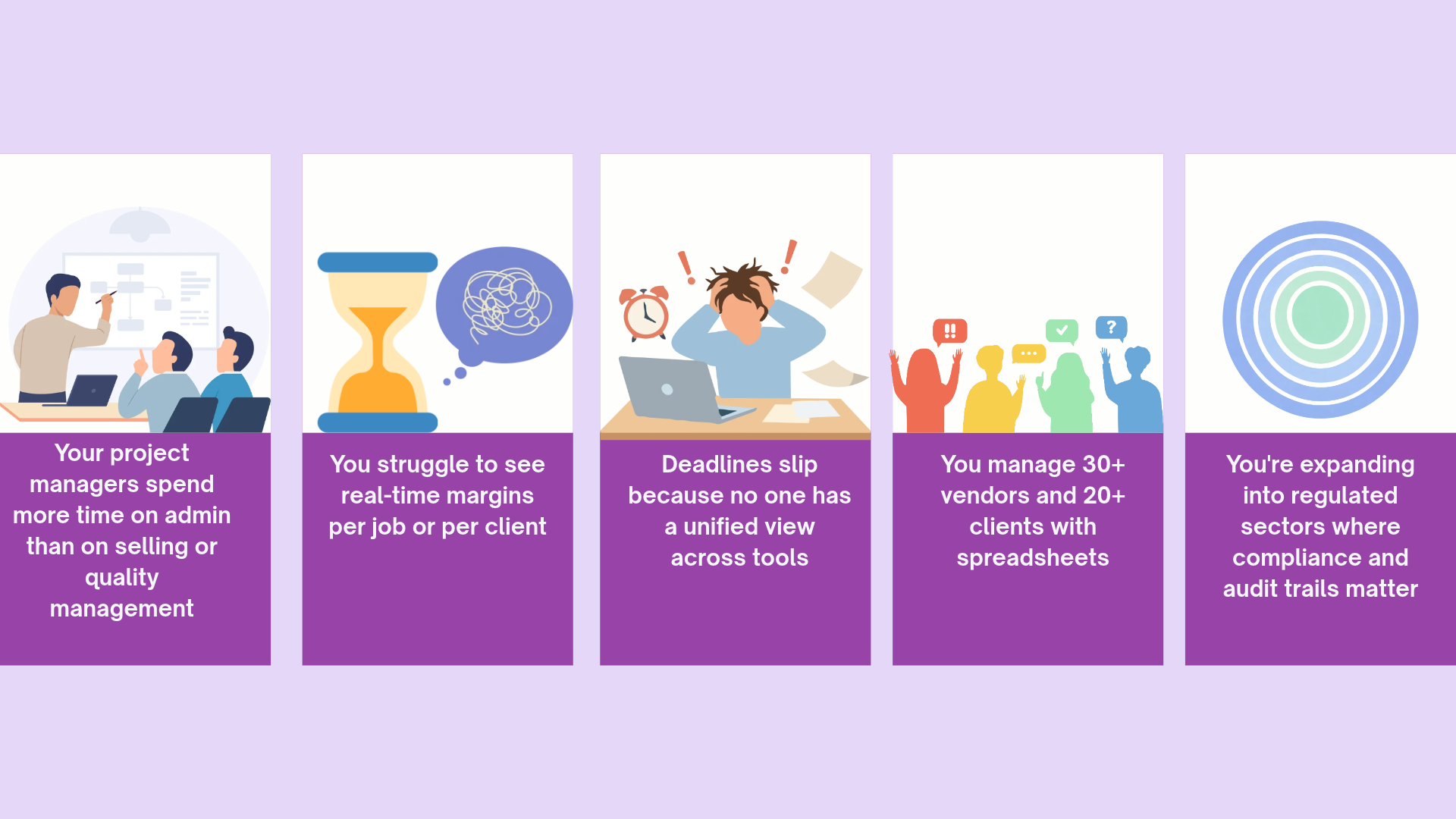
- Your project managers spend more time on admin than on selling or quality management
- You struggle to see real-time margins per job or per client
- Deadlines slip because no one has a unified view across tools
- You manage 30+ vendors and 20+ clients with spreadsheets
- You're expanding into regulated sectors where compliance and audit trails matter
Quick self-assessment: Do you copy the same data into 3 or more tools? Is job profitability opaque until month-end? Are your linguistic assets scattered across different platforms? Are you worried about losing a corporate client due to information security concerns? If you answered "yes" to two or more, plan a TBMS migration within the next 6–12 months.
Awtomated is optimized for small-to-mid-sized agencies that have outgrown spreadsheets and generic SaaS but don't want the complexity and cost of large enterprise systems. If you're at that stage, it might be worth exploring how Awtomated could replace 4–5 tools with one while fitting around the CAT/TMS tools your localization team already knows.

FAQ
These questions cover common concerns agency owners raise when rethinking their tech stack and considering a TBMS like Awtomated. Each answer draws on typical agency scenarios and Awtomated's capabilities.
How hard is it to migrate from spreadsheets, Trello, and QuickBooks into Awtomated?
Most small and mid-sized agencies migrate in phases over 4–12 weeks, starting with active clients and projects while leaving historical data in legacy tools initially. Typical steps include exporting client and vendor lists from spreadsheets, importing rate tables into Awtomated, configuring services and price lists, and connecting to accounting tools. Awtomated is designed to coexist with existing tools during transition, so agencies can move specific workflows - like quoting and invoicing - first, then phase out Trello boards and manual finance spreadsheets. Client-facing disruption can be minimal when planned: portals and new workflows are introduced gradually while preserving email-based habits initially.
Can we keep our existing CAT/TMS tools if we adopt Awtomated?
Absolutely. Awtomated is built to complement, not replace, existing TMS and CAT environments like memoQ, Trados, Phrase, Smartcat, or Lokalise. Production work in various components of the translation workflow continues in your preferred CAT tool, while Awtomated manages quoting, project metadata, client data, vendor assignments, and finance. This protects past investment in translation memory and workflows while giving agencies the consolidated business view they currently lack. Over time, agencies often standardize on fewer tools, but the immediate benefit comes from centralizing operations rather than forcing a CAT/TMS switch.
How does Awtomated handle client data security and compliance?
Awtomated is a cloud-based platform with role-based access control, encryption in transit, and secure file handling designed for LSP workflows. Audit trails on key actions - job creation, file downloads, status changes - support compliance needs for clients in regulated industries like finance and life sciences. Agencies can configure access for internal PMs, external vendors, and clients to ensure that only the right parties see specific projects and context-sensitive linguistic assets. We encourage readers to review our security documentation or contact our team for details on certifications and data residency options.
What kind of reporting and profitability tracking can we expect?
Awtomated calculates project profitability automatically by combining client prices, vendor rates, and actual task data - languages, services, word counts, and currencies. Main analytics views include profitability per job, per client, per vendor, and per service type, plus dashboards for revenue trends and outstanding receivables. Agencies can export data via CSV or API to their own BI tools for content management and advanced reporting, while relying on Awtomated as the source of truth for operational metrics. This level of visibility into margins - across different projects, each language pair, and each service provider - is nearly impossible when data is scattered across Trello boards, email, and QuickBooks entries.
Is Awtomated only for agencies, or can in-house translation teams use it too?
While Awtomated was designed primarily for translation agencies and LSPs, an in house translation team with multi-vendor workflows and complex finance or approval processes can benefit significantly. In-house teams may use fewer finance features but still gain value from structured project management, vendor coordination, stakeholder portals, and reporting across multiple brands or product lines. The fit is strongest for teams that need more control than a generic project tool offers but don't want the overhead of large enterprise systems. We invite interested in-house localization teams to discuss their specific localization needs to validate whether Awtomated's TBMS approach matches their internal operating model.

Building software that helps small and medium-sized language service providers run their business.
About Rishi →Table of Contents
- Why So Many Translation Agencies Run on "Franken-Stacks"
- The Hidden Costs of Running Translation on Generic Tools
- Key Components of a Modern Translation Agency Tech Stack
- How Agencies Use HubSpot Today – And Where It Falls Short
- Trello, Asana & Jira: Great for Tasks, Weak for Localization Workflows
- QuickBooks, Xero & Excel: The Financial Black Box
- Where the CAT/TMS Fits – And Why It's Not Enough
- Linguistic Assets, Client Data, and the Risk of Lock-In
- From Five Disconnected Tools to One TBMS: What Awtomated Centralizes
- Designing a Future-Proof Tech Stack for Global Growth
- Integrations, APIs, and Working With Existing Tools
- AI-Powered Automation + Human Expertise: The New Baseline
- When Should an Agency Move From Five Tools to One TBMS?
- FAQ