AI in Translation Project Management: Real vs Hype in 2026
Key Takeaways
- In 2026, AI in translation project management is powerful but not "set and forget"-human translators and project managers remain central for quality, accountability, and client trust.
- AI translation tools, from google translate to LLM-based engines, deliver the most value when embedded inside governed translation workflows with mandatory human review, not used as standalone shortcuts.
- Awtomated, as a Translation Business Management Software (TBMS), orchestrates ai powered translation, resource allocation, and quality control across the entire process rather than simply providing a raw mt engine.
- Project managers should focus AI on repetitive, high-volume work-quotes, vendor selection, status tracking-while keeping strategic decisions, risk assessment, and client communication in human hands.
- This article separates hype from practical reality with concrete 2025–2026 examples and provides a roadmap for adopting AI in translation PM without sacrificing translation quality or data security.
Introduction: AI in Translation PM Has Grown Up (But Not Grown Alone)
Between 2020 and 2026, artificial intelligence moved from basic machine translation to LLM-based, ai powered translation workflows embedded directly in translation project management. What was once a side tool for gisting rough drafts is now woven into scheduling, vendor selection, quality estimation, and budget forecasting. The global language services market reached an estimated $72.6 billion in 2025 and is projected to hit $73.4 billion in 2026, and AI-driven translation technologies are key to that industry growth.
Today, project managers juggle neural machine translation, large language models, ai tools for scheduling, and classic CAT and translation memory setups-creating both opportunity and confusion. Language barriers, global content pressure, and the sheer volume of translation needs have elevated translation PM from an operational task to a strategic function. Machine translation usage increased from 59% to 69% in 2018 alone, and adoption has only accelerated since.
Awtomated exists to centralize these ai translation tools, human translators, and business operations in one place-not as another mt engine, but as the orchestration backbone. The rest of this article shows where ai in translation genuinely delivers in 2026 and where overpromising can hurt quality, timelines, or compliance.

What "AI in Translation Project Management" Really Means in 2026
AI in translation PM is far more than running text through google translate. It encompasses workflow automation, risk scoring, analytics, and intelligent routing-all within a TBMS like Awtomated. Here are the core ai capabilities a PM actually sees on screen in 2026:
- MT and LLM-based ai translation: Neural machine translation uses deep learning to produce more accurate translations, while large language models evaluate context instead of translating word-by-word. Together, they handle pre-translation for dozens of language pairs.
- Automated job routing: AI agents automatically route, parse, and analyze incoming content. The system identifies file types and estimates project timelines before a PM even opens the job.
- Predictive timelines: AI optimizes planning and scheduling by analyzing historical project data and can predict project completion times with high accuracy.
- Quality estimation: AI engines analyze translations to calculate error rates or edit distances, generating quality scores that trigger human review when thresholds aren't met.
- Budget forecasting: The system compares cost implications across options-pure human translation, MT plus post editing, or LLM plus human review-and shows margins instantly.
AI translation tools can process over 100 billion words daily and support over 130 languages, meaning ai-powered translation can handle hundreds of languages at scale. But improved fluency from deep learning and large language models since 2023 has come with ongoing hallucination and terminology issues. Machine learning algorithms still mis-handle complex or technical language, rare terms, and locale-specific formatting. That's why human oversight remains non-negotiable for anything beyond low-risk content.
The contrast matters: generic ai translation tools-standalone chatbots, browser extensions, mobile apps-offer speed but zero governance. AI powered translation inside a governed system logs decisions, versions, and approvals, turning translation technology from a liability into an asset.
Real Use Cases: Where AI Already Delivers Value for Translation PMs
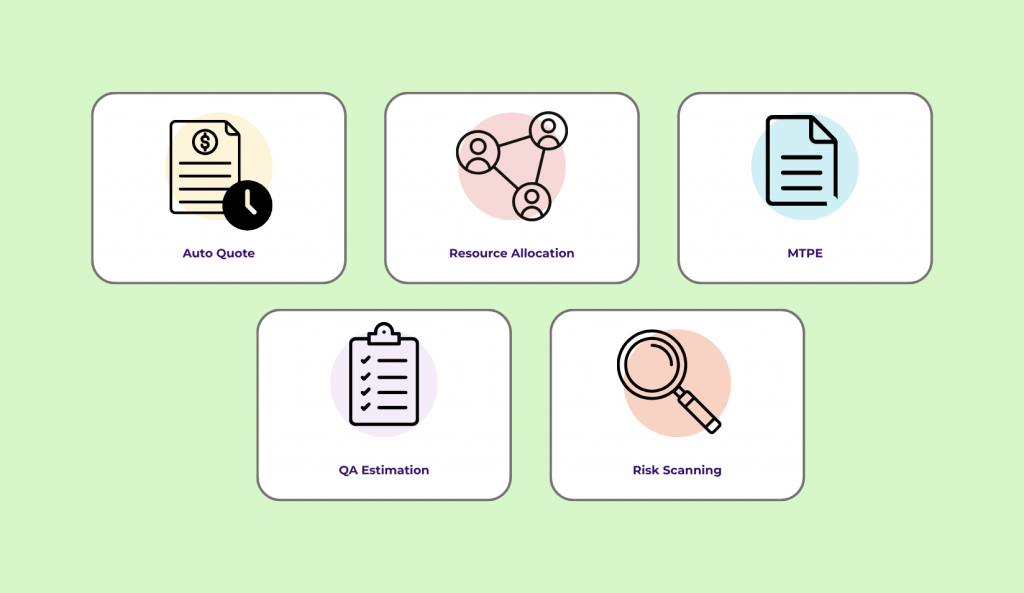
From Awtomated's vantage point as a TBMS, the most successful deployments of ai in translation are specific, measurable use cases-not broad "replace humans" promises. AI automates repetitive tasks, allowing project managers to focus on high-value activities. Here's where results are concrete:
- Automatic quote generation: Machine translation costs around $0.10 per word on average compared to $0.22 for human translation. AI-powered quoting uses historical rates and TM leverage to produce accurate estimates in seconds, eliminating manual work that once consumed hours.
- Intelligent resource allocation: AI pre-assigns tasks to qualified linguists based on historical data-systems like T-Rank™ consider over 30 factors for translator selection, from subject-matter expertise to past quality scores and availability. Assigning linguists becomes data-driven, not guesswork.
- MT plus LLM pre-translation for documentation: A gaming hardware company using MTPE across 15+ languages achieved 57% cost savings and a 140% increase in content volume processed. Automating tasks significantly accelerates project completion at this scale.
- Automated QA and quality estimation: AI tools identify errors in real-time, streamlining post editing processes. AI dynamically enforces brand voice and consistency across translations, and mt quality flags ensure professional linguists spend time where it matters most.
- Risk scanning: AI identifies potential risks by scanning project documents and communications-flagging terminology gaps, formatting issues, or missing context before translation begins.
- Data preparation and TM reuse: A medical content provider reduced workload by over 60% through strategic data preparation, TM reuse, and deduplication-without sacrificing quality.
AI reduces project turnaround times significantly, and localization teams can manage larger volumes of content without increasing headcount. AI-driven translation can process vast datasets quickly, making it possible for the same PM team to handle 2–3× the volume of translation projects once repeatable workflows are configured. The resulting translations from these hybrid workflows consistently meet or exceed quality benchmarks when governance is in place.
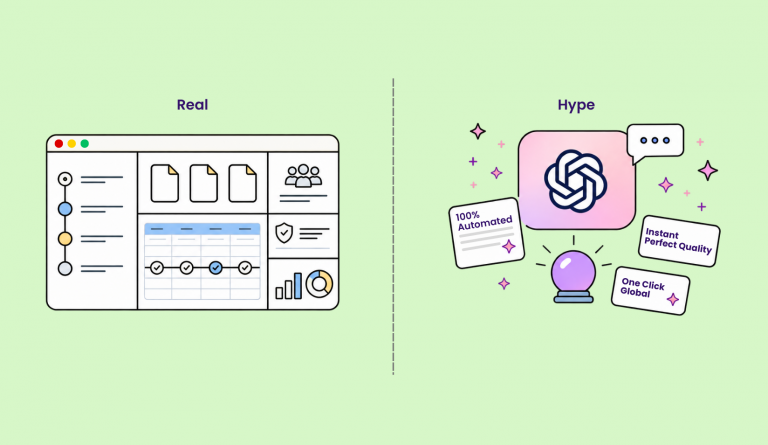
Hype vs Reality: Limits of AI Translation in Professional Workflows
Consumer expectations shaped by "one-click translate" tools diverge sharply from the reality of regulated, brand-sensitive translation work. Here's what's myth and what's fact in 2026:
Common myths:
- AI translation can fully replace human translators for all content types. It cannot-domains with high risk still demand human expertise.
- LLMs no longer hallucinate. Purpose-built legal AI tools still hallucinate 17–33% of the time; general models score even worse.
- Generic MT is good enough for legal documents, medical device documentation, or financial texts. Regulators, liability concerns, and brand reputation force stricter thresholds.
When AI-only is acceptable vs. when it isn't:
- Acceptable: internal chats, low-risk support content in common languages, analytics dashboards, knowledge base gisting.
- Not acceptable: translating sensitive legal or medical content, marketing campaigns requiring cultural nuance, creative content with idiomatic expressions or humor, and any content where inaccurate translations carry legal or safety consequences.
Specific failure modes:
- Mistranslated dates and numbers across locales (e.g., "04/05/2025" interpreted differently in US vs EU formats).
- Invented references-courts have sanctioned attorneys for using AI-generated citations that were fabricated.
- Cultural tone-deafness: cultural references, humor, and brand voice lost or warped in machine learning output without a professional translator reviewing.
- Confidentiality breaches when content is pasted into public chatbots instead of processed inside a secure TBMS.
- Inconsistent quality when automated quality assurance is not paired with human intervention for high-risk segments.
Regulatory pressure is mounting. EU AI Act themes demand transparency, logging of model usage, and human oversight. The translation industry cannot afford to ignore these trends.

Human Translators and PMs in an AI-First Era
AI in translation amplifies the role of human translators and project managers-it doesn't erase it. AI acts as an augmented project partner rather than replacing human linguists. The shift moves people from manual file handling to higher-value linguistic and strategic tasks.
- New PM responsibilities: Designing ai powered translation workflows, defining risk tiers, configuring human review steps, interpreting AI analytics for clients, and ensuring the entire process meets compliance requirements.
- Translator evolution: Human translators become linguistic reviewers, style guardians, and subject-matter specialists. They correct AI output and feed improvements back into Awtomated's translation memories and term bases. AI enhances human translators' efficiency and quality rather than sidelining them.
- Feedback loops: AI continuously learns from human edits to improve future translation accuracy. AI systems learn from human feedback to improve translation accuracy, creating a cycle of continuous improvement.
- What stays human: The human touch in voice, cultural nuance, and relationship management. Human interpretation of client intent, human post editing of sensitive segments, and human expertise in subject-matter domains remain irreplaceable.
By 2026, leading teams use ai tools to remove repetitive work-tracking POs, progress emails, simple status updates-while translation professionals focus on ensuring high quality translations that no machine can guarantee alone.
How Awtomated Orchestrates AI in Translation Project Management
Awtomated is a Translation Business Management Software built to centralize AI translation engines, human translators, and business data in one AI-aware control plane. Artificial intelligence transforms translation and localization into an automated ecosystem-but only when properly orchestrated.
- Multi-engine connectivity: Awtomated connects to multiple AI translation tools-from machine translation engines like NMT providers to LLM-based engines-while enforcing client-specific rules about when to use MT, when to require human review, and when to skip AI altogether. Unlike other tools that lock you into one engine, Awtomated is engine-agnostic.
- Smart job routing: AI-assisted routing matches jobs to the best linguists using historical performance, language pair constraints, and availability. AI can reduce project management overhead significantly.
- Governance and audit: Audit trails log which artificial intelligence AI model was used on which job, how client term bases and style guides are enforced, and who approved final global content. Role-based access, ISO-27001 compliance, and GDPR adherence are built in.
- ROI comparison dashboards: PMs compare the ROI of different ai powered translation options-pure human, MT plus post editing, LLM plus human review-across translation projects using dashboards, without needing spreadsheets or guesswork.
Evaluating ROI of AI-Powered Translation in 2026
AI translation ROI should evaluate time, quality, risk, and scalability-not just cost per word. Many enterprises learned this the hard way in 2024–2025 rollouts. Companies measure ROI by comparing cost savings and speed gains alongside error rates and client satisfaction.
- Key ROI levers: Reduced turnaround time for large volumes, less manual PM overhead per job, improved consistent quality across languages, and fewer client escalations.
- Risk-tiered content: PMs segment content into tiers-internal vs. marketing vs. legal-and assign different AI/human mixes. Awtomated stores and enforces these tiering rules. AI improves cost-effectiveness by handling partial translations and speeding up drafts for low-risk content while reserving full human translation for high-stakes material.
- Concrete example: A global ERP provider localized software into five new languages, saving 35% vs. all human translation by using MTPE for documentation and human translation for UI. A DeepL/Forrester TEI study found enterprises saw approximately 345% ROI over three years-but only when the full ecosystem of governance, TM, post editing, and quality gating was in place.
- The bottom line: AI translation solutions promise dramatic gains in efficiency for businesses, but "cheapest per word" is not always best ROI when risk is high. Translation software must balance speed with ensuring accuracy.
Practical Adoption Roadmap: Bringing AI into Your Translation PM Stack
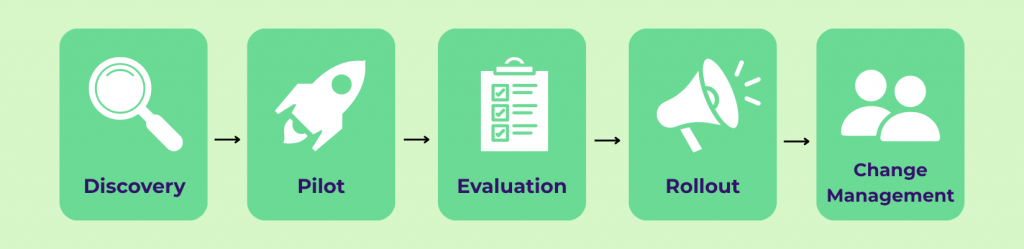
In 2026, most teams already experiment with AI, but few have a structured, low-risk roadmap. Here's a step-by-step approach using Awtomated as the hub:
- Discovery: Audit current translation workflows, content risk levels, existing TMs, glossaries, turnaround times, and cost per word. In 2018, 69% of companies used machine translation for translation needs-adoption is no longer optional, but governance is.
- Pilot: Select one or two content types (e.g., internal knowledge base, product descriptions) and a small set of language pairs. Start with low-risk content where AI translation can be tested safely.
- Evaluation: Measure time to edit, human edit distance, complaint rate, and cost per word. MTPE adoption doubled from 26% to 46% between 2022 and 2024, but many rollouts failed because quality gates weren't implemented.
- Roll-out: Standardize successful workflows inside the TBMS, expand into more languages and content types, and lock in governance rules.
- Change management: Train PMs and linguists on modern ai translation tools. Align sales and account managers so they can explain AI usage and human review levels to clients clearly. Involve translators early in defining acceptable MT and LLM usage.
Awtomated serves as the central place to configure pilots-enabling MT only on certain projects, limiting use of public models, and capturing feedback data automatically for future optimization.

Future Trends: What's Next for AI in Translation PM Beyond 2026?
Looking beyond 2026, expect stronger domain-adapted LLMs, more reliable quality estimation, and deeper integration of ai in translation into content and product pipelines. AI translation will evolve into a comprehensive strategic partner for global audiences, not just a cost-cutting tool. This isn't science fiction-it's the trajectory visible in current R&D.
- Fully AI-assisted project planning: automatic scoping, risk scoring, and timeline generation for translation services before a PM reviews.
- Continuous localization: near real-time localization driven by commit hooks, where content updates flow through translation management systems as code ships.
- AI agents under supervision: small-task coordination-file prep, vendor pings, status summaries-handled by AI agents while PMs supervise and intervene where needed.
- Regulatory and buyer trends: increasing demand for in-region or on-premise machine translation engines, contractual requirements to log human review steps, and more questions about which models handle client data.
- Awtomated's trajectory: as AI grows more capable, the TBMS becomes the "AI operations layer" for translation agencies and language services providers, ensuring humans stay in control while automation scales to serve global audiences across every content type.
FAQ
Is AI translation good enough to replace human translators altogether?
Even in 2026, ai translation excels at speed and first drafts but still struggles with brand voice, cultural nuance, humor, idiomatic expressions, and high-stakes contexts. Human translators remain essential in professional workflows. Awtomated supports hybrid workflows by design, combining AI engines with mandatory human review steps for sensitive content. Most enterprises now treat AI as an accelerator and cost optimizer-not a full replacement for expert linguists who bring the human touch.
When should we avoid using AI translation tools altogether?
Avoid MT and LLMs for content that is heavily regulated, extremely confidential, or where a small error creates legal or safety issues-certain medical device IFUs, litigation materials, or M&A documents, for example. In Awtomated, PMs configure project templates that disable AI usage for such content types, ensuring only vetted human translators handle them. If in doubt, start with human-only translation and later test AI on redacted or low-risk samples.
Can we safely use Google Translate or public chatbots for business translation?
While google translate and public chatbots work for personal, low-stakes use, they raise confidentiality and compliance concerns with customer or internal business data. Use AI engines through secure integrations inside translation solutions like Awtomated, where access, logging, and data deletion policies are controlled. Many enterprises now require contracts and DPAs with AI providers-difficult to enforce when employees rely on ad-hoc consumer apps or mobile apps.
How do we explain AI usage and human review to our translation clients?
Create clear, written service descriptions distinguishing full human translation, MT plus post editing, LLM-assisted translation, and internal-only AI drafts-including which steps involve human review. PMs can use Awtomated's project templates and reporting to show clients exactly which ai powered translation steps were used and who approved the final result. Transparent conversations about trade-offs between speed, cost, and consistent quality build trust far better than burying AI usage in fine print.
How can a small LSP or localization team start using AI without a big budget?
Start with low-cost or built-in MT connections and focus first on automating PM overhead-quotes, status tracking, repetitive communication-via Awtomated rather than investing immediately in custom LLM training data. Pick one or two content types to pilot MT plus light human review, tracking time to edit and client feedback. A TBMS like Awtomated helps small teams plug into multiple ai translation tools while keeping a single, consistent workflow and translation management layer, so they can scale gradually without a complex tech stack.

Building software that helps small and medium-sized language service providers run their business.
About Rishi →Table of Contents
- Introduction: AI in Translation PM Has Grown Up (But Not Grown Alone)
- What "AI in Translation Project Management" Really Means in 2026
- Real Use Cases: Where AI Already Delivers Value for Translation PMs
- Hype vs Reality: Limits of AI Translation in Professional Workflows
- Human Translators and PMs in an AI-First Era
- How Awtomated Orchestrates AI in Translation Project Management
- Evaluating ROI of AI-Powered Translation in 2026
- Practical Adoption Roadmap: Bringing AI into Your Translation PM Stack
- Future Trends: What's Next for AI in Translation PM Beyond 2026?
- FAQ